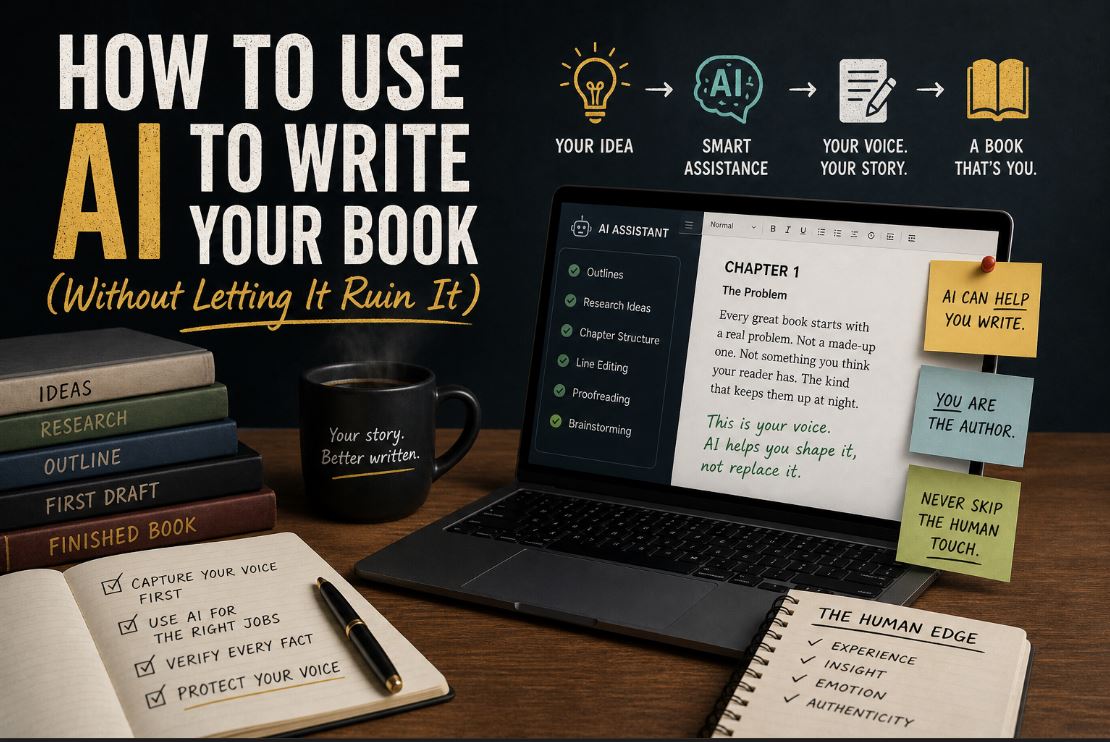
Yes. AI can generate an outline, chapters, characters, even an entire book-length manuscript. But producing enough words to fill a book and producing a book worth reading are two different problems, and most of the actual difficulty lives in that gap.
The more useful question isn’t whether AI can write a book. It’s which parts of the process should stay human and which parts AI can actually speed up. AI is good at organizing ideas, questioning an argument, transcribing spoken memories, spotting structural gaps, and critiquing a draft. It’s much worse at supplying the lived experience, the specific detail, and the point of view that make a book worth someone’s time. This guide walks through both sides of that line.
Can AI Write a Book? The Quick Answers
| Question | Short answer |
|---|---|
| Can AI write a book? | Yes. It can produce book-length text, but generating text and producing a publication-ready book aren’t the same thing. |
| Can AI help me write a book? | Yes. It’s strong at brainstorming, outlining, transcription, organizing, critique and revision support while you stay the author. |
| Can AI write a book for me? | Technically yes, but a fully AI-generated manuscript raises real originality, quality, repitition and disclosure questions. |
| Can I publish an AI-written book on Amazon? | KDP allows it, but requires you to disclose AI-generated text, images, or translations when you publish. |
| Do I have to disclose AI-assisted writing to Amazon? | No. Amazon’s own guidelines state AI-assisted content, where you wrote it and AI only edited, refined or helped brainstorm, doesn’t need disclosure. |
| Can an AI-written book be copyrighted in the US? | Material generated entirely by AI isn’t protected. Human-authored portions of a work can still qualify, based on the actual human contribution. |
| Can AI make mistakes in a book? | Yes. It can produce fabricated or inaccurate claims with total confidence, so factual content needs independent verification. |
| Should I use AI to write my book? | Use it where it removes friction without taking over the thinking, the experience, or the voice that make the book yours. |
Writing with AI and having AI write for you are not the same thing. AI can remove friction from the process without replacing authorship. The real question isn’t how much AI you use. It’s which decisions, creative and intellectual, you’re willing to hand over. AI style of writing is easily detected by publishers, along with repetition issues.
Pros and Cons of Using AI to Write a Book
| Potential advantage | Corresponding risk/disadvantage |
|---|---|
| Faster brainstorming | Generic ideas |
| Rapid outlining | Formulaic structure |
| Instant feedback | Bad advice delivered with total confidence |
| Breaks blank-page paralysis | Dependence on generated prose |
| Summarizes your own notes | Can quietly drop important nuance |
| Flags repetition | Can introduce its own repetitive patterns |
| Low-cost assistance | Professional editing may still be necessary |
| Organizes large amounts of material | Context and continuity can degrade over length |
| Helps non-native writers refine language | Can flatten a writer’s natural voice |
| Available any time | No accountability for factual errors |
How Can AI Help Me Write a Book?
This is where AI earns its keep, and it’s not the same as asking it to write your chapters. A few workflows we’ve seen actually work.
Speak the Book Before You Write It
If you freeze in front of a blank document, don’t start there. Record yourself telling the story out loud, the way you’d tell it to a friend. Run the recording through a transcription tool like TurboScribe. Feed that transcript to an AI tool and ask it to identify recurring themes, a rough chronology, anecdotes worth keeping, and gaps you skipped over. Build your outline from what comes back, then write the actual chapters yourself, using AI for editorial support rather than as the source.
The difference matters. The raw material came from you, not from a prompt. That’s a different thing entirely from typing “write Chapter 1 of my autobiography” and hoping for the best.
Write Badly First, Then Let AI Be the Editor
Most people do this in the wrong order. They open a chat window, describe the idea, and ask AI to generate an outline or a first chapter, then edit what comes back. At that point you’re not really writing your book anymore. You’re editing AI’s version of your idea, on AI’s structure, in AI’s sentence patterns, and heavy editing afterward doesn’t fully remove that.
The fix is to reverse the sequence. Write your version first, however rough. A thousand ugly, unpolished words with no worry about quality. Then hand it to AI and ask specific questions: where does this argument get muddy? Which paragraphs repeat the same point? What would a skeptical reader push back on? Which claims need evidence? Where does the pacing drag? Ask it to flag problems, not to rewrite the passage itself.
That’s a sharper use of the tool than “make this better,” because AI stays the critic instead of becoming the author. You keep the decisions about what to change. For a full breakdown of how to adjust this depending on how strong a writer you already are, including exact prompts for each level, see our guide on using AI to write your book without losing your voice.
Let AI Interview You
Instead of asking AI to write your memoir, tell it to ask you one question at a time about a specific event, then follow up whenever your answer skips over an unexplained person, decision, or consequence. Don’t let it draft the chapter yet. Just answer. Over several sessions this builds a surprising amount of real source material, and it works especially well for memoir, business books, and experience-based self-help.
Use AI to Stress-Test Your Outline
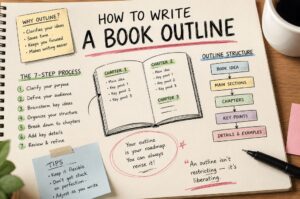
Build the outline yourself first. Then ask AI what promise the book is making to the reader, whether every chapter actually advances that promise, which chapters overlap, what objections go unanswered, and what a reader would expect to see that isn’t there. You decide what to do with the answers. AI’s job here is to poke holes, not to build the structure.
Can AI Write a Book for Me From Start to Finish?
Technically, yes. Practically, this is where AI’s weaknesses show up fastest, and long-form writing exposes them in a way a single paragraph never does.
Repetition. AI can make the same conceptual point three different ways across a manuscript without noticing it already made it.
Flattening. Human prose naturally varies, in pace, sentence length, emphasis, humor, and the occasional deliberate silence. AI tends to smooth all of that into a consistent, slightly generic register.
Generic examples. There’s a real difference between “at 2:13 a.m., our biggest customer cancelled” and “entrepreneurs often face unexpected challenges.” AI defaults toward the second unless it’s working from specific, real material you’ve given it.
Continuity problems. A full manuscript has to keep names, motivations, dates, and earlier claims consistent across tens of thousands of words. That’s exactly where long AI-generated runs tend to drift.
Confident factual errors. Especially risky in nonfiction, biography, health, finance, or history, where a wrong but confidently stated claim can cause real damage.
Voice drift. Individual chapters can each read acceptably while the manuscript as a whole doesn’t feel like one person needed to write it.
Our 7-Question AI Manuscript Test
We use a version of this checklist when reviewing manuscripts that leaned heavily on AI. It’s not a scientific instrument, just an editorial gut check.
- Does the book contain ideas you couldn’t get from the first page of a search result?
- Does it include experiences or observations unique to its author?
- Does every chapter actually move the argument or story forward?
- Could three chapters swap places without a reader noticing?
- Does the prose keep re-explaining something it already explained?
- Are the factual claims traceable to real sources?
- After twenty pages, could a reader describe the author’s actual personality or point of view?
If the answer to #4 and #5 is yes, and most of #1, #2 and #7 come back no, AI probably helped produce a lot of text without producing much of a book.
Do Readers Notice AI-Written Books?
We can’t claim readers can always tell, and no one credibly can. What’s more defensible is that certain patterns show up often enough in weak machine-assisted writing that readers notice something feels off, even without naming AI specifically: excessive summarizing, predictable transitions, generic metaphors, constant qualification, symmetrical sentence rhythms, vague anecdotes without sensory detail, and conclusions that just repeat the introduction.
None of that proves AI wrote it. Humans write badly in exactly the same ways, plenty of them long before generative AI existed. The Authors Guild’s own 2025 annual report has described concerns about AI-generated books reading as “voiceless and flat” and adding little beyond information already available elsewhere, but that’s the Guild’s advocacy position, not a neutral finding, and it’s worth reading it that way.
A separate concern is factual reliability, and it’s worse with free tools than most authors realize. A free AI tool doing research performs a shallow crawl, pulls minimal context, and fills the rest from training data, then states the result with the same confident tone it would use if it had actually researched the topic thoroughly. You can’t tell the difference from the output alone. Paid tools do better, but even they’re inconsistent, sometimes going deep, sometimes barely scratching the surface, with no reliable way to know which one you got until you check. This isn’t just anecdotal. NIST’s Generative AI Profile names “confabulation,” AI confidently presenting erroneous or fabricated content as fact, as one of its formally identified risk categories for generative systems. The rule that follows from this: any external fact, statistic, or claim AI generates for your book needs verification against the original source, not against another AI response.
Can You Copyright an AI-Written Book?
It depends on how much of the work is actually human-authored, not on whether AI touched the project at all.
The U.S. Copyright Office’s January 2025 report is direct on this: material generated entirely by AI, without meaningful human creative input, isn’t eligible for copyright protection. But the report also confirms that using AI as an assistive tool, rather than a substitute for human creativity, doesn’t strip protection from the human-authored parts of a work. In practice: your own writing, structure, and creative choices remain protectable even if AI helped you get there. What isn’t protectable is expression that AI generated on its own, prompt or no prompt.
Can You Publish an AI-Written Book on Amazon?
Yes, within Amazon’s own rules, and the rules are more specific than most articles on this topic suggest. According to Amazon KDP’s Content Guidelines, you’re required to disclose AI-generated text, images, or translations when you publish or republish a book. AI-assisted content, meaning you created the actual material yourself and used AI only to edit, refine, error-check, or brainstorm, does not need to be disclosed. The distinction Amazon draws is simple in principle: who actually created the content that ends up in the book.
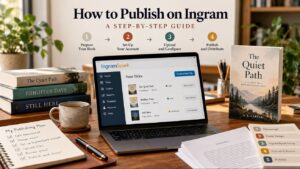
Not every platform takes the same approach. IngramSpark’s Catalog Integrity Guidelines explicitly prohibit content created through automated means, including AI-generated material, rather than allowing it with disclosure the way Amazon does. If you’re planning wide distribution beyond Amazon, check each platform’s current policy rather than assuming Amazon’s rules apply everywhere.
What AI Can I Use to Help Me Write a Book?
This isn’t a “best AI tools” ranking, and it shouldn’t be. The tool itself is a smaller factor than most people assume. The quality of the result depends heavily on your prompts, source material, editorial judgment, fact-checking, and revision. Match the tool to the job instead of expecting one system to write the whole book.
| Category | What it’s good for |
|---|---|
| General-purpose LLMs | Brainstorming, critique, outline stress-testing, self-interview prompts |
| Transcription tools (TurboScribe and similar) | Turning spoken material into usable written source content |
| Grammar and style tools | Line-level polish on writing you’ve already produced |
| Research-support tools | Surfacing questions and leads for you to verify against primary sources |
| Fiction-specific writing tools | Scene drafting and continuity tracking, still needing human revision |
When Should and Shouldn’t You Use AI to Write Your Book?
Don’t lean on it when the book’s value is your own lived experience. No one buys a memoir for a statistical approximation of someone’s childhood.
Don’t lean on it where accuracy is critical. Medical, legal, financial, and historical claims need a real source, not a confident-sounding sentence. The Authors Guild’s AI best practices guidance makes the same point to its members: verify factual claims independently rather than trusting AI output at face value.
Don’t lean on it with confidential material until you’ve checked the tool’s privacy terms and whatever contractual obligations apply to that information.
Be careful when you’re still figuring out what you actually think. Writing isn’t only recording thoughts you already had. Sometimes the writing is what produces the thought. If AI hands you an argument before you’ve worked through it yourself, you can skip the exact process that would have produced the book’s most original material.
It’s a real help for organizing hundreds of scattered notes, generating interview questions, cleaning up transcription, comparing outline versions, checking consistency across chapters, and getting past blank-page paralysis. Used that way, AI removes friction without removing authorship.
FAQs
Is it legal to use AI to write a book? Yes, there’s no law against it. What varies is what you can protect and what you can publish where. Purely AI-generated text isn’t copyrightable, and some distributors, unlike Amazon, don’t allow AI-generated content at all.
Does Amazon allow AI-written books? Yes, but with a disclosure requirement. AI-generated text, images, or translations must be disclosed to Amazon at publication, while content you wrote yourself and only used AI to refine doesn’t need to be.
Can publishers detect AI writing? Detection tools exist and are improving, but none are reliable enough to treat as definitive, and false positives happen. Several distributors, including IngramSpark, now screen for AI-generated content directly rather than relying solely on author disclosure.
Do you have to disclose AI use in a book? Depends on the platform and how much AI actually contributed. Amazon requires disclosure of AI-generated content but not AI-assisted content. IngramSpark’s guidelines prohibit AI-generated content outright. Check the specific policy of wherever you plan to publish.
Can AI write a novel? It can generate one, but fiction depends heavily on voice consistency, character continuity, and pacing across tens of thousands of words, exactly where long AI-generated runs tend to drift and flatten.
Can AI write a nonfiction book? Yes, with the same caveat that matters most for nonfiction specifically: every factual claim, statistic, and citation needs independent verification, since AI can generate incorrect information with total confidence.
How much of a book can AI write? Technically, all of it. Practically, the more of the actual manuscript AI generates rather than assists with, the more risk accumulates around originality, factual accuracy, voice consistency, and, in some cases, what you can copyright or where you can publish.
How fast can AI write a book? Fast, in terms of raw word count, sometimes within hours. How much of that first output survives serious editing, fact-checking, and revision is a separate question, and it’s usually a large gap.
Where This Leaves You
AI can produce a book-length manuscript faster than any human ever could. What it can’t manufacture is the specific memory, the argument you actually believe, or the voice that makes a reader trust the person behind the page. It also has no real way to tell you whether the book is working: whether the story is emotionally resonant, whether the argument would actually persuade your target reader, whether the structure serves the book you’re trying to write. Ask it, and it will tell you the writing is good, because it doesn’t have the context to tell you otherwise. The authors who get the most out of these tools tend to use them to remove friction, organizing notes, stress-testing structure, catching repetition, without handing over the thinking that made the book worth writing in the first place.
If you’ve tried working with AI and the manuscript still isn’t coming together, or you’d rather have an experienced writer handle the process while you stay the source of the material, our ghostwriting services walk through exactly that. If you’ve already got a full draft, AI-assisted or otherwise, and it needs a professional pass to actually be ready for readers, that’s what our book editing services are for.
About the Author
Author, Writing Coach & Senior Manuscript Editor
Thomas Schaffer is an author, writing coach, and senior manuscript editor with nearly two decades of professional experience. He holds a B.A. in Communications from the University of Texas at Austin and specializes in health, lifestyle, leadership, and personal-development books.
writersofthewest.net · Professional Ghostwriting Services, Book Editing & Publishing Guidance