Introduction
Publishing a book sounds quick in theory. In reality, it rarely is. Most first-time authors think they’ll hit publish in a few months. Then the edits begin. Then more edits. Covers get redesigned. Formatting acts up. Platform approvals take their time. Suddenly, those few months stretch out longer than expected.
Even experienced authors misjudge it. They know delays happen, but still get caught off guard. Marketing plans aren’t ready. Files don’t upload cleanly. KDP throws up small issues that slow everything down. Nothing dramatic. Just enough to stall progress.
After working with hundreds of authors across traditional publishing, self-publishing, and Amazon KDP, the patterns are pretty clear. Traditional publishing moves slower but follows a set path. Self-publishing can be faster, if you stay organized. KDP sits somewhere in between. It depends a lot on how clean your files and metadata are.
So, how long does it take to publish a book? That’s what this breaks down. Different timelines, different formats, different experience levels. Also the usual roadblocks, the mistakes that waste time, and what actually helps you move from draft to a finished book without dragging the process out.
How Long Does It Take to Publish a Book? (Quick Answer)
Okay, short answer first. The timeline mostly depends on how you choose to publish:
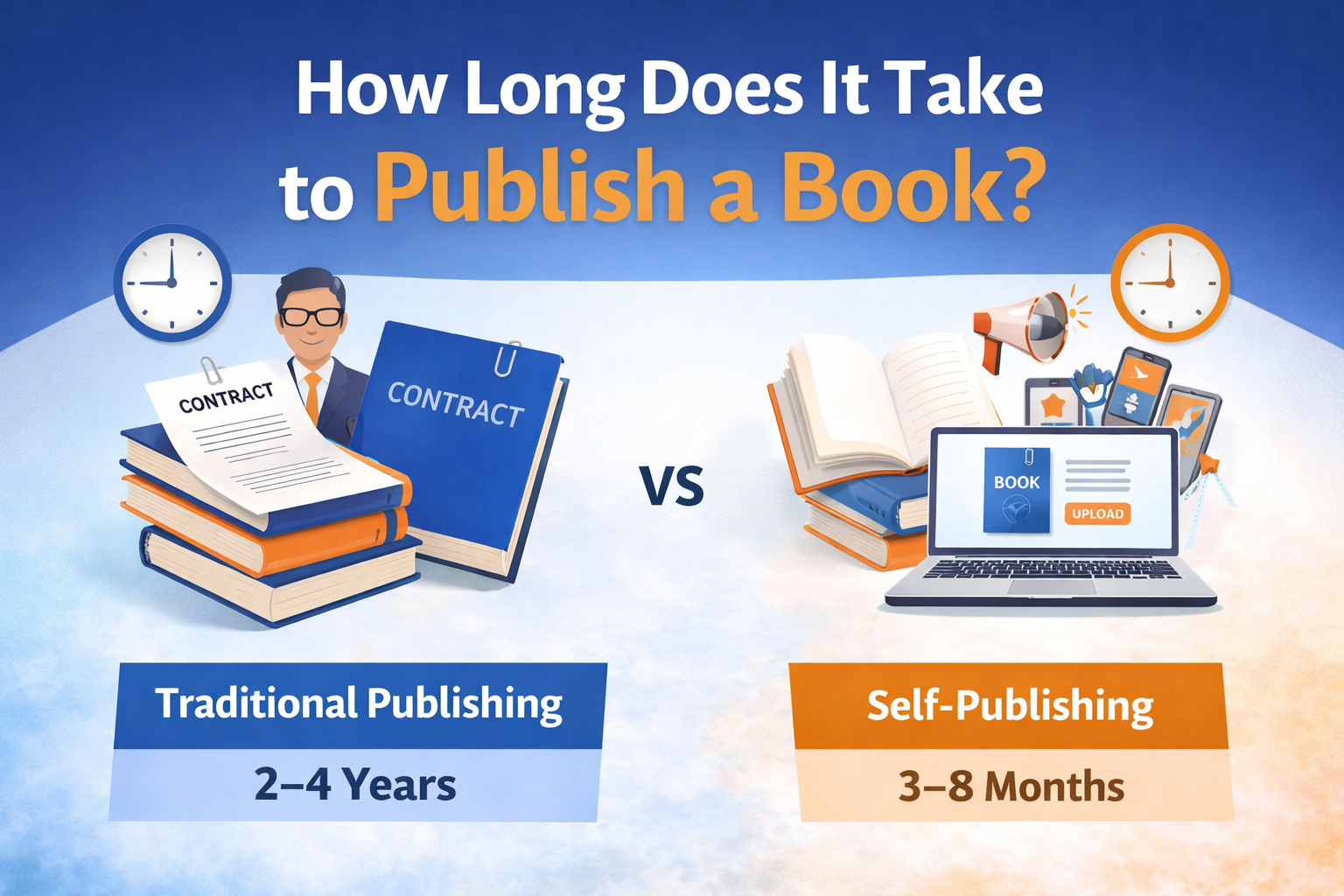
- Traditional publishing: 2 to 4 years
- Self-publishing: 3 to 8 months
- Amazon KDP (after upload): 24 to 72 hours
These aren’t optimistic guesses. This is what actually happens across real projects. Most of the waiting? It happens before the book is even ready to go live.
If you’re trying to figure out how long does it take to self publish a book, start here. Pick your route. That one decision changes everything. You’re either in a multi-year process or something that wraps up in months.
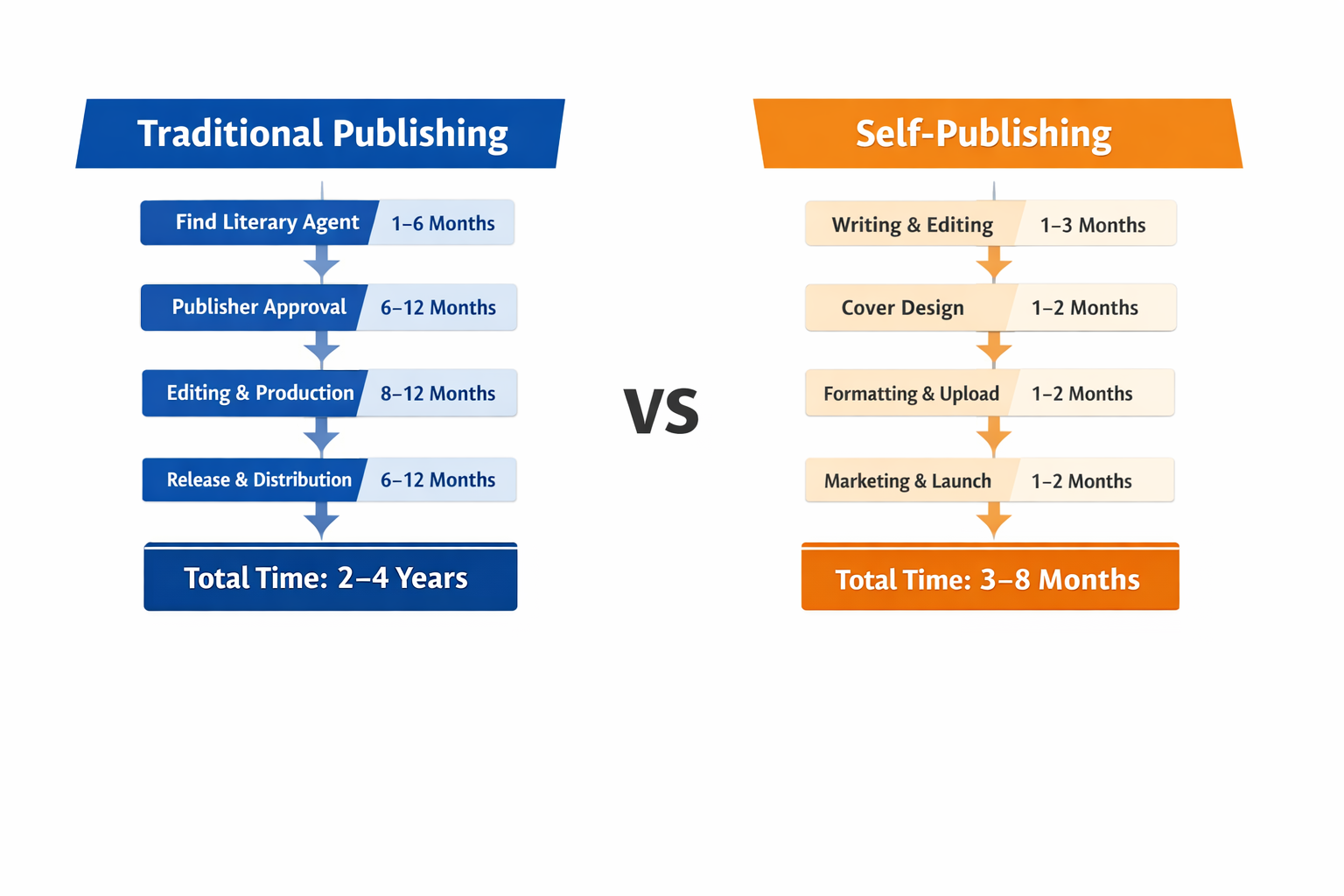
Traditional Publishing Timeline (2–4 Years)
So why does traditional publishing take so long? It’s not the writing. It’s the system. Publishers plan far ahead, and your book has to fit into that timeline.
Most houses work 12 to 24 months in advance. That means even after you sign a deal, your book isn’t next in line. It’s slotted into a schedule that already exists. That alone eats up a big chunk of time.
Finding a Literary Agent (3–12 Months)
This part surprises people. It’s not just about how well you write.
Agents look at positioning first. Where does the book fit? Who is it for? If that’s unclear, queries sit. And sit. But when the positioning is sharp and the market is obvious, replies come faster. Not instantly, but faster.
Editing with an Agent (1–3 Months)
This stage is not light editing. It’s prep work for getting your book picked up.
A lot of manuscripts have the same issue. Slow openings. Unclear direction. Agents push for changes here, sometimes big ones. If the structure needs fixing, this phase stretches.
Getting a Publishing Deal (2–12 Months)
This is where things get unpredictable.
| I worked with a client who had strong interest from editors in just a few weeks. Sounds fast, right? The deal still took five months. Why? The publisher already had similar books lined up and needed internal approval to move forward. |
That’s normal. Publishers are not just picking good books. They’re building a list that fits together.
Production and Release (12–24 Months)
This is the part most people don’t expect.
Even when your manuscript is done, the wait isn’t over. Publishers hold releases to match marketing plans, retail timing, and seasonal demand. I’ve seen finished books sit for over a year just to launch at the “right” time.
So yeah, timelines stretch. Not because of one delay. But because the whole system is built that way.
How Long Does It Take to Self Publish a Book?
So, here’s the honest answer. There’s no fixed timeline. It stretches or shrinks depending on how ready your manuscript is before you start.
In most projects, the gap between finishing in four months or dragging to eight isn’t about effort. It’s about rework. If the structure is shaky or the positioning is unclear, you end up repeating steps. Fixing things mid-way instead of moving forward.
Where Time Is Actually Spent
| Stage | Typical Duration | What Causes Delays in Practice |
| Editing and Cover Design | 2–3 months | Structural rewrites, unclear positioning, multiple cover revisions |
| Formatting | 1–3 weeks | Print file errors, inconsistent layout, failed uploads |
| ARC and Pre-Launch | 1–3 months | Late reviewer outreach, weak early traction |
| Platform Approval | 3–10 days | Metadata errors, content flags, file rejections |
Get the early stages right, and everything else moves faster. Skip that, and the timeline expands. Every time.
Editing and Cover Design (2–3 Months)
This is where things usually go off track.
| I had a client with a business book and a six-week launch plan. Sounds tight, but doable. Then we reviewed the manuscript. Same ideas repeated across chapters. It needed a full restructure. That alone added seven weeks.
At the same time, the cover kept changing. Why? The audience shifted. It started as a general business book, then moved toward early-stage founders. Four redesigns later, the timeline had doubled before formatting even started. |
This happens a lot. If the manuscript and positioning aren’t clear from the start, editing and design turn into a loop.
Authors who use book editing services for authors early usually go through this once. Those who skip it? They circle back later. That’s where time disappears.
Formatting (1–3 Weeks)
Formatting looks simple. It isn’t.
Ebooks are usually fine. One or two uploads and you’re done. Print is different. Margins, trim size, bleed. Small errors, but they add up.
Each failed upload can cost you a few days. Fix it, resubmit, wait again. Do that a few times and suddenly you’ve lost a week or two.
This is where small technical issues quietly stretch timelines.
ARC and Pre-Launch (1–3 Months)
This part doesn’t just affect timing. It affects results.
| I’ve seen two similar nonfiction books handled very differently. One author started ARC outreach eight weeks before launch. They got over 40 early reviews. The other waited until two weeks before release. Fewer than 10 reviews.
Both books went live on time. Only one had traction. |
So yeah, this stage matters. Not just for when you launch, but how you launch.
Final Approval (3–10 Days)
At this point, speed depends on how well you prepared earlier.
Clean files with proper metadata usually get approved in a few days. Messy files go back into review. Each rejection adds more waiting.
And this is the part people miss. When you think about how long does it take to self publish on Amazon, the delays aren’t really about the platform. They come from rushing earlier steps.
How Long Does It Take Amazon KDP to Publish?
KDP looks instant from the outside. Upload, click publish, done. In reality, it depends on how clean your files are.
Most of the time, approvals land within 24 to 72 hours. But even experienced authors get caught off guard. Small issues start popping up. Before you know it, that quick turnaround turns into a week.
Approval Edge Cases
Ebooks usually go through fast. Then there are exceptions.
- Illustrated or heavily formatted ebooks often slow things down. Fonts, large images, complex layouts. These trigger extra checks. I had a client whose technical guide got delayed five days just because of image resolution.
- Content that raises flags can also pause everything. Excerpts from well-known material or historical texts sometimes get pulled into manual review. That can sit for a week or more.
These cases aren’t common, but they explain most of the delays people complain about.
File Rejection Patterns
Most delays are not KDP’s fault. They come from the files.
- EPUB errors: missing cover links, broken table of contents
- Print files: margin issues, wrong bleed, fonts not embedded
- Non-standard sizes: anything outside 6×9 or 8.5×11 can slow reviews
Here’s the pattern. Authors rush formatting to save time. Then the file gets rejected. Each reupload adds a few more days. It stacks up quickly.
Metadata Issues
This one gets overlooked a lot.
- Author name does not match between KDP and ISBN
- Keywords or categories that break KDP rules
- Wrong publication dates or edition details
These seem minor. They’re not. Files sit in review until they’re fixed.
From what I’ve seen, around 30 to 40% of delayed approvals come from metadata issues, not file errors. Quiet problem, big impact.
Ebook vs Print Approval Time
| Format | Typical Approval | Real-World Considerations |
| Ebook | 24–72 hours | Standard text, properly formatted, passes first upload; complex layouts or large images may add 3–5 days |
| Paperback | 3–10 days | Print review checks margins, trim, bleed, and binding; multiple iterations common |
| Hardcover | 5–14 days | Less common; physical quality checks and binding specifications add extra review |
The table shows how long does it take KDP to publish. If you notice, you will find why print files almost always take longer than ebooks. You might think that you have a clean manuscript. But when it comes to small technical or metadata errors, every mistake costs time.
Key Insight
The fastest KDP publications are those where:
- The manuscript and cover are fully finalized
- Files are formatted according to Amazon specifications
- Metadata is double-checked against ISBN records
Now if you have skipped any of these steps, you might face repeated reuploads and approval delays. But if you want a quick guarantee for never facing these issues, you’ll choose Amazon book publishing services. This will make sure files, metadata, and formatting are correct before upload. This simple choice can help you avoid common pitfalls that can add days or weeks.
How Long Does It Take to Publish an Ebook vs Print Book
The timelines for ebooks and print editions differ more than most authors realize. If you understand where time is actually spent, you can easily prevent last-minute delays and unnecessary stress.
| Format | Typical Approval | Real-World Insight |
| Ebook | 24–72 hours | Simple text passes quickly; complex layouts, embedded images, or tables can add 2–5 days. One client’s illustrated guide required three uploads before approval due to image sizing. |
| Paperback | 3–10 days | Print review checks margins, bleed, and trim. Even minor misalignments add multiple review cycles. |
| Hardcover | 5–14 days | Physical quality checks and binding specifics extend review. Less common, but mistakes here almost always delay publication. |
Why this matters: Many authors think print is just “ebook plus paper.” But the truth is, print requires technical precision. Metadata errors, margin issues, or missing embedded fonts are the main culprits behind delays. The platform has nothing to do with it.
| One nonfiction author came to Writers of the West with plans for a hybrid release. Ebook and paperback, both at once. Sounds simple, but the details told a different story.
The manuscript had small formatting issues. Nothing dramatic, but enough to cause trouble. The ebook’s table of contents didn’t line up properly. The paperback had margin problems, and the chapter headers didn’t match the trim size. Left as is, this would have delayed approval by about two weeks, maybe more. So we fixed everything in parallel. Editing, formatting, metadata checks. All moving at the same time, not one after the other. End result? Both versions went live in 10 days. Not three weeks. Cleaner layout, smoother ebook experience, and no last-minute surprises. Writers Of The West, client case March 2024 |
Traditional vs Self-Publishing Timeline
So which takes longer? Well, looking at timelines side by side can show you why traditional and self-publishing timelines are so different. Control is the main factor, not writing speed.
| Stage | Traditional Publishing | Self-Publishing | Key Insight |
| Editing | Included once under contract | 2–3 months | Self-publishers control the pace. Traditional relies on publisher schedules. |
| Literary Agent / Acquisition | 3–12 months / 2–12 months | N/A | Finding an agent and signing a deal adds months before production starts. |
| Formatting & Production | 12–24 months | 1–3 weeks | Print production dominates traditional timelines. Self-publishing moves faster if the manuscript is ready. |
| Marketing / ARC | Managed by publisher | 1–3 months | Self-publishers must plan launches early to avoid weak traction. |
| Approval & Release | Publisher sets schedule | 3–14 days | Self-publishing approval depends mostly on file quality and metadata. |
| Total | 2–4 years | 3–8 months | Control versus schedule drives the difference. |
Patterns Seen in Practice
Traditional publishing can be a sneaky beast. Even authors who’ve done it before get hit with months of waiting while their manuscript sits for the “right” seasonal release. Self-publishing? Faster, yes. But only if your draft, formatting, and metadata are actually ready.
One client cut through the chaos with professional ghostwriting services. Content locked, structure set, editing flowed straight into formatting. What usually takes six months wrapped up in three.
The lesson here? Timelines aren’t magic. They’re about control, prep, and having the right help when you need it.
What Slows Down the Publishing Process
Even with a finished manuscript, timelines can stretch in ways that surprise authors.
Editing Depth
Big rewrites or multiple rounds of polishing always push things back. Formatting, ARC distribution, and launch schedules all slip. Skip proper editing and you’ll be revisiting the same stages, losing weeks.
Genre Complexity
Technical guides, illustrated books, or sci-fi with heavy world-building? They take longer. Extra edits, image placement, and formatting add time, even on self-publishing platforms.
Author Experience
First-time authors often underestimate platform quirks, metadata rules, or formatting headaches. Experienced authors spot these early and glide through faster.
Platform and Metadata
Many ask, how long does it take kdp to publish. Sure, ebooks usually approve in 24–72 hours, but oversized covers, file errors, or messy metadata can stretch that to several days.
Marketing and Launch Prep
Pre-launch reviews, ARC outreach, and promo schedules all need time. Rush them and you risk both timing and book impact.
Key Insight
Delays stack across stages. Get editing, formatting, and metadata right upfront, and your book moves forward instead of looping backward.
Fastest Way to Publish a Book
Speed doesn’t come from shortcuts. It comes from knowing the bottlenecks and preparing everything ahead.
- Start with a polished manuscript
A manuscript that’s fully edited and structured keeps you from going in circles. I had a client trying to self-publish fast, but chapters needed reshaping. That added six weeks. When the draft is ready from the start, the process flows. - Coordinate editing, formatting, and design
Run these steps together instead of one after another. Authors who plan editing, layouts, and covers in parallel often cut timelines in half. It’s like giving your book a fast pass. - Pre-plan marketing and ARC distribution
Don’t wait until the end to think about beta readers, reviews, or promo campaigns. Prepping these early means your book can launch the minute approvals are done. - Simultaneous file preparation
While the manuscript is being polished, format print files, ebooks, covers, and metadata. Doing everything at once avoids bottlenecks and repeated revisions.
Key Insight
Fast publishing isn’t about platform speed alone. It’s about preparation and parallel workflows. Authors using this method often launch in 3–8 months instead of the usual six to twelve for self-published books.
Realistic Timelines Based on Author Type
Okay, so how fast your book gets out really depends on you, your draft, and how much you know the ropes.
- First-Time Author
Newbies often underestimate editing, formatting, and metadata headaches. Even if the draft looks good, the platform rules bite back. One debut nonfiction author aimed for four months, but structural tweaks and layout fixes stretched it to six. Yeah, it happens. - Experienced Author
If you’ve done this before, things move way quicker. You know the pitfalls, the uploads, the tiny details. One fiction writer launching a series managed ebook and paperback in ten weeks. Knowledge = speed. - Ghostwritten Book
Here’s the magic. Ghostwritten drafts cut out early delays. One business book client had editing, design, and marketing prep all running at once. Boom! Twelve weeks from draft to launch. Half the time a first-timer would need.
Key Insight: Timelines aren’t about the platform. They’re about prep, experience, and how ready your manuscript is. The more you lock that down, the faster the launch.
Common Mistakes That Delay Publishing
Even seasoned authors hit bumps that are totally avoidable. Spotting these can save you weeks or months.
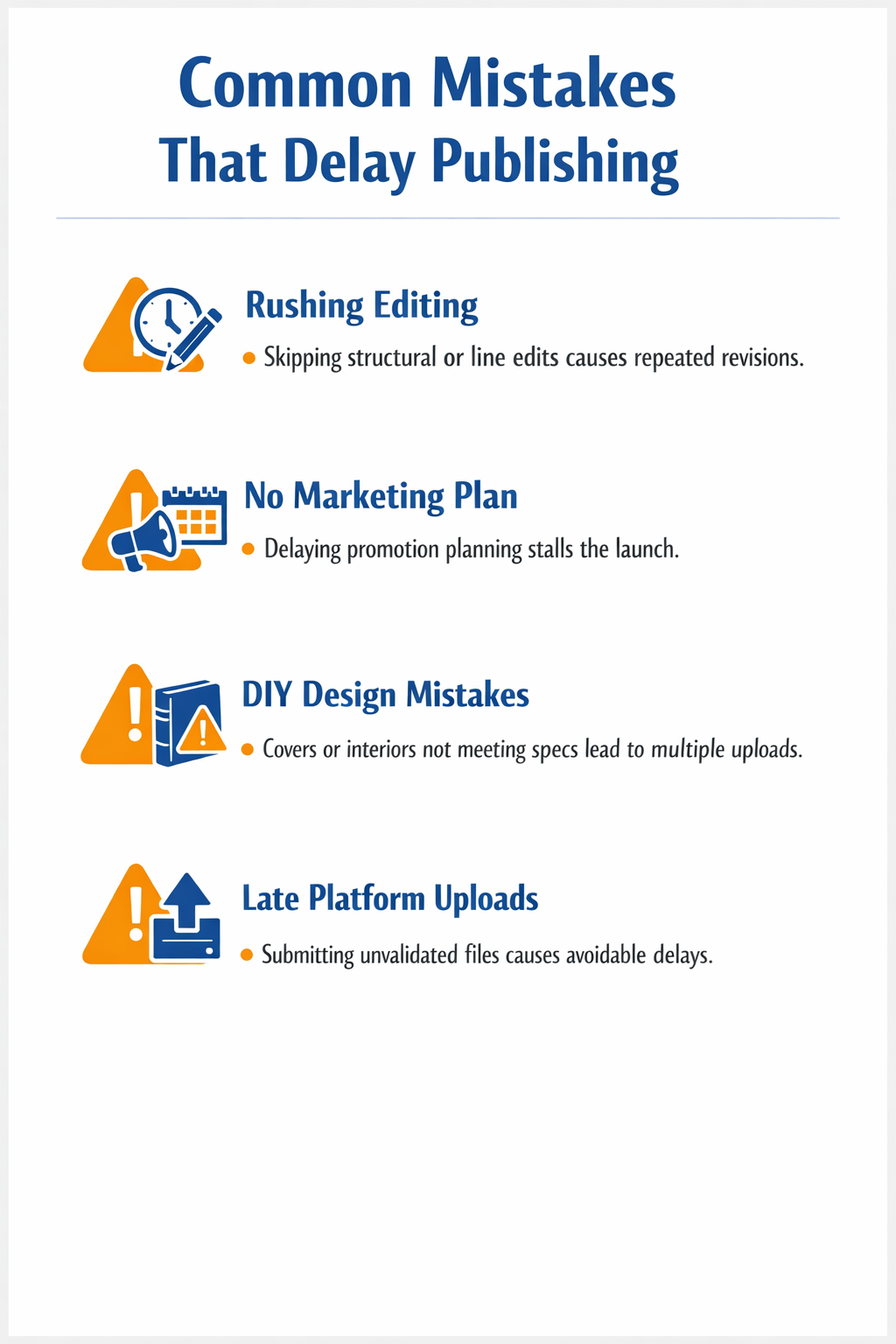
- Rushing Editing
Skipping structural or line edits seems like a time-saver. Spoiler: it is not. One client tried to fast-track a business manuscript. Chapters ended up repeating ideas. Fixing it added six weeks before formatting could even start. Okay, that hurt. - No Marketing Plan
Waiting until the draft is finished to think about promotion? Big mistake. Authors who line up ARCs, pre-orders, and outreach early can go live the second approval drops. Instant launch. - DIY Design Mistakes
Covers and interiors that do not meet platform specs are a trap. Even tiny issues such as fonts too big, bleed off, or margins off mean multiple uploads. Both ebook and print get held up. - Late Platform Uploads
Submitting files without checking metadata, format, or categories is a classic first-timer problem. Multiple re-uploads waste days. Experienced authors avoid this by prepping everything in advance.
Key Insight: The platform itself is rarely the bottleneck. Editing missteps, marketing delays, design errors, and sloppy file prep are what really drag timelines. Handle them early and your book moves fast.
FAQs
How long does it take to self publish a book?
Typically 3–8 months, depending on editing, formatting, and marketing prep. First-time authors often need extra time; experienced authors move faster.
How long does it take to self publish on Amazon?
Ebooks usually go live in 24–72 hours; paperbacks take 3–10 days if files and metadata are correct.
How long does it take KDP to publish?
Ebooks: 1–3 days. Paperbacks can take up to 10 days if revisions are needed. File validation and metadata accuracy prevent delays.
Can you publish a book in a week?
Only with a fully edited, formatted manuscript and prepped metadata. Ebooks are fast; print requires additional review days.
Why does traditional publishing take so long?
Multiple approval layers and scheduled release slots make total timelines 2–4 years, including editing, design, and distribution.
Conclusion: Making the Right Publishing Choice
Knowing how long does it take to publish a book is kind of like guessing traffic on a Monday morning. You can estimate, but there are always surprises. Okay, so the right path really depends on your goals and what you can actually handle.
Traditional publishing? Nice support, wide distribution, all that polish. But it moves like a snail in molasses. Self-publishing is faster, gives you control, but only if everything: manuscript, design, marketing, is ready to go. No shortcuts.
Most smooth launches come from planning like a pro. Delays rarely come from platforms. They hide in unfinished edits, messy layouts, or metadata errors. Ghostwriters or professional help can bulldoze those bottlenecks and still keep your book sounding like you.
Pick the route that matches your prep and your vibe. Nail the workflow, set a realistic timeline, and suddenly your book goes from idea to out-in-the-world without drama.
About the Author
Author, Writing Coach & Senior Manuscript Editor
Thomas Schaffer is an author, writing coach, and senior manuscript editor with nearly two decades of professional experience. He holds a B.A. in Communications from the University of Texas at Austin and specializes in health, lifestyle, leadership, and personal-development books.
writersofthewest.net · Professional Ghostwriting Services, Book Editing & Publishing Guidance