
There’s a point in almost every memoir draft where the writing slows down. Not because the story runs out, but because the writer starts explaining everything. Background. Motives. What people meant. What they didn’t say but should have said.
That’s where most memoirs lose their grip.
You don’t need to explain everything. You need to explain the right things. The rest either sits quietly in the scene or disappears.
I learned this the hard way. Years ago, I worked on a manuscript where the author had written forty pages about her childhood before anything actually happened. Careful explanations. Family history. Context stacked on context. By page forty-one, when something finally shifted, it felt late. Almost irrelevant.
We cut thirty of those pages.
Not because they were bad. Because they were unnecessary.
The story didn’t need them. The writer thought it did.
Why Most Memoirs Fail Before the Story Begins
Memoir is not about telling everything
A memoir is selective. It always has been. You are not recording your life. You are shaping meaning out of it.
That distinction sounds simple, but it changes how you handle every paragraph. When writers try to include everything, the story spreads out and weakens. Nothing stands out because everything is given equal weight.
Readers do not want a full record. They want a clear movement.
The problem is control, not content
Most drafts don’t fail because there isn’t enough material. They fail because there is too much of it, all treated as equally important.
You can feel it when reading. The story stalls. It circles back. It explains again what was already clear.
The issue is not writing skill. It is restraint.
The question underneath the question
“How much should I explain?” sounds technical. It isn’t.
The real question is quieter.
What does the reader actually need in order to understand the change at the center of this story?
Everything else is optional.
How to Decide What to Include in Your Memoir
Every memoir runs on a single idea
Not a topic. Not a timeline.
A controlling idea.
Loss. Control. Identity. Distance. Something that moves from one state to another. That movement decides what belongs in the book.
I worked with a writer who insisted on keeping long passages about his early career. Detailed, accurate, even interesting. But his memoir was about losing control, not building a career.
We removed most of it.
What stayed was one moment. He sat in his car outside his office, engine running, unable to go inside. That moment carried more weight than ten pages of explanation ever did.
This is usually the point where writers either stall out or bring in professional memoir writing services to help shape what actually belongs in the narrative and what does not.
Relevance is not about accuracy
Writers often defend explanation by saying it is true. That is not the standard.
The standard is relevance.
If a scene or detail does not push the central movement forward, it becomes excess. Even if it happened. Even if it mattered at the time.
You are not writing for the past. You are writing for the reader.
The quiet test every scene must pass
You start to see it during revision.
Does this moment change anything?
Does it deepen the conflict?
Does it sharpen the emotional movement?
If the answer is no, the explanation attached to it will not save it.
The Three Elements Every Memoir Chapter Needs
Context gives orientation, not weight
Context tells the reader where they are. Who is present. What kind of world this is.
It matters. But not for long.
Writers tend to front-load context. They explain before anything has happened. The result is distance. The reader has information but no experience.
Context works best when it slips into the scene. A line. A detail. Enough to keep the reader steady without slowing them down.
Experience carries the story
This is where the memoir lives.
Scenes. Movement. Dialogue. Action.
Most of the writing should happen here. Not in explanation, not in summary. In lived moments.
You do not need to explain a hospital corridor if the reader can feel it through what happens there. The sound of a machine. A nurse adjusting a blanket. A sentence cut short.
That is enough.
Reflection gives meaning, but only in measure
Reflection is where you step back and interpret what happened.
It is necessary. Without it, a memoir becomes a sequence of events with no center.
But too much reflection weakens the story. It tells the reader what to think instead of letting them arrive there.
There is a rhythm that works. Scene first. Then a brief pause. Then meaning, placed carefully.
Not everything needs interpretation.
What to Cut From Your Memoir Draft
Expand the moments where something shifts
When something changes, the writing slows down.
You stay in the moment longer. You allow detail to build. You let the reader feel the shift before moving on.
These are the moments that earn explanation. Not all of it, but enough to make the change visible.
Compress what the reader already understands
Routine does not need space.
Daily life, repeated patterns, familiar situations. The reader already knows how these feel. You do not need to recreate them in full.
A line can replace a page.
This is where most drafts can be reduced without losing anything essential.
Remove what carries no weight
Some details sit in the draft because they happened. Not because they matter.
You start to recognize them. They do not connect to the central movement. They do not change the reader’s understanding. They sit there, waiting to be justified.
They rarely are.
A simple pattern that holds up
| Type of moment | What to do with it | Why it matters |
| Turning point | Expand | The shift needs space to land |
| Emotional realization | Develop briefly | Meaning needs clarity, not volume |
| Routine experience | Compress | The reader already understands it |
| Background context | Reduce | Only needed for orientation |
| Repetition | Remove | Weakens pacing and impact |
You do not apply this mechanically. But it holds more often than not.
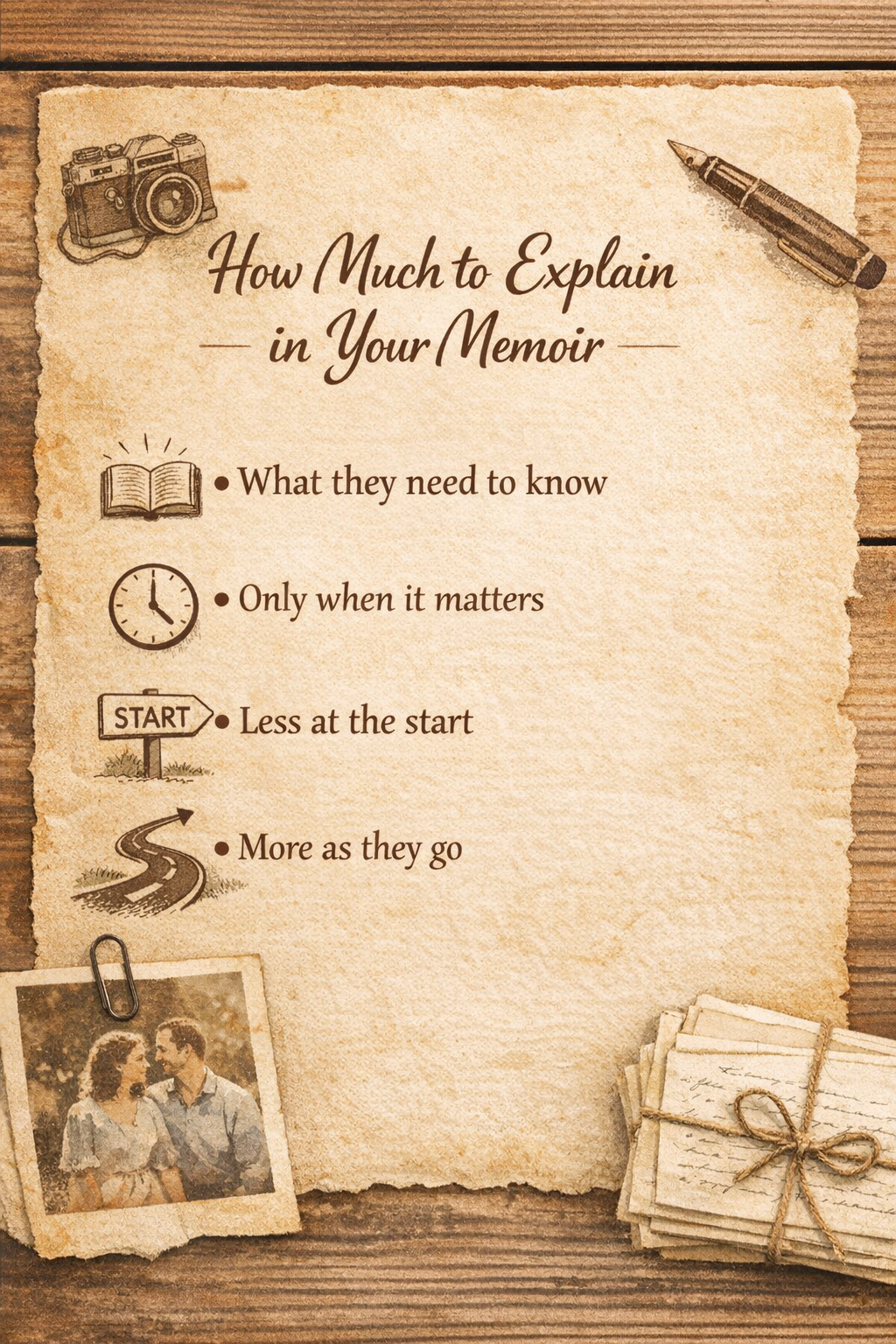
The Most Common Memoir Writing Mistakes
Over-explaining slows everything down
This is the obvious one.
Long passages between scenes. Repeated interpretation. Background that arrives too early or too often.
The reader starts to drift. Not because the story is weak, but because it is being explained instead of experienced.
Under-explaining creates distance
Less obvious. More common than it seems.
worked on a memoir that moved quickly from one major event to another. Clean writing. Strong scenes. But no reflection.
Nothing settled.
We added small pauses. Not long explanations. Just enough to anchor what had happened. A paragraph after a hospital visit. A moment in a parking lot where the writer noticed the radio still playing.
That was enough.
At this stage, some writers find that working with an experienced ghostwriter helps them identify where the story needs depth and where it needs restraint.
You rarely get the balance right at first
You rarely get this right on the first pass. Most drafts lean too far in one direction. Either everything is explained, or too much is left unsaid.
The difficulty is perspective. When you already know the story, it feels complete. What seems obvious to you is often missing for the reader.
This is why balance only emerges in revision. You start to notice where the writing overcompensates and where it withholds too much. Then you correct it, slowly, section by section, until the movement feels natural.
How to Edit a Memoir: What Stays and What Goes
You start by seeing where explanation replaces experience
In early drafts, explanation is embedded in the writing and reads as part of the scene. On revision, it becomes visible as a separate layer that is doing work the scene should already be doing.
You see where a scene stops to explain what is already clear from the action. You see repetition of meaning across adjacent sentences with no added information. You see background expanding beyond what the moment requires, taking space from the event itself.
Once this is visible, the choices are straightforward. Remove what repeats. Keep what carries the scene. Everything else becomes noise against the narrative.
Cutting does not mean losing meaning
Writers resist cutting because it feels like losing something important.
In most cases, you are removing repetition, not meaning. This is often where focused memoir editing services become useful, especially when you can no longer see clearly what is necessary and what is just familiar.
Expansion matters just as much
Not every problem is excess. Some moments pass too quickly. Important shifts are mentioned and then left behind.
These are the places where you add space. Not explanation for its own sake, but enough detail and reflection to let the moment land.
Balance is not only about cutting. It is also about staying longer where it matters.
How Memoir Structure Affects How Much You Need to Write
Linear stories need controlled context
If your memoir moves in order, the reader is learning the world at the same pace as the story. That means they do need some basic orientation early on. Who is involved, where this is happening, what kind of situation they are stepping into.
But this is where most writers overdo it. They treat the beginning like a full setup section and start explaining everything before anything has actually happened. That slows the entry point of the story.
Context should be light and functional. Enough to prevent confusion, not enough to stall movement. The moment it turns into extended explanation, the reader is no longer inside the scene. They are being briefed on it.
Too much information too early creates distance. The reader is informed, but not engaged.
Nonlinear structure changes the equation
When your memoir moves across time instead of following a straight line, explanation stops behaving the same way. You are no longer building one continuous setup. You are building separate moments that the reader connects on their own.
This often reduces the need for long context blocks. The reader fills gaps by comparing one scene with another. Meaning comes from pattern, not sequence.
But each section still has to hold on its own. If a moment is too thin, the reader has nothing to hold while they wait for the next piece of information.
Nonlinear writing does not remove explanation. It redistributes it.
A simple way to see this:
Instead of writing: “I was 12, living in a strict household, and my father had already started enforcing rules that shaped everything I did. That year, I stopped speaking at dinner.”
You might write: “I stopped speaking at dinner.”
Later, in another section: “By the time I was twelve, silence at the table had become expected.”
Same information. Different delivery. The first version explains upfront. The second lets the reader assemble it across time.
Timing matters more than volume
Most writers assume the problem is how much explanation they are giving. It usually is not. The issue is when that explanation appears in the story.
If you explain too early, you remove tension before the scene has a chance to form. The reader has information, but no reason yet to care about it. If you explain too late, the reader is already confused and has to backtrack mentally just to follow what is happening.
The same detail can work or fail depending on placement. Context that feels heavy at the start of a chapter often reads as necessary once the reader has already seen the situation unfold.
One manuscript had a scene where a character walks out of a family dinner. In the first draft, the writer explained the family history and long standing conflict before the scene even started. The walkout felt flat because there was nothing to build toward.
We moved the explanation to after the scene. First, the argument. First, the exit. Then the brief context that made sense of what the reader had just witnessed. The shift was immediate. The scene gained weight without adding any extra detail.
FAQs
How much detail should you include in a memoir?
You include enough detail for the reader to understand what is happening and why it matters. That usually means expanding moments of change and reducing everything else. Detail works when it sharpens the experience. If it does not, it becomes excess.
Should you explain every event in your life story?
No. A memoir is selective. You are shaping a narrative around a central movement, not recording everything that happened. Events that do not support that movement can be reduced or removed.
How do you decide what to cut from a memoir?
You look at function. Each scene should either move the story forward, deepen the central idea, or add emotional clarity. If it repeats something already shown or adds unnecessary context, it can be removed.
What happens if you over-explain in a memoir?
The pacing slows down. Scenes lose their force because they are interrupted. The reader shifts from experiencing the story to processing information.
What happens if you do not explain enough in a memoir?
The reader loses clarity. Important moments feel thin because there is no reflection to support them. The story moves, but it does not stay with the reader.
Conclusion
You do not arrive at a number. Or a rule you can apply everywhere.
You arrive at a feel.
A sense of when a scene can stand on its own and when it needs support. When to stay longer and when to move on.
It changes from chapter to chapter.
I still think about that hallway from the early manuscript. The one with the flickering light. The writer had explained what it meant in careful detail.
We removed the explanation.
The light stayed.
About the Author
Cell Biologist, Sociologist & Senior Editor, Writers of the West
Robert Whitehead is an American sociologist and cell biologist at the University of Virginia. He has been with Writers of the West for six years, bringing a rare combination of scientific rigor and behavioral insight to biography, fiction, and book design editorial work. His research background strengthens narrative authenticity, analytical precision, and structural coherence across a wide range of manuscript types.
writersofthewest.net · Professional Ghostwriting Services, Book Editing & Publishing Guidance