What Should My First Book Be About? A Personal Guide.
Most first-time authors don’t have a writing problem. They have a deciding problem.
What should be book be about?
The idea has been sitting in their head for months, sometimes years. They know they want to write a book. They just can’t commit to what it should be about, which direction to go, or whether anyone would actually read it.
This guide doesn’t give you a list of prompts and wish you luck. It walks you through a decision at a time, in the right order, so by the end you know exactly what kind of book you should write and why. Take it step by step. Don’t skip ahead.
Quick Answer: What Kind of Book Should You Write?
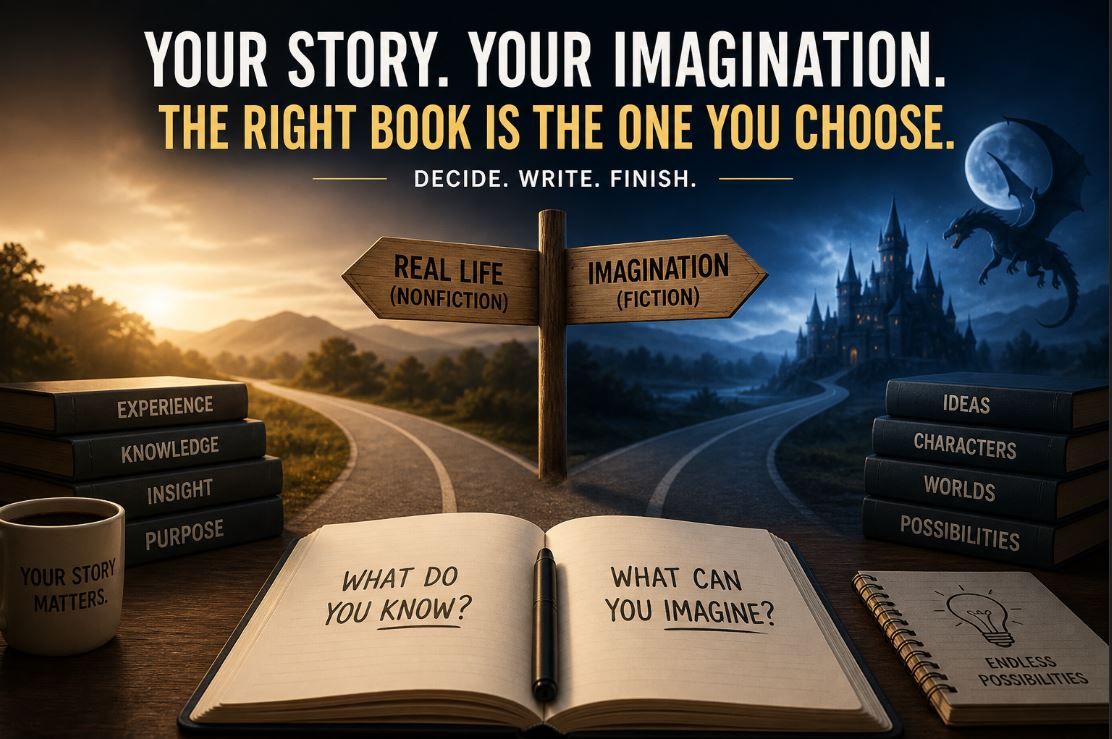
Start by asking yourself two questions. How much have you lived, and how vivid is your imagination? Strong life experience points toward nonfiction. Strong imagination points toward fiction. If both apply, memoir or literary fiction suit you equally well.
From there the choice narrows quickly. Nonfiction writers choose between their personal story as the book, which is memoir or autobiography, or their knowledge and expertise as the book, which is self-help, business, or how-to. Fiction writers choose based on what comes first in their imagination. Characters and emotions point toward romance or literary fiction. A world with its own rules points toward fantasy or science fiction. A situation and what happens next points toward thriller or mystery.
Once you know your genre, test your idea with three questions. Can you describe it in two sentences? Do you know exactly who your specific reader is? And do you know what that reader gets from finishing it? If you can answer all three clearly your idea is ready to write. If any of them stump you that is where to focus before you write a single word.
Step 1: Run Yourself Through These Two Questions First
Before genre, before topic, before anything else, two things about you determine the entire direction of your first book.
Question 1: How much have you lived?
Not whether your life is interesting enough. Everyone thinks their life isn’t interesting enough. The real question is whether you have experiences, expertise, or a perspective built from real events that other people would find valuable, instructive, or deeply relatable.
Think about it this way. Have you been through something significant that changed how you see the world? Have you spent years becoming genuinely good at something? Do people consistently come to you for advice or insight on a specific topic because they trust what you know?
If yes to any of those, your raw material is real life. That’s a nonfiction signal.
Question 2: How vivid is your imagination?
Again, not whether you think you’re creative enough. The question is whether you naturally invent. Do stories, characters, and scenarios appear in your head unprompted? When you daydream, are you building worlds and people that don’t exist? Have you been mentally writing a story for years without putting it on paper?
If yes, your raw material is imagination. That’s a fiction signal.
Most people are stronger in one than the other. Some are genuinely strong in both, which opens up certain genres we’ll get to. But start here and be honest. The answer to Step 1 decides everything that follows.
Step 2: The First Fork Fiction or Nonfiction?
Use your answers from Step 1 to find yourself in this table. Don’t force it. The right row will feel accurate.
| Your Profile | Where You Belong |
|---|---|
| Strong life experience, limited imagination for invention | Nonfiction |
| Strong imagination, limited significant personal story or expertise | Fiction |
| Strong in both real experiences AND vivid imagination | Either works. Memoir, narrative nonfiction, or literary fiction all suit you. |
| Neither feels dominant yet | Start with fiction. Imagination develops faster than lived experience can be manufactured. |
Once you know your branch, move to the step that matches. Nonfiction writers go to Step 3. Fiction writers jump to Step 4.
Step 3: Nonfiction Writers What Kind of Story or Knowledge Do You Have?
Nonfiction splits into two distinct directions and which one fits depends on what your raw material actually is.
Direction A: Your personal story is the book
This is memoir, autobiography, and narrative nonfiction. The value is the experience itself: what you went through, how it changed you, and what the reader gets from living it alongside you on the page. You don’t need to be famous. You need to have lived through something that other people either relate to deeply or want to understand from the inside.
Direction B: Your knowledge or expertise is the book
This is self-help, business, how-to, and professional nonfiction. The value is what you know and what you can teach. The book isn’t about your life. It’s about what your years of experience have produced in terms of insight, method, or perspective that others can apply to their own.
Use this table to find your nonfiction direction:
| Your Raw Material | Best Nonfiction Genre | What Makes It Work |
|---|---|---|
| Survived or overcame something significant | Memoir | Emotional truth, specific detail, transformation arc |
| Built expertise in a professional field | Business or professional nonfiction | Counterintuitive insight, frameworks, practical value |
| Want to change how people think or live | Self-help or motivational | Clear argument, actionable content, relatable language |
| Fascinated by someone else’s life or a historical event | Biography or narrative nonfiction | Research depth, storytelling craft, subject access |
| Have a specific skill or process to teach | How-to or instructional | Clear structure, step by step logic, real examples |
| Deep faith or spiritual journey | Christian or spiritual nonfiction | Authentic voice, tradition grounding, community relevance |
The scope trap most nonfiction beginners fall into:
First-time nonfiction writers almost always try to write too big. A memoir covering an entire life. A business book covering an entire career. A self-help book solving every problem at once. The books that actually work are narrower than you think. One period of your life, not all of it. One core idea, not everything you know. One specific problem you solve, not a comprehensive overview of your field. Narrow the scope before you start and your book will be stronger and faster to write.
Writers of the West is a full-service ghostwriting, editing, and publishing company with offices in Houston, Los Angeles, and New York. If you’ve worked through these steps and have a clear idea but aren’t sure how to turn it into a finished book, our professional book writing services and eBook writing services are built for exactly this moment.
Now move to Step 5.
Step 4: Fiction Writers: What Kind of Imagination Do You Have?
Not all imagination works the same way. Some writers think in emotions and relationships. Some think in systems and worlds. Some think in plot and tension. The kind of imagination you have determines which fiction genres will feel natural and which will feel like fighting yourself on every page.
Answer this honestly: when you imagine a story, what comes first?
A: Characters and how they feel about each other You see people before you see plot. The emotional dynamic between characters is what draws you in. You find yourself more interested in why someone does something than what they do next.
B: A world or a system that doesn’t exist You see a place, a set of rules, a reality that isn’t this one. The world itself is what excites you. You’ve probably already thought more about how the magic works or what the political structure looks like than about any specific character.
C: A situation and what happens next You see a scenario someone in danger, a secret about to come out, a crime that doesn’t add up. Plot is what drives you. You think in twists, reveals, and escalating stakes.
Use your answer to find your fiction direction:
| What Comes First in Your Imagination | Best Fiction Genre | What the Genre Rewards |
|---|---|---|
| Characters and emotional dynamics | Romance, contemporary fiction, literary fiction | Depth of feeling, authentic relationships, distinctive voice |
| A world with its own rules | Fantasy, science fiction, romantasy | World-building consistency, internal logic, series potential |
| A situation and what happens next | Thriller, mystery, psychological suspense | Pacing, plot structure, tension management |
| Real history with invented characters | Historical fiction | Research depth, period authenticity, narrative craft |
| Relationships with a supernatural edge | Paranormal romance, dark romance, gothic fiction | Genre trope mastery, emotional intensity, atmosphere |
| The experience of being young | YA fiction | Authentic adolescent voice, emotional stakes, identity themes |
Book writing ideas for beginners in fiction:
Whatever genre you’ve landed on, resist the urge to write the biggest version of your idea first. The most common reason first novels don’t get finished is scope. A romance set in one city over three months teaches you more about structure, pacing, and voice than an eight-book fantasy epic. Start contained. Go bigger on the next one.
Book writing ideas for teenage writers and young adult fiction:
If you’re a younger writer your age is an asset, not a disadvantage. YA fiction written by someone who genuinely remembers adolescence from the inside has an authenticity that older writers spend years trying to manufacture. Write what you actually know about being young right now.
Book ideas to write for fantasy specifically:
Fantasy looks approachable because you’re inventing everything. In reality it’s one of the harder genres to execute well for exactly that reason. Your world’s internal rules have to hold up. Magic systems, political structures, histories, and geographies all need internal consistency. Before you write chapter one you need to know significantly more about your world than ever appears on the page. If that excites you, you belong here. If it sounds exhausting, consider a genre with less world-building overhead.
Now move to Step 5.
Step 5: The Idea Clarity Test
You now know your branch and your genre. This is where most writers stall because the idea is still too big or too vague to actually start. Run your idea through these three questions before you commit.
Can you describe your book in two sentences?
If you need five sentences to explain what it’s about, the idea isn’t focused enough yet. Keep narrowing until two sentences cover it completely. This isn’t a pitch exercise. It’s a clarity exercise. If you can’t describe it simply you don’t fully know what it is yet.
Who is the specific reader sitting down to read it?
Not “anyone who likes thrillers” or “people interested in self-improvement.” A specific person. Their age, their situation, what they’re struggling with, what they want to feel when they finish. The more specific this person is in your mind the better your book will be.
What does your reader get from finishing it?
Fiction readers want an emotional experience: to feel something they don’t feel in their regular life. Nonfiction readers want a transformation: to think, behave, or see something differently after reading. What specifically does your book deliver?
If you can answer all three clearly your idea is ready. If any of them stump you that’s where to focus before you write a single word.
Step 6: Book Topics and Genre Market Reality
This step doesn’t decide what you write. It tells you what to expect when you’re done. Go in with clear eyes.
Fiction market current size and momentum:
| Genre | Annual Market Size | Momentum | What to Know |
|---|---|---|---|
| Romance and romantasy | $1.4B+ | Very high, BookTok driven | Largest and most active readership. High expectations for tropes and consistency. |
| YA fiction | $730M | Stable | 78% of buyers are adults. Series and emotional intensity perform best. |
| Thriller and mystery | $728M | Reliable and steady | Readers are habitual. Genre rewards series and tight plot structure. |
| Fantasy and science fiction | $590M | High, especially romantasy crossover | Average reader buys 7 books per year from the same author. Series commitment required. |
| Literary and contemporary fiction | Large but harder to measure | Steady | Harder to market without platform. Voice and craft matter most. |
Nonfiction market current momentum:
| Genre | Momentum | What to Know |
|---|---|---|
| Self-help and personal development | Very high | Mental health, productivity, and finance performing strongest. |
| Memoir | Growing | Authenticity and connection drive sales more than fame. |
| Business and professional | Solid | Works best when the author has genuine authority and an existing audience. |
| Religious and spiritual | Highest year-over-year growth of any nonfiction category | Large and loyal readership, especially Christian nonfiction. |
| How-to and instructional | Stable | Evergreen if the topic has consistent demand. |
Adult fiction sales rose 12.6% recently to $3.26 billion while nonfiction grew 1.3% to $2.88 billion. Fiction is where the momentum is. But nonfiction at nearly $3 billion annually still rewards expertise and authenticity at a serious level.
Chasing a trending genre without the passion to sustain it produces the books that get abandoned halfway through. The market data tells you what’s working for other people. Only you know what you’re capable of writing all the way to the end.
Step 7: What Your First Book Should Be
After running through all six steps most writers land clearly in one of these places.
You have a significant personal story and the emotional honesty to tell it. Write memoir. Keep the scope tight: one period, one experience, one transformation. Not your whole life.
You have deep expertise and opinions that differ from the mainstream. Write a business or self-help book. Lead with the counterintuitive argument, not a comprehensive overview of everything you know.
You’re drawn to emotional storytelling and have been reading romance for years. Write romance or contemporary fiction. Start contained: two people, a clear conflict, a resolution, before going bigger.
You’ve been building a world in your head and you read fantasy obsessively. Write fantasy. Accept it will take longer and plan for a series not a standalone.
You love tension, psychological complexity, and plot. Write a thriller or mystery. Study the structure of three books in your chosen subgenre before you start writing yours.
You’re a younger writer drawn to the experience of adolescence. Write YA. Your authenticity in this space is an advantage nobody older can replicate.
The writers who finish their first books are rarely the ones who chose the most marketable idea. They’re the ones who chose the idea they couldn’t not write. Use these steps to find that idea. Then start.
About the Author
Behavioral Science Writer & Analytical Story Editor
Robert Whitehead is an American behavioral science writer and cell biologist with over six years at Writers of the West. He specializes in behavioral analysis, logical storytelling, and research-driven manuscripts.
writersofthewest.net · Professional Ghostwriting Services, Book Editing & Publishing Guidance