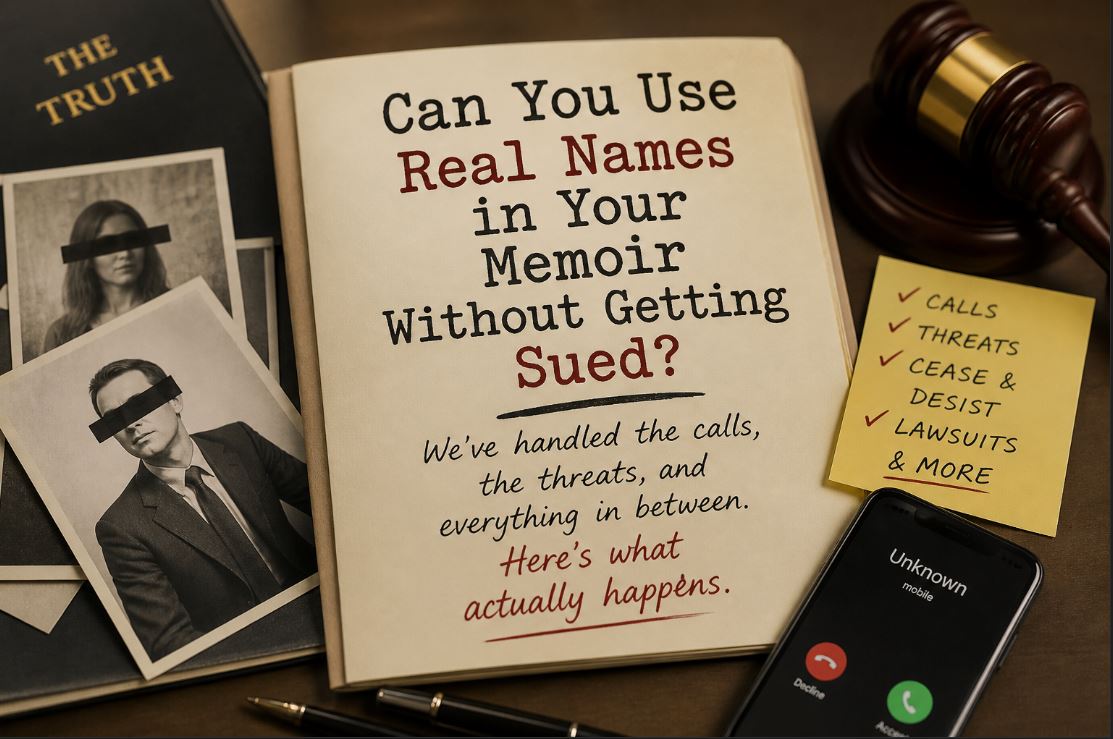
Can you use real names in your memoir without getting sued? We’ve handled the calls, the threats, and everything in between. Here’s what actually happens.
You’ve got a story. A real one. The kind that kept you up at night for years before you finally decided to write it down. And somewhere between your first draft and your publishing dreams, one question stops you cold.
Can I use real names in my book?
It’s the most common question memoir writers ask us at Writers of the West while working with our professional ghostwriters. Not “how do I structure my chapters” or “what tense should I write in.” This one. Every time.
The short answer is yes, you can use real names. The longer answer is that whether you should depends on a few things most writing guides gloss over entirely.
We’ve been offering self publishing services long enough to have seen what happens after books go live, including the calls, the threats, and the rare cases where things actually get complicated. So rather than give you another article full of theoretical legal warnings, here’s what the process actually looks like from the inside.
Can I Use Real Names in My Memoir?
Legally, yes. Nothing stops you from naming real people in your memoir. The First Amendment protects your right to tell your story, and truth is your strongest defense against any legal challenge.
That said, using real names opens two specific doors you need to know about before you publish.
The first is defamation. In writing, that’s called libel, and it only applies to false statements presented as fact that damage someone’s reputation.
If what you wrote actually happened, you are on solid legal ground. If you exaggerated, misremembered, or implied something you can’t prove, that’s where things get complicated.
The second is invasion of privacy. This one catches writers off guard because truth is not a defense here. You can write something completely accurate about someone and still face an invasion of privacy claim if that information was private and they never consented to having it made public. A secret health condition, an affair nobody knew about, a family member’s addiction that was never discussed outside the home.
Even if every word is true, publishing it without permission is legally risky territory.
Here’s the practical reality though: most memoir writers are not public figures writing about other public figures. They’re ordinary people writing about their lives, their families, and the people who shaped them. For that audience, the legal risk of using real names is real but often overstated. Lawsuits are expensive, slow, and draw attention to the very content the named person wants buried.
Can I Use Celebrity Names in My Book?
This one has a cleaner answer than most people expect. Yes, you can reference celebrities, public figures, and well-known names in your memoir or nonfiction work, as long as you’re writing truthfully and in context.
Public figures have significantly less legal protection against what’s written about them compared to private individuals. To win a defamation case, a public figure has to prove not just that you wrote something false, but that you did so knowing it was false or with reckless disregard for whether it was true. That’s a high bar.
Where writers get into trouble with celebrity names is when they invent dialogue, imply private facts they don’t actually know, or use a famous person’s name in a way that suggests endorsement of their book. Writing that you once had a conversation with a well-known figure and describing what they said is memoir. Inventing what they said and presenting it as fact is where the legal exposure begins.
For fiction writers using real public figures as characters, the rules shift again. The more prominent the role, the more important it becomes to clearly signal fictionalization through disclaimers and transformed storytelling.
Can You Sue Someone for Using Your Name in a Book?
Yes, anyone can sue anyone for almost anything. The more useful question is whether they’d win, and on that front, the odds generally favor the author.
At Writers of the West, we’ve seen this play out enough times to recognize the pattern. After a book goes live, if someone is named and unhappy about it, the contact rarely comes directly from the person themselves. Almost always it comes from someone acting on their behalf. A family member, a friend, occasionally a lawyer. The named person usually stays in the background, probably because acknowledging the book publicly draws more attention to it.
What these contacts almost always want is the same thing: take the book down. Not damages, not a court date, not a formal legal process. Just removal.
When we haven’t used real names in a client’s book, which is the majority of cases, those conversations tend to end very quickly. There’s nothing to defend when the person isn’t identifiable to a general audience. When real names were used, the conversation gets longer, but the outcome is usually the same. The threat rarely escalates beyond a phone call or an email.
The one situation where that calculus changes is when the named person has real legal standing, genuine evidence that what was written is false, and the financial motivation to pursue it. That combination is rarer than most first-time authors fear.
How to Write About Someone Without Using Their Name
This is where most writing guides give you a checklist and call it done. Change the name, swap the city, alter the physical description. All of that is correct and worth doing. But there’s a layer underneath it that matters more.
The goal of using a pseudonym isn’t just to change the label. It’s to make the person unidentifiable to someone who doesn’t already know your story. If you change the name but keep every other detail intact, anyone who knows you will still know exactly who you’re writing about. That’s fine for people in your personal circle. What protects you legally is that strangers reading your book can’t connect the character to a real person.
A few techniques that actually work:
Change the first letter of the name and the number of syllables. Don’t just swap “David” for “Daniel.” That’s too close. Go from “David” to “Marcus” or “Tom.”
Shift the setting. If the events happened in Chicago, move them to Detroit. If the person worked in finance, put them in real estate. These details matter to identifiability more than most writers realize.
Composite characters are another option, where you combine traits and experiences from two or three real people into one fictional character. This is ethically sound and legally cleaner, but be transparent about it. A brief author’s note explaining that some characters are composites goes a long way.
One thing to keep in mind: changing a name alone is not a shield. If someone is easily identifiable from the surrounding details, they can still pursue a legal claim even without their name in the text. The standard isn’t whether they recognize themselves. It’s whether a reasonable reader who knows them would recognize them too.
When Using Real Names in Your Book Is the Right Call
Here’s something most publishing articles won’t tell you, probably because it doesn’t fit neatly into a legal framework.
Sometimes naming someone is the whole point.
We had a client who had been abused. She knew the risks. She understood that using his name was a decision that could invite pushback. She chose to do it anyway because the story she was telling required it, and because telling it without naming him felt like protecting someone who had already taken enough from her.
That’s a legitimate reason to name someone. Not recklessness. Not revenge. A deliberate choice made with full awareness of the consequences.
The authors who tend to regret naming someone are the ones who didn’t think it through before publication. The authors who don’t regret it are usually the ones who weighed the decision carefully, understood what they were doing, and made a conscious call.
If you’re writing about abuse, injustice, or experiences where accountability matters to the story, naming someone may be the right decision for you. Just make it a decision, not a default.
Should I Change Names in My Memoir? The Honest Tradeoff
Most of our clients choose pseudonyms, and most of the time that’s the right call. Not because the truth isn’t worth telling but because the name itself rarely changes the power of the story.
Readers connect with what happened to you. They connect with how you processed it, survived it, and came out the other side. The specific name of the person who hurt you or helped you is usually less important to the reading experience than writers assume. What readers want is emotional truth. That doesn’t require a name.
The practical benefit of pseudonyms is that they keep the conversation short after publication. When someone contacts us unhappy about a book that doesn’t use real names, there isn’t much to argue about. The general public can’t identify the person. The legal exposure drops significantly. The story still gets told.
The tradeoff is that some writers feel changing names diminishes their story or softens a truth they worked hard to tell. That feeling is valid and worth sitting with before you decide. If a pseudonym would make you feel like you’re hiding something you have a right to say, that matters. Your relationship to your own story is part of this decision too.
Will You Actually Get Sued for Writing About Real People?
People threaten to sue authors a lot more than they actually do it.
Litigation costs money, takes years, and in the case of memoir, usually requires the plaintiff to prove something is false. If your story is true and you’ve told it carefully, a lawsuit is an uphill battle for anyone who objects to what you wrote.
What actually happens in most cases is a strongly worded message, occasionally from a lawyer, asking for the book to be taken down or a specific passage removed. Sometimes it’s the named person. More often it’s someone operating on their behalf because they don’t want to acknowledge the book directly.
These contacts rarely go further. The threat of a lawsuit and an actual lawsuit are very different things, and most people who are unhappy about being in a book are not interested in the time, cost, and additional publicity that legal action would bring.
That doesn’t mean you should write carelessly or with disregard for the people in your story. It means the fear of legal consequences shouldn’t stop you from telling a story that deserves to be told.
How to Protect Yourself Before You Publish Your Memoir
Write your first draft with all the real names. Get the story out honestly. Worry about what to change later.
When you’re closer to publication, look at each person you’ve written about and ask yourself two questions: Is this person identifiable to strangers from the details I’ve included? And is what I’ve written about them something I can stand behind factually?
If the answer to the first question is yes and the portrayal is negative, consider a pseudonym. If the answer to the second question is uncertain, go back and tighten your recollections before anything else.
And if you’re working with a ghostwriter or a publishing company, have this conversation early. Not because the legal risk is likely to materialize into something serious, but because knowing your approach from the start makes the whole book better.
Your story is worth telling. The names in it are a decision, not a barrier.
Writers of the West is a full-service ghostwriting, editing, and publishing company with offices in Houston, Los Angeles, and New York. If you’re working on a memoir and need memoir writing service, and have questions about how to handle real people in your story, we’re happy to talk through it with you.
About the Author
Author & Developmental Editor
Brienna Burroughs is an American author and developmental editor with years of publishing experience. She focuses on story structure, narrative development, and manuscript clarity.
writersofthewest.net · Professional Ghostwriting Services, Book Editing & Publishing Guidance