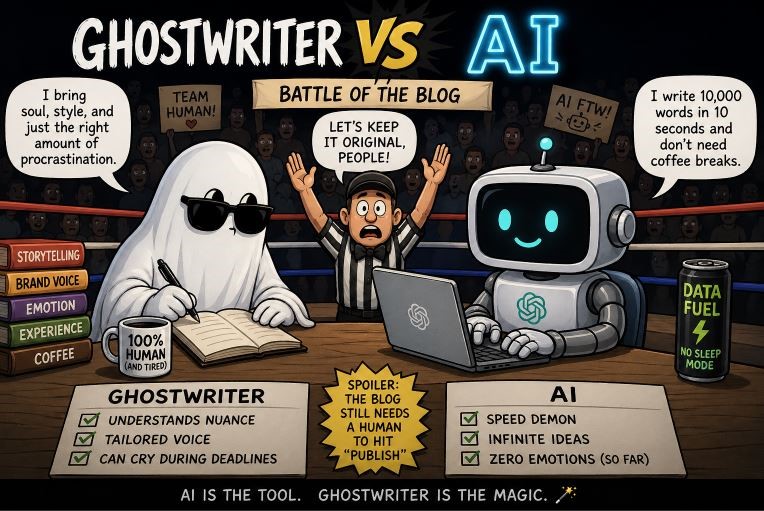
Hiring a ghostwriter or using AI to write your book? This honest breakdown covers what AI gets right, where it falls apart, and how to figure out which option makes sense for your specific project.
Ghostwriter vs AI: The Decision Most Authors Get Wrong
You have the story, the expertise, or the idea. What you do not have is 400 hours to sit down and write a full manuscript. So you are looking at your options, and right now those options are roughly: hire a professional ghostwriter, or fire up ChatGPT and see what happens.
Both paths lead to a finished document. Only one of them leads to a finished book that actually sounds like you wrote it.
That distinction matters a lot more than most people realize until they are already deep into the wrong choice.
This guide is going to be straight with you about both options. No cheerleading for either side. Just an honest breakdown of what AI does well, where it completely falls apart, and how to decide which makes sense for your specific project before you waste time or money finding out the hard way.
What AI Can Do in the Book Writing Process
Giving AI zero credit would be dishonest. There are specific things these tools do genuinely well, and ignoring that does not help anyone make a smart decision.
AI for Research and Outlining: Where It Genuinely Helps
If you have recorded interviews, scattered notes, old blog posts, presentations, and voice memos spread across six different places, AI is surprisingly good at making sense of that pile. Tools like ChatGPT can take a wall of unstructured input and sort it into themes, summaries, and rough chapter groupings within a couple of hours.
For someone who has been sitting on a book idea for years because the material feels too scattered to tackle, this kind of organization can be the push that finally gets the project moving.
How AI Helps Test Book Structure Before You Start Writing
One of the more underrated uses of AI in book projects is structural testing. Instead of building one outline and discovering its problems three chapters into a draft, you can generate five different structural approaches in a single afternoon and compare which one actually makes sense for what you are trying to say.
This is AI doing what it does best: producing options fast so a human can pick the right one.
AI Book Editing Tools: What They Catch and What They Miss
AI editing tools like Grammarly and ProWritingAid are legitimately useful for flagging repeated phrasing, inconsistent sentence structure, and readability issues across long documents. These are tedious patterns to catch manually. AI surfaces them quickly. That saves real time during revision.
The problem starts when people assume that catching the pattern is the same as fixing the book. It is not even close to the same thing.
When AI Writing Is Enough for Your Book (If You Are Okay With People Knowing)
Fair warning: this section is going to be honest in a way that might sting a little.
There are situations where AI writing is technically sufficient for a book project. If your book is a short informational ebook under 15,000 words and the whole point is to get something out fast, AI can produce a usable draft. If you are creating a basic how-to guide or internal reference document where nobody is going to read it expecting a distinctive voice, function matters more than form and ai tools like ChatGPT, Claude, can deliver function.
But here is what that category quietly requires you to be fine with: the writing will not sound like you. It will sound like a competent summary of your topic written by no one in particular. Readers with any experience will sense it. Colleagues in your field will likely recognize it. And if your name is on the cover of something that reads like it was assembled by a tool rather than written by a person, that is a statement about how seriously you take your own work.
For most people reading this, that matters. Originality matters. Professional reputation matters. The tone that comes through when someone reads your book and gets a sense of who you actually are, that matters too. If any of those things are on your list, AI writing is not really enough, even when it technically produces a book.
The table below makes it easier to figure out which side of the line your project sits on before you commit to either path.
| What You Are Building | What Matters Most | Ghostwriter Vs AI |
| Short informational ebook or lead magnet | Speed and low cost | AI with your own editing |
| Basic how-to guide or internal document | Function over voice | AI with your own editing |
| Business book tied to your brand | Credibility and originality | Professional ghostwriter |
| Memoir or personal story | Voice, tone, and emotional truth | Professional ghostwriter |
| Thought leadership title | Authority and distinctiveness | Professional ghostwriter |
| Legacy or family history book | Personal voice and accuracy | Professional ghostwriter |
| Book to support speaking or consulting | Professional reputation | Professional ghostwriter |
If your project lands in the bottom half of that table, the question is not really ghostwriter vs AI. It is just ghostwriter.
Where AI Ghostwriting Breaks Down for Serious Book Projects:
Why AI-Written Books All Sound the Same
Here is the core issue with AI-generated writing that most people do not figure out until they have already wasted several weeks on a draft.
AI models are trained on enormous amounts of existing text. When they write, they produce the most statistically likely version of whatever you asked for. That means the output tends toward the average. The most common way that kind of sentence gets written. The most typical way that type of section gets structured. The transitions that show up most frequently in content about your topic.
Your voice is not average. Your specific perspective, the way you move from one idea to the next, the things you think are worth explaining versus worth leaving out, the examples you reach for because of your particular experience, none of that is in any training dataset. AI cannot generate what it has never seen.
The result is a manuscript that covers all the right ground and sounds like it was written by no one in particular. Readers describe it as informative but forgettable. Technically correct but flat. They finish it and remember the topic, not the person.
Can AI Write in Your Voice? The Honest Answer
This is where a lot of AI writing experiments go sideways. People feed the tool samples of their own writing, get back something that vaguely matches their sentence length and tone, and assume the voice problem is solved.
Style is surface level. Sentence length, vocabulary range, how formal or casual the writing sounds. AI can approximate those things after processing enough samples.
Voice is something deeper. It is the accumulated result of how a specific person thinks. The questions they find worth asking. The things they assume the reader already knows versus the things they stop to explain. The places where they get more personal and the places where they pull back. Voice is not a style setting you can dial in. It is the whole person on the page.
A professional ghostwriter captures voice by spending real time with the author, asking specific questions, and building the manuscript around what is genuinely theirs. That process cannot be replicated by a prompt.
The Biggest Problem With AI-Generated Book Drafts
This one catches a lot of people off guard. AI drafts look polished. The paragraphs are complete. The structure is organized. The sentences are clean. It reads like something finished.
Then you read it again a few days later and something feels off that you cannot immediately name. By chapter three you start to notice that every section resolves the same way. Every transition lands in a predictable spot. The writing does not build. It just continues.
Experienced editors call this uniform prose. Everything is correct and nothing is interesting. Fixing it is not an editing job. It is a rewriting job. You are not adjusting what is there. You are replacing large portions of it with writing that actually has a perspective behind it.
At that point, the time savings from using AI in the first place have mostly evaporated.
What a Professional Ghostwriter Does That AI Simply Cannot:
How a Human Ghostwriter Captures Your Specific Voice and Story
A good ghostwriter is not just a fast typist with better grammar. They are a structural architect and an interviewer who figures out what is genuinely interesting about your story or expertise, and then builds a manuscript around that specific thing rather than around the average version of your topic.
The process starts with deep conversations. Not a quick intake form. Real conversations where the ghostwriter is listening for the details that make your angle different from everything else that already exists on this subject. Those details become the book.
Why Book Structure Requires Human Judgment, Not AI
Here is something that does not get talked about enough in the ghostwriter vs AI conversation: structure is not just about chapter order. It is about when the reader learns what, which scenes carry emotional weight, where the pacing needs to slow down, and where it can move fast.
AI can arrange material logically. It cannot sense when a chapter is emotionally out of sequence, when a revelation comes too early and undercuts what follows, or when a section that is well-written does not belong in this particular book. That kind of judgment comes from reading hundreds of manuscripts and understanding how readers actually experience narrative.
Code for text boxes:
Case Study
A memoir writer came to us with a complete manuscript. Three opening chapters of background and context. Clear writing. No forward motion. The whole thing was setup with no story. We pulled those chapters out entirely and moved a later scene to the opening page. It dropped the reader directly into the moment the whole book was actually about. Suddenly the manuscript had a reason to exist. That decision is not something a pattern-matching system produces. It comes from asking what this book is for and who it is for. — Writers of the West editorial team
If you’re are weighing whether your project needs a professional ghostwriter, this is what the process looks like at Writers of the West.’]
Ghostwriter vs AI Cost: What You Are Actually Paying For
What AI Book Writing Tools Actually Cost (Including Your Time)
The tool subscription is cheap. Somewhere between $20 and $100 a month. That part is real. What people do not account for going in is the cost of their own time spent prompting, reviewing, restructuring, and rewriting the output into something that actually works.
For a full-length book, that process realistically takes 40 to 100 hours of your own time on top of the tool cost. If your time has any professional value, that number adds up fast.
The Real Risk of Using AI to Write Your Business Book or Memoir
For a business book, a memoir, or any title you plan to use to establish credibility, the risk of an AI-written manuscript showing is significant. Not because AI writing is technically bad. Because it is generically good, and generic does not build a reputation.
Books that get recommended, reviewed, and talked about have a specific perspective behind them that the reader cannot find anywhere else. That is what makes someone tell a colleague to read it. AI cannot produce that outcome because it does not have a specific perspective. It has an averaged one.
A book that fails quietly is one of the more frustrating things that can happen to someone who had something genuinely worth saying. It does not get reviewed. It does not circulate. It sits in a catalog while the author wonders what went wrong.
How Professional Ghostwriters Use AI Tools Without Losing Your Voice
This is a question worth asking any ghostwriter you are considering hiring: how do you use AI in your process?
The honest answer from a professional is that AI gets used at specific stages for specific purposes. Research organization, structural testing, pattern detection during editing. It does not get used to generate the manuscript itself. The drafting, the voice work, and every editorial decision are entirely human.
Most experienced ghostwriters will tell you they reject a significant portion of anything AI generates. Not because it is wrong, but because it sounds like it came from a system rather than a person. If a passage reads too smoothly and resolves too neatly, it usually means someone needs to go back in and break it down until it sounds like the author again.
If you’re looking for a book writer for hire, get in touch.
Ghostwriter or AI: How to Make the Right Call for Your Book
The short version: it depends on what you need the book to do.
If your book is a quick content asset where speed matters more than distinction, AI tools can get you a draft. Budget significant time for rewriting. Keep your expectations calibrated to the outcome.
If your book is connected to your professional reputation, your brand, your story, or any goal where the quality of the writing actually matters, you need a human ghostwriter. Not because the pages have to be hand-typed on a mechanical keyboard to count. Because the person behind the book needs to show up on every page, and that requires a human who has spent real time understanding who that person is.
The books that do something for their authors are the ones where the reader finishes and thinks: I want to hear more from this person. AI does not produce that reaction. A good ghostwriter does.
FAQs: Ghostwriter vs AI for Book Writing
Will my ghostwriter use AI to write my book?
A professional ghostwriter uses AI as a support tool at specific stages, mainly for research organization and editing pattern detection. The actual writing, voice work, and structural decisions are entirely human. If a ghostwriter tells you they will just run your interviews through AI and hand you the output, that is a red flag worth paying attention to.
How can I tell if a book was written by AI?
The most consistent sign is uniform prose. Every section resolves the same way. Transitions are predictable. The writing moves forward without building. There is no sense of a specific perspective behind the sentences, just well-organized content that could have come from anyone. Readers often describe it as informative but unmemorable.
Is AI ghostwriting cheaper than hiring a human ghostwriter?
The tools are cheaper upfront. The hidden cost is your own time spent managing, reviewing, and rewriting the output. For a book connected to your professional reputation, the cost of a generic result can be significantly higher than the cost of hiring someone to do it right the first time.
Can AI actually write in my voice?
AI can approximate your style after processing samples of your writing. Voice is something different. It is the specific way you think on paper, the questions you find worth asking, the examples you reach for, the places you slow down and the places you move fast. That requires a human writer who has spent real time learning how you actually talk and think.
What is the difference between a ghostwriter who uses AI and one who does not?
A ghostwriter who uses AI well applies it at research and editing stages while maintaining full human control over every page of the manuscript. The final book should be indistinguishable from one written without AI. The difference is in the process, not the outcome. What you are paying for either way is the human judgment that shapes the book.
Ghostwriter vs AI: The Final Word
AI did not change who writes the book. It changed some of the tools available while writing it.
The final manuscript still depends on decisions that AI does not make. What belongs in this book and what does not. What the reader needs to feel by the last page. Where the voice needs to get more personal and where it needs to pull back. How to make someone who has never met the author feel like they have by the time they are done reading.
Those are human decisions. They always have been. Ghostwriter vs AI is really a question about what you want your book to be. If the answer is something that works for you long after it is published, that outcome takes a human writer who knows how to make it happen.
About the Author
Speculative Fiction Writer & Emotional Narrative Editor
Natalia Coldwater is a Brooklyn-based writer and editor with a Bachelor of Fine Arts (B.F.A.) in Creative Writing from Brooklyn College and more than two years at Writers of the West. She focuses on psychological storytelling, character voice, and emotional clarity in fiction and personal-development manuscripts.
writersofthewest.net · Professional Ghostwriting Services, Book Editing & Publishing Guidance