Questions about memoir every writer should answer before drafting. Learn how structure, focus, and decision-making shape a compelling life story.
Introduction
So, here’s the thing.
Most people sit down to write a memoir thinking it’s about remembering their life clearly enough to put it in order. That’s not really how it works. Memory is messy. Selective. Sometimes it even contradicts itself depending on the day you ask it.
What actually holds a memoir together are questions about memoir. Not abstract ones. Very specific ones. The kind that decides what stays in the story and what never makes it in.
And once you start working with those questions, you notice something a bit uncomfortable. A lot of what you thought was “the story” is just unnecessary details.
What to Ask Yourself Before Writing a Memoir: The Foundation
Is a Memoir Built on Questions or Timeline?
A memoir can have beautiful scenes and still feel like it has no direction. That usually happens when there’s no central question holding everything in place. Without that, everything feels equally important, which means nothing really is.
What Happens When You Skip Pre-Writing Questions in Memoir?
When writers skip this step, the draft expands in the wrong way. They add more explanation, more background, more context that doesn’t actually do anything to move the story forward. Clear questions about memoir don’t limit the story. They stop it from drifting.
How Do You Turn Personal Memory Into a Memoir Worth Reading?
Memory alone doesn’t do much on the page. It has to be shaped into something that takes the reader beyond the writer and into the memory. That shift happens when a question starts guiding what the memory is doing there in the first place.
At this stage, some writers start working with memoir ghostwriters because it becomes hard to see how that memory feels from a reader’s perspective.
Not because they can’t write it. But because they’re too close to it.
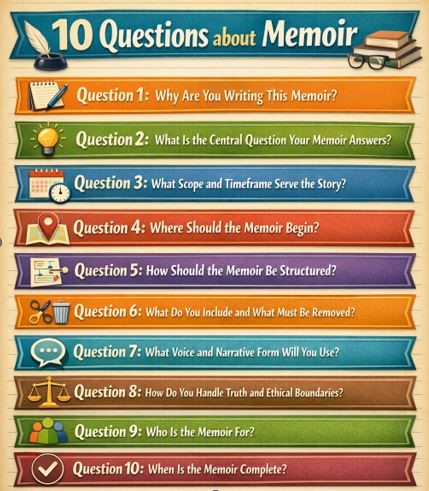
Question 1: Why Are You Writing This Memoir?
Most answers start out sounding fine. I want to tell my story. I want to make sense of my past. I want to remember things properly.
But if you sit with it for a bit longer, you usually find something more specific underneath. Something that doesn’t sound as simple.
There’s often a moment or a thread that keeps showing up no matter how much you try to move past it. That’s usually closer to the real reason that memoir exists.
If that part stays vague, the writing tends to float.
Question 2: What Is the Central Question Your Memoir Answers?
This is where things start to settle or fall apart.
You need one question. Not a theme or a bunch of ideas. Just one clear thread the whole book is working through.
It doesn’t need to sound elegant. In fact, if it sounds too polished, it’s probably not honest enough yet.
Everything else in the memoir either supports that question or distracts from it. There isn’t much middle ground.
| Aspect | Memoir | Autobiography |
| Core focus | A specific life segment | Entire life span |
| Structural driver | Central question or theme | Chronological sequence |
| Narrative selection | Highly selective | Broad and inclusive |
| Purpose | Meaning construction | Life record |
| Reader experience | Interpretive and reflective | Informational and linear |
Question 3: How Much of Your Life Should a Memoir Cover?
This is where people usually overreach.
People usually think more material means more depth. Actually, it doesn’t work that way. What you get instead is dilution.
A tighter scope forces you to stay close to the actual pressure of the story. It keeps you from drifting into everything that happened before or after what actually matters.
Question 4: Where Does a Memoir Start And Where Does It Not?
Not at the beginning. Memoir is not an autobiography.
That’s usually the first mistake.
The starting point is rarely where life started to make sense. It has to start where something changed. Where the story becomes active instead of explanatory.
There’s almost always a scene in a memoir timeline that feels slightly too sharp or too revealing to open with. That hesitation is worth paying attention to.
If it feels like you’re exposing too much too soon, you’re probably close.
Question 5: What Is the Best Structure for a Memoir?
Don’t start with structure. Start with writing scenes that feel important or memorable.
At the beginning, memoir writing is usually a collection of moments rather than an organized narrative. You might write something from childhood, then jump to a recent event, then back again. That’s normal at this stage.
Structure comes later when you have enough material to see what actually belongs together. You start noticing which events connect naturally and which ones feel out of place or repetitive.
At that point, you shape the memoir around those connections. The structure is based on what the material is already doing, not something decided at the beginning.
Question 6: What to Include in a Memoir and What to Cut?
This is where things get a bit uncomfortable.
Because now you have to start saying no to things that feel important.
Case Study
A writer working on a family memoir opened with three chapters of background material explaining relationships and history in detail. The writing was clear, but it functioned as setup rather than progression and did not serve the book’s central question, which focused on a later rupture.
In revision, our editors removed those opening chapters entirely and a later scene was moved to the beginning. It entered without full context, with names appearing before explanation. That initial disorientation was kept.
The structure tightened as a result. Context was reintroduced only where the narrative required it, not in advance of it.
Writers Of The West (client case, March 2024)
Some parts of your story matter deeply to you, but they don’t actually carry the central question forward. Keeping them in just because they feel meaningful takes the narrative’s focus away from the main question.
This is usually the point where memoir editing services become useful. Not because they understand your life better, but because they’re not emotionally attached to what you’ve written.
They can see what the structure can’t hold.
Question 7: What Voice and tone Should You Use When Writing a Memoir?
Pick the voice based on what the scene needs to do.
If the goal is to make the reader feel the moment as it happened, use an immediate voice.
Example:
“I open the door. He’s already inside. I don’t remember inviting him.”
This works when tension or uncertainty is the point. You stay inside the moment. No explanation.
If the goal is to explain what the moment meant, step back.
Example:
“I didn’t understand it then, but that was the first time he crossed a boundary I would keep excusing for years.”
Same event, different job. This version gives interpretation, not just experience.
Most drafts mix these without control. You’ll see a scene written in detail, then suddenly interrupted by long explanations. That weakens both.
A better pattern is simple.
Stay inside the scene while it’s happening. Step out after it ends.
For narration, decide who is in control. The past version of you, or the present one.
If the past self is leading, the writing shows confusion, limited awareness, incomplete understanding. That works for scenes where the reader should discover things gradually.
If the present self is leading, the writing is clearer and more direct. That works when you need to connect events or explain decisions.
Example shift:
Inside the moment:
“I thought I was helping. I didn’t question it.”
Looking back:
“I was trying to fix something that wasn’t mine to fix.”
Neither is better on its own. It depends on what the section needs to do.
From an editorial standpoint, the rule is basic.
If a scene feels flat, it’s probably too distant.
If a section feels heavy or repetitive, it’s probably over-explained.
Adjust the voice accordingly.
Question 8: How Do You Handle Truth and Ethical Boundaries?
Start with this rule: you are responsible for accuracy, not certainty.
If you remember a conversation clearly, write it as you remember it. If you don’t remember exact wording, don’t invent dialogue to make it sound clean. Paraphrase instead, or signal uncertainty in the narration.
Example:
“I don’t remember his exact words, but the message was clear. He wanted out.”
That is acceptable. Fabricated precision is not.
When it comes to other people, focus on actions and impact, not speculation about intent.
Better:
“He left the room and didn’t come back that night.”
Worse:
“He left because he wanted to punish me.”
The first stays observable. The second assumes motive you cannot verify.
If a detail could realistically harm someone’s privacy or reputation, change identifying information unless there is a strong narrative reason not to. That includes names, locations, and specific roles when they are not essential to the story.
You are not writing a public record of everyone involved. You are writing your experience of events.
A common boundary issue in early drafts is overconfidence in memory. Writers often present scenes with exact detail because it feels more authoritative. But precision does not equal truth in memoir. It has to be supported by what you actually know.
A safer and more honest pattern is to separate what you saw, what you felt, and what you are interpreting.
Example:
“I saw him leave the house. I felt relieved. I assumed it meant the argument was over.”
That structure keeps the writing grounded without overstating certainty.
Ethically, the line is simple:
Do not create facts you cannot stand behind. Do not assign intent you cannot verify. Do not present memory as certainty when it isn’t.
Question 9: Who Is the Audience for Your Memoir?
At the beginning, it’s mainly for you. That’s normal. You’re still figuring out what happened and what it means, so the writing stays close to your own memory.
But if the draft stays there too long, it starts to assume too much. You know what “that day” means, or why a small detail matters, but the reader doesn’t.
For example, writing “I didn’t go back after that day” works for you because you already know the context. For a reader, it needs at least a little grounding so they understand what changed, even if you don’t explain everything.
At some point, you start adjusting for that. Not by over-explaining, but by adding just enough clarity so someone outside your memory can follow the thread.
That shift usually improves the writing. It forces you to be clearer about what actually matters in each section.
This is also where external feedback, like manuscript critique services, can help. Not to change the content, but to point out where something makes sense to you but doesn’t carry across to someone reading it fresh.
Question 10: How Do You Know When a Memoir Is Finished?
A memoir is complete when the reader understands the main idea without needing more scenes to explain it.
If you keep adding material and it is no longer changing how the story reads, you are just repeating the same point in different situations.
For example, if the memoir is about rebuilding trust after a family rupture, and the reader already understands how that rupture shaped your choices, another similar story from a different year doesn’t add much. It only restates the same pattern.
At that point, the work is finished even if there are still memories left to include. Completion is based on clarity, not on how much is left in your memory.
Answering Questions About Memoir Through Practice
Why Repetition Strengthens Clarity in Memoir Writing
You don’t answer these ten questions once and move on. That’s not how you do this. You return to them as the draft evolves. What you thought was certain early on changes under the entire narrative most of the time. That’s not a failure. It’s refinement. Each revision through the material tightens the focus and removes what no longer fits.
How Adjustment Improves Memoir Writing
There’s a point where you realize your original framing was slightly off. Not completely wrong, just not precise enough. Now that… can be frustrating. It means you have to rewrite sections you thought were finished. Still, that adjustment is where the work improves. If you avoid it, your story will feel like wandering.
How Craft Emerges Over Time in Memoir Writing
Strong memoir writing is built through revision, not initial drafts. You have to begin with instinct, then test how it looks in writing, then reshape it. The process is long and slow. But necessary if you want solid story telling.
Common Mistakes When Answering Questions About Memoir
Why Treating Memoir as an Autobiography Is a Mistake
Now I know you want to include everything in your memoir. Because for you completeness equals depth. It doesn’t. What it does, however, is create dilution. The story loses direction because nothing is prioritized. Your memoir needs selection, not accumulation.
Why Avoiding Difficult Material Weakens a Memoir
There’s always a section you hesitate to write. You want to soften it, delay it, or skip it entirely. Just thinking about writing it makes your skin crawl. But guess what happens if you skip it? The reader can feel that absence even if they don’t know what’s missing. Your memoir’s narrative weakens when the most difficult moments are avoided.
Why Leaving Structure Unresolved Weakens a Memoir
Some drafts remain unfinished because the writer never really answers questions about memoir. They float around ideas instead of resolving them. The result? A text that feels unfinished, even if the word count suggests otherwise.
FAQs: Questions About Memoir Writers Often Ask
What makes a memoir different from an autobiography?
A memoir focuses on a specific part of life and builds meaning around it. An autobiography tries to cover everything from start to finish.
Do I need perfect memory to write a memoir?
No. Memory is inconsistent. What matters more is coherence and honesty in how you present what you remember.
How do I decide what to leave out in my Memoir?
If something doesn’t support the central question, it doesn’t belong in the final draft.
Can I write without knowing the structure first in my memoir?
Yes. Structure often becomes visible only after material has been written.
Is it okay to change names or details in my memoir?
Yes, especially for privacy. But the emotional truth should stay intact.
How long should a memoir be?
There’s no fixed length. The scope of the story determines the length, not the other way around.
Conclusion
At some point, the writing stops feeling like exploration and starts feeling like decision-making.
You look at a scene and realize it doesn’t belong just because it happened. It belongs only if it serves the question you’re actually trying to answer.
And once you see that clearly, you can’t really unsee it.
There was a draft once where I kept a paragraph far longer than I should have. I knew it didn’t fit, but I kept convincing myself it added depth. It didn’t.
Eventually I cut it, and the strange part was how quiet the page became afterward. Not emptier. Just more certain.
That kind of quiet is usually where the real story starts to show up.
If you need help writing and editing your memoir, please get in touch by the chat widget below or fil out the form and our specialist will get in touch.
About the Author
Editorial Consultant & Professor of Medicine, Writers of the West
Dr. Issac McKinney is a Professor at the School of Medicine at the University of Houston and has worked with Writers of the West as a freelance editorial consultant for over four years. His background in academic writing and medical research informs his editorial approach, which emphasizes clarity, logical flow, doctrinal precision, and actionable structure. He works across biography, self-help, Christian nonfiction, and health manuscripts, bringing analytical rigor and professional publishing standards to every project.
writersofthewest.net · Professional Ghostwriting Services, Book Editing & Publishing Guidance