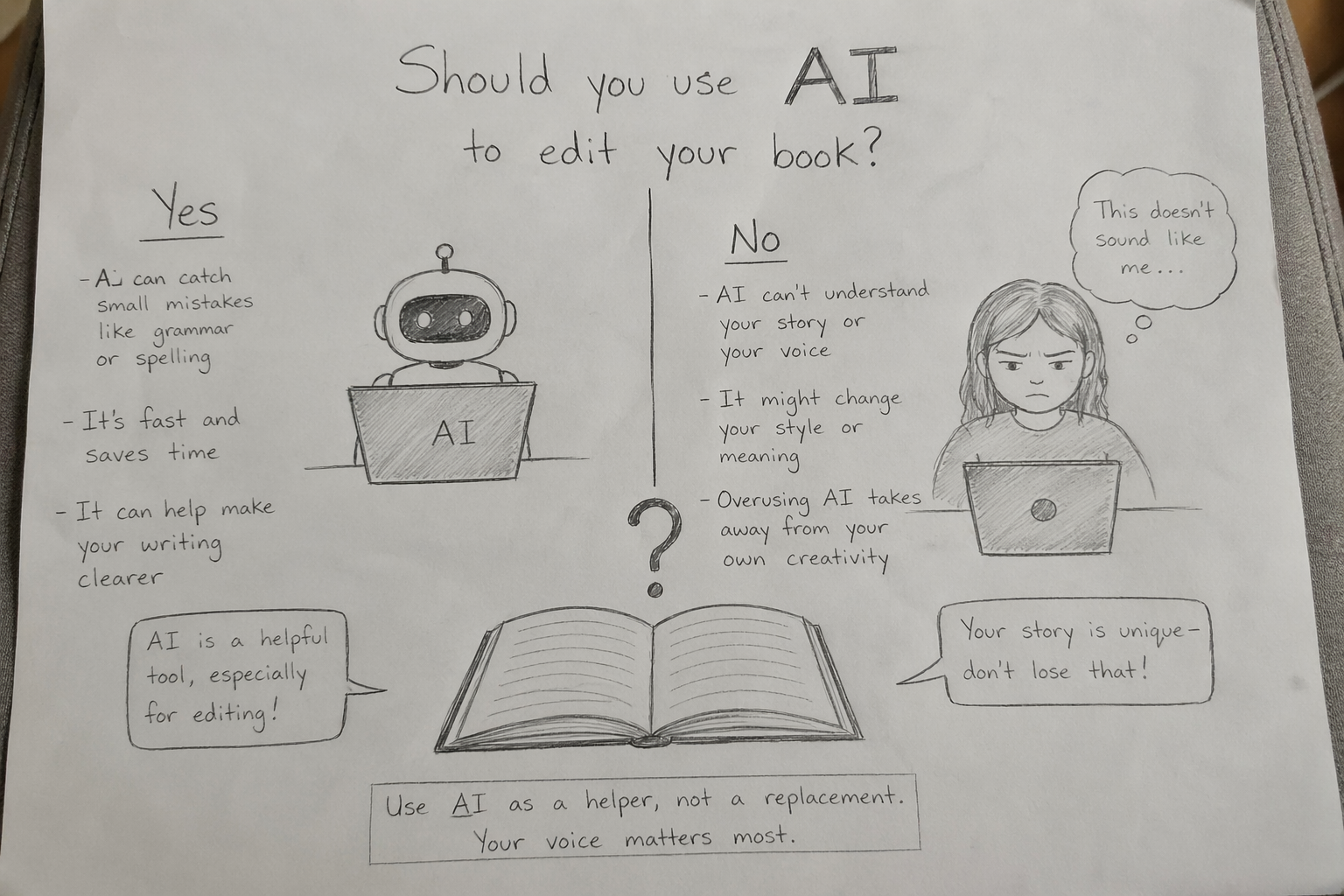
Should I Use AI to Edit My Book? What Every Author Needs to Know Before They Try
So you finished your manuscript. Maybe it took you six months, maybe it took you six years. Either way, you typed the last sentence, leaned back, and felt that rare, beautiful feeling of being done.
Then someone, probably a well-meaning friend or a Reddit thread on should I use AI to edit my book, told you to run it through an AI editing tool before doing anything else.
You went down that rabbit hole and came out more confused than when you started because half the comments said yes and the other half said it destroyed their manuscript. Sounds reasonable. Sounds free. Sounds like the kind of thing a smart author would do.
But here is the thing nobody tells you upfront: using AI to edit your book is a bit like handing your car to someone who has read every car manual ever written but has never actually driven one.
Technically informed.
Practically dangerous.
We have been editing, ghostwriting, and publishing books at Writers of the West since 2004. We have seen manuscripts in every possible condition walk through our door. And over the last couple of years, a new category has emerged: the AI-edited manuscript. We can spot one in about thirty seconds. Not because AI is always terrible, but because it leaves very specific fingerprints, and most of them are not good.
This is not an article telling you AI is evil and you should avoid it entirely. It is an honest breakdown of what AI editing tools actually do, where they genuinely help, where they quietly damage your work, and what we have personally watched happen to real manuscripts when authors leaned on them too hard. Including some stories that will make you feel significantly better about your own editing choices.
Let’s get into it.
Understanding the Different Types of Book Editing – Which Editing Can AI Do?
Before we can talk about whether AI can edit your book, we need to clear up a common misconception that trips up almost every author we work with. “Editing” is not one single thing. It is actually four very different jobs, and each one operates at a completely different level of your manuscript.
Developmental editing is the big picture stuff. Does your story actually work? Are your characters doing anything interesting? Does the pacing drag for forty pages in the middle where nothing happens? Is the emotional payoff of your ending earned, or does it land like a wet sock? A developmental editor reads your entire manuscript and gives you feedback on whether the book functions as a book.
Structural editing looks at how your chapters and scenes are organized. Is information revealed in the right order? Are your chapter breaks in sensible places? Does the opening chapter actually make someone want to read chapter two?
Copy editing works at the sentence and paragraph level. Clarity, flow, consistency, word choice, grammar, whether you have used the word “suddenly” forty-seven times. Copy editors are also responsible for catching things like a character whose eye color changes from brown in chapter three to green in chapter nine.
Proofreading is the final pass. Typos, punctuation, formatting, the occasional homophone disaster where “their” became “there” and somehow survived everything else.
Here is why this matters: AI tools perform at completely different levels of reliability across these four types of editing. Treating them as interchangeable is how authors get into serious trouble, because what AI does reasonably well at one level it can actively wreck at another. Keep this framework in your head for the rest of this article and things will make a lot more sense.
Here is the full picture in one place:
| Editing Type | What It Involves | What AI Actually Does | AI Reliability | Verdict |
| Proofreading | Typos, spelling, punctuation, formatting errors | Catches most surface errors accurately and quickly | High | Safe to use as a first pass. Review suggestions before accepting. |
| Copy Editing | Sentence clarity, word choice, consistency, grammar, flow, author voice | Fixes grammar and flags repetition but frequently flattens voice and accepts no responsibility for what it changes | Medium to Low | Use cautiously. Never accept suggestions blindly of copyediting from AI. Bad for memoir or ghostwritten work. |
| Structural Editing | Chapter and scene organization, information sequencing, narrative architecture | Can flag obvious repetition across chapters but has no reliable sense of narrative flow or why structure exists | Low | Not recommended to use ai for line editing. AI has no understanding of why a structural choice was made. |
| Developmental Editing | Plot logic, character arcs, pacing, emotional payoff, whether the book works as a whole | Produces generic feedback, sometimes contradicts itself across sessions, occasionally invents content that is not in the manuscript | Very Low | Do not use AI for developmental editing. A human developmental editor is the only option that works. |
What Types of Books Can AI Practically Edit?
Alright, let’s be fair. We are not here to bash AI for the sport of it. There are things AI editing tools genuinely do well, and pretending otherwise would be a disservice to you.
At the proofreading level, AI is legitimately useful. Tools like Grammarly and ProWritingAid catch typos, flag grammatical errors, catch punctuation problems, identify passive voice, notice when you have used the same word four times in one paragraph, and highlight sentences that have grown so long they have become a different zip code.
These are real, practical functions. They work. For surface level cleanup before submitting a manuscript to a professional editor, running a proofreading pass with one of these free or low-cost AI tools can actually save you money because your editor will spend less time on mechanical errors and more time on the deeper work that actually transforms your book.
If you are specifically looking for the best AI book editor free to use for that surface pass, Grammarly and ProWritingAid are the most widely used options and both have solid free tiers. For a more fiction-focused AI novel editor experience, AutoCrit and ProWritingAid both offer genre-specific feedback at the copy level. All of them are useful for proofreading. None of them are substitutes for a professional editor at any deeper level, which the rest of this article will make very clear.
AI tools are also decent at flagging certain consistency issues. Tense shifts, sudden changes in point of view, the kind of structural repetition that happens when you write chapter four in January and chapter eighteen in October and forgot you already covered that ground. They are fast, they do not get tired, and they do not charge by the hour.
So yes. For a proofreading pass, with caveats we will get to in a moment, AI tools earn their place. The problem is that most authors do not stop at proofreading. They push further. And that is where things start going sideways.
Where Using AI to Edit Your Book Can Seriously Backfire
This is the section we actually wrote this article for. Because what follows is not theoretical. These are patterns we see regularly. Real manuscripts, real problems, real authors who came to us after the damage was already done.
How AI Book Editing Inflates Your Word Count and Fills Your Manuscript With Repetition
There is a particular kind of chaos that AI creates when it rewrites at the copy editing level, and it is one of the least discussed problems in the AI conversation. AI does not tighten prose. It rephrases it. Those are two very different things.
When a human copy editor looks at a clunky sentence, they ask: what is this sentence trying to do, and what is the most efficient way to do it? Sometimes the answer is a shorter sentence. Sometimes it is a completely different sentence. Occasionally it is deleting the sentence entirely because it is not doing anything useful. When AI looks at a clunky sentence, it looks for a grammatically cleaner version of the same sentence. It is not asking whether the sentence should exist. It is asking how to make the existing sentence look better. And when you have a whole manuscript full of sentences AI has “improved” this way, the book gets longer. Not better. Longer.
We had a client come to us with a manuscript that had started life at around 50,000 words. A solid, tight nonfiction book. By the time it reached us it had ballooned to over 85,000 words. The author had run it through AI tools multiple times and accepted most of the suggestions. What had happened was genuinely impressive in a horrifying way: the AI had rephrased ideas from slightly different angles across multiple chapters, introduced redundant transitions, added explanatory sentences to things that did not need explaining, and generally padded the manuscript in ways that each looked reasonable in isolation but were collectively a disaster.
Here is the part that made the job harder than it needed to be: the author refused to go back to the original. They had convinced themselves that what the AI produced was better, because individual sentences did look cleaner and more polished. They were not wrong about that in isolation. But a manuscript is not a collection of individual sentences. It is a living, connected thing, and the AI had no awareness of that. It had improved the trees while burning down the forest.
Untangling that manuscript took our editors significantly longer than editing the original would have. That is time the author paid for twice, once in wasted weeks chasing AI suggestions and again in the editorial work required to undo the damage.
Why AI Editing Kills Author Voice and How Professional Copy Editors See It
This one is more subtle than the word count problem, which makes it more dangerous.
Your voice as a writer is not just the words you choose. It is your rhythms, your sentence patterns, the specific way your humor lands, the slightly unusual construction that makes a line of yours sound unmistakably like you and nobody else. A great copy editor preserves all of that while cleaning up the things that genuinely need cleaning. They know the difference between a mistake and a choice.
AI does not know that difference. AI sees a fragment and flags it. AI sees an unconventional comma usage and suggests a correction. AI sees a sentence that starts with “And” and quietly freaks out. If you are a writer who uses fragments intentionally for rhythm, who punctuates for effect rather than rule, who has developed a style that breaks a few conventions on purpose, AI editing will systematically sand all of that away.
Professional editors who receive AI-edited manuscripts have started talking about this openly. The manuscripts arrive looking technically clean, grammatically pristine, and completely empty. There is nobody home. The voice has been averaged out into generic Standard English and the author, who accepted the suggestions without fully understanding what they were agreeing to, cannot tell you why any of the changes were made.
Case Study
We had a ghostwriting client whose book had been beautifully captured by our writer over several months of interviews and drafting. The author had a distinctive conversational style, some deliberate grammatical informality, a tendency toward long winding sentences that somehow always arrived somewhere worth going. After we delivered the manuscript they ran it through an AI editing tool before final publication. They came back to us puzzled because the book “sounded different.”
It sounded different because the AI had corrected the informality. It had tightened the winding sentences into something efficient and sensible and completely unlike the way the author actually spoke and thought. The ghostwriter had spent months learning to sound like this person. The AI undid that work in an afternoon.
Why AI Cannot Fix Emotional Depth in Your Book No Matter How You Prompt It
This might be the most important thing in this entire article, so we are going to say it plainly: if your book lacks emotional depth, AI cannot give it emotional depth. Not through editing. Not through any amount of reprompting. Not at all.
Here is why. AI generates language by predicting what words are most statistically likely to follow other words, based on a vast training set of existing text. That means AI converges on what is most commonly written rather than what is most powerfully written. It produces the average version of emotion. The shape of grief without the substance of it. The outline of joy without the specific true detail that makes a reader’s chest tighten in recognition.
We worked with an author on a memoir that had genuine, powerful material at its core. Real experiences, real stakes, real emotional truth buried in the writing. But the author had spent weeks before coming to us running chapters through AI tools with prompts like “make this more emotional” and “this section needs more feeling” and “can you add depth here.” The AI had obliged every time. It had added emotional language. Quite a lot of it. Phrases about the weight of grief, the rawness of vulnerability, the journey of healing.
Every single bit of it rang false.
Not because the events were not emotional. They were deeply emotional. But because AI emotional language is borrowed from a thousand other books about grief and healing, and it sits on top of a personal story like a costume rather than skin. The author’s actual voice, the specific unrepeatable way they described things, was underneath all of it, muffled and fighting to get out.
When our editors worked with this author to strip the AI-added material and return to the original voice, the book came alive. But it cost the author weeks of circular AI-chasing and additional editing time to get there.
The lesson here is important: prompting AI to fix an emotional problem in your manuscript is like asking someone to describe a color they have never seen. They will give you a description. It will sound plausible. It will be completely wrong.
The AI Feedback Loop: What Happens When You Keep Asking AI to Edit Until It Is Happy
Buckle up, because this case study is something else.
Case Study
We had an author contact us after what they described as “three months of editing.” We assumed this meant three months of intensive self-editing, which is not unusual. It was not that.
They had spent three months running their manuscript through AI editing tools in a loop. Here is how it went.
They ran it through the first AI tool. It gave them a list of problems and suggestions. They worked through every single one, accepted every suggestion, addressed every flag. They ran it again. The tool found more problems. They fixed those too. Eventually the tool ran out of significant suggestions and they felt ready to move on.
They ran it through a second AI tool to double check. That tool found significant problems. Some of them were errors the first tool had introduced. Some of them contradicted suggestions the first tool had made. They fixed those. Ran it again. More problems. Fixed them.
They tried a third tool. That tool told them the manuscript needed a lot of work and generated a fresh list of suggestions. The author, by this point, had spent three months chasing AI approval and had completely lost track of what the original manuscript sounded like, what they actually thought was good, and whether any of these tools had any idea what they were talking about.
Here is the thing about AI editing tools that nobody explains clearly enough: they do not agree with each other. They are trained on different data, optimized for different outcomes, and they have no shared understanding of what a good book actually is. They each have opinions. Those opinions conflict. And none of them have any memory of what your manuscript looked like before you started, which means none of them can tell you whether you are moving forward or backward.
When we finally received this manuscript it had been processed to within an inch of its life. The original voice was almost entirely gone. The structure had been rearranged in ways that did not make narrative sense because different tools had suggested different things and the author had tried to satisfy all of them. The book was technically clean and editorially broken.
There is no AI tool that will tell you your manuscript is finished. That is not how they are designed. They are designed to find things to suggest. If you keep running a manuscript through them looking for the moment when a machine tells you it is good enough, that moment will never come. What you will get instead is a document that has been endlessly processed and is now nothing like the book you originally wrote.
How AI Editing Undoes Everything a Professional Ghostwriter Built
This is a specific problem that does not get talked about enough and it is something we see regularly because we do a lot of ghostwriting work.
When a ghostwriter works with an author, the entire job is learning to disappear. The writer conducts interviews, studies how the author speaks, absorbs their vocabulary and rhythm and the specific way they move from one thought to another. A great ghostwriter produces a manuscript that sounds completely and unmistakably like the author, not the writer. That process takes months and requires a level of human attunement that cannot be automated.
When an author receives that manuscript and runs it through an AI editing tool before publication, they often undo that work entirely without realizing it. The AI does not know that the voice it is correcting was deliberately constructed. It does not know that the informality was intentional. It does not know that the long sentences were a feature, not a bug. It just sees deviations from standard usage and suggests corrections.
If you have paid for professional ghostwriting services, run the delivered manuscript through AI editing tools and accepted the suggestions, you have essentially paid a ghostwriter to capture your voice and then paid AI to remove it. We have seen this happen. It is painful every time.
The right approach if you want a second pass on a ghostwritten manuscript is to bring it back to a human editor who understands that their job is to refine the voice that exists, not replace it with something grammatically tidier.
What Happens to Your Book’s Structure When AI Tries Developmental Editing
So far we have mostly been talking about AI at the copy editing and proofreading levels. Let’s talk about what happens when people try to use AI for developmental editing, because this is where the wheels come off most spectacularly.
Developmental editing requires holding the entire book in mind at once. It requires understanding what the author was trying to achieve, how well the execution serves that intention, and how to give feedback that helps the author get there without making the book someone else’s vision. It requires genuine understanding of narrative, of character psychology, of how emotion builds across two hundred pages. It requires being human.
A lot of tools market themselves as an AI novel editor capable of structural and developmental work. Some of them are genuinely impressive at identifying surface-level pacing signals or flagging chapters where word count drops dramatically. But marketing and capability are not the same thing, and what these tools flag is not the same as understanding why something is not working or knowing how to fix it.
AI developmental feedback tends to be heavy on style observations and almost completely useless on substance. It will tell you your pacing is slow in chapter two without being able to tell you why or how to fix it. It will note that a character feels underdeveloped without being able to identify what specifically is missing or how the character’s arc needs to shift. It will sometimes invent observations entirely.
In one documented experiment by a professional editor, ChatGPT provided developmental feedback on a novel and hallucinated a character who did not exist in the book. It also suggested a plot development that had not happened, and when asked for more specific feedback, gave entirely different pacing notes on the same manuscript than it had provided two days earlier with the same prompt.
That is not editing. That is improvisation.
If your book has deep structural problems, a developmental editor is what you need. Not because we are trying to sell you something, but because structural problems genuinely require a human who can read your whole book, understand what you were going for, and have a real conversation with you about how to get there. An AI tool running a manuscript through a pattern recognition algorithm is not a substitute for that, no matter how convincingly it phrases its suggestions.
The Over-Acceptance Problem: Why Saying Yes to Every AI Suggestion Breaks Your Manuscript
We saved this one for last because it connects everything above and it is the root cause of most of the damage we see.
When you run your manuscript through an AI editing tool, the interface does something psychologically interesting: it highlights problems. Every flagged sentence, every suggested change, every colored underline creates a visual representation of everything that is supposedly wrong with your writing. If you have been working on a book for a long time and you are deep in the insecurity that most authors feel at the end of a draft, that interface can feel devastating. And it can create a powerful urge to just fix everything. To accept everything. To make all the flags go away.
The problem is that not every AI suggestion is correct. Not even close. AI tools flag intentional stylistic choices as errors. They suggest changes that technically improve a sentence while destroying its rhythm. They catch real problems but also create false alarms, and an author who does not have the editorial confidence to distinguish between the two will accept things they should not accept.
The other part of this is tunnel vision. When you are working through a list of AI suggestions, you are looking at the manuscript as a series of isolated flags rather than as a connected whole. You stop reading for flow, for buildup, for the cumulative effect of how one paragraph lands after another. You start managing a repair list. And when you are done, your manuscript might have fewer red underlines, but it will almost certainly read worse as a complete piece of writing.
The over-acceptance problem is not the author’s fault. It is a natural response to a tool that is designed to make problems visible. But awareness of it is your best defense against it.
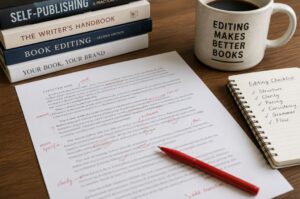
Twenty years of editing books has taught us one thing above everything else: a great book needs a great human editor. If your manuscript is ready for that, our professional book editing services are designed for exactly where you are right now. Whether you need a clean proofreading pass, thorough copy editing, or a full developmental edit that looks at your book from the ground up, we have the right editor for your project. See what our book editing services include and get a free quote today.
A Note on Amazon KDP and AI Content Disclosure
Since a lot of authors asking this question are thinking about self-publishing on Amazon, this is worth covering clearly.
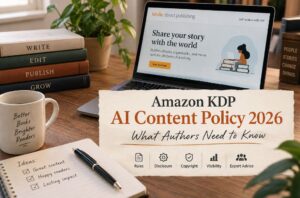
Amazon KDP requires you to disclose if your book contains AI-generated content, including text, images, or translations. This has been mandatory since late 2023 and enforcement has tightened considerably in 2025 and 2026. The key distinction is between AI-assisted, meaning you wrote the book and used AI tools for things like grammar checking or brainstorming, which does not require disclosure, and AI-generated, meaning the AI produced the actual text even if you edited it afterward, which does require disclosure.
Currently there is no confirmed direct algorithmic ranking penalty for disclosing AI-generated content. However, with over 30% of new titles on KDP now carrying AI disclosure, the reader trust question is a real and growing concern. In a crowded market where readers are increasingly aware of and skeptical about AI content, being perceived as an AI-generated book carries reputational weight that compounds over time.
The practical takeaway: if you used AI to edit rather than write your book, and if you reviewed and made deliberate choices about every suggestion rather than accepting them blindly, you are in AI-assisted territory and disclosure is not required. If AI generated substantial portions of your text, disclose it and make sure whatever you submit genuinely meets Amazon’s quality standards, because enforcement is active.
The Data Privacy Risk That Nobody Is Talking About
Here is something that almost never comes up in conversations about AI book editing, and it should.
When you upload your manuscript to an AI editing tool, you are uploading your intellectual property to a platform whose data terms you probably have not read. Depending on the platform and their terms of service, your original work could potentially be used to contribute to training future AI models.
For most fiction authors this is an uncomfortable thought. For authors writing memoirs with sensitive personal material, books containing proprietary professional knowledge, or any work with significant commercial value, it is a serious concern. Your manuscript contains original ideas, original expression, and in the case of memoir, potentially deeply private information about real people and real events.
Before you upload a full manuscript to any AI platform, read their terms of service around data usage and training. It takes ten minutes and it could save you a problem that cannot be undone.
So Is It Okay to Use AI to Edit Your Book? The Honest Answer
Here is the framework we would give to any author asking this question.
Yes, with caution: Use a free AI proofreading tool for a surface pass before professional editing. It will catch real errors, save your editor time, and cost you nothing. But read every suggestion yourself before accepting it. Do not accept anything that changes how you actually sound.
Proceed carefully: For copy editing, AI tools can be useful but only if you maintain editorial authority over every suggestion. If you find yourself accepting changes because they look right rather than because you understand why they are better, stop. You are in over-acceptance territory.
No: Do not use AI for developmental or structural editing. It cannot do this job reliably and the risk of confusion, contradictory feedback, and structural damage to your manuscript is high.
Definitely not: Do not use AI editing tools on a memoir, personal narrative, or any ghostwritten manuscript where the author’s specific voice is the entire point of the book. AI will correct that voice into something generic and you will lose what made the book worth reading in the first place.
Read the terms: Do not upload a full manuscript to any AI platform without understanding what they do with your data.
What Our Editors See When a Manuscript Has Been Over-Edited by AI
We will leave you with this, because it is the most honest thing we can say.
When a manuscript comes to us after heavy AI editing, we can feel it almost immediately. The prose is often technically clean. The grammar is correct. The sentences are properly formed. And it is completely, deeply lifeless. There is no one speaking. There is no particular human being on the other side of the words. The book has been optimized to the point where all the interesting irregularities, all the specific personality, all the choices that made it somebody’s book rather than any book, have been smoothed away.
The authors who send us these manuscripts are often frustrated and confused. They have done a lot of work. They have followed a lot of suggestions. The manuscript looks better by certain measurable standards. But something is wrong and they can feel it, they just cannot name it.
What is wrong is that the book stopped being theirs somewhere in the process.
We have been doing this for over twenty years and we have worked with authors at every stage, from first draft to final polish. The books we are proudest of are the ones that sound completely and unmistakably like the person who wrote them. Editing should make a book more itself, not less. A professional human editor knows the difference between a mistake and a choice. They know when to correct and when to leave well alone. They understand that their job is to serve the author’s vision, not replace it with something that passes a grammar check.
That is not something AI can do. Not yet. Possibly not ever.
If you are serious about your book, bring it to people who are serious about books. We would love to be those people.
Frequently Asked Questions
Should I use AI to edit my book? For a proofreading pass before professional editing, AI tools can be useful and cost effective. For copy editing, use them cautiously and review every suggestion yourself. For developmental or structural editing, no. AI cannot reliably perform deep editorial work and the risk of damaging your manuscript is real.
Is it okay to use AI to edit your writing? It depends on what kind of editing you mean. AI tools handle surface errors reasonably well. They handle voice, emotion, structure, and developmental feedback poorly. Review every suggestion critically rather than accepting changes wholesale.
What is the best free AI book editor? Grammarly and ProWritingAid are the most widely used free AI proofreading and copy editing tools. Both have free tiers that work well for surface cleanup. Neither is a substitute for professional editing at the developmental or structural level.
Can AI do developmental editing on a novel? Not reliably. AI developmental feedback tends to be generic, occasionally contradictory, and sometimes factually wrong about the content of the manuscript. For genuine developmental editing, a human editor who can read your entire book and have a real conversation with you about it is the only option that works.
Does Amazon KDP penalize AI generated books? There is no confirmed direct algorithmic ranking penalty for AI disclosure on KDP. However Amazon requires disclosure if your content is AI-generated rather than AI-assisted, and enforcement has increased significantly. Reader perception of AI-generated books is also an emerging concern in a crowded self-publishing market.
What do professional editors think about AI-edited manuscripts? Most professional editors report receiving manuscripts that are grammatically clean but lack voice, personality, and emotional presence after heavy AI editing. The over-acceptance problem, where authors say yes to every suggestion without understanding why, is increasingly common and creates manuscripts that are technically processed but editorially broken.
About the Author
Senior Editor, Writers of the West
Francis Vincent is a best-selling American author and senior editor at Writers of the West. He holds both a B.A. and M.A. in English Literature, with graduate work at the University of Colorado Boulder. His editorial specialization spans productivity, habits, line editing, and dialogue refinement. He focuses on clarity, flow, and practical structure — helping authors translate ideas into polished, publishing-ready manuscripts while preserving their voice and intent.
writersofthewest.net · Professional Ghostwriting Services, Book Editing & Publishing Guidance