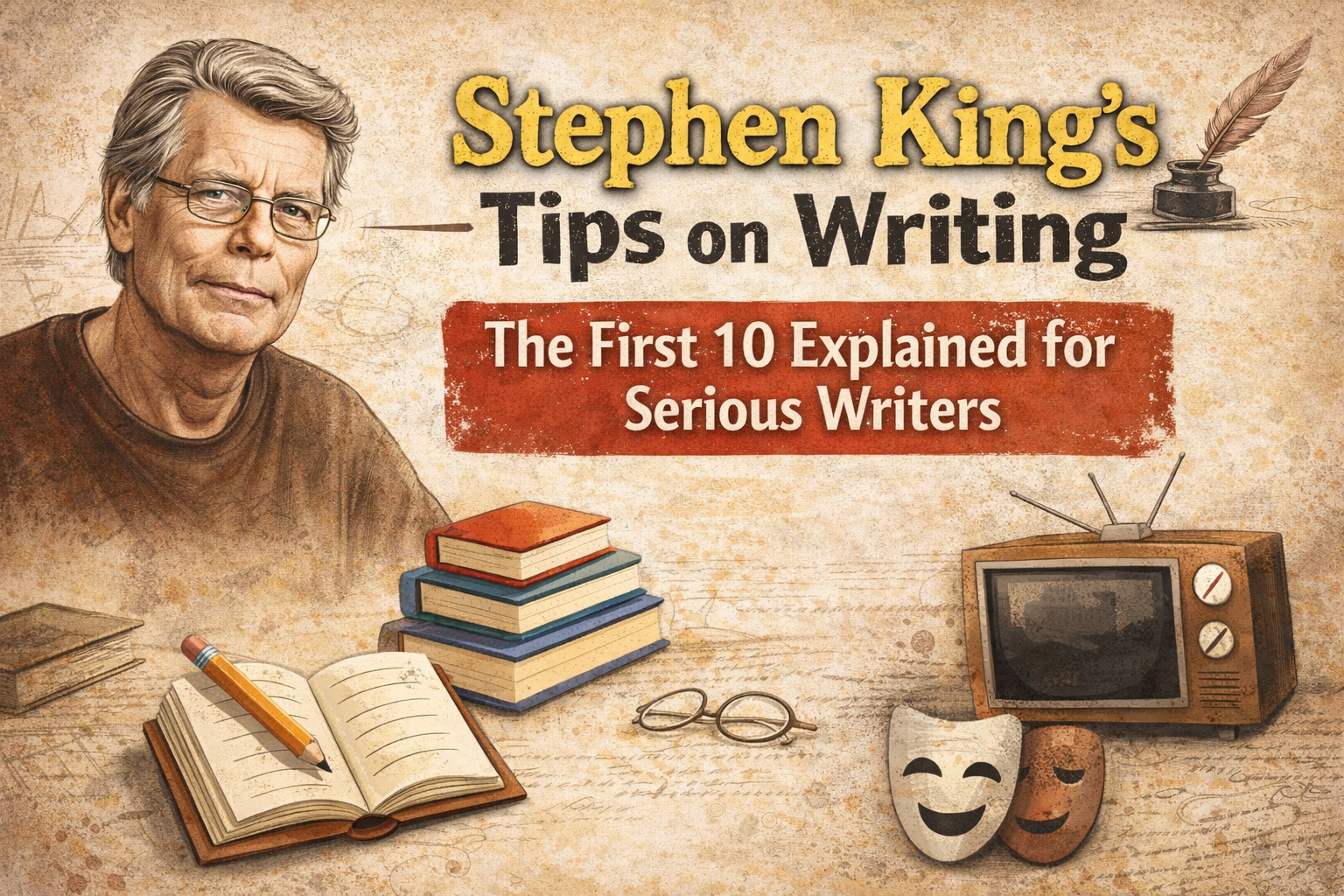
Stephen King’s tips on writing have helped more serious writers fix their drafts than almost any other set of principles in modern fiction. Published in his famous book On Writing, these ideas do not arrive as theory. They arrive as pressure. Each one targets a specific habit that weakens sentences before the writer even notices it happening. This article breaks down the first ten, what they actually do inside a real draft, where they hold up, where they have limits, and why some of them only click after you have already made the mistake they were designed to prevent.
Why Stephen King’s tips on writing work in practice
Most writing advice arrives too late. After the draft. After the structure has already settled into something harder to change.
These writing tips operate earlier than that. They sit inside the act of writing itself, shaping sentences before they fully form. That is why they feel strict. They are not describing outcomes. They are interrupting habits.
They act at the moment a sentence is still forming
There is a short window where a sentence is still flexible. Most writers miss it. They complete the line first, then judge it as a finished object. By then, fixing it takes more effort than preventing it.
King’s rules work inside that window. You notice the weak verb as it appears. You catch the passive structure before it settles. You remove unnecessary words before they attach to rhythm.
Small interventions, early timing. That is the mechanism.
They prevent accumulation rather than fix damage
Weak writing is rarely one problem. It is repetition. A few extra words here, a softened verb there, dialogue that explains instead of carrying meaning.
Individually, nothing major. Together, it slows everything down.
These rules interrupt that buildup. Instead of repairing a messy draft later, you avoid creating it in the first place. That is why experienced editors often see less structural damage in drafts shaped this way.
They force decisions at sentence level
Many drafts fail because sentences avoid deciding what they are doing.
Is this line moving the story or describing it? Is this dialogue carrying weight or just sounding natural. Is this word precise or just familiar.
King’s approach forces those decisions immediately. You cannot rely on phrasing to hide uncertainty. Every sentence has to justify itself in plain terms.
That pressure is uncomfortable, but it is effective.
A real editing case from manuscript cleanup work
Case Study
A historical fiction manuscript came to us at Writers Of The West with clean grammar but slow pacing. Scenes repeatedly started with description, then action, then dialogue.
One confrontation scene in a coastal village made it clear. The tension was buried under weather and setting detail.
We rewrote only that chapter in passes, not all at once.
First pass: removed explanatory phrasing around actions.
Second pass: stripped dialogue tags where tone was already clear.
Third pass: tightened verbs so movement stopped needing support words.
Nothing was added. Only pressure was redistributed.
The client’s reaction was not about language. It was about speed. They said the scene finally “arrived on time.” That was the exact phrase.
That is what these rules do in practice. They change timing more than wording.
They train attention, not obedience
These tips are not rules to follow mechanically. They are signals.
They show where writing starts leaning on explanation instead of precision. Where sentences avoid clarity. Where structure is being delayed.
Even when you break them, you do it consciously. That is the shift.
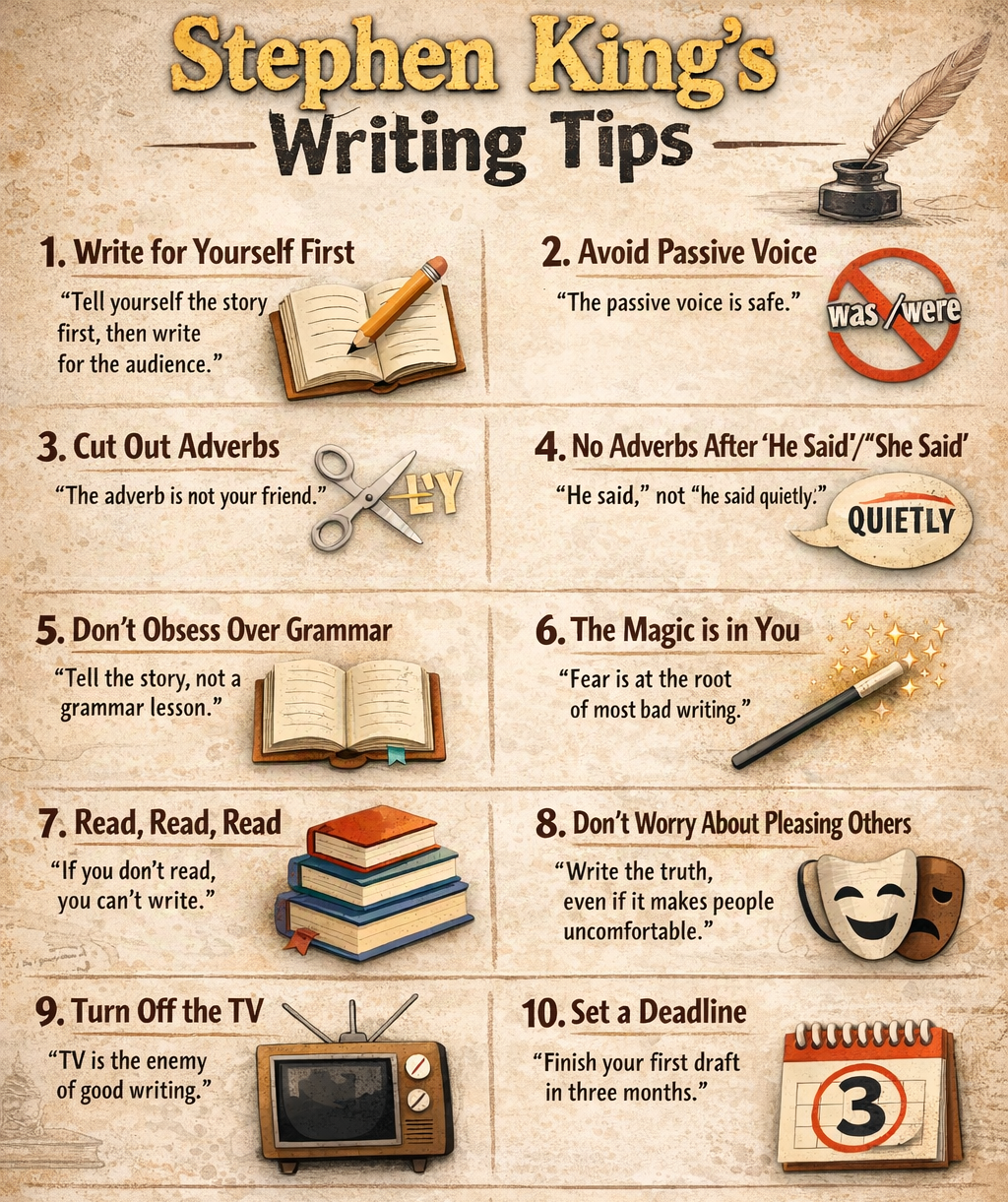
1. First write for yourself, and then worry about the audience
“When you write a story, you’re telling yourself the story. When you rewrite, your main job is taking out all the things that are not the story.”
This works cleanly at the beginning. Writing without an audience removes hesitation. The draft moves faster.
But it creates a second problem. You start keeping what interests you, not what serves the story.
You can see what disciplined revision looks like in The Great Gatsby, especially in the closing lines: “So we beat on, boats against the current, borne back ceaselessly into the past.” There is nothing extra there. No explanatory padding. The sentence carries theme, movement, and tone in one motion.
That kind of compression does not come from writing for yourself alone. It comes from cutting everything that does not survive a second reading. King put it plainly in On Writing: “When you rewrite, your main job is taking out all the things that are not the story.” That is where the first draft ends and the real work begins.
At that stage, some writers begin to see how wide the gap is between drafting and shaping. That is often where professional ghostwriting services enter, not as a replacement for writing, but as a way to bring structure to what already exists.
2. Don’t use passive voice
“Timid writers like passive verbs for the same reason that timid lovers like passive partners. The passive voice is safe.”
This is directionally true, but too absolute.
Passive voice weakens a sentence when it hides responsibility. But it can also be used deliberately. In Hamlet, the line “I am slain” removes the attacker from focus. The emphasis falls entirely on the state of being, not the action that caused it. That shift creates finality.
The problem is not the passive voice itself. It is unconscious use. When it becomes default, the writing starts to drift without you noticing. King’s point in On Writing was not that passive voice is always wrong. It was that writers reach for it out of habit, and habit is the problem.
3. Avoid adverbs
“The adverb is not your friend.”
This one holds more often than it fails.
Adverbs tend to appear where the verb is not doing enough work. Replace the verb and the sentence tightens.
Look at The Old Man and the Sea. In a line such as “He rowed steadily and it was no effort for him since he kept well within his speed,” the movement is carried by the verb “rowed,” supported by structure, not padded with multiple modifiers. The sentence does not need “smoothly” or “carefully” to explain itself.
That is the standard this rule is pushing toward. Not elimination, but precision. King wrote that the adverb is a sign the writer does not trust the verb, and in most cases, that distrust is earned.
4. Avoid adverbs, especially after “he said” and “she said”
This is where the rule becomes precise.
Dialogue that depends on adverbs usually signals something missing in the line itself. If a character has to speak “angrily” every time, the anger is not present in the words.
In Pride and Prejudice, consider Darcy’s line: “She is tolerable, but not handsome enough to tempt me.” There is no adverb attached to “he said.” The tone carries through the phrasing itself. The dismissal is clear without any added explanation.
That is what effective dialogue does. It removes the need for reinforcement. King was specific about this in On Writing: he called adverbs after dialogue tags “a Pauline Kael of the writing world,” meaning they signal a kind of critical over-management that undermines the line’s own honesty.
5. But don’t obsess over perfect grammar
“The object of fiction isn’t grammatical correctness but to make the reader welcome and then tell a story.”
This is one of the stronger points in the list.
Perfect grammar does not guarantee effective writing. You can have a technically flawless paragraph that goes nowhere.
At the same time, ignoring grammar entirely creates friction. The reader may not name the issue, but they feel it when a sentence stops behaving predictably.
This is often where writers reach a limit with self-editing. Not because they cannot write, but because they cannot see their own patterns clearly anymore. King’s reminder that “the object of fiction isn’t grammatical correctness but to make the reader welcome” matters most here. A reader who feels welcome will forgive a lot. A reader who feels lectured by perfect sentences will not stay long. That is where fiction editing services tend to become relevant, not as correction alone, but as distance.
6. The magic is in you
“I’m convinced that fear is at the root of most bad writing.”
Fear does appear. It shows up as hesitation, avoidance, or overworking sentences that should have been left alone.
But it is not the only cause. Some weak writing comes from certainty that is not earned.
This idea works best as a warning, not as a full explanation. King was talking about the kind of fear that produces safe sentences, vague intentions, and endings that apologize for themselves. That specific fear is real, and it shows up more often than most writers admit.
7. Read, read, read
“If you don’t have time to read, you don’t have the time (or the tools) to write.”
Reading builds internal structure when attention is present.
In Beloved, the opening line, “124 was spiteful. Full of a baby’s venom,” shows how much can be done with very little. The house is given character immediately, without explanation. The sentence is short, but it carries weight.
That kind of control comes from familiarity with how sentences behave, not from rules alone. King’s point was that reading is not research or preparation. It is the actual training. The writer who does not read is working without the one tool that cannot be taught any other way.
8. Don’t worry about making other people happy
“If you intend to write as truthfully as you can, your days as a member of polite society are numbered, anyway.”
There is truth here, but also risk.
Writing honestly does not mean ignoring clarity. If the reader cannot follow the sentence, the point does not land, no matter how honest it feels.
The balance is not between truth and audience. It is between truth and structure. King wrote that writing truthfully means your days in polite society are numbered anyway, which is a pointed way of saying that writing designed to please everyone tends to interest no one. The real standard is clarity, not comfort.
9. Turn off the TV
“TV, while working out or anywhere else, really is about the last thing an aspiring writer needs.”
The object has changed. The pattern has not.
Anything that fragments attention weakens continuity. Sentences begin to break apart. Thought loses momentum. Sustained focus is part of the work, not something separate from it. King’s advice was about television specifically, but the mechanism he described applies to anything that pulls attention away before a thought has time to finish forming.
10. You have three months
“The first draft of a book, even a long one, should take no more than three months, the length of a season.”
This depends on how you work.
A fixed timeline can create momentum. It can also force decisions too early.
The useful part is the pressure to finish before the draft loses shape. King described the three-month window as the length of a season, which is a useful frame. Long enough to develop something real, short enough that the original energy has not expired. At a certain scale, especially with longer narratives, that pressure becomes difficult to maintain alone. That is often where fiction ghostwriting services for novels come into the process, not as substitution, but as continuation.
FAQs
Do Stephen King’s tips on writing work for nonfiction too?
Yes. The same problems show up: unclear sentences, weak verbs, and over-explaining. In nonfiction, writing tips for writers often matter even more because clarity is tied directly to reader trust, not just style.
Why is passive voice such a focus in Stephen King’s writing advice?
Because it hides responsibility in a sentence. It becomes easy to slip into without noticing. Used too often, it slows narrative movement and weakens clarity, which is why most writing tips target it early.
Are adverbs always a problem in drafts?
No. They are only an issue when they replace better verb choices. When that happens repeatedly, the writing loses precision. Many tips for authors focus on spotting this pattern during revision.
What does writing for yourself first actually change?
It reduces early self-editing. The draft moves faster because you are not performing for a reader while writing. This separation is one of the most practical writing tips for writers in early drafting.
How do these habits suggested by Stephen King affect editing later?
They reduce structural fixes. Editing shifts from repairing unclear sentences to improving rhythm and flow. That is where Stephen King on writing becomes practical rather than theoretical.
Why do writers still struggle after learning these rules?
Because knowing the rule is not the same as noticing it in real time. These principles only work when attention is trained on how the sentence is forming, not just what it says.
Conclusion
These tips are not rules sitting on a page waiting to be followed. They behave more like pressure inside the draft. You feel them when something starts to go slightly off, even if you cannot explain it yet.
Some of them hold up most of the time. Passive voice tends to dull action when it becomes automatic. Adverbs often show up when the verb has already failed and is asking for help. Even grammar, when overprotected, can choke the life out of a sentence that only needed to move.
But none of this stays fixed in stone. Writing does not work like that. It bends depending on what the scene needs, what the voice is doing, what the moment is trying to carry. The point is not obedience. It is awareness. Once you see the pattern, you cannot really unsee it.
That is the real value behind Stephen King’s tips on writing. Not a set of instructions, but a way of noticing what the draft is doing while it is still becoming itself. And once that kind of noticing sets in, it starts arriving earlier than the sentence you were planning to write next.
About the Author
Editor & Illustrator, Writers of the West
Trin Lucas is an American writer, editor, and illustrator who has worked with Writers of the West for over five years. She holds a BFA in Illustration from the Rhode Island School of Design and specializes in children’s books, visual storytelling, and structured nonfiction. Her editorial work focuses on rhythm between text and imagery, narrative clarity, and layout coherence — helping authors align storytelling with illustration for a cohesive reading experience.
writersofthewest.net · Professional Ghostwriting Services, Book Editing & Publishing Guidance