
Introduction
You already know the book matters. That’s not the debate. The real question is if you keep struggling with it yourself or just hire a ghostwriter and move on with your life.
Here’s the part people don’t understand. A ghostwriter doesn’t steal your voice or take credit for your idea. That’s not how it works. You bring the ideas, the stories, the perspective. They take that raw material and shape it into something that actually makes sense from start to finish. Same voice, just… clearer. Less rambling. Fewer incomplete thoughts sitting in Chapter Three.
Because if we’re being honest, most books don’t fail because the idea is weak. They fail because the process takes too long. You start strong, maybe even a little overconfident, and then somewhere in the middle you slow down. Life gets in the way. The draft gets messy. You tell yourself you’ll “fix it later.” Later doesn’t show up.
So this isn’t really about talent. It’s about completion. It’s about if you want to spend the next year reading the same chapters or if you want to hold a finished manuscript. That’s the lens this blog uses as it explains five practical reasons people end up choosing to hire a ghostwriter. You will understand how a professional can save you time, and help you actually finish your book. By the end, you will have a clear sense to decide whether hiring a ghostwriter is the right move for your project.
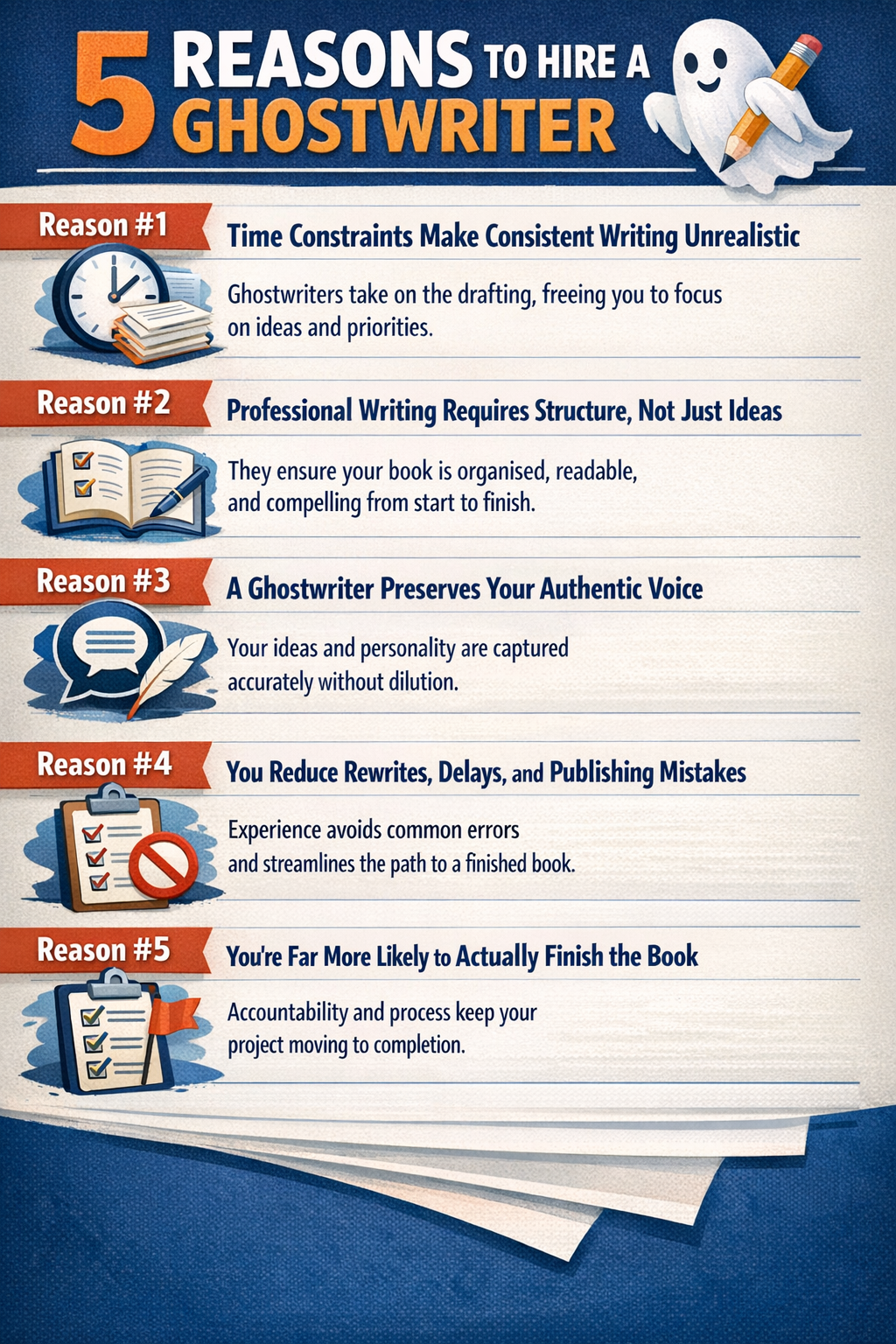
Reason 1: Time Constraints Make Consistent Writing Unrealistic
Writing a book needs attention every single day. Most busy professionals cannot manage that. I worked with a client who was a tech executive. She was full of brilliant ideas but with no spare hours. All she could manage was weekends, evenings, or an hour here and there. Months passed, and she was only able to finish a few chapters.
How a Ghostwriter Keeps Projects Moving
Bringing in a full-service ghostwriting firm like Writers Of The West transformed the process. She provided the main concepts and the ghostwriter guaranteed consistent progress. The manuscript was completed in under six months.
Consistency Protects Your Momentum
Books have a way of stalling when life gets busy. I learned it the hard way early in my career. I have spent many years on long drafts and rewriting the same chapters. That’s also how I kept missing publishing windows. Ghostwriters can help with that. They keep your project moving, and they always make sure it still sounds like you.
Reason 2: Professional Writing Requires Structure, Not Just Ideas
Once the time problem was under control, our tech executive had another problem. She had all these brilliant ideas in the form of notes, emails, and sticky notes, but turning them into a good book was another story. Great ideas are not the only thing needed to make a book. If you don’t have a proper outline, chapters will jump around, stories will keep repeating themselves, and the main points will be lost.
Organising Ideas for Impact
The ghostwriter came in and brought some order. She grouped the topics, made the chapters flow naturally, and arranged each section so that it built toward a bigger message. Her complicated ideas suddenly made sense without feeling overwhelming.
Ensuring Narrative Consistency
The voice, tone, and pace stayed true to the client’s style as the ghostwriter kept the writing moving. She made sure that nothing felt out of place and nothing got forgotten. The book came together as one clear story very quickly and efficiently.
Why Structure Matters for Any Author
Finishing a book takes a long time. Not because the ideas are bad but because there is no plan. Random chapters, weak arguments, and uneven pacing can make readers lose interest very easily. A professional makes sure your book sounds smooth and keeps people reading. That is what makes the process of writing your story something you can actually finish and feel proud of.
Reason 3: A Ghostwriter Captures Your Voice Without Diluting It
Okay so the manuscript was coming along but now our tech executive was worried about something that most clients that hire a ghost writer for the first time are concerned about. She was wondering if the book would sound like her at all with someone else writing it now.
Translating Thought Patterns Into Voice
The ghostwriter did not force a new style. She listened to how our client explained things and paid attention to her tone. She also studied her phrasing through calls, notes, and feedback. The goal was not to rewrite her thinking but to polish the way she already expressed it. That’s why the result was a book that sounded like her, just clearer and more focused.
Maintaining Authenticity at Scale
As more and more chapters were written, keeping the voice consistent became even more important. Every section needed to sound like it came from the same person even while covering different topics. This is what prevents the uneven tone that often appears when authors work alone.
Why Voice Preservation Matters
Many people assume ghostwriting would make their book sound different from how they would have written it. In reality, an experienced ghostwriter makes your voice stronger and keeps it the same across the whole book.
How professional ghostwriters maintain your voice throughout the book:
- Initial interviews capture phrasing, style, and tone.
- Continuous feedback makes sure that the entire book sounds like it’s coming from the same person.
Reason 4: You Reduce Rewrites, Delays, and Publishing Errors
So, the manuscript was starting to take shape, and our tech executive finally looked at the drafts with a sharper eye. And you know what she noticed? Okay, not just that the writing was solid, but that the usual headaches were mostly gone. No missing sections. No repeated stories. No entire chapters that needed to be redone. Everything just… flowed. The ghostwriter had already caught the problems before they even had a chance to appear. Smooth process, all the way.
Avoiding Common Writing Pitfalls
Here’s the thing: when you go it alone, rewrites sneak up on you. You realize too late that a section repeats, a chapter drifts, or the structure just doesn’t hold. Ghostwriters catch these early, so you don’t spend weeks or months fixing things that could have been avoided. And the biggest perk? This makes using book editing services for authors way less painful because the big structural and narrative hiccups are already gone. No surprise messes. No last-minute chaos.
Efficiency Comparison: Self-Written vs Ghostwritten Drafts
| Aspect | Self-Written Draft | Ghostwritten Draft |
| Structural consistency | Often uneven, requires multiple revisions | Built correctly from start, minimal corrections |
| Narrative flow | Arguments repeat or get lost | Cohesive, chapter-to-chapter logic ensured |
| Revisions needed | 3–5 full rewrites typical | Usually 0–1 major rewrite |
| Timeline impact | Can extend project by months | Keeps project on schedule |
| Editing dependency | High reliance on external editing | Reduced; editing focuses on polishing rather than fixing |
Reason 5: You’re Far More Likely to Actually Finish the Book
Okay, so here’s what really separates people who “want to write a book” from people who actually have one. It’s not talent. It’s not even the idea. It’s finishing. That’s the part most people actually struggle with. They start strong, get a few chapters in, and then things slow down. Life steps in, the draft gets pushed aside, and suddenly months have passed.
In this case, things played out differently. All the scattered notes, incomplete ideas, all of it started coming together into something real. A complete manuscript! Which, honestly, already puts you ahead of most first-time authors.
Accountability Drives Completion
Writing on your own sounds flexible until it becomes optional. And once it’s optional, it slips. Meetings take over. Work piles up. The draft quietly moves to the bottom of the list. What changed here was simple. There was a system. Someone expecting progress. A steady pace that didn’t depend on mood or free time. That kind of structure keeps things moving, even on days when you would rather not look at the document at all.
From Ongoing Draft to Finished Manuscript
A lot of writers stay stuck in this strange loop where they are always improving the same chapters. It feels productive, but it never ends.
Ghostwriting avoids that trap. It is built with an end in mind from the start. It has clear steps, clear milestones, and a clear point where the book is done. That is where hiring a ghostwriter to write your book starts to make actual sense. It turns something open-ended into something you can actually complete.
Why Completion Is the Real Advantage
Here’s the simple truth. An unfinished book does nothing. It doesn’t build credibility, it doesn’t reach readers, it doesn’t create opportunities. It just sits there.
A finished book, on the other hand, that’s where things start to happen. That’s what people read, share, talk about. So in the end, this isn’t really about writing. It’s about finishing.
Writing Yourself vs Hiring a Ghostwriter
Even after seeing the benefits of ghostwriting, some authors wonder if they could manage writing the book themselves. To make it easy to understand, here’s a simple comparison of the key differences:
| Aspect | Writing Yourself | Hiring a Ghostwriter |
| Time Investment | High — balancing writing with other commitments is difficult | Low — ghostwriter handles drafting while you focus on ideas |
| Writing Skill Needed | Must manage structure, flow, and readability on your own | Professional craft ensures polished chapters and narrative consistency |
| Voice & Authenticity | Hard to maintain consistently across chapters | Ghostwriter captures your voice without dilution |
| Error & Revision Risk | High — self-written drafts often need multiple rewrites | Reduced — experience avoids common mistakes and delays |
| Completion Likelihood | Moderate — many projects stall mid-way | High — accountability and process keeps momentum |
| Publishing Knowledge | Must research processes independently | Ghostwriter can advise on publishing strategy and downstream steps |
Why This Comparison Matters
A ghostwriter doesn’t just crank out words. They guide you through the important steps after the draft. That includes formatting, covers, distribution, all that stuff that makes first-time authors panic. Instead of guessing or wasting weeks on trial and error, they connect the authors straight to professional self publishing services. The book actually reaches readers, and you avoid most of the usual chaos.
When You Should NOT Hire a Ghostwriter
Okay, so hiring a ghostwriter is not always the answer. Sometimes the fun of writing a book is in the trial-and-error part. If you like discovering your voice as you go, or playing with ideas, or just making awful first drafts for the thrill of it, go ahead! I’m all for it! Especially if your budget is tight. Because then paying someone for every step could get… complicated.
Creative Exploration vs Efficiency
Some writers live for the process. They don’t just want a finished book. They want to struggle with ideas, rewrite sentences, and experiment with storylines that might flop. Ghostwriters can speed things up, sure, but they also take away some of the hands-on fun. So, if experimenting is part of the joy, outsourcing may rob you of that.
Budget and Scope Considerations
Ghostwriting costs money. A lot of it. If funds are limited, hiring a professional editor or consultant might make more sense. You still get guidance and polish but now you don’t have to give up control or use all your savings. If you understand what you are ready to invest in time, money, and energy upfront, it really helps you make a smarter choice. Having said, that, Writers of the West works with any and all budgets, with flexible payment plans.
Project Type or Niche Matters
Not every book works well with outsourcing. Some highly specialized academic texts, experimental fiction, or personal memoirs with sensitive content usually need you to write them. Some projects are so sensitive that they require you to be fully involved to keep the voice authentic and avoid legal or ethical issues.
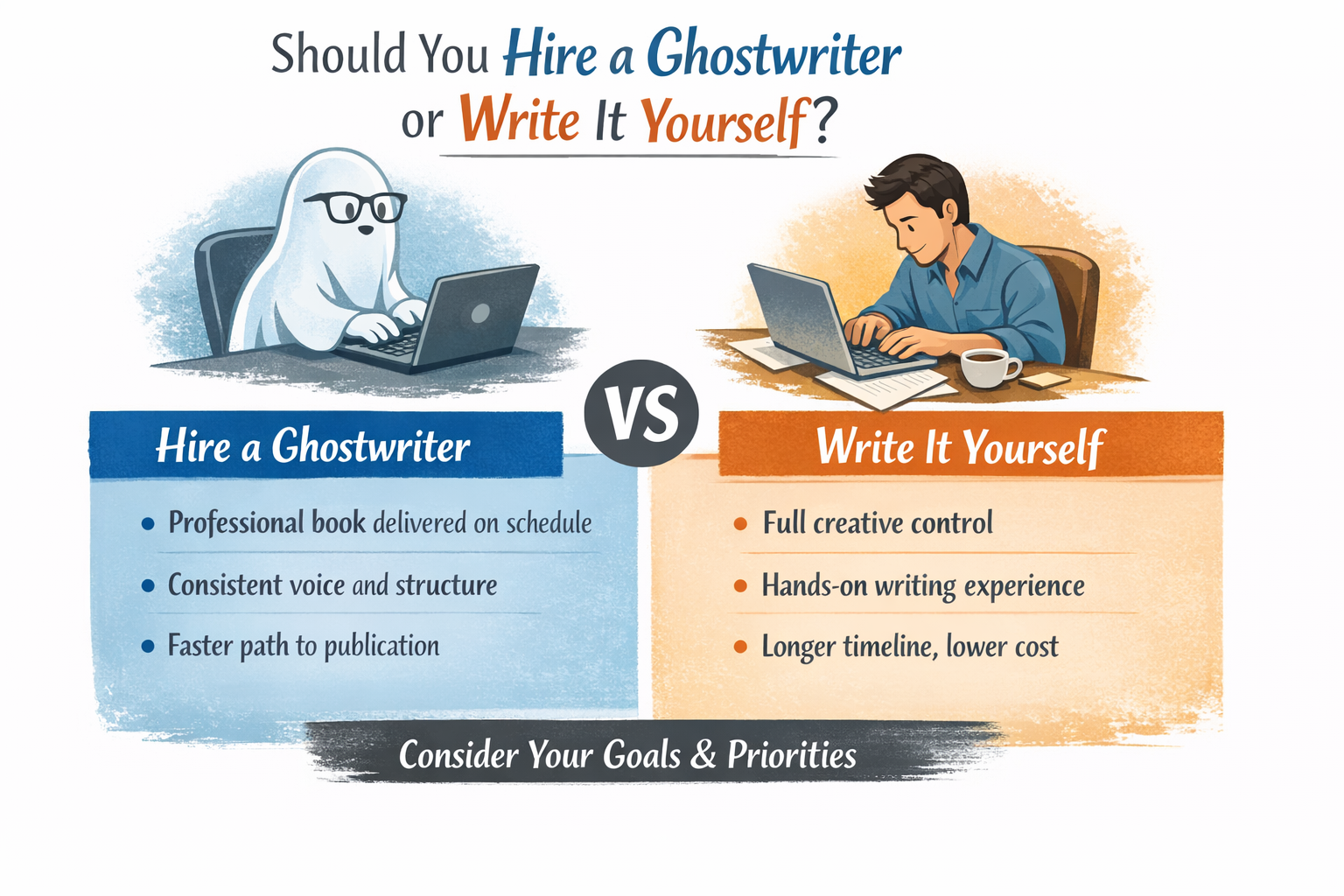
Final Decision: Should You Hire a Ghostwriter or Write It Yourself?
So, after thinking about time, skill, structure, efficiency, and actually finishing the book, the choice really comes down to what matters most to you. Both routes have perks, it just depends on how you want to play the game.
Hire a Ghostwriter if you want:
- A professional, polished book delivered without endless delays
- Your voice captured and consistent across every chapter
- Fewer rewrites and a smoother, faster path to getting published
Write it yourself if you want:
- Full creative control, every word and turn of phrase is yours
- The messy, hands-on process of discovering your own voice
- A longer timeline that costs less upfront but might cost patience
FAQs
Q1: Can I still write the book myself if I hire a ghostwriter?
Yes. You can bring ideas, outlines, or drafts. The ghostwriter tidies, structures, and polishes while keeping your voice intact.
Q2: How long does it take to complete a book with a ghostwriter?
It varies, but professionals keep things moving. Regular deadlines and check-ins prevent the draft from gathering dust.
Q3: Will a ghostwriter understand my unique voice?
They do. Through interviews, notes, and examples, they mirror your tone so the book still feels like you.
Q4: Is hiring a ghostwriter only for celebrities or high-profile authors?
Not at all. Entrepreneurs, thought leaders, and first-time authors hire ghostwriters to save time and finish efficiently.
Q5: How do I know if hiring a ghostwriter is worth it?
If you value speed, structure, and actually finishing, a ghostwriter turns your ideas into a polished book faster and with fewer headaches.
Conclusion
So, here’s the truth. It all comes down to your priorities, time, and goals. A ghostwriter brings structure, keeps things moving, and makes sure your ideas actually turn into a finished manuscript, all while keeping your voice intact.
If finishing the book, avoiding mistakes, and having a polished, ready-to-publish product matter, understanding why hire a ghostwriter is key. This isn’t about taking shortcuts. It’s about making a smart move that gets results.
Look at your schedule, your energy, and what professional support is worth to you. That’s how you decide if the book stays a concept or becomes real.
About the Author
Senior Crime & Thriller Writer, Writers of the West
Thomas Schäffer is a senior crime and thriller ghostwriter at Writers of the West, known for disciplined structure and character-focused storytelling. He brings logical plot progression, grounded character motives, and consistent pacing to mystery and thriller manuscripts. His work emphasizes believable narrative development from opening hook to final resolution, helping authors craft compelling, publication-ready crime fiction.
writersofthewest.net · Professional Ghostwriting Services, Book Editing & Publishing Guidance