Somewhere around the fortieth or fiftieth birthday, a lot of people hit the same wall. Decades of material sitting in their head, none of it organized, and a growing sense that if they don’t get it down soon, most of it disappears with them. That’s usually the moment someone sits down at a laptop, opens a blank document, types “Chapter One,” and then closes the laptop twenty minutes later because nothing comes out right.
The problem almost never comes from having too little to say. It’s the opposite. Sixty or seventy years of experience doesn’t fit neatly into a book, and nobody hands you instructions for deciding what stays, what goes, where a story belongs, or how a lifetime turns into ten or twelve chapters that actually read like a story instead of a timeline.
How to Write an Autobiography Book: The Short Version
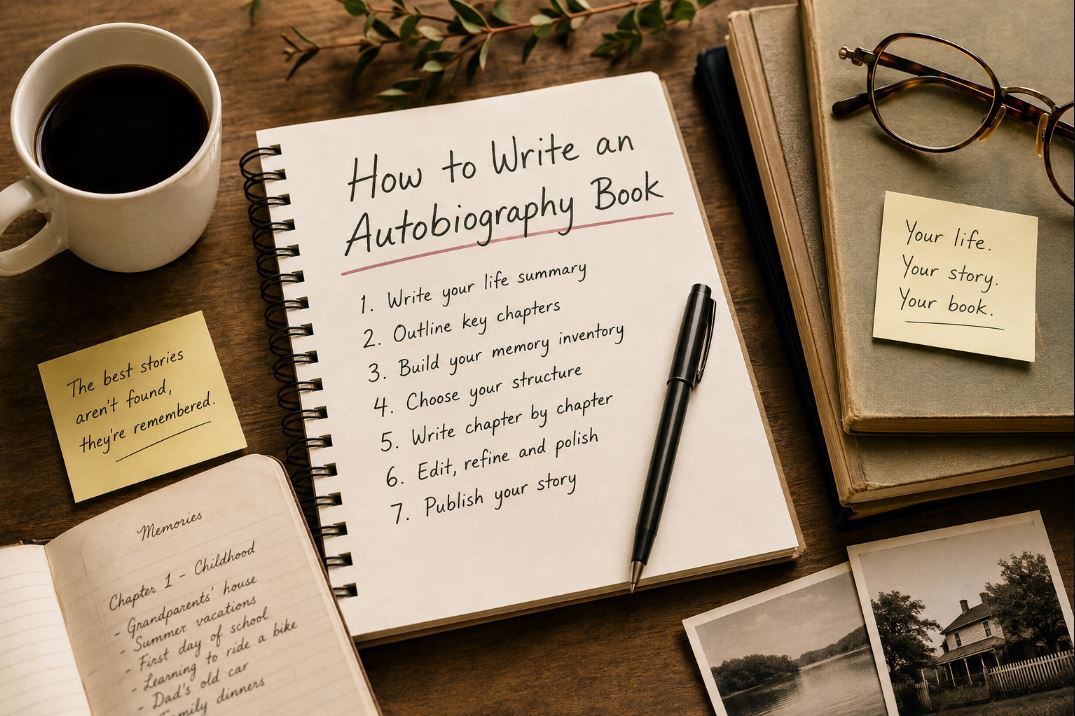
Here’s the direct answer before anything else. How to write an autobiography book, in short: get the full story out of your head in rough form, divide that into loose chapters, fill each chapter with memory fragments as they surface, let the material sit and grow for a week or two, do some light research to verify and enrich it, then choose a structure that fits what you actually have. Only after that do you start writing finished chapters, followed by structural editing, line editing, and eventually formatting and publishing.
At Writers of the West, we’ve worked with more than 2,500 authors across our writing, editing and publishing services. Through that work, we’ve seen many of the problems that can make life-story projects difficult, particularly organizing years or decades of memories into a coherent manuscript. The process below reflects the practical approach we recommend.
What Is an Autobiography?
An autobiography is an account of a person’s own life, usually written in the first person by that person or, in the case of a ghostwritten project, told in their voice and from their perspective. It doesn’t need to cover every event that ever happened to the author. A good one selects the experiences that add up to something a reader can actually follow, and it leaves out the thousands of Tuesdays that didn’t matter.
Autobiography vs Biography vs Memoir
People use these three words interchangeably, which causes more confusion than it should.
| Autobiography | Memoir | Biography | |
|---|---|---|---|
| Who writes or is credited | The subject (often with a ghostwriter) | The subject | Someone other than the subject |
| Whose life it covers | The author’s own life | The author’s own life | Another person’s life |
| Typical scope | A substantial portion of the whole life | A specific period, theme or relationship | Usually the whole life, sometimes a defined era |
| Point of view | First person | First person | Third person, typically |
| Primary purpose | Tell the full arc of a life | Explore one thread deeply | Document and interpret someone else’s life |
The biggest confusion is between autobiography and memoir. An autobiography tends to span most of a life, from childhood through the present. A memoir zooms in. A memoir about surviving a divorce, or building a company, or a single year of war, is still a memoir even if the author lived to be ninety. And an autobiography can absolutely be professionally ghostwritten while still being published, marketed and legally credited as the subject’s own life story. If your project is actually about someone else’s life rather than your own, that’s a biography, and our [Biography Writing Services page] covers that process specifically.
How to Write an Autobiography About Yourself Without Just Listing Events
Here’s the trap almost everyone falls into first: they start listing what happened. Born here, moved there, went to this school, took that job, married this person. It reads like a resume, and a resume isn’t a story.
Your life is the source material. It isn’t automatically the story. A story needs selection, which means leaving out far more than you include. It needs perspective, meaning the reader has to feel the events through you, not just be told they occurred. It needs a theme, some thread that ties chapters together so the book is about something beyond “things that happened to one person.” And it needs change, a sense that the person on the last page understands something the person on page one didn’t yet.
That’s really the whole difference between an autobiography and a timeline with extra adjectives. Two people can live through the exact same event, a divorce, a bankruptcy, a diagnosis, and one account reads as a list while the other reads as a book, and the difference almost never comes down to better sentences. It comes down to whether the writer figured out what the event actually meant to the larger arc before they started describing it.
That’s what the rest of this process is built to help you find. Not just what happened, but what it added up to.
How to Write an Autobiography Book, Step by Step
This is the part most guides get wrong. They tell you to brainstorm, outline, write, edit, publish, and leave you to figure out what any of that actually means at 11pm with a blank screen in front of you. Here’s what we walk authors through instead.
Step 1: Write a Summary of Your Entire Story
Before you touch a chapter outline, write a rough, ugly summary of your whole life. Not beautiful writing. Not even complete sentences half the time. Just get the shape of it down: childhood, family, the important relationships, school, career, the big wins, the losses, the turning points, the moves, the decisions you’d take back, the ones you wouldn’t, how your thinking changed along the way.
Depending on how much life you’ve lived, this might run four pages or forty. Length doesn’t matter here. What matters is that you can’t intelligently divide a story you haven’t seen in full yet, and right now, you haven’t seen it in full. Nobody has, not even you. It’s been sitting in fragments.
Step 2: Divide the Summary Into Rough Chapters
Once the whole-life summary exists, break it into loose periods or events. Something like:
Chapter 1: Childhood and family
Chapter 2: Leaving home
Chapter 3: University and early adulthood
Chapter 4: Starting a career
Chapter 5: Marriage and family
Chapter 6: The crisis
Chapter 7: Starting again
Chapter 8: Building the business
Chapter 9: Success and what it cost
Chapter 10: Looking back
These are working labels, not final chapter titles, and this is the part where we stop most authors from wasting a month. Don’t try to find the perfect book title yet. Don’t agonize over clever chapter names. “Chapter 6” is a perfectly good chapter title in July. You don’t yet know what this book is really about, not in the way you will once it’s written, and the actual title usually shows up on its own somewhere around the third or fourth chapter draft.
Step 3: Build a Memory Inventory Under Every Chapter
Now go back through each rough chapter and drop in bullet points. Not paragraphs. Fragments. Triggers. Under Childhood, something like:
- grandmother’s kitchen
- father’s old car, the one that never started in winter
- first day at school
- the fight with my brother over the bike
- moving house
- summer at the lake
- dad’s money problems, the ones nobody talked about
- Mrs. Alvarez, the teacher who told me I could actually write
- what mom said the morning I left for college
Even the tiny stuff counts. A smell can unlock a whole scene you forgot existed. A photograph, an object, a half-remembered argument, all of it goes in as a fragment. Think through people, places, conversations, arguments, celebrations, embarrassments, sounds, letters, emails, old journals, news events from that year, family stories you’ve heard secondhand, moments you were scared, moments you were proud, decisions, regrets, and things you believed then that you don’t believe anymore.
Step 4: Let the Outline Sit for a Week or Two
Don’t rush to call the outline finished. This step gets skipped constantly, and it’s one of the more valuable ones. Once you’ve got a rough chapter structure with memory bullets underneath, let it sit for a week, sometimes two. Memory doesn’t work on command. It works when you’re driving, or doing dishes, or half asleep.
You’ll suddenly remember an old friend you hadn’t thought about in decades. Something a parent said once, offhand, that you’ve carried for thirty years without noticing. An event you’d forgotten completely resurfaces out of nowhere. You realize two things happened in the opposite order from how you’d remembered them. A story you thought belonged in Chapter 3 actually belongs in Chapter 7.
Whenever that happens, open the document and drop a bullet under the right chapter. That’s it. The outline becomes a living file that keeps growing on its own, and that makes remembering an entire life feel a lot less like standing in front of a mountain and being told to climb it in one sitting.
Step 5: Research Your Own Life
Once the memory inventory has some real weight to it, start verifying and filling gaps. Go through old photographs, journals, letters, emails, text messages, calendars, certificates, records, and if it’s relevant, newspaper archives. Talk to siblings, parents, childhood friends, a spouse, old colleagues, a former business partner. Anyone who was there.
Here’s the part that trips people up: someone else’s memory of the same event will sometimes flatly contradict yours. That’s fine. It’s expected, honestly. An autobiography is a personal account, not a court transcript, but you still want to handle factual claims responsibly. There’s a real difference between writing “this happened” and writing “this is how I remember it happening,” and good autobiographies know which sentence they’re writing at any given moment.
Your Autobiography Planning Checklist
- Write your life summary
- Divide it into rough chapters
- Add memory pointers under each chapter
- Let the outline sit for a week or two
- Add newly remembered stories as they surface
- Review photos, letters and documents
- Speak with people who were there
- Choose your narrative structure
- Rearrange chapters into their final order
- Start Chapter One
Choose the Structure After You Know What Material You Have
Most guides tell you to pick your structure on day one. We do the opposite, and there’s a reason. You can’t intelligently structure material you haven’t discovered yet. Once you’ve got the summary, the rough chapters, the memory inventory, and some research behind you, then you look at everything and decide how the story actually wants to be told.
Chronological. Childhood through the present, in order. Works well when the natural progression of the life is already a strong story on its own.
Thematic. Chapters built around ideas rather than dates: family, ambition, faith, business, loss, identity. Useful when a life doesn’t move in one clean line, or when certain threads matter more than the calendar does.
Start with the defining moment. Open on the most dramatic or pivotal event, even one that happened decades in, then loop back to the beginning. Say the raw chronological outline was Childhood, University, Marriage, Business, Bankruptcy, Recovery, Success. After sitting with all that material, the author realizes the bankruptcy is the actual center of gravity, the event everything else orbits. The book becomes Bankruptcy, Childhood, Early Ambition, University, Building the Business, Warning Signs, Collapse, Family During the Crisis, Recovery, Success, Reflection. Opening there creates tension the strict timeline never had.
Hybrid. Mostly chronological, with a few thematic chapters or a flashback dropped in wherever it strengthens the story rather than interrupts it.
Rearrange the Outline Before Writing the Manuscript
This is the entire point of doing the planning first. Moving Chapter 8 above Chapter 1 takes about four seconds in an outline. Doing the same move after you’ve already written fifty thousand words of manuscript is a much longer weekend, and not a fun one.
While the material still lives in outline form, move chapters around freely. Combine the weak ones. Split anything overloaded. Cut what doesn’t belong. Notice which periods of the life are missing entirely. Ask, chapter by chapter, whether it actually moves the larger story forward or just documents time passing. Once it feels right, lock in a working version. It can still shift later. It probably will.
Start Writing Your Autobiography, Chapter by Chapter
Now you write. By this point Chapter One isn’t a blank page anymore, not really. You already know what it’s about, why it exists, roughly where it sits in the larger arc, which memories belong in it, who shows up, and what actually happens. The bullet points become scenes.
One practical note that saves people a lot of frustration: while you’re deep in Chapter 1, you’ll probably remember something that belongs in Chapter 6. Don’t chase it. Don’t abandon what you’re writing. Open the outline, drop one quick bullet under Chapter 6, and go straight back to Chapter 1. That single habit is the difference between finishing a manuscript and having six half-finished chapters and a folder of scattered notes.
How to Make an Autobiography Interesting
There’s a real difference between documenting what happened and telling a story about it. Compare:
Weak: In 1998, I moved to Chicago. I started a new job. I met several people there.
That’s a record. It’s not a story yet. Here’s what actually closes that gap.
Write important moments as scenes, not summaries. A scene has a place, a time, people in a room, and something happening in real time. “I moved to Chicago” is a fact. Standing in an empty apartment on a February night, radiator ticking, boxes still taped shut, wondering if this was a mistake, is a scene.
Use dialogue selectively. You won’t remember exact wording from twenty years ago, and readers know that. A few well-placed lines, even paraphrased, do more work than a page of exposition. Save dialogue for moments that turned on what was actually said.
Include sensory details that actually matter. Not every scene needs weather and smell. The ones that do are the ones where a specific detail carries emotional weight, the particular meatloaf your mother made on a night nothing else about dinner was normal.
Give scenes conflict or an unanswered question. Something has to be at stake, even if it’s small. Will the interview go well. Will the marriage survive the year. A scene without tension reads like a caption under a photograph.
Alternate scene with summary. Not every month of a life deserves a full scene, and trying to write one for each stretches a manuscript past the point anyone wants to read it. Transitional periods can be covered in a paragraph or two. Save full scenes for the moments that actually changed something.
Include reflection without explaining every emotion. A line or two of what you understood, or didn’t yet understand, goes further than several sentences spelling out exactly how you felt. Trust the scene to do some of that work on its own.
Let the reader know what you didn’t know at the time. This is worth its own section, because it’s one of the most reliable ways to add depth to a life story, and it’s covered in full just below.
Write What You Thought Then, Not Only What You Know Now
This one matters more than people expect. It’s tempting to narrate your past using everything you’ve since learned, which quietly turns you into a narrator who somehow already knew how everything would turn out. Nobody actually lived that way.
Take the fragment “father lost the shop in 1997, mother didn’t tell us how bad the money really was.” Written flat, factually, it reads like a court filing. Written as a scene from the perspective of the person you were at the time, not knowing yet how it would resolve, feeling only that dinner was quieter than usual and nobody would answer a direct question, it becomes something a reader can actually feel. That gap, between what you believed then and what you understand now, is where most of the emotional depth in an autobiography actually lives.
What Should You Leave Out of an Autobiography?
A life contains hundreds of thousands of individual moments. A book holds maybe two hundred pages. Something has to give.
The test we use with authors: does this event help a reader understand the person, the conflict, the theme, or the change that happens over the course of the book? If the honest answer is no, it probably doesn’t belong, even if it mattered enormously to you personally. Importance to you and narrative necessity for the reader aren’t the same thing, and that gap is where a lot of first drafts run three hundred pages too long.
Repetition is the other trap. If you got fired twice under nearly identical circumstances, you probably don’t need both scenes. One representative version, told well, usually does the work of both.
How to Write About Other Real People
Keep this in mind before you get too far into drafting. You’re writing your own story, but other real people appear in it, and that comes with responsibility.
Consider privacy, accuracy, memories that conflict with someone else’s version of events, sensitive family history, and information that could identify someone who didn’t ask to be part of a published book. If your manuscript includes serious allegations, disputed events, or anything with real legal exposure, it’s worth having a professional review it before publication, not after.
How to Start an Autobiography
The first page doesn’t have to start with “I was born on.” That opening line has been used so often it’s practically wallpaper at this point. A few stronger approaches:
Begin with a defining moment. Drop the reader straight into the bankruptcy hearing, the delivery room, the diagnosis, whatever the pivot point of the book actually is.
Begin with a vivid, specific memory. The smell of a grandmother’s kitchen at 6am. The sound a screen door made in a house that no longer exists.
Begin with conflict. A disagreement, an argument, a decision that split a family down the middle.
Begin with an unusual image. Something concrete and slightly strange that the reader can’t quite place yet, and wants to.
Begin with a question the whole book eventually answers. How does a kid who failed algebra twice end up running a company with four hundred employees?
How to Write an Autobiography Outline + Free Template
Here’s a working framework, not a rigid formula:
Opening, a defining moment, image or question. Chapter 1, origins and family. Chapter 2, childhood experiences that shaped the author. Chapter 3, adolescence and early independence. Chapter 4, entering adulthood. Chapter 5, major relationships, career, family. Chapter 6, the major conflict or turning point. Chapter 7, consequences. Chapter 8, change or rebuilding. Chapter 9, where it eventually led. Chapter 10, reflection and what the author understands now.
Here’s a blank chapter template you can copy directly:
Chapter #: Period or theme: Purpose of this chapter: Major events: People involved: Memories and scenes: Documents or photos to check: What changed by the end of this chapter: Memories to investigate later:
How to Write an Autobiography: Example and Sample
Here’s a working autobiography sample that shows the difference a little craft makes. Take the same raw fragment from earlier: father lost the shop, 1997, mother didn’t tell the kids how bad it really was.
Weak factual version: In 1997, my father’s shop went out of business. My mother didn’t tell us how serious our financial situation was. It was a difficult time for our family.
Improved version: The shop closed on a Tuesday, though nobody said so at dinner. Dad came home early that week, which never happened, and sat in the car in the driveway for what felt like a long time before coming inside. Mom made the same meal she always made, meatloaf, like Tuesday was still Tuesday. Nobody mentioned the shop. I was eleven, old enough to notice the quiet but not old enough to understand what it meant, and it would be another four years before I found out how close we’d come to losing the house too.
The improved version works because it’s a scene, not a report. It has a specific day, a specific meal, a child’s limited understanding at the time, and a small gap of information (the house, the four years) that the reader wants resolved. That gap is doing more emotional work than any direct statement of “we were struggling financially” ever could.
How to End an Autobiography
An ending doesn’t need to mean the story is finished, because it usually isn’t. A strong closing chapter can offer reflection, a sense of resolution, a callback to whatever opened the book, and honest recognition of how the narrator has changed since the events described. It can look forward instead of simply wrapping up. What it shouldn’t do is reach for a generic inspirational close that the actual story never earned. If the life described was messy, the ending gets to be a little messy too.
Edit the Autobiography in Stages
“Proofread it” isn’t a plan. Editing happens in layers, and doing them out of order wastes time.
Structural editing first. Does the story actually work? Are the chapters in the right order? Is anything important missing? Is anything repeated that doesn’t need to be?
Scene and narrative revision next. Are the important moments actually brought to life, or just described?
Line editing after that. Clarity, consistency, word choice, rhythm.
Proofreading last. The final pass, once the manuscript is genuinely finished, not before.
Polishing individual sentences before the structure is settled is one of the most common ways authors waste months. Fix the skeleton first.
From Manuscript to Published Autobiography
Writing the manuscript is one stage of a longer process. After the manuscript is finished, the typical path runs through editing, proofreading, interior formatting, cover design, ISBN and metadata where applicable, distribution setup, and finally publication and marketing. None of that needs to feel intimidating on its own, but it’s worth knowing upfront that “finished writing” and “published book” are two different milestones, often separated by additional production time.
Writing It Yourself vs Working With an Autobiography Ghostwriter
Plenty of people can and should write their own autobiography. If you enjoy the process, have the time, can stay disciplined without a deadline hanging over you, and want to be hands-on through every stage, doing it yourself is a completely reasonable choice.
A professional ghostwriter tends to make more sense when someone has a genuinely compelling story but isn’t a writer by trade, when they’re too busy to give the project the months it needs, when decades of memory feel completely unmanageable to organize alone, when they’ve started this project two or three times already and never gotten past Chapter 3, or when they specifically want an experienced team running interviews and pulling the story out of them rather than starting from a blank page themselves. This is where working with autobiography ghostwriters tends to save people the most time.
Professional autobiography and biography work typically covers interviews, information gathering, research, outlining, drafting, revision rounds with the author, editing, and eventually publishing preparation. If that sounds closer to what you need, our autobiography writing services page walks through exactly how that process works from the first call onward.
Frequently Asked Questions
How do you write an autobiography about yourself? Start by writing a rough summary of your whole life, then break it into loose chapters and fill each one with memory fragments as they come back to you. Research to verify details, choose a structure once you know what material you actually have, then write chapter by chapter. Editing and formatting come after the manuscript is complete.
How do I write an autobiography of myself? The process is the same regardless of how the question is phrased, whether you’d call it writing an autobiography of yourself or about yourself. Get the full story down roughly first, organize it into chapters, gather memories under each one, and only decide on a final structure once the material has had time to develop.
How do you write an autobiography for school? School autobiographies are usually much shorter than a full book and should follow whatever length and format your teacher assigned. A simple structure works well: an introduction that establishes who you are, two or three body sections covering key experiences or influences, and a short closing reflection.
How do students write an autobiography? Students generally focus on a handful of formative experiences rather than an entire life. Pick two or three moments that shaped who you are now, connect them with a clear theme, and keep the structure simple: introduction, body, reflection.
How do you write an autobiography for college? This usually means an application essay rather than a full autobiography. Follow the specific prompt and word limit given by the institution, and focus on experiences that speak directly to what the admissions committee is asking about.
How do you write an autobiography for a scholarship? Scholarship autobiographies should focus on relevant experiences, challenges you’ve overcome, achievements, and goals rather than trying to summarize an entire life. Tie everything back to why you’re a strong fit for that specific scholarship.
How do you write an autobiography for a job? This is usually closer to a professional autobiographical statement than a full autobiography. Focus on career-relevant experiences, skills and growth rather than childhood or unrelated personal history, unless the employer specifically asked for more.
How do you write an autobiography essay? An autobiography essay is a condensed version of the same process: pick the experiences that matter most to the assigned theme or prompt, organize them with a clear beginning, middle and end, and keep the scope tight rather than trying to cover an entire lifetime.
How long should an autobiography be? Many full-length autobiographies fall somewhere around 60,000 to 100,000 words, but there is no required length, and it varies by genre and how much of the life is covered. School essays and shorter autobiographical pieces are typically just a few hundred to a couple thousand words, depending on the assignment.
How long does it take to write an autobiography? There’s no single timeline. It depends on the complexity of the life being covered, how much research and how many interviews are involved, how much time the author can dedicate each week, and how many revision rounds the manuscript goes through. Many full manuscripts take several months to a year from the first summary to a finished draft.
How do you write an autobiography introduction? Open with a defining moment, a vivid specific memory, a moment of conflict, an unusual image, or a question the book eventually answers, rather than starting with a birth date. The goal is to pull the reader into a scene immediately instead of opening with background information.
How do you write a conclusion for an autobiography? A strong autobiography conclusion offers reflection and perspective rather than a tidy sense that everything is resolved. It often circles back to whatever opened the book, and shows how the narrator’s understanding has changed since the events described.
Can someone else write my autobiography? Yes. This is called ghostwriting, and it’s common practice for autobiographies. The book is still built entirely from your memories, your voice and your experiences, and you retain final approval over everything before it’s published.
Can you write an autobiography about someone else? Not technically. A first-person account of someone else’s life is a biography rather than an autobiography. If that’s actually what you’re working on, our [Biography Writing Services page] covers that process in detail.
How do you ghostwrite an autobiography? This question usually means one of two things: how to hire someone to ghostwrite your own life story, or how to work as the ghostwriter on someone else’s. If you’re hiring, the process runs through interviews, research, outlining, drafting and revision rounds until the manuscript sounds like the subject’s own voice. If you’re the one doing the writing, the same outline-first method in this guide applies, built from the subject’s memories and interviews rather than your own.
About the Author
Behavioral Science Writer & Analytical Story Editor
Robert Whitehead is an American behavioral science writer and cell biologist with over six years at Writers of the West. He specializes in behavioral analysis, logical storytelling, and research-driven manuscripts.
writersofthewest.net · Professional Ghostwriting Services, Book Editing & Publishing Guidance