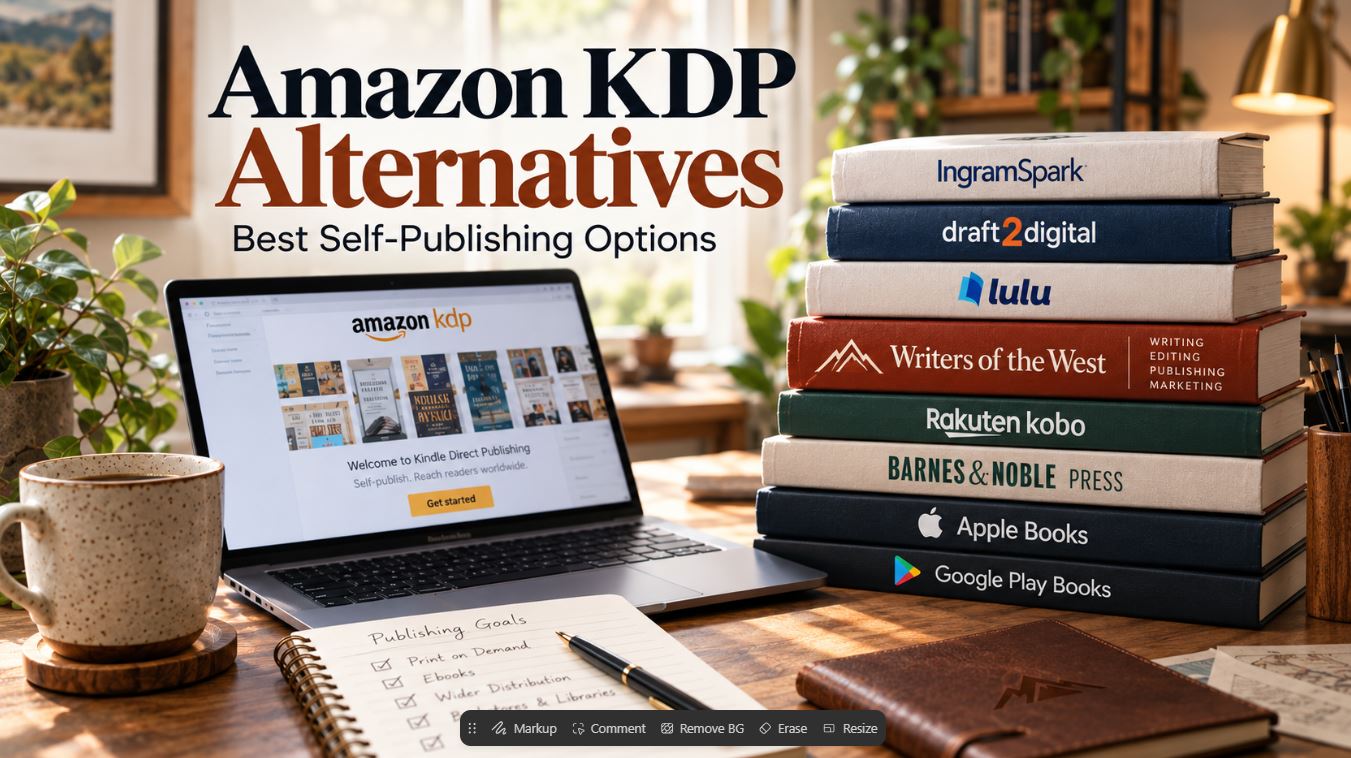
The best Amazon KDP alternatives depend on what KDP can’t do for your book. For wider print distribution to bookstores and libraries, we usually reach for IngramSpark, then Draft2Digital or Lulu depending on the project. For ebooks sold outside Amazon, Kobo Writing Life, Barnes & Noble Press, Apple Books and Google Play Books each let you publish directly. What we don’t recommend is leaving KDP by default. For an ordinary paperback or ebook aimed at Amazon readers, it’s still the platform we prefer at Writers of the West.
So before comparing alternatives to Amazon KDP, it’s worth being precise about the problem you’re trying to solve. Below, you’ll find what KDP actually limits, the four different kinds of “alternative” people mean, two comparison tables built from each platform’s own documentation, and the setups we use when one platform isn’t enough.
Platform terms change. Figures below were checked against each platform’s help pages on September 30, 2026.
Do You Need an Amazon KDP Alternative, or Just an Addition?
Most authors who search for a KDP alternative don’t need to leave KDP. They need something KDP doesn’t offer for one edition of their book, and the fix is usually to add a second platform, not swap the first one out.
These questions sort it out quickly:
- Has KDP rejected the physical format you need, such as a short color book or a hardcover with a dust jacket?
- Do you want bookstores and libraries to be able to order your print book?
- Do you want your ebook for sale on Kobo, Apple, Google or NOOK?
- Would you rather manage one dashboard than five?
- Do you want to sell print copies from your own website?
- Or do you simply prefer not to depend on Amazon?
Each answer points somewhere different. A children’s picture book that’s too short for KDP’s standard color option has a production problem. An author who wants library orders has a distribution problem. Someone tired of Kindle exclusivity has an ebook problem. One platform rarely fixes all three.
What Counts as an Alternative to Amazon KDP? The Four Types
“KDP alternative” covers four different kinds of business. Mixing them up is why so many comparison lists put Walmart next to Lulu as if they did the same job.
| Type | What it does | Examples |
|---|---|---|
| Print-on-demand publishing and distribution | Prints copies as they’re ordered and feeds print titles into retail and wholesale channels | IngramSpark, Draft2Digital Print, Lulu |
| Direct ebook publishing | Lets you upload an ebook straight to one store’s ecosystem | Kobo Writing Life, Barnes & Noble Press, Apple Books, Google Play Books |
| Aggregators and distributors | Take one set of files and metadata and send them to many stores | Draft2Digital, IngramSpark, Lulu |
| Retailers | Where readers buy books; often not somewhere an author can upload to directly | Amazon, Barnes & Noble, Walmart, Waterstones, Booktopia |
The categories overlap. Draft2Digital is mainly an ebook aggregator but also prints paperbacks. IngramSpark is a printer, a wholesale distributor and an ebook distributor. Barnes & Noble is a retailer that also runs its own publishing platform. What matters is knowing which role you need a company to play for a particular edition. Authors who’d rather not coordinate printers, distributors, ISBNs and several dashboards themselves can have the whole process managed with our self publishing services.
What KDP Can’t Print: Page Count and Format Limits
KDP’s print rules depend on ink, paper, trim size and binding, so “KDP needs 24 pages” is only true for some configurations. These are Amazon’s current ranges:
| KDP format | Page count | Notes |
|---|---|---|
| Paperback, black ink (white or cream) | 24 to 828 | Maximum drops on larger trim sizes and cream paper |
| Paperback, standard color | 72 to 600 | The lower-cost color option |
| Paperback, premium color | 24 to 828 | Costs more per copy; suited to image-heavy books |
| Hardcover | 75 to 550 | Case laminate only, no dust jacket; five trim sizes |
Two other limits come up often in our publishing work. KDP hardcovers aren’t eligible for Expanded Distribution, KDP’s route to bookstores and libraries, and they aren’t available on Amazon.co.jp. And Expanded Distribution itself pays a 40% royalty minus printing costs, with no control over wholesale discounts or returns.
That’s why the books that hit KDP’s limits tend to be the same types: short color children’s books, photo and art books, puzzle and activity books under 72 pages that want the cheaper color option, and hardcovers that need a dust jacket or bookstore distribution.
If your book fits within those limits, KDP is usually the right home for it, and the upload is only part of the job. Categories, keywords, the book description and A+ content decide whether Amazon shoppers find the book, and that’s the work covered by our Amazon KDP publishing services help.
Best Amazon KDP Alternatives for Print on Demand and Distribution
When a book needs something KDP’s print side can’t provide, our order of preference in Writers of the West’s publishing work is IngramSpark, then Draft2Digital, then Lulu. That’s our experience, not an independent score. The right choice still depends on the format and where you want the book sold.
IngramSpark: Best KDP Alternative for Bookstore and Library Distribution
IngramSpark is the self-publishing arm of Ingram, the largest book wholesaler in North America. Its value isn’t printing, since plenty of companies print on demand. It’s the catalogue. IngramSpark says titles are made available to more than 45,000 retailers, online stores, libraries and universities, including Amazon, Barnes & Noble, Walmart.com, Waterstones, Foyles, Blackwell’s, Chapters Indigo, Booktopia and Fishpond. It prints in Tennessee, Pennsylvania, the UK, Australia and the UAE, with partner printers in several other countries.
The piece most authors misunderstand is what that access means. Being in Ingram’s catalogue means a bookstore can order your book. It doesn’t mean any store will. Stores decide what to stock, and they’re far more likely to order a title they can return if it doesn’t sell. IngramSpark lets you choose: non-returnable, returnable with copies shipped back to you (US only, with a shipping charge per book), or returnable with copies destroyed. Its own user guide says a 53% to 55% wholesale discount with returnable status “generally allows for the widest availability.” Both settings cost you margin, so they’re business decisions, not checkboxes.
On cost, IngramSpark dropped its title setup fees in 2023 and added a 1% fee on books sold through its wholesale distribution network. Revisions are free until you approve the eproof; changes after approval carry a fee. US self-publishers can get free ISBNs, but those carry IngramSpark’s “Indy Pub” imprint and can’t be used on KDP or anywhere else. Ebooks distributed through IngramSpark pay 85% of the net revenue Ingram receives.
Hardcovers are the other reason we use it. IngramSpark offers case-laminate hardcovers in gloss, matte or its Digital Cloth finish, and its hardcovers go into the same wholesale catalogue as paperbacks, which a KDP hardcover can’t do.
When we’d choose it: bookstore and library availability, hardcovers with distribution, or any print edition where returns and discounts matter. When we wouldn’t: a straightforward paperback sold almost entirely on Amazon, where KDP is simpler and pays better per copy.
Draft2Digital: Simplest Route for Paperbacks Plus Wide Ebooks
Draft2Digital started as an ebook aggregator, and that’s still where it’s strongest. Its print service, D2D Print, is deliberately narrow: perfect-bound paperbacks in black and white only, distributed to Amazon and to the Ingram channels that reach Barnes & Noble and most independent bookstores. There’s no hardcover and no color printing. Author copies ship only to the US and Canada.
For a novel or a text-only nonfiction book, that’s often enough, and the setup is easier than IngramSpark. You get one free update per book every 90 days, with “Change Tokens” for extra updates. We’ve found the limits show up quickly on anything more complex, which is why it sits second for print in our experience.
One recent change: in April 2026, Draft2Digital introduced a one-time $20 activation fee for new accounts and a $12 annual maintenance fee for accounts earning less than $100 in net proceeds over 12 months, effective May 14, 2026. Existing accounts don’t pay the activation fee. Its ebook side is covered further down.
Lulu: Best for Direct Sales and Specialty Formats
Lulu is a capable printer with a wider format range than D2D Print, including hardcovers with dust jackets and linen wraps. Its standout feature is direct sales. Lulu Direct connects to Shopify, Wix and WooCommerce, prints and ships each order automatically, and lets you keep all the sale revenue while paying Lulu only for printing and shipping.
The friction is in retail distribution. To list a print book through Lulu’s Global Distribution, you have to buy and approve a printed proof first, and new titles carry a non-refundable $4.99 distribution review fee. Lulu says listings take approximately 12 weeks or longer to appear with retailers. Paperbacks go to Amazon and Ingram, but hardcovers and linen wraps are eligible for Ingram distribution only. None of that is a flaw, exactly. It just makes Lulu slower and more hands-on for retail than the other two, and better suited to authors selling from their own site.
KDP vs. IngramSpark vs. Draft2Digital Print vs. Lulu
| Feature | KDP | IngramSpark | D2D Print | Lulu |
|---|---|---|---|---|
| Best use | Print books sold mainly on Amazon | Bookstore and library availability | Simple B&W paperbacks alongside D2D ebooks | Direct sales and special formats |
| Print on demand | Yes | Yes | Yes | Yes |
| Paperback | Yes | Yes | Yes | Yes |
| Hardcover | Yes, case laminate, 75+ pages | Yes, case laminate incl. cloth finish | No | Yes, incl. dust jacket and linen |
| Color | Standard (72+ pages) and premium | Yes, several tiers | No, B&W only | Yes |
| Short books | 24-page minimum; 72 for standard color | Varies | Varies | Varies |
| Amazon | Direct | Via distribution | Via distribution | Paperback only |
| Bookstores | Expanded Distribution, paperback only | Yes, 45,000+ outlets | Via Ingram | Via Ingram |
| Libraries | Expanded Distribution, paperback only | Yes | Via Ingram | Via Ingram |
| Print proof required | No | Eproof approval; print proof optional | Not specified | Yes, for Global Distribution |
| Upfront fees | None | None to set up; 1% on wholesale sales; fees after eproof | $20 new-account activation | $4.99 distribution review |
| Wholesale discount control | No | Yes | Not specified | Not specified |
| Returns | No | Your choice (3 options) | Not specified | Not specified |
| Sell from your own site | No | Not covered here | No | Yes, via Lulu Direct |
| Main limitation | No bookstore route for hardcovers; no returns | More decisions; margin cost of discounts and returns | B&W paperback only | Proof, fee and ~12-week listing time |
“Varies” means the answer depends on trim, paper and binding, so check the platform’s calculator for your exact specification. “Not specified” means we couldn’t find it in the platform’s current documentation.
Amazon KDP Alternatives for Low-Content, Puzzle and Short Books
For most low-content books, including journals, planners, puzzle books and activity books, the best KDP alternative is often KDP itself with a different setting, such as premium color, which allows 24-page color books. When the problem is binding or a format KDP doesn’t print, Lulu and IngramSpark are the places to compare. Start by identifying which KDP requirement is actually blocking you rather than which company might replace KDP.
Usually it’s one of these:
- Page count with color. A 40-page color activity book fails the 72-page minimum for standard color. It qualifies at 24 pages with premium color, but the cost per copy is higher.
- Binding. KDP’s print formats are paperback and case-laminate hardcover, so a planner or workbook that needs spiral or coil binding has to go elsewhere.
- Hardcover length. KDP hardcovers need at least 75 pages, which rules out most picture books in hardcover.
If premium color pricing works, staying on KDP is usually the simplest answer for a low-content book sold on Amazon. If the book needs a binding or format KDP doesn’t print, compare Lulu’s product range and IngramSpark’s hardcover options against your exact specification before uploading anything. Low-content books also sell mainly on Amazon, so distributing one through a wholesaler rarely changes much on its own.
Best Amazon KDP Alternatives for Ebook Publishing
The best KDP alternatives for ebooks are Apple Books, Google Play Books, Kobo Writing Life and Barnes & Noble Press, which each pay around 70% of the list price when you publish directly. Draft2Digital reaches all of them from one account for roughly 10% of the retail price. Print distribution and ebook distribution are separate decisions. You can print through KDP and sell ebooks everywhere, or the reverse. The one hard rule is KDP Select: enrolling a Kindle ebook puts it in Kindle Unlimited for a 90-day term, and during that time the ebook has to be exclusive to Amazon. Print editions aren’t affected.
Kobo Writing Life
Kobo pays 70% of list price on original ebooks priced at or above its thresholds ($2.99 USD, £1.99, €1.99, $2.99 CAD and equivalents), and 45% below them. It’s worth taking seriously if you have readers outside the US, since thresholds are set in several currencies, and Kobo Writing Life also sells to libraries through OverDrive, paying 50% of the library price.
Barnes & Noble Press
B&N Press pays 70% of the retail price you set on NOOK ebooks and also offers print editions sold on BN.com. It’s the direct route into the Barnes & Noble ecosystem, which is largely US-focused.
Apple Books
Apple pays 70% on every ebook “regardless of price,” with no file-delivery fees, no limits on free books and no price matching. For authors who like to test prices or run free promotions, that flexibility is the draw.
Google Play Books
Google Play Books pays a 70% revenue split in more than 60 supported countries, regardless of price, for publishers who’ve accepted its updated terms. Eleven markets, including India and Japan, are on a different split. Google doesn’t charge fees for the 70% split.
Writers of the West
Writers of the West is a full-service publishing company that works on top of these platforms, so authors get the right one for each edition without managing any of them. We handle KDP publishing for Amazon and global distribution to 50+ platforms, including Barnes & Noble, Walmart and Target, along with formatting and cover files built to each printer’s specifications, ISBNs, metadata, categories and keywords. Packages also include marketing that no print-on-demand platform offers: press releases, blog features, paid social and Amazon ads, influencer campaigns and digital billboards. Authors keep 100% of their rights and royalties, publishing packages run from $699 to $5,999, and payment plans start at a deposit of roughly 30%.
Amazon KDP vs. Alternatives for Ebook Sales
| Platform | Author share | Exclusivity | Best for | Type |
|---|---|---|---|---|
| Amazon KDP | 70% at $2.99 to $12.99 (US, minus delivery cost), otherwise 35% | Only if enrolled in KDP Select | Kindle readers; Kindle Unlimited | Direct |
| Kobo Writing Life | 70% at or above threshold, 45% below | None stated | Readers outside the US; library sales | Direct |
| B&N Press | 70% of retail price | None stated | NOOK readers in the US | Direct |
| Apple Books | 70% at any price | None | Apple device users | Direct |
| Google Play Books | 70% in 60+ countries | None stated | Android and Google users | Direct |
| Draft2Digital | Store’s rate minus about 10% of list price | None | Many stores from one dashboard | Aggregator |
| IngramSpark (ebooks) | 85% of Ingram’s net receipts | None stated | Adding ebooks to an existing Ingram account | Aggregator |
KDP raised the top of its 70% price band from $9.99 to $12.99 on July 7, 2026. If your ebook is priced between $10 and $12.99, the comparison with other stores changed this year.
Publishing Direct vs. Using an Aggregator
Direct publishing usually pays more, and an aggregator saves admin time. Here’s the arithmetic on a $4.99 ebook sold through Apple. Direct, you get 70%, about $3.49. Through Draft2Digital, which keeps roughly 10% of the retail price, you get about 60%, or $2.99. That 50-cent difference repeats on every sale in every store.
What the 50 cents buys is time. Going direct means a separate account, tax interview, payment setup and upload at Amazon, Kobo, B&N, Apple and Google, and every price change or new cover goes into five dashboards. An aggregator takes one upload and one metadata record.
What we see work well is a hybrid: go direct with the one or two stores that sell most of your copies, and let an aggregator handle the long tail.
How Do I Get My Book on Walmart, Waterstones and Other Bookstores?
Usually you don’t upload to these stores at all. Most books reach them through a chain:
Author or publisher → printer or distributor → retailer → reader
Walmart.com, Waterstones, Foyles and Blackwell’s in the UK, Chapters Indigo in Canada, and Booktopia and Fishpond in Australia and New Zealand are all named retail partners in IngramSpark’s distribution network. You reach them by distributing through Ingram (directly or via D2D Print or Lulu), not by opening accounts with each store. Booktopia, which also owns the Angus & Robertson brand, went into administration in July 2024 and resumed trading within weeks under new owner DigiDirect.
Being distributed into a retailer’s supply chain does not guarantee the retailer will stock, feature or even list every title. KDP says the same about its own Expanded Distribution: the decision to list a book rests with distributors, and the decision to order it rests with individual booksellers and libraries.
Can I Sell on Amazon Without KDP?
Yes, for print books. Amazon is a retailer as well as the company that runs KDP, and it lists print books supplied through distributors. IngramSpark names Amazon among its retail partners, D2D Print distributes paperbacks to Amazon, and Lulu submits paperbacks to Amazon through Global Distribution. The listing then comes through the distributor rather than your own KDP account.
This helps with editions KDP can’t produce, like a jacketed hardcover. For a standard paperback, publishing directly on KDP is normally simpler and pays more per Amazon sale. For Kindle ebooks, KDP is the direct route; aggregators such as Draft2Digital can also deliver to Amazon.
When Amazon KDP Is Still the Better Choice
For an ordinary paperback or ebook whose readers are mainly on Amazon, we generally prefer KDP when it supports the book. The reasons are practical:
- It sells directly on the store where most self-published books are bought, with no intermediary.
- The paperback royalty is 60% of list price minus printing at $9.99 and up (50% below). Amazon’s own example is a $15, 333-page book: 60% of $15 minus $5.00 printing leaves $4.00 per sale.
- There’s no upfront fee, no required print proof and no distribution review.
- Kindle ebooks, Kindle Unlimited and Amazon’s advertising tools all sit in the same ecosystem as your print listing.
KDP also has a real limit on its bookstore route. Expanded Distribution pays 40% minus printing, excludes hardcovers, and requires that your ISBN not already be submitted through another distributor. That last rule is what makes combining KDP with IngramSpark something you have to set up carefully.
Which Amazon KDP Alternative Should You Use?
Match the platform to the specific gap: IngramSpark for bookstores, libraries and distributed hardcovers; Lulu for direct sales and jacketed formats; Draft2Digital for simple paperbacks and one-dashboard ebooks; and the direct ebook stores for the highest per-sale share. KDP stays in the mix for Amazon sales in almost every case.
| Your situation | Consider | Why |
|---|---|---|
| Standard paperback, sold mainly on Amazon | KDP | Direct listing, 60% royalty at $9.99+, no fees |
| Ebook aimed at Kindle readers or Kindle Unlimited | KDP (Select optional) | Kindle Unlimited requires Select exclusivity |
| Want bookstores and libraries able to order your print book | IngramSpark | 45,000+ outlets; returns and discount controls |
| Hardcover with bookstore distribution | IngramSpark | KDP hardcovers aren’t eligible for Expanded Distribution |
| Hardcover with a dust jacket, sold from your site | Lulu | Jacketed formats plus Lulu Direct |
| Simple B&W paperback alongside wide ebooks | Draft2Digital | One dashboard for both |
| Short color book under 72 pages | KDP premium color, or compare Lulu and IngramSpark | Standard color needs 72+ pages |
| Ebook sales in Canada and Europe | Kobo Writing Life | 70% at threshold; library sales via OverDrive |
| Ebook on NOOK | B&N Press | 70% of retail price |
| Ebook on Apple devices | Apple Books | 70% at any price; no price matching |
| Ebook on Google Play | Google Play Books | 70% in 60+ countries |
| Many ebook stores, one account | Draft2Digital | Keeps about 10% of retail; no exclusivity |
Don’t Want to Manage Multiple Publishing Platforms Yourself?
Once a book goes past a single KDP upload, most of the work is decisions and admin: which platform prints which edition, which ISBN goes where, what discount and returns setting makes sense, and keeping metadata consistent across stores. At Writers of the West, we pick the route for each book rather than putting every project on the same platform.
That can include ebook and print formatting, cover files built to each printer’s specifications, ISBN setup, metadata, KDP publishing, category and keyword research, book descriptions and A+ content, and setup on additional distributors for wider availability. What no publisher can honestly promise is a ranking, a bookstore order or a sales figure, and we don’t.
Frequently Asked Questions
What is the best alternative to Amazon KDP?
For print books that need bookstore and library distribution, IngramSpark is the alternative we use most, because its catalogue reaches more than 45,000 retailers and libraries and lets publishers set discounts and returns. For ebooks, Kobo, Apple Books, Google Play Books and B&N Press each pay around 70%, and Draft2Digital reaches them all from one account.
Is IngramSpark better than Amazon KDP?
It depends on where the book will sell. KDP is usually better for books sold mainly on Amazon: it’s direct, has no fees and pays a 60% paperback royalty at $9.99 and up. IngramSpark is better when bookstores and libraries matter, or for hardcovers that need wholesale distribution, which KDP hardcovers can’t get.
Can I use KDP and IngramSpark at the same time?
Yes, and many publishers do. Use KDP for Amazon and IngramSpark for wider distribution, but don’t enroll the KDP edition in Expanded Distribution, as IngramSpark itself advises. Use an ISBN you own on both, because IngramSpark’s free ISBNs can’t be used on KDP.
Do I need different platforms for ebooks and print books?
No, but you can use different ones. Print and ebook distribution are separate decisions. The only restriction is KDP Select, which makes the enrolled ebook exclusive to Amazon for 90-day terms; print editions aren’t affected.
Which KDP alternative gets books into bookstores?
IngramSpark is the main route, and D2D Print and Lulu also reach bookstores through Ingram’s network. All of them make a book available to order; none can make a store stock it. Returnable status and a competitive wholesale discount improve the odds.
The Better Question to Ask
If KDP works for your book and Amazon is where your readers are, there may be no reason to trade it for one of the Amazon KDP alternatives above. The better question is what your book needs that KDP doesn’t provide. For some authors that’s bookstore and library distribution through IngramSpark. For others it’s simpler aggregation through Draft2Digital, a jacketed hardcover or direct sales through Lulu, or ebook sales through Kobo, NOOK, Apple Books and Google Play Books. In our experience, the setup that works best is rarely KDP against everything else. It’s KDP plus the right additional channels for that particular book.
Sources: KDP print options · KDP color ink options · KDP hardcover · KDP Expanded Distribution · KDP paperback royalty · KDP ebook list price requirements · KDP ebook royalties · KDP Select · IngramSpark distribution · IngramSpark user guide · IngramSpark fee changes · IngramSpark free ISBNs · IngramSpark FAQs · Draft2Digital FAQ · D2D fees · D2D Print · Lulu Global Distribution · Lulu Direct · Kobo Writing Life earnings · B&N Press ebook pricing · Apple Books for Authors · Google Play Books revenue split · Booktopia
About the Author
Senior Editor, Writers of the West
Francis Vincent is a best-selling American author and senior editor at Writers of the West. He holds both a B.A. and M.A. in English Literature, with graduate work at the University of Colorado Boulder. His editorial specialization spans productivity, habits, line editing, and dialogue refinement. He focuses on clarity, flow, and practical structure — helping authors translate ideas into polished, publishing-ready manuscripts while preserving their voice and intent.
writersofthewest.net · Professional Ghostwriting Services, Book Editing & Publishing Guidance