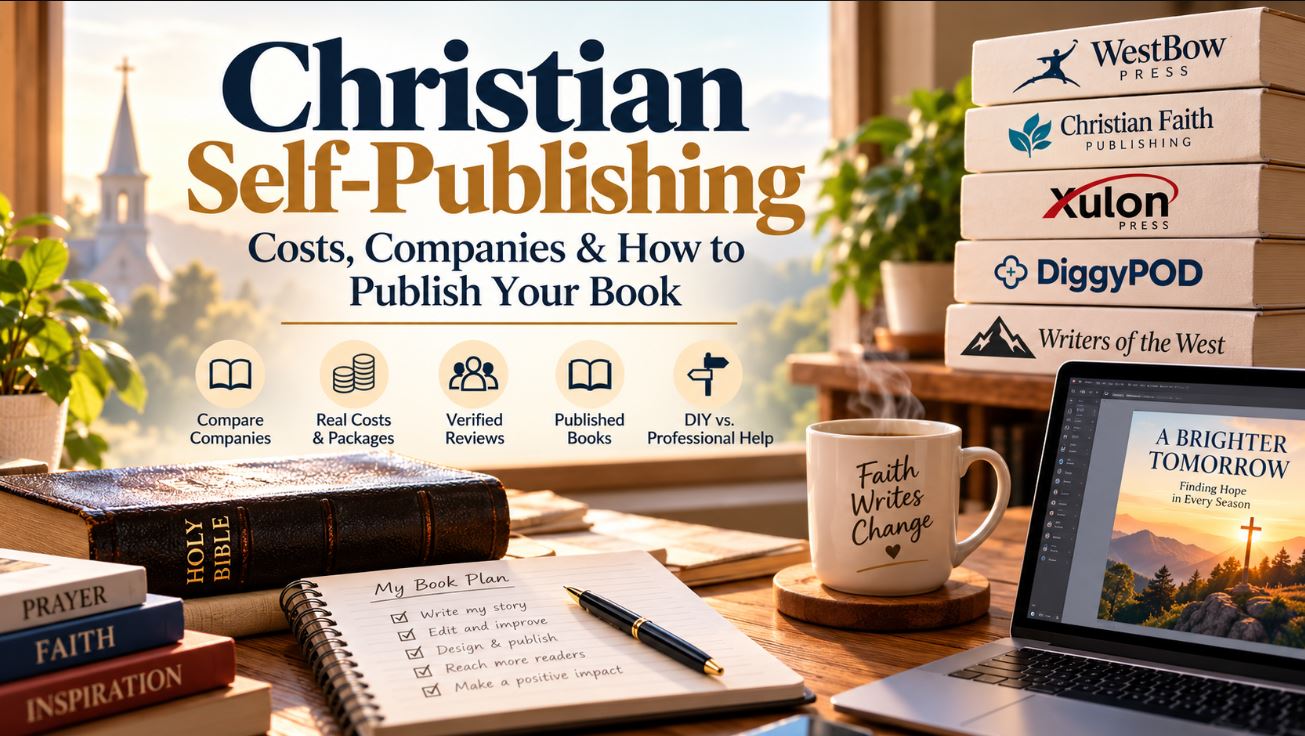
Quick answer: Christian self-publishing means you pay for and control your faith-based book instead of waiting for a traditional publisher. You can publish free on your own through Amazon KDP and IngramSpark, pay roughly $1,000 to $3,000 for a freelance editor and designer, or buy a full-service package. In this guide, packages range from $699 (Writers of the West Bronze) to $15,599 (WestBow Ignite), With a breakdown of the top Christian self-publishing companies below.
What Is Christian Self-Publishing?
Christian self-publishing is any route where the author funds the book and keeps control of it, rather than a publisher buying the rights and paying the author an advance. The word “self” describes who pays and who decides. It does not mean you have to do every job yourself. Most people self-publishing Christian books hire help for at least the editing and the cover.
There are five arrangements you will run into:
| Model | Who pays | Who controls the book | What it usually looks like |
|---|---|---|---|
| Traditional Christian publishing | The publisher | The publisher, under contract | Agent or proposal, selective acceptance, an advance against royalties, long timelines |
| DIY self-publishing | The author, mostly in time | The author | You upload files to Amazon KDP or IngramSpark and hire nobody, or hire freelancers one by one |
| Assisted self-publishing | The author | The author | You buy individual services (an editor, a cover designer) and publish under your own account |
| Full-service publishing package | The author | The author, within the package contract | One company handles editing, design, ISBN, distribution and some marketing for a fixed fee |
| Hybrid publishing | Shared, but the author usually pays most | Varies by contract | Selective acceptance, author investment, often a higher royalty share than traditional |
The practical differences come down to four things: how much editing you actually get, who owns the ISBN and publisher-of-record listing, how royalties are calculated, and whether distribution means “available to order” or “on a shelf.” Those four points come up again and again in the company comparisons below.
One thing worth saying plainly: a company that calls itself Christian is not automatically better at editing, distribution or sales. What it may offer is familiarity with your readers, comfort with theological content and an understanding of how churches and ministries buy books. Those are real advantages, but they have to be shown in the work, not the branding. That is why this guide covers both Christian-only providers and general publishing services that work with Christian authors.
If you need Christian book editors, or need help of experienced Christian Ghostwriters, contact us on the form below. If you want to jump straight to Christain self publishing services, get in touch.
Christian Self-Publishing Companies Compared
The five companies below are listed in a fixed editorial order, not ranked by a score. Each one solves a different problem, and the right choice depends on how ready your manuscript is and how much help you want.
| Company | Best for | Starting price | Full-service options | Public portfolio | Independent reviews (checked Oct 2026) |
|---|---|---|---|---|---|
| WestBow Press | Authors who want a Christian-only imprint linked to HarperCollins Christian Publishing | $1,499 (Foundation) | Integrated packages; Testimony includes an editorial assessment, not a copyedit | Yes, own bookstore plus retailer listings | Trustpilot 4.0 from 914 reviews (company invites reviews) |
| Christian Faith Publishing | Authors who want a full copyedit and marketing extras bundled | $4,085 (Purely Publishing) | Integrated packages; full copy editing listed in base services | Yes, many titles at retailers | BBB about 4.7 from 330+ reviews; Trustpilot 2.2 from 12 |
| Xulon Press | Authors who want a long-running Christian-only press | Quote required | Packages plus paid add-ons | Yes, own bookstore and wide retail listings | Google 3.4 from 56; BBB data differs between profiles |
| Writers of the West | Authors who want a lower entry price, payment plans or writing help | $699 (Bronze, Amazon-only) | Integrated tiers from Bronze to Titanium | Yes, faith titles at retailers | BBB accredited, A+; 100+ Reviews Across Google, Trustpilot, and Reviews.io |
| DiggyPOD | Pastors, churches and ministries that need printed copies | Priced by print specs (quote) | Printing plus separately sold editing and design; no bundled publishing package | Printing credits, not publisher credits | ResellerRatings 4.59 from 3,789; Google 4.6 from 50 |
Google figures for Xulon and DiggyPOD come from Google Business Profile screenshots taken on October 29, 2026. Review sources and dates are in the verification sheet at the end.
1. WestBow Press
WestBow Press is the self-publishing arm associated with Thomas Nelson and Zondervan, the two imprints of HarperCollins Christian Publishing. The day-to-day work is run by Author Solutions in Bloomington, Indiana, which Publishers Weekly described as handling WestBow’s production, editing levels and marketing packages. On BBB, WestBow appears as an alternate name of Author Solutions, LLC, accredited since 2010.
Packages. WestBow’s lowest-priced option is the Foundation package at $1,499, advertised on its own page rather than in the main package lineup. The core packages run from Testimony at $2,699 and Ministry at $4,899 through Legacy at $8,299, Connect at $11,399 and Ignite at $15,599. Testimony includes ebook, softcover and hardcover formats, a cover design, interior layout, up to 20 images, one ISBN, Ingram distribution, a Library of Congress number, 10 softcover copies, 1 hardcover and 25 ebook gift codes.
The editing catch. Testimony includes an editorial assessment. A specialist reviews part of your manuscript and recommends further editing if needed. That is not a copyedit or a proofread, and the extra editing costs more.
The Thomas Nelson link. WestBow says publishing with it gives an “opportunity for discovery” by Thomas Nelson and Zondervan, and its guide names authors like Annie Downs who were later signed. That is a possibility, not a feature of the package. WestBow books are published under the WestBow name, not as Thomas Nelson titles.
Reviews. Trustpilot shows 4.0 from 914 reviews. Praise centers on helpful staff. Complaints mention total costs higher than expected, slow updates and being passed between many staff members.
Best suited for: authors who value the HarperCollins Christian connection and can budget for editing on top of the package.
2. Christian Faith Publishing
Christian Faith Publishing (CFP), based in Meadville, Pennsylvania, sells done-for-you publishing packages to Christian authors across fiction, nonfiction and children’s books. It is not a traditional publisher; the author pays.
Packages. CFP publishes three tiers: Purely Publishing at $4,085, Launch at $5,681 and Launch+ at $8,081, paid over time. The base services listed on its packages page include full copy editing, ISBN, page and cover design, ebook conversion, print editions, distribution, a press release, an author page on CFP’s site and wholesale author copies. Purely Publishing also lists a podcast interview, Amazon optimization, a narrated video trailer and complimentary copies. Launch adds a custom author website, a social media campaign, bookmarks and a video interview. An audiobook is a separate add-on.
Why the editing matters. Of the three Christian-specific companies here, CFP is the one that lists full copy editing as a base service. That is a meaningful difference from an editorial assessment.
Contract and royalties. CFP’s published publishing agreement is worth reading before you call. The author keeps the copyright, but grants CFP exclusive worldwide print and ebook publishing rights for an initial two-year term. The agreement renews for further two-year terms unless you cancel at least 60 days before it expires. Authors receive the proceeds paid by retailers, and once the author’s investment has been recovered, CFP keeps a $0.50 administrative fee per copy sold. Royalties are paid once they reach $100, and the agreement provides for transferring the production files to the author on request. Keeping your copyright and granting someone exclusive publishing rights are two different things, so note the renewal date if you sign. Individual signed contracts may differ from the published version.
Reviews. The picture depends on where you look. BBB shows an A+ rating and an average of about 4.7 stars from several hundred customer reviews (the exact count differed between BBB pages in October 2026), alongside more than 40 complaints in the last three years. Trustpilot shows 2.2 from 12 reviews, with complaints about editing errors, slow communication and unclear royalty reporting. Twelve reviews is a small sample next to BBB’s several hundred, but the complaint themes are worth raising directly.
Best suited for: authors who want a full copyedit and a set of promotional extras in one package and are comfortable paying several thousand dollars.
3. Writers of the West
Writers of the West is a Houston-based full-service self-publishing company founded in 2004, with ghostwriting, editing and publishing under one roof. It is not an exclusively Christian publisher; it publishes Christian titles alongside memoir, fiction, poetry and children’s books.
Packages. Its published tiers are Bronze $699, Silver $1,299, Gold $2,199, Platinum $3,799 and Titanium $5,999. The tiers mainly differ in reach and promotion: Bronze is Amazon-only, Silver covers about 10 platforms, and Gold reaches about 20 including Walmart and Target, with Platinum and Titanium going wider. Gold includes cover design, formatting and typesetting, paperback, hardcover and ebook editions, 20 proof copies, library and bookstore distribution access, Amazon A+ content and a book trailer. Higher tiers add audiobook and more promotion. Installment plans are available.
Rights and royalties. The company says authors keep their rights and 100% of royalties, with no fee taken from sales. The package ISBN is registered with Writers of the West as publisher of record and assigned to the author’s book; authors can use their own ISBN instead.
Portfolio. Faith-based titles include Grieving Wisely by Dr. Joseph B. Omosigho (ISBN 9798295564925, January 2026) and A Walkthrough of the Bible by Doug Kroeker (2026).
Reviews. Writers of the West is BBB accredited with an A+. Trustpilot shows 4.4 from 28 reviews, 4.9 from 30 reviews on Reviews.io and 4.7 from 56 Reviews on Google.
Limitations. It is not a Christian-only imprint, which matters to some authors. Bronze is Amazon-only, so wider distribution means a higher tier. Gold covers design and typesetting but not a full edit, so editing is an extra cost if you need it.
Best suited for: authors on a tighter budget, authors who need writing help as well as publishing, and authors who don’t need a Christian-only imprint name.
4. Xulon Press
Xulon Press, in Maitland, Florida, is one of the oldest Christian self-publishing companies. It was founded in 2000 and is owned by Salem Media Group. It publishes only Christian and faith-aligned books.
Packages. Xulon does not publish current package prices in a form we could verify. Older third-party reviews put its packages between $1,699 and $4,999, and Xulon has offered à la carte options in the past, but those figures are dated. Treat Xulon as quote-required and ask for a written breakdown.
What to ask for in the quote. Whether copyediting is included or extra, who sets the retail price, what you pay for author copies, how royalties are calculated, and whether a hardcover is included. Older reviews raised concerns about high per-copy print costs and paid add-ons, so get those numbers in writing.
Portfolio. Xulon runs an online bookstore and its titles appear across retailers. For example, Walmart lists Blood Covenant (ISBN 9781628717051, 2014) with Xulon Press as the publisher.
Reviews. Google shows 3.4 from 56 reviews (checked October 29, 2026). BBB is harder to read: one Xulon profile shows 4.32 from 78 customer reviews and 23 complaints in three years, while another Maitland listing shows a single review and no accreditation. Check which profile matches the office you will work with.
Best suited for: authors who want a publisher that only handles Christian books and are willing to negotiate a custom quote.
5. DiggyPOD
DiggyPOD is a book printer in Tecumseh, Michigan, that also sells author services. It says more than 75% of the roughly 100,000 books it prints each month are Christian titles, which makes it relevant to ministries even though it is not a publisher in the usual sense.
Services. Paperback, hardcover and spiral-bound printing, short runs and print-on-demand, plus separately sold editing, interior design, cover design, ebook and audiobook conversion and distribution support. It offers free file review, hard-copy proofs and free shipping on orders of 100 books or more. Prices depend on page count, trim size, binding and quantity, so you get a quote rather than a package price.
Publisher or printer? Printing a book does not make DiggyPOD its publisher. If you buy your own ISBN and print with DiggyPOD, you are the publisher of record. That is a plus for ownership but means you handle distribution decisions yourself.
Reviews. ResellerRatings shows 4.59 from 3,789 reviews, and Google shows 4.6 from 50 (screenshot, October 29, 2026). DiggyPOD’s own claim of thousands of five-star reviews was not checked against its underlying sources.
Best suited for: churches, pastors and ministries that need a few hundred printed copies of a study guide, devotional or sermon series, and authors who already have print-ready files.
What Customers Say Across Independent Review Sites
No single review site tells the whole story, so check at least three before you sign anything. The table below shows what each platform said when we checked, without averaging them into one misleading number.
| Company | Trustpilot | BBB | Other independent reviews | |
|---|---|---|---|---|
| WestBow Press | Not independently verified | 4.0 from 914 (company invites reviews) | Listed under Author Solutions, LLC; accredited since 2010 | ComplaintsBoard: 1.1/5 from 1 review; 27 complaints. |
| Christian Faith Publishing | 4.4 from 538 (reported Jan 2026, not rechecked) | 2.2 from 12 | Accredited, A+; about 4.7 from 330 to 413 customer reviews (count varies by page); 40+ complaints in 3 years | RevDex: 582 archived review/comment entries, not independently verified. Writer Beware has also published an investigation into the company. |
| Xulon Press | 3.4 from 56 | Not independently verified | One profile: 4.32 from 78 reviews, 23 complaints in 3 years; another Maitland listing: 1 review, not accredited | ComplaintsBoard: 1.5/5 from 2 reviews; 17 complaints. ALLi has published an independent cautionary assessment. |
| Writers of the West | About 4.7 (count to confirm) | 4.4 from 28 | Accredited, A+; customer review count not checked | Reviews.io 5.0 from 19; GoodFirms 4.9 to 5.0 (listing and profile differ); Clutch 5.0 from 2 |
| DiggyPOD | 4.6 from 50 | Not independently verified | Not independently verified | ResellerRatings 4.59 from 3,789 |
A few patterns stand out. BBB’s letter grade measures how a business handles complaints, and accreditation is a paid membership, so neither tells you whether authors were happy. Small samples swing easily: 12 or 23 reviews can move a full star with a handful of new posts.
Across the complaints we read, the same issues repeat at every company: total cost ending up higher than the package price, slow communication, editing quality, and confusion over royalties. When you talk to any company, ask about each of those directly and get the answers in writing.
Christian Self-Publishing Packages: What You Actually Get
A lower package price does not always mean a lower total cost. What matters is what the package includes and what you will have to buy on top. Here is one comparable package from each of the three companies that sell bundled tiers.
| Service | WestBow Testimony ($2,699) | Christian Faith Publishing Purely Publishing ($4,085) | Writers of the West Gold ($2,199) |
|---|---|---|---|
| Full manuscript editing | Optional extra | Included (full copy edit) | Not included |
| Editorial assessment | Included | Not listed | Not listed |
| Proofreading | Not included | Not publicly confirmed | Not publicly confirmed |
| Cover design | Included | Included | Included |
| Interior formatting | Included | Included | Included |
| Paperback | Included | Included | Included |
| Hardcover | Included | Not publicly confirmed | Included |
| eBook | Included | Included | Included |
| Audiobook | Not included | Optional extra | Not included (higher tiers) |
| ISBN | Included (one) | Included | Included |
| Author copies | 10 softcover, 1 hardcover | Complimentary copies (number not stated) | 20 proof copies |
| Online distribution | Included (Ingram, Books in Print) | Included | Included (about 20 retailers incl. Walmart, Target) |
| Bookstore and library ordering access | Included through Ingram | Included | Included |
| Press release | Not included | Included | Listed on one company page, not another; confirm |
| Author website | Not included | Author page on CFP’s site | Not publicly confirmed |
| Amazon metadata optimization | Not included | Included | Included (A+ content, categories and keywords) |
| Marketing assistance | Not included | Podcast interview, narrated video trailer | Book trailer, Amazon A+ content |
| Project management | Not publicly confirmed | Not publicly confirmed | Included (dedicated project manager) |
| Copyright ownership | Not publicly confirmed | Author keeps copyright; CFP holds exclusive publishing rights during the term | Author keeps rights |
| Royalty arrangement | Not publicly confirmed for this package | Retailer proceeds to author; $0.50 fee per copy after investment is recovered | Author keeps 100% of royalties |
What the table shows:
- Lowest price among the three: Writers of the West Gold at $2,199, then WestBow Testimony at $2,699 and Christian Faith Publishing Purely Publishing at $4,085. WestBow’s Foundation package is cheaper at $1,499 but includes less than Testimony.
- Most complete editing on paper: Christian Faith Publishing, because full copy editing is listed in its base services. WestBow Testimony gives you an assessment, and a real edit costs extra. Writers of the West Gold includes cover design, formatting and typesetting but not a full edit, so budget for editing separately if your manuscript needs it.
- Formats: WestBow Testimony and Writers of the West Gold both include paperback, hardcover and ebook.
- Most promotional extras: Christian Faith Publishing, with a podcast interview, a video trailer and a press release. Writers of the West Gold includes a trailer and Amazon A+ content.
- Most flexible payment: Writers of the West, which offers installment plans; Christian Faith Publishing’s fee is also paid over time.
- Most likely to need add-ons: WestBow Testimony, for editing and marketing.
- Contract term to watch: Christian Faith Publishing’s agreement renews every two years unless you cancel at least 60 days ahead.
The real comparison is the total. If your manuscript needs a full copyedit, the $2,699 package plus a separate edit can end up costing more than a package that included the edit from the start. Before you compare prices, get each company’s written quote for your word count with editing included.
Published Christian Books You Can Independently Verify
A company’s own portfolio page is a starting point. A listing at an independent retailer is better evidence that a book really exists and carries that company’s name. These examples were checked at retailers, not on the companies’ own sites. A listing shows a book is available to buy; it does not tell you how many copies sold.
| Company | Book title | Author | Publisher or service relationship | Independent retailer |
|---|---|---|---|---|
| WestBow Press | Legacy | Larry Calabrese | Publisher of record, 2015, ISBN 9781490890333 | Christianbook.com |
| Christian Faith Publishing | Grace and Peace | Deanna Langworthy | Publisher of record, May 2019, ISBN 9781645692812 | Eden.co.uk |
| Xulon Press | Blood Covenant | Bonnie Nye | Listed publisher, 2014, ISBN 9781628717051 | Walmart |
| Writers of the West | Grieving Wisely | Dr. Joseph B. Omosigho | Publisher of record, January 2026, ISBN 9798295564925 | Barnes & Noble, Libristo |
| Writers of the West | A Walkthrough of the Bible | Doug Kroeker | Publisher, 2026 | NetGalley |
| DiggyPOD | Not independently verified | n/a | Printer, not publisher of record | n/a |
DiggyPOD is the odd one out because it prints books rather than publishing them. A book it printed will usually list the author’s own imprint as publisher, so there is no simple retailer search that ties titles back to it.
Where Christianbook.com Fits
Christianbook.com is a Christian retailer, not a publishing company. You cannot buy a publishing package from it, but it is still useful when you are planning a Christian book.
First, it is a research tool. Search its catalog for your category (devotionals for women, men’s Bible studies, Christian historical fiction) and look at page counts, trim sizes, prices and covers. That tells you what readers in your niche already buy.
Second, it is evidence. When a self-published title shows up there, as WestBow’s Legacy does, you can see the publisher name, format and ISBN for yourself.
Third, it shows the gap between being orderable and being stocked. A book distributed through Ingram can often be ordered by retailers, but Christianbook decides what goes into its own catalog. No publishing company can guarantee a listing there, so treat any promise of “Christian bookstore distribution” as access to ordering, not a shelf.
If your goal is a traditional Christian publishing contract rather than self-publishing, Christianbook’s own self-publishing information page points authors toward the Evangelical Christian Publishers Association’s manuscript proposal service, which shares proposals with member publishers.
How Much Does It Cost to Self-Publish a Christian Book?
Self-publishing a Christian book can cost almost nothing if you do every job yourself, roughly $1,000 to $3,000 if you hire a freelance editor and designer, or anywhere from $699 to more than $15,000 for an all-in package from the companies in this guide. The biggest variable is editing. Affordable Christian self-publishing usually means paying for a good edit and doing the rest yourself, or choosing a lower-priced package that still includes editing.
DIY Christian self-publishing
Uploading a book to Amazon KDP is free. Amazon earns its share when a copy sells. Paperback royalties on Amazon.com are 60% of list price minus printing cost for books priced at $9.99 or more, and 50% below that; ebooks earn 35% or 70% depending on price. For example, a 250-page black-and-white paperback sold on Amazon.com costs about $4.00 to print, so a $14.99 list price pays you about $5 a copy.
IngramSpark also charges nothing to set up a title and, since February 2026, nothing for revisions. It charges a small market access fee on sales through its distribution network. IngramSpark is the route most self-published books take to get into bookstore and library ordering systems.
The costs that are not free:
- ISBN. Amazon will give you a free ISBN for KDP, but it shows “Independently published” as the imprint and can only be used on KDP. Your own ISBN from Bowker costs $125 for one or $295 for ten. Each format needs its own.
- Proof copies. You pay printing and shipping on author copies at either platform.
- Editing, cover and formatting, if you hire them out (below).
- Marketing, which can be zero or as much as you choose to spend.
Hiring individual professionals
The Editorial Freelancers Association’s 2026 rate chart lists fiction copyediting at about 2.0 to 2.7 cents a word, and reported rates for copyediting in general run 2 to 5 cents. For a 50,000-word devotional, that is roughly $1,000 to $2,500 for a copyedit alone. Developmental editing costs more, and proofreading less. Reedsy’s marketplace averages are similar: 2.7 cents for copyediting, 3.6 cents for developmental editing and 2.0 cents for proofreading.
Cover design and formatting prices vary too much between freelancers to give a reliable range. Ask three designers for quotes that include the full print wraparound cover and the ebook cover, not just the front.
Full-service Christian self-publishing packages
A package bundles editing, design, ISBN, distribution and some marketing for one fee. Using the prices above:
| Route | Typical cost | What you still pay for |
|---|---|---|
| DIY on KDP and IngramSpark | $0 to $295 (ISBNs) plus proof copies | Everything you can’t do yourself |
| Freelancers plus DIY upload | Roughly $1,000 to $3,000 or more, mostly editing | Marketing |
| Writers of the West | $699 to $5,999 | Depends on tier |
| WestBow Press | $1,499 to $15,599 | Copyediting at lower tiers |
| Christian Faith Publishing | $4,085 to $8,081 | Audiobook, add-ons |
| Xulon Press | Quote | Ask for the full breakdown |
Your real price depends on how polished the manuscript is, how many formats you want, whether you have illustrations or color pages, and how much marketing you buy.
How to Self-Publish a Christian Book in 7 Steps
You can self-publish a Christian book on your own by finishing and editing the manuscript, clearing Scripture permissions, designing the book, getting an ISBN, uploading to KDP and IngramSpark, and then marketing it to the readers who need it. Here is each step in order.
Step 1: Know exactly who the book is for
“Christians” is not an audience. A 30-day devotional for new mothers, a 12-week men’s Bible study, a testimony of recovery, a Christian romance and a children’s picture book about Noah are sold in different ways, to different buyers, at different prices. Devotionals and studies often sell through churches and small groups in bulk. Fiction sells mostly online. Children’s books need illustrations and color printing, which changes your costs. Decide this first, because it shapes every other step.
Step 2: Finish and edit the manuscript
Editing happens in layers. A developmental edit looks at structure: does the argument hold, does the story work, is anything missing. A copyedit fixes sentences, grammar and consistency. A proofread catches the last typos after the book is laid out. For theology, devotionals and Bible studies, add a fourth layer: someone who knows your tradition should check doctrine, Scripture references and quotations. If budget is tight, the copyedit is the one to keep.
If you’d rather have one team cover every layer, professional book editing services can handle the developmental edit through the final proofread.
Step 3: Check your Scripture permissions
Modern Bible translations are copyrighted. Each publisher sets its own rules for how much you can quote without asking. The NIV, for example, allows up to 500 verses without written permission, as long as they are not a complete book of the Bible and make up less than 25% of your text, and the right copyright notice appears in your book. HarperCollins Christian Publishing applies similar limits to the NKJV and its other translations. Above those limits, you must request permission and may pay a fee. Hymns and worship songs still under copyright (in the US, generally anything published in 1931 or later) and quotes from other books need their own permission too. Check the rules for every translation you quote, and put the required notices on your copyright page.
Step 4: Design and format the book
You need a front cover that works as a small thumbnail online, a full wraparound cover for print (front, spine and back, sized to your page count), and an interior laid out for your trim size. A 6 x 9 inch paperback is standard for nonfiction; devotionals and gift books often use smaller sizes. The ebook needs its own reflowable file. Hardcovers need a separate cover file and, usually, a separate ISBN.
Step 5: Decide on your ISBN
There are three ways to get one:
| ISBN source | Cost | Publisher of record | Works where |
|---|---|---|---|
| Free KDP ISBN | Free | “Independently published” | Amazon KDP only |
| Assigned by a publishing service | Included in package | The service’s imprint | Wherever that service distributes |
| Bought from Bowker | $125 single, $295 for ten | You or your imprint | Anywhere |
An ISBN identifies an edition of a book. It does not decide who owns the copyright. You own the copyright to your manuscript from the moment you write it, whichever ISBN route you take. What changes is whose name appears as publisher in retailer databases and how easily you can move the book later.
Step 6: Publish and distribute
Most self-published Christian authors use two platforms together: KDP for Amazon, and IngramSpark for everyone else, including bookstores and libraries that order through Ingram. If you buy a package, the company handles this for you. Either way, “distribution” means the book can be ordered. It does not put the book on a store shelf. Stores stock books they expect to sell, and that usually comes from local demand, events or a relationship you build with the store.
Step 7: Market the book to real readers
Marketing helps readers find the book, but nothing guarantees sales. What tends to work for Christian books is close to home first: your church, your denomination’s events, small-group leaders who might use a study, local Christian bookstores that host signings, and pastors you know. Online, look for Christian podcasts that interview authors, faith-based book reviewers, and Facebook groups for your niche. An author website with a clear way to buy the book and an email list you own will outlast any single campaign.
DIY vs. Professional Christian Self-Publishing
DIY costs less money and more time. Hiring help costs more money and saves time, but it only pays off if the help is good and you know exactly what you are buying.
| Factor | DIY | Professional help |
|---|---|---|
| Upfront cost | $0 to a few hundred dollars | About $700 to $15,600 for packages, or freelancer fees |
| Time | Weeks to months of learning and setup | Mostly reviewing and approving |
| Editing quality | Only as good as the editor you find, or yourself | Depends on the level in your package; check it |
| Cover and formatting | Templates or your own skills | Professional designers |
| Distribution | You set up KDP and IngramSpark | The company sets it up |
| Marketing | All yours | Some included, most still yours |
| Support | Platform help pages | A named contact, ideally |
| Technical skill needed | Moderate | Low |
| Account control | Your accounts, your data | Sometimes the company’s accounts; ask |
When DIY is the better choice
Go DIY if your budget is limited, your manuscript has already been professionally edited, you’re comfortable with Word, PDFs and online dashboards, you want full control over price and files, or the book is mainly for your church, family or a small group. A sermon series or a family testimony printed for 200 people does not need a $5,000 package.
When professional help makes more sense
Hire help if the manuscript still needs real development, you want several formats including audiobook, the layout is complex (study questions, charts, color pages, children’s illustrations), you want wider distribution set up correctly, or you would rather spend your time on ministry than on file specifications. A project manager who coordinates editing, design and launch is worth something to busy pastors and first-time authors.
What no company can promise is sales, rankings or bookstore placement. You are paying for expertise and convenience, and you should judge any offer on those terms.
How to Choose a Trusted Christian Self-Publishing Company
A trustworthy Christian self-publishing company shows its prices or gives a written itemized quote, has books you can find at independent retailers, has a review history on more than one independent site, and gives you a contract that leaves your rights and royalties with you. Check each of these before you pay a deposit.
Transparent prices. Can you see package prices on the website, or will they give you a written quote that lists every service? A quote that only exists in a sales call is a warning sign.
A portfolio you can check. Ask for three titles in your genre, then look them up on Amazon, Barnes & Noble or Christianbook.com yourself. Read the sample pages. Look at the covers at thumbnail size.
Independent reviews. Read Google, Trustpilot and BBB together. Look at the dates, how the company responds to complaints, and whether the same problem keeps coming up.
What the package really includes. Ask the editing question in plain words: “Will an editor correct every page of my manuscript, or only review a sample?” Ask what author copies, revisions and changes after publication cost.
Copyright ownership. You should own the copyright to your manuscript. Ask who owns the cover art and the formatted files, and whether you get those files if you leave.
ISBN and publisher of record. Find out whose name will appear as publisher and what happens to the ISBN if you move the book elsewhere.
Royalties. Ask whether you receive 100% of what the retailer pays, or a percentage of it, and whether the company takes any fee per copy sold. Ask how often you are paid and whether you can see sales reports.
Contract terms. How long is the agreement? Is it exclusive? How do you cancel, and what do you get back? Have someone you trust read it before you sign.
Distribution claims. “Available in 40,000 bookstores” usually means available to order. Ask for examples of their books actually stocked in stores.
Christian editorial skill. Can the editor handle Scripture references, translation notices and the expectations of your tradition? Ask who will edit your book and what they have edited before.
Christian Book Distribution and Marketing
Most Christian self-published books reach readers through Amazon and the Ingram network online, and through churches and personal relationships offline. Bookstore shelves are the hardest channel, and no service can buy you a spot on them.
It helps to separate three things that sound alike:
- Technical distribution. Your book’s data is in Ingram’s and Amazon’s systems, so it can be ordered.
- Retailer ordering. A store or website actually lists it or orders copies when asked.
- Sales. Readers buy it.
A publisher can promise the first. Retailers decide the second. The third depends on readers knowing the book exists.
Here is where each channel tends to fit:
| Channel | How books get there | What to expect |
|---|---|---|
| Amazon | KDP or a publisher’s account | The main online sales channel for most self-published books |
| Barnes & Noble, Books-A-Million, Walmart and other sites | Ingram distribution | Usually listed online; physical stocking is rare without local demand |
| Christianbook.com | Its own catalog decisions | Not guaranteed for any self-published title |
| Local Christian bookstores | Your relationship with the store; often consignment | Best with a signing event or church connection |
| Churches and ministries | Bulk orders of author copies | Often the strongest channel for studies and devotionals |
| Christian book fairs and conferences | Exhibitor tables, speaking slots | Good for meeting readers and other authors |
| Podcasts and faith-based reviewers | Pitching interviews and review copies | Builds credibility and discovery |
| Author website and email list | Your own platform | The one channel you fully control |
| Social media groups | Niche communities | Slow, but steady if you take part instead of only posting links |
Price your author copies so you can sell them at church events and still cover printing and shipping. For many devotional and Bible study authors, a single church adopting the book for a small-group season is worth more than a month of online ads.
Frequently Asked Questions
What are the best Christian self-publishing companies?
There is no single best company. WestBow Press, Christian Faith Publishing and Xulon Press publish only Christian books. Writers of the West offers lower entry prices and writing help but is not Christian-only. DiggyPOD is a printer that suits ministries needing physical copies. The best fit depends on how much editing you need, your budget and whether a Christian-only imprint matters to you.
What is the most affordable Christian self-publishing option?
Publishing yourself through Amazon KDP and IngramSpark is the cheapest, since both are free to use. Among the companies compared here, Writers of the West’s Bronze package at $699 is the lowest published package price, but it covers Amazon only. Compare total cost, including editing, not just the starting price.
How much does it cost to self-publish a Christian book?
Anywhere from nearly free to more than $15,000. Doing it yourself costs little beyond an ISBN and proof copies. Hiring a freelance copyeditor for a 50,000-word book typically runs $1,000 to $2,500. Full-service packages in this guide range from $699 to $15,599.
Can I self-publish a Christian book for free?
Yes. Amazon KDP and IngramSpark charge nothing to upload, and KDP offers a free ISBN. You will still pay for proof copies, and skipping professional editing and cover design is a real risk to how the book is received.
Can I publish a Christian book on Amazon?
Yes. Amazon KDP accepts Christian books of every kind, including devotionals, Bible studies, fiction and children’s books. Paperbacks earn 60% of list price minus printing for books priced $9.99 or more, and ebooks earn 35% or 70%.
Do I need a Christian publisher to publish a Christian book?
No. Plenty of faith-based books are published independently or through general self-publishing companies. A Christian publisher may understand your audience better, but the platforms, distribution and retailers are the same.
What is included in Christian self-publishing packages?
Usually cover design, interior formatting, an ISBN, print and ebook formats and online distribution. Editing levels, author copies, hardcovers, audiobooks, press releases and websites vary widely, so check each one against the specific package.
Can self-published Christian books be sold in Christian bookstores?
They can be ordered by stores through Ingram, but stores choose what they stock. Local stores are most open to authors who bring readers in, through a signing, a church connection or proven local demand. Online Christian retailers make their own catalog decisions.
Do Christian self-publishing companies let authors keep their royalties?
It depends on the contract. Some companies pass on 100% of what the retailer pays, while others pay a percentage or take a fee per copy. Ask for the royalty clause in writing before you pay.
Is Christian self-publishing better than traditional publishing?
Neither is better for everyone. Self-publishing is faster and leaves you in control, but you pay the costs. Traditional publishing pays you and covers production, but it is hard to get into and the publisher controls the final book. Some authors self-publish first to build a readership.
Choosing Your Route
If your manuscript is edited and you’re comfortable with online tools, publishing yourself on KDP and IngramSpark is the cheapest way to get a Christian book in front of readers. If you want a Christian-only imprint, WestBow, Christian Faith Publishing and Xulon each offer that at different prices and editing levels. If you mainly need printed copies for a ministry, a printer like DiggyPOD may be all you need.
Whichever way you go, compare total cost rather than starting price, confirm the editing level in writing, and look up the company’s books yourself.
Hiring an editor, a cover designer, a formatter and someone to handle distribution separately can work well, but it means managing four people and four invoices. An affordable full-service company puts those jobs under one contract and one project manager, which suits authors who would rather spend their time on ministry than on file specifications. If that is what you need, you can compare Writers of the West’s publishing packages and ask for a quote for your manuscript.
About the Author
Author & Developmental Editor, Writers of the West
Brienna Burroughs is an American author and developmental editor with years of publishing experience. She focuses on story structure, narrative development, and manuscript clarity.
writersofthewest.net · Professional Ghostwriting Services, Book Editing & Publishing Guidance