Is Self-Publishing Really Worth it? A Honest Breakdown
Self-publishing is worth it in 2026 for authors who know what they need the book to do and budget for that outcome. It can earn real money, build a professional reputation or simply get an important story into print. It rarely does all three at once, and a single book with no marketing plan is the version most likely to disappoint.
Self-publishing means you become the publisher. Editing, cover, interior layout, ISBN, price and marketing are your decisions and your costs. Some authors do most of that themselves. Others hire freelancers one job at a time, or use self-publishing services that handle production and distribution under one agreement.
Most self-published books are sold through Amazon’s Kindle Direct Publishing. Listing a book there is free. Getting readers to find it is the hard part, which is why some authors hire Amazon publishing services and many others feel let down a month after launch.
Is Self-Publishing Worth It in 2026?
Yes, when the return you care about is bigger than what the book costs you in money and time. Authors self-publish for three kinds of return: income, professional credibility, and personal meaning. Most disappointment comes from expecting one of them and planning for another.
As a self-publishing agency, we’ve published books for each of these reasons, and every one of the examples below is live on Amazon, so you can check the proof yourself.
Income. These are books built to compete for readers and sales. Love Against the Wall, a military novel by Hagos Weldegebriel Debesay that we published, reached #1 Best Seller in Amazon’s Middle Eastern Literature category. Custody MD by Dr. Adwoafuaa Nwokocha reached #1 in two New Releases categories at once, including Parental & Juvenile Family Law. Lost in Disneyland by David Rivello was published to sell to its audience on Amazon and beyond. Income is the hardest return to get from a single book, which the next section explains.
Professional credibility. These books exist to put an expert’s name in front of the right people, and their value doesn’t depend on high sales. We published The Kidney Stone Survival Guide, written by three physicians, and From Dreamer to Achiever by Pierre Poteau, Ph.D., to put their authors’ expertise in front of patients, clients and audiences. For a doctor, consultant or speaker, one new client or invitation can repay the whole cost of the book.
Personal meaning. These books are written to be kept, shared and remembered. The Kid From Ralph, Alabama, Bobby Samuel’s life story, and Lines of Life and Love, a poetry collection by Nita Childress, are books we published because the story and the work mattered to their authors. Judging books like these by royalties misses the point, so the sensible plan is a budget the author is comfortable spending for its own sake.
Can a Self-Published Book Make Money?
Yes, but most don’t make much. In Written Word Media’s 2025 Indie Author Survey of 1,346 authors, 44% earned $100 a month or less, while 8% earned over $10,000 a month. The difference came down to how many books an author had, whether they had an email list, and how well each book was published and marketed.
Authors with five to nine books had a median income of about $50 a month. Those with 25 or more books had a median of about $3,000. Authors with an email list earned a median of about $300 a month, compared with about $15 for those without one. The figures are self-reported and lean toward prolific romance writers, so a first-time nonfiction author shouldn’t treat them as a forecast. The pattern still holds: income follows the catalog and the author’s direct line to readers.
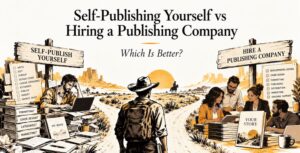
DIY vs Hiring a Publisher: What We See When the Outcome Matters
Whether you publish yourself or hire a team matters most when the book has a job to do: earn back its cost, win clients, or raise the author’s profile. When a book is a personal project, doing it yourself is a perfectly good choice. When the outcome is needed, mistakes become expensive.
That’s the pattern we see at Writers of the West. Many of the authors who contact us have already published once on their own and come back for formatting, distribution or marketing. The problems are usually the same: a cover rejected at upload, an interior that breaks in print, a description written in ten minutes, or a book placed in categories its readers never browse. None of these stop a book from going live. They stop it from being found, and fixing a book after launch costs more than building it right the first time, because the early momentum is already gone.
When we publish a book, positioning comes before the upload. We spend up to 10 business days researching which categories the book can realistically lead, which phrases its readers actually search, and how the strongest comparable books are titled, priced and described. That research is behind the #1 rankings for Love Against the Wall and Custody MD above. Advertising shows the same gap. In our own Amazon Ads campaigns, click-to-sale rates have ranged from about 10% on some books to about 1% on others, and the difference is mostly in the positioning and the listing, not the ad budget.
A ranking proves a book reached its readers. It doesn’t prove profit on its own, which is why the break-even number below matters. But for a professional whose name is on the cover, or an author who needs sales to justify a series, visibility is the outcome. We compare both routes stage by stage in DIY self-publishing vs hiring a publishing company.
If you hire help, you can hire individual freelancers, often through a marketplace like Reedsy, which charges those professionals a 10% service fee (Reedsy), or work with one team under one agreement. Before paying anyone, ask who does the work, what’s included in writing, who owns the files and the KDP account, and whether any share of your royalties goes to them. The right answer to the last question is none.
How Many Copies Do You Need to Sell to Break Even?
Divide your total investment by the royalty you earn per copy. If you clear $4 a copy, a $1,299 investment needs 325 sales and a $5,000 investment needs 1,250. Run this number before you spend anything, because it tells you whether sales alone can ever justify the budget.
Break-even copies = total investment ÷ net royalty per copy (round up)
The $4 figure is illustrative, roughly what a mid-priced paperback or ebook earns after Amazon’s share and printing. What you spend depends on how much you hire out, and we break that down in how much it costs to self-publish a book.
| If you spend | At $4 a copy, you need to sell |
|---|---|
| $500 | 125 copies |
| $1,299 | 325 copies |
| $2,500 | 625 copies |
| $5,000 | 1,250 copies |
For context, $1,299 is our Silver publishing package, which covers ebook, paperback and hardcover editions with distribution to 10+ retailers. It doesn’t include editing, so add editing and advertising to your own figure or the answer will look better than it is.
If 1,250 copies of one book sounds like a lot, it is. A novelist planning a series can treat book one as an investment in books two to five. A consultant can count one new client as the return. A memoirist can decide what the book is worth without pretending sales will settle it.
Here’s a breakeven calculator that can help you calculate how many copies you need to sell to make up what you pay determined by your royalty-rate:
Work out your own break-even
Is Self-Publishing on Amazon Worth It?
Yes, for most authors. Amazon KDP costs nothing to use, pays 70% royalties on ebooks priced $2.99 to $12.99 and up to 60% on paperbacks, and lets you update or revise a book at any time. The trade-offs are that KDP does no editing, design or marketing for you, and its free ISBN only works on Amazon.
Here’s what the platform actually pays and does, as of October 2026:
| KDP feature | What it means for you |
|---|---|
| Ebook royalty | 70% on Amazon.com for prices from $2.99 to $12.99 (minus a small delivery fee), 35% outside that range. The top of the range rose from $9.99 in July 2026 (KDP). |
| Paperback royalty | 60% of list price minus printing at $9.99 and above, 50% below that (KDP). A 300-page paperback at $14.99 costs $4.60 to print and earns about $4.39. |
| Kindle+ (formerly Kindle Unlimited) | Renamed on October 22, 2026, now with audiobooks. Ebooks enrolled in KDP Select earn per page read, in exchange for 90 days of ebook exclusivity. Amazon hasn’t said how the change affects payouts (Written Word Media). |
| Free ISBN | Works for KDP print editions only and lists the publisher as “Independently published” (KDP). Your own ISBN is needed for your own imprint or for printing elsewhere. |
| Revisions | You can upload a corrected file, a new cover or a new edition whenever you like. |
That last row is underrated. A traditionally published book can stay frozen for years. On KDP, an author can fix a typo tonight or come back to a book a decade later. Gerald S. Passmore first released The Paintings in 2014 and returned in 2026 with a revised edition, which self-publishing makes straightforward.
What KDP doesn’t do is decide your categories, keywords and description well for you. Amazon uses those to decide who sees the book, and that’s covered step by step in how we position books to rank on Amazon. The other decision is whether to stay Amazon-only. KDP Select’s page reads and promotions reward exclusivity, while selling through Apple Books, Kobo, Barnes & Noble and libraries spreads your risk.
Is Kindle Self-Publishing Worth It?
Yes. A Kindle ebook costs nothing to print, earns the highest royalty rate on Amazon and is where most romance, fantasy and thriller readers buy. The real decision is whether to enroll it in KDP Select for Kindle+ page reads, which means giving up every other ebook store for 90 days at a time.
Is Self-Publishing Worth It? What Reddit Authors Say
On Reddit’s r/selfpublish, the honest answer from experienced authors is “yes, but not with one book and no plan.” The most common regrets are paying for ads too early, publishing a single short book with nothing for readers to buy next, and spending more than the genre can return.
One poet described spending about $150 a month on Amazon ads for six months while royalties peaked at $100 in a single month. The replies were practical rather than discouraging: poetry rarely supports paid ads, one short book gives readers nothing to buy next, and the price was high for the length. That experience is real. What it shows is that ads didn’t suit that book, not that self-publishing doesn’t work. A romance author with eight books in a series is running a different business, and the survey numbers above say the same thing.
Where Self-Published Books Lose Money
Most losses come from small shortcuts that get expensive after launch, not from the big costs. The usual culprits are unedited AI drafts, print files that fail Amazon’s specifications, rushed descriptions and wrong categories. Each costs far more to fix after publication than before.
The manuscripts that reach us show the same problems again and again: paragraphs repeated by AI drafting tools, prompts nobody deleted, a character whose age changes between chapters, and trim or bleed settings that get a print file rejected. Plenty of independent authors avoid all of these. But fixing them later means re-editing, re-uploading and sometimes a new edition. If you’re using AI tools at any stage, read what AI editing can and can’t catch, and our list of common self-publishing mistakes.
Is Self-Publishing Worth It for Fiction, Nonfiction, Memoir and Poetry?
It depends on the genre. Fiction earns the most in self-publishing, especially series in romance, fantasy and thrillers. Nonfiction pays off mainly through the author’s professional reputation. Memoir is usually worth it for personal reasons, and poetry works best on a small budget sold through readings and direct sales.
Fiction. Income in self-publishing is concentrated here. It rewards authors who write in series, release regularly and use covers that look right for the genre. A standalone literary novel is the hardest kind to make pay.
Nonfiction and business books. They sell when they answer a question readers are already searching for, written by someone with real credibility. For professionals, the bigger return is often what the book brings in indirectly.
Memoir. Usually worth publishing for reasons that have nothing to do with sales. A modest budget protects that value from financial disappointment.
Is Self-Publishing Poetry Worth It?
Yes, if the goal is getting your work to readers who want it, on a budget sized to a small market. Poetry rarely earns back paid advertising, so readings, local bookstores, open mics and a mailing list tend to do more. Our guide to publishing a poetry book goes further.
Is Self-Publishing Better Than Traditional Publishing?
It’s better for authors who want control, faster publication and higher royalties per copy. Traditional publishing is better for authors who want an advance, bookstore distribution and a publisher who carries the financial risk, and who can wait through a long, selective process to get there.
Many authors don’t treat it as a permanent choice. Publishing first and building real sales can make an author more attractive to agents and publishers later. We compare the two routes in self-publishing vs traditional publishing.
When Is Self-Publishing Not Worth It?
Self-publishing usually isn’t worth it when the manuscript isn’t ready, when the plan depends on sales nobody can explain, or when losing the money would genuinely hurt. It’s also the wrong route for an author whose real goal is a traditional advance, and a risky one with any company that won’t put prices and terms in writing.
None of these are reasons never to publish. They’re reasons to fix the plan first.
Frequently Asked Questions
Is it worth it to self-publish a book?
Yes, if the manuscript is ready and the budget matches the outcome you need. A book meant to build a career or a series justifies more investment than a personal project. Most first books sell modestly, so treat the first one as the start of a readership.
Is Amazon KDP worth it for new authors?
Yes. KDP is free, reaches the largest book market in the US and pays 70% on ebooks priced $2.99 to $12.99. Sales depend on positioning, a strong description and marketing, not on being listed.
Can you make money self-publishing a book?
Yes, but most authors earn modest amounts. In the 2025 Written Word Media survey, 44% earned $100 a month or less, while authors with large catalogs and email lists earned far more.
How much does it cost to self-publish a book?
Anywhere from almost nothing to several thousand dollars, depending on how much you hire out. Our cost guide breaks it down line by line.
Do you keep your rights when you self-publish?
Yes. Self-publishing doesn’t transfer your copyright. If you hire a company, check the contract for who owns the files and the KDP account and whether the company takes any share of royalties.
The Verdict
Self-publishing is worth it when you know what the book has to do and spend in proportion to it. For a novelist willing to build a series, it’s one of the few routes where the author keeps both control and most of the money. For a professional, one well-published book can repay its cost many times over without selling many copies. For an author with a story that needs telling, the return is the book itself.
When the outcome matters, the way the book is published matters too. Decide which return you’re after, run the break-even number, and choose DIY or professional help based on how much is riding on the result.
About the Author
Journalist, Historian & Research Editor, Writers of the West
Peter Campbell is an American journalist and historian from Englewood, New Jersey, raised in Rockport, Massachusetts, with a history degree from Boston University. He specializes in research-driven nonfiction, historical context, and fact-based manuscript development.
writersofthewest.net · Professional Ghostwriting, Book Editing & Global Publishing