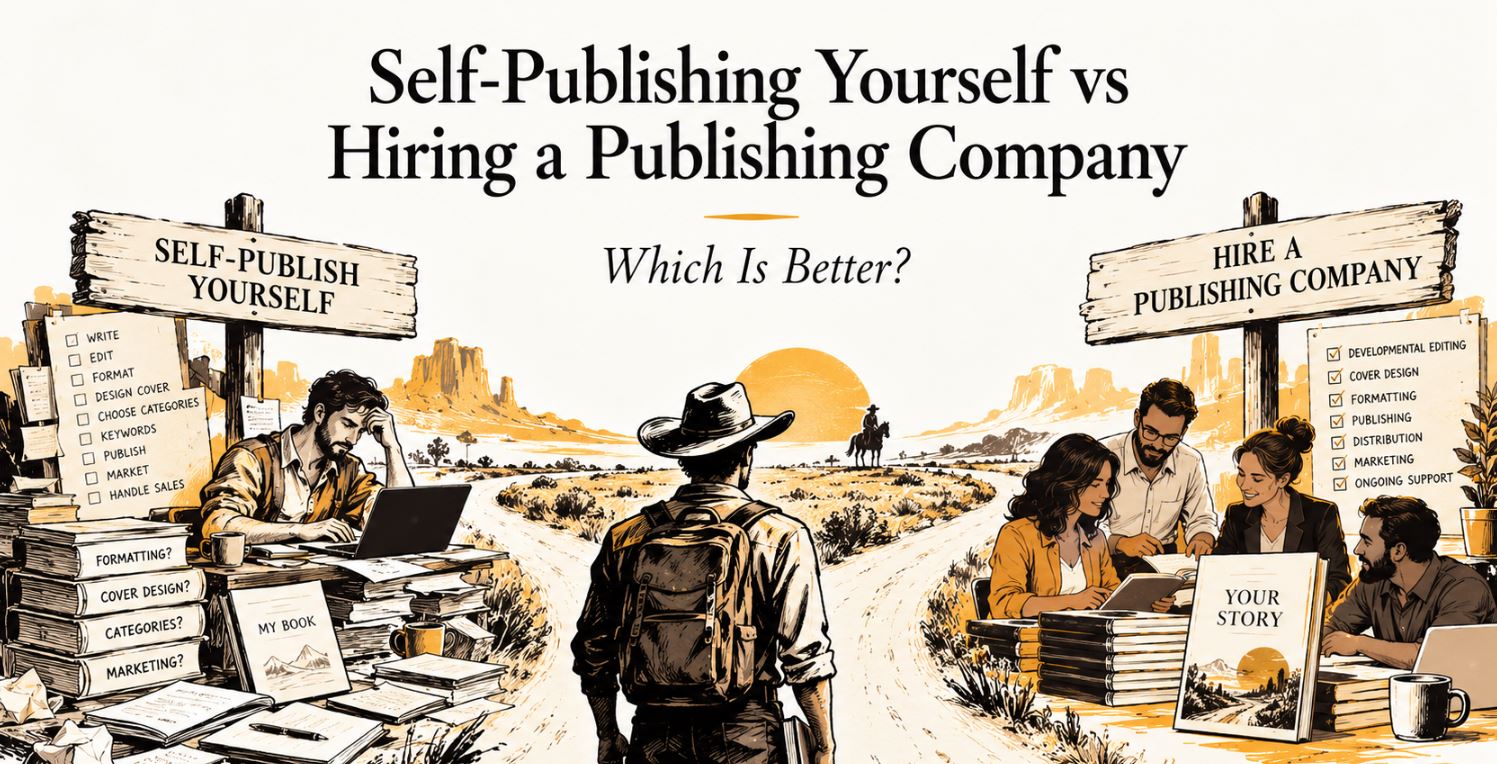
You can upload a book to Amazon KDP yourself for free, but the upload is the only free part. A book that can compete needs professional editing, a print-ready cover built to Amazon’s exact specs, typeset interiors for every edition, researched positioning, distribution beyond Amazon and an author presence readers and search engines can verify. A self-publishing company brings trained specialists, insider data from many published books and existing distribution and marketing reach. DIY gives you none of those by default; you either have the skills, buy them one by one, or publish without them.
The common advice, from forums and AI assistants alike, is “don’t pay anyone, just do it yourself with AI.” What Writers of the West sees in practice is authors who followed that advice, got stuck, and came to a publishing company anyway, usually with problems like these:
- Copyright gaps. The US Copyright Office has concluded that purely AI-generated material can’t be copyrighted, so authors who let AI write large parts of a book may not own protectable rights in those parts. AI output can also echo other people’s work, and Amazon makes the author responsible for any infringement.
- Rejections over AI use. KDP requires authors to disclose AI-generated text, images and translations, and can reject or remove books that give readers a poor experience. Many literary agents and traditional publishers decline manuscripts that read as AI-written.
- AI prompts left in the book. Leftover instructions and chatbot replies like “Certainly! Here’s a revised version of chapter 3” that slipped through into the published text.
- Formatting failures. Broken eBook layouts, misaligned print interiors and covers that don’t match the spine bring complaints, refunds and poor reviews, which push the book’s ranking down and are hard to recover from.
| Factor | DIY self-publishing | Hiring a self-publishing company (e.g. Writers of the West) |
|---|---|---|
| Uploading to KDP | Free | Free; same platform, published through your own account |
| Editing | AI can catch typos; line and developmental editing need a human editor | Professional proofreading, line and developmental editors |
| Print-ready cover | Needs print-design skills: spine width from page count, bleed, CMYK, 300 DPI, one wrap-around PDF. AI image tools don’t produce this file | Built to spec by cover designers for each format |
| Interior | Typesetting, plus indexing, bibliography and notes for nonfiction, in professional layout software | Typesetting, indexing and bibliography preparation by formatters |
| ISBN and publisher name | Free KDP ISBN works on KDP only and shows “Independently published”; your own imprint means buying ISBNs | ISBN route planned for you: KDP ISBN or a purchased Bowker ISBN |
| Amazon positioning | AI suggestions and guesswork; no access to real keyword volume or sales data | Researched against competing books, real search data and results from past launches |
| Distribution reach | Amazon, plus whatever you set up yourself | Established distribution, up to 50+ retailers including bookstore and library networks |
| Marketing reach | Built from zero, one channel at a time | Existing press, blog, influencer, ad and billboard channels |
| Author digital presence | Usually a social profile and maybe a website | Author website, press releases, blog features and listings that reference each other |
| Experience | Usually your first time through each step | A team that has solved each problem many times |
| Upfront cost | Free upload; production, ISBNs and marketing cost extra | Package price |
| Rights and royalties | Fully yours | Fully yours with a reputable company |
The sections below go through each row: what DIY really involves, what AI can and can’t do for you, and how Writers of the West handles the same work.
Is Self-Publishing on Amazon Really Free?
Only the upload is free. Amazon KDP charges nothing to list an eBook, paperback or hardcover. What it doesn’t do is make your files print-ready, design your cover, or give you an ISBN you can use anywhere else. “Free to publish” and “free to publish a professional book” are different claims.
A print cover is a technical file, not just artwork
Amazon’s paperback cover requirements are specific:
- One PDF containing back cover, spine and front cover as a single image
- Spine width calculated from your exact page count and paper type (for example, page count × 0.0025″ on cream paper)
- 0.125″ (3.2 mm) bleed on the top, bottom and outside edges
- Images at 300 DPI minimum, in CMYK, with fonts embedded and transparencies flattened
- Spine text only if the book has at least 79 pages
- A barcode area kept clear on the back cover
Current AI image tools can generate cover artwork. They don’t produce this file: they don’t calculate a spine from your page count, add bleed, work in CMYK or lay out a back cover and barcode zone. Amazon’s free Cover Creator is designed for simple template covers. A cover that competes with professionally published books in its genre still takes a designer who knows both the genre and the print specs.
Every format needs its own formatted file
A paperback interior needs a chosen trim size, margins and a gutter that widens as page count grows. A hardcover has its own specs. An eBook needs reflowable text, working navigation and clean breaks across Kindle devices. A Word document exported once doesn’t cover all three, and formatting faults are one of the most common reasons KDP sends files back.
Owning your publisher identity means buying ISBNs
Print books need an ISBN. Amazon’s ISBN rules give two options:
- Free KDP ISBN. It can only be used on KDP, and the book’s imprint appears as “Independently published.”
- Your own ISBN. You can list your own imprint, and use the same ISBN with other printers and distributors. In the US, ISBNs come from Bowker, at $125 for one or $295 for ten. Each format needs its own.
Your copyright isn’t affected either way. The ISBN decides who is listed as publisher of record and where that number can be used. An author who wants their own imprint and freedom to distribute beyond Amazon has to buy ISBNs.
What Amazon does give you for free
Amazon’s metadata guidelines let you choose up to three categories and up to seven keywords. Those fields are free. Knowing which three categories and which seven phrases will actually get the book found is not. That comes from research and experience, covered in the case study below and in Writers of the West’s Amazon KDP publishing services.
What Does DIY Self-Publishing Actually Require?
DIY self-publishing requires you to do, or hire and manage, about fifteen separate jobs, from editing and typesetting to ISBNs, metadata, distribution and marketing. Uploading the book is only one of them:
- Manuscript preparation. Finishing the draft and deciding it’s ready for an editor.
- Editing. Developmental, line or copy editing, depending on what the book needs.
- Proofreading. A final pass for typos and errors after editing.
- Typesetting and formatting. Separate interiors for eBook, paperback and hardcover, plus indexing, bibliography, notes and image placement for nonfiction.
- Cover design. A front cover for the eBook, plus a full wrap with spine and back cover for print.
- ISBN decisions. Free KDP ISBN or your own, and what that means for wider distribution.
- Metadata. Title, subtitle, series, contributors, reading age and primary marketplace.
- Book description. The copy that sells the book on its product page.
- Keywords. Seven phrases based on how readers actually search.
- Categories. Three categories that are both relevant and winnable.
- Pricing. List price per format, printing costs and royalty goals.
- Upload and troubleshooting. Fixing whatever KDP flags in review.
- Distribution. Deciding whether to go beyond Amazon, and setting it up.
- Amazon page assets. A+ Content, Author Central and editorial reviews.
- Author presence and marketing. A website, press, reviews, ads and outreach, before and after release day.
Several of these are professional trades in their own right: editing, cover design and print layout. Others, like positioning and marketing, depend on judgment built across many books. A DIY author either has those skills, pays separately for them, or publishes without them, and readers can usually tell which.
What Does DIY Self-Publishing Really Cost?
DIY self-publishing costs $0 to upload, but rarely $0 to do properly. The real comparison is money plus skill plus execution risk:
| Cost | DIY | Hiring a company |
|---|---|---|
| Platform | $0 to upload on KDP | $0; the company uses the same platforms |
| ISBNs | Free KDP ISBN (KDP-only, “Independently published”), or $125 for one / $295 for ten from Bowker for your own imprint | ISBN route handled; Bowker ISBN can be included |
| Production | Whatever you pay a freelance editor, cover designer and formatter, or the quality cost of doing it without them | Included in the package price |
| Marketing | Ad spend, website, PR, video, outreach, each bought and managed separately | Included at higher package tiers, or added on |
| Skill and time | Learning cover specs, layout software, metadata research and ad platforms; fixing rejections | Reviewing and approving work |
| Risk | A weak cover, wrong categories, broken formatting or a flat launch, discovered after release | Carried by a team that has made those calls before |
For reference, Writers of the West’s self-publishing packages currently run from $699 for an Amazon-only paperback release to $5,999 for all formats, 50+ retail channels and a full marketing campaign, with payment plans available.
The cheapest path on paper isn’t always the cheapest path in practice. A book published for free with the wrong categories and an unedited manuscript can cost more in lost readers than professional help would have cost in fees. Equally, a simple book for a small audience doesn’t need a $6,000 campaign. Match the spend to the stakes.
Can AI Self-Publish a Book for You?
No. AI can help with narrow tasks like proofreading, but it can’t replace the editor, cover designer, typesetter or publisher, and it’s unreliable on the jobs that decide whether a book sells. Here is where it stands, job by job.
Editing: good for proofreading, weak for line and developmental work
AI tools are genuinely useful for catching typos, grammar slips and inconsistent spelling. Line editing and developmental editing are different. Run a manuscript through AI and the usual results are:
- Repetition. The same phrases, sentence shapes and transitions recur across chapters.
- A generic, recognizable tone. Prose drifts toward the same smooth, interchangeable voice, and readers increasingly spot it.
- Prompt-dependent quality. The output is only as good as the instructions, and a first-time author rarely knows what to ask for.
- Lost voice and structure. AI rewrites sentences; it doesn’t judge whether chapter 4 belongs before chapter 2, or whether the argument holds.
A human developmental or line editor works on what the book is doing, not just how each sentence sounds.
At Writers of the West, we’ve seen a large and growing number of self-published books arrive with AI editing mistakes already in print:
- Chatbot responses left in the text, such as “Here’s a polished version of your paragraph” sitting in the middle of a chapter
- Divider lines and stray symbols carried over when text was copied and pasted out of a chat window
- Formatting inconsistencies from pasting sections in at different times: changing fonts, spacing, heading styles and indents from one chapter to the next
Most of these are found after the book is published, often by buyers who already have copies in hand. A reader who finds a leftover AI reply on page 40 stops taking the book seriously, and often the author with it. For a professional, expert or business author, that damage reaches well beyond one book’s reviews.
Keywords and categories: no access to the real data
An AI assistant can suggest seven keywords and three categories in seconds. They will sound plausible. But Amazon doesn’t publish keyword search volume, and a chat assistant isn’t connected to the research tools that estimate it or to live category rankings. It also has no insider data: which categories moved for similar books, which descriptions converted, which ad targets produced sales. A publisher builds that knowledge across many launches. In Writers of the West’s own Amazon Ads campaigns, click-to-sale rates have ranged from about 10% on some books to about 1% on others, which is exactly the kind of pattern no general AI tool can see.
Covers and formatting: artwork is not a print file
AI image tools generate pictures. They don’t calculate a spine from your page count, add bleed, convert to CMYK, lay out a barcode area or typeset an interior. Those files still have to be built by someone who knows the specs.
The pattern this creates
AI makes DIY feel easier at the start, which is why so many authors go that route. The problems show up later: a cover rejected at upload, an interior that breaks in print, a listing that never surfaces in search. Many authors who contact Writers of the West have already published once on their own and come back for formatting, distribution or marketing. Fixing a published book usually costs more than building it right the first time.
Why Does Publishing Experience Matter When Self-Publishing?
Experience matters because it replaces trial and error. A first-time author meets every publishing decision for the first time. An experienced publishing team has already met most of them, often many times.
The problems that cost DIY authors the most time are rarely dramatic. They’re the ordinary ones that are hard to diagnose when you’ve never seen them:
- A paperback interior rejected for margins or gutter that don’t match the page count
- Bleed errors on image-heavy books, or a cover file sized for the wrong spine width
- An EPUB that looks fine in Word but breaks on a Kindle: lost section breaks, stray page breaks, a dead table of contents
- A category that describes the book perfectly but buries it among thousands of competing titles
- Keywords that sound right to the author but that almost no reader types
- A description that summarizes the plot but never tells a browser why to buy
- A price that undercuts royalties, or sits outside what readers in that genre expect
- A KDP review flag on the files, cover or metadata, and no idea which fix Amazon will accept
Each of these is solvable. The difference is whether you solve it once, from experience, or three times, by guessing. The Writers of the West team brings decades of combined publishing experience, and these are the problems its project managers handle week to week.
What Does a Self-Publishing Company Actually Do? A Writers of the West Case Study
A self-publishing company takes a manuscript through editing, typesetting, cover design, Amazon positioning, distribution and launch under one managed process. Here is how a book moves through Writers of the West, and what you would be doing yourself at each stage.
Stage 1: Manuscript preparation
A professional process starts before anything touches KDP. Every Writers of the West publishing project includes a complimentary editorial assessment, because authors are rarely the best judges of their own manuscript’s readiness.
Where the assessment shows the book needs work, authors can use professional book editing services at the level the manuscript actually needs: developmental editing for structure and argument, line editing for voice and flow, and proofreading for the final pass. Those are three different jobs, and only the last one is something AI handles reasonably well.
Stage 2: Formatting and production
Interior production is far more than converting a Word file. Typesetting means setting fonts, leading, chapter openings, running heads, widows and orphans, and page breaks so a printed page reads like a professionally published book. A paperback also needs the right trim size, margins and a gutter that widens as page count grows; a hardcover has its own specs; an eBook needs reflowable text and working navigation across Kindle devices.
Nonfiction adds another layer. Indexes, bibliographies, endnotes, tables and images all have to survive every format, and an index has to be rebuilt whenever pagination changes. Writers of the West’s self-publishing packages include interior formatting and typesetting, plus indexing and bibliography preparation where a book needs them.
Covers create a separate problem. Print editions need a full wrap: front, spine and back, sized to the exact page count and paper type. Writers of the West prepares interior and cover files for each format the author chooses, then sends them for the author’s approval before upload. Authors who want only this stage can use standalone book formatting services.
Stage 3: Amazon positioning before publication
This is the stage most DIY authors skip, and where experience shows most. A manuscript can be technically ready for Amazon before it’s strategically ready. Writers of the West takes up to 10 business days before publishing to research where a specific book can compete. The process, documented in how Writers of the West positions books to rank on Amazon, runs in this order:
- Identify every legitimate category. List all Amazon categories where the book genuinely belongs, and no others.
- Assess each one. Evaluate each category against a set of internal factors developed over years of publishing. Competition is one factor, not the only one.
- Study the competition. In the strongest candidates, analyze roughly the top 10–15 ranking books: titles, subtitles, descriptions, positioning and search language. The question is why those books rank, not how to copy them.
- Research reader language. Find the terms readers actually use to look for books like this one. They often differ from the author’s own words.
- Decide the positioning. Combine the category, competition and search findings to find where the book’s real strengths meet real reader demand.
- Build the listing around it. Description, keywords, categories, subtitle (if still flexible), Author Central and A+ Content all support one coherent position.
This process has produced documented #1 results. A Walkthrough of the Bible by Doug Kroeker reached #1 in New Releases in Paul’s Letters within its first week. Custody MD by Dr. Adwoafuaa Nwokocha reached #1 in two New Releases categories at once. Love Against the Wall by Hagos Weldegebriel Debesay reached #1 Best Seller in Middle Eastern Literature within its first week. These are snapshots of specific moments, not permanent rankings, and no publisher can guarantee a #1 position.
The book description
A good description has two jobs, and most fail one of them. It must make clear what the book is, using words relevant readers understand and search for. And it must sell the book to the person already on the page, deciding whether to click buy.
Descriptions that read like a synopsis tend to fail the second job. Descriptions built on atmosphere and adjectives fail the first. Descriptions stuffed with keywords fail both, and Amazon’s guidelines prohibit keyword phrases in the description field anyway.
Writers of the West writes descriptions from the positioning research, not from the manuscript alone. The starting question isn’t “what happens in this book?” It’s “what is the reader who would love this book looking for, and what do they need to hear to choose it over the ten books beside it?”
Keywords
There is a difference between typing seven words into KDP and building a keyword strategy. Amazon lets authors enter up to seven keywords. A DIY author often fills them with phrases that feel accurate, or asks an AI tool for suggestions that sound plausible but match nothing readers type.
A researched approach works differently. It starts with the phrases readers actually use, checks them against competing books, tests each for relevance to this book’s content, and makes the keywords, description and categories reinforce each other. Amazon prohibits keywords that reference other authors, other books or sales rank, so relevance is a rule, not just good practice.
Categories
Writers of the West doesn’t pick whichever category looks easiest. Relevance comes first: Amazon’s guidelines prohibit categories unrelated to the book’s content. Within the relevant set, the team weighs competition and realistic ranking opportunity. A category can describe a book perfectly and still leave it invisible among thousands of titles.
Other Amazon assets
The upload is not the end of the Amazon work. Depending on the package, Writers of the West also handles:
- Pricing, set against Amazon’s printing costs, genre norms and the author’s royalty goals
- ISBN decisions: the free KDP ISBN, or a Bowker ISBN where wider use makes sense
- KDP review issues: if Amazon flags the manuscript, cover, metadata or print specs, the team revises and resubmits
- Author Central: author profile, biography and photo
- Editorial reviews placed on the product page
- A+ Content: the image-and-text modules below the description
- Amazon Ads and launch strategy, for authors who add marketing
All of this sits inside Writers of the West’s Amazon KDP publishing services, coordinated by one dedicated project manager.
Is It Cheaper to Hire Freelancers Than a Self-Publishing Company?
Not always. Hiring freelancers separately makes you the general contractor for your own book. Most DIY authors don’t do every job alone. They hire some of it out, and then they manage the people they hired. A fully professional DIY book can involve separately hiring:
- an editor and a proofreader
- a formatter and a cover designer
- a publishing or metadata specialist
- a website designer and a PR person
- an advertising specialist and a social media marketer
Each one is a separate search, price negotiation, brief, revision loop, deadline and handoff. When the formatter’s files don’t match the cover designer’s spine width, the author is the one who has to notice, and the one who has to get them talking.
Think of building a house. You can hire your own plumber, electrician, carpenter, tiler and painter. A contractor is valuable because the trades are coordinated under one schedule, and someone else answers for the gaps between them. Publishing works the same way.
Writers of the West runs a high volume of publishing projects through an established team and a managed workflow, coordinated by a single project manager. An author hires the company once, rather than paying one-off specialist rates and coordinating every provider individually.
In DIY, every specialist reports to the author. In a managed model, one project manager carries the coordination.
That doesn’t mean an agency is always cheaper. A disciplined author who needs only an editor and a cover designer may spend less hiring those two directly. The real advantage is narrower and more defensible: bundling production under an established high-volume workflow can reduce both coordination costs and the premium attached to hiring every specialist as a separate one-off engagement.
How Hard Is It to Market a Self-Published Book Yourself?
Harder than publishing it. Publishing takes weeks; marketing is ongoing, and it’s where the DIY workload grows fastest. “Post about it on social media” is not a marketing plan. A serious campaign can draw on a dozen or more separate channels, each with its own skills, tools and costs.
Here is the range of capabilities Writers of the West’s book marketing services cover, grouped by where they work:
| Where it works | Capabilities |
|---|---|
| On Amazon | Amazon Ads, category positioning, bestseller campaign strategy, A+ Content, editorial reviews, listing audits |
| Online, off Amazon | Social media promotion, paid social ads (Facebook, Instagram, TikTok), niche book-blog features, influencer outreach, podcast promotion |
| Media | Press release distribution, book video trailers |
| Author brand | Author website with direct book sales, branding assets, printed flyers |
| Reach | Global distribution, digital billboards in the author’s chosen city |
Doing even three of these yourself means learning three ad platforms or outreach processes, and judging which results are real. A placement isn’t a sale, a follower count isn’t influence, and a syndicated press release isn’t editorial coverage. Writers of the West’s own guide to book marketing strategies that actually work covers how to tell the difference.
Not every author needs every marketing channel. A first memoir for family and community needs a very different plan from a business book meant to build a consulting practice. The value of a full-service team is that those capabilities already exist when the book needs them, and someone who has run them before decides which ones fit.
What Is an Author’s Digital Presence, and Why Does It Matter?
An author’s digital presence is the network of websites, articles, press and profiles that confirm who the author is, and it decides whether readers, media, search engines and AI tools take that author seriously. When a reader, journalist or podcast host hears about a book, they search the author. When someone asks Google or an AI assistant about a topic, those systems favor names they can confirm across several trustworthy sources. An author who exists only as an Amazon listing and a social profile gives them almost nothing to work with.
A strong author presence is a set of sources that point to and confirm each other:
- An author website with the book, the bio and links to every retailer
- Press releases distributed to news sites, naming the author, book and subject
- Blog features and articles on niche book and topic sites that link back to the author
- Retail and reader profiles such as Amazon Author Central and Goodreads, with consistent names, bios and photos
- Editorial reviews placed on the product page and quoted elsewhere
- Podcast, interview and guest-post appearances that mention the book by name
Each piece on its own does little. Together, with the same name, bio and book details everywhere, they make the author look established to readers and easier for search engines and AI tools to recognize. That is how an author begins to rank for their own name and their book’s subject.
This is hard for someone who has just finished writing a book. It takes web design, PR writing, outreach to editors and site owners, and the patience to keep every profile consistent. A new author also has no existing media relationships to pitch through. Writers of the West builds these pieces as part of its marketing work: author websites, press releases to 100+ news outlets, features on high-traffic book blogs, editorial reviews and Author Central setup, all pointed at the same author and book.
Should You Distribute Your Book Beyond Amazon?
Usually, yes. Amazon is enormous, but it isn’t the whole book market. Some readers buy eBooks on Apple Books or Kobo. Some want a print copy from Barnes & Noble, Walmart or an independent bookstore. Libraries order through their own channels.
The right question isn’t how many platforms a book is on. It’s which readers the book needs to reach, and where they buy. Some authors genuinely need only Amazon. Others care about:
- bookstore and library availability
- international retailers
- multiple eBook stores
- print distribution beyond Amazon
- formats Amazon handles differently, such as audiobooks
There’s also a real tradeoff to plan around. Enrolling an eBook in KDP Select, which unlocks Kindle Unlimited and Amazon’s promotion tools, requires that eBook to be exclusive to Amazon for each 90-day term. Going wide and going exclusive are different strategies, and picking one by accident is a common DIY mistake.
Writers of the West’s self-publishing services scale distribution by package, from Amazon alone up to 50+ retail channels, including Ingram-based bookstore and library distribution. Each retailer listed on that page links to a live book Writers of the West has published there, from Barnes & Noble and Waterstones to Walmart, Target, Apple Books and Kobo, so authors can verify the distribution rather than take it on trust.
Do You Lose Your Rights If You Hire a Self-Publishing Company?
Not with a reputable company. It depends on the company and the agreement. Some assisted-publishing arrangements keep books in company-controlled accounts, take a share of royalties, or attach conditions to when the author gets full rights and production files. Others don’t.
Before signing with any company, check four things in writing:
- Whose account is the book published in? Yours, or the company’s?
- Who keeps the royalties? All of them, or does the company take an ongoing percentage?
- When do you own the files? From signing, or only after final payment or project completion?
- Whose name is listed as publisher? And do you get to choose?
With Writers of the West, the answers are on the record. According to its Amazon KDP publishing page, the book is published through the author’s own dedicated KDP account, and the author keeps 100% of ownership, publishing rights and royalties. The author also decides whether Writers of the West is named as publisher. Its self-publishing page adds that ownership starts from the day the contract is signed, not on completion or final payment, and that the company takes no ongoing percentage of book sales.
In practice, that means hiring Writers of the West changes who does the work, not who owns the book.
When Should You Self-Publish a Book Yourself?
Self-publish yourself when you already have the skills, the book is simple, and reach beyond Amazon doesn’t matter. That’s a narrower group than the usual advice suggests. DIY is the better choice when most of these are true:
- You already have professional editing, cover design or typesetting skills, or have published before
- The book is simple: a novel or short guide with no index, bibliography or complex layout
- You only need an Amazon release, and the free KDP ISBN is fine for you
- You already have an audience and the marketing experience to reach it
- The book is for a small circle, such as a family history or a community resource, and commercial reach doesn’t matter
- You have a real budget for the freelancers you’ll still need, and the time to manage them
If only one or two of these describe you, “do it yourself” usually becomes “do some of it yourself, then pay to fix the rest.” That is the most expensive way to publish.
When Is It Worth Hiring a Self-Publishing Company?
It’s worth hiring a self-publishing company when the book needs professional-grade production and a reach you can’t build alone. Saving time is part of it, but the bigger difference is skill and exposure: trained editors and designers, positioning research, established distribution and existing marketing channels. The strongest cases are:
- Entrepreneurs, executives and experts whose book supports a business, practice or speaking career
- Professionals whose book represents their reputation to clients and peers
- Serious career authors planning a series or several releases
- Authors publishing several formats at once: eBook, paperback, hardcover and audiobook
- Authors who want broad distribution, including bookstores, libraries and international retailers
- Authors with limited time who would rather write the next book than learn to format this one
- Authors who want a coordinated launch, with marketing planned before release day rather than after
The more commercially or professionally important the book is, the greater the cost of getting the production and positioning wrong. A typo-filled memoir shared with family is an embarrassment. A typo-filled business book handed to prospective clients is a lost deal.
Frequently Asked Questions
Can I self-publish without a company?
Yes, you can upload directly to Amazon KDP for free. To publish a professional print book you still need a print-ready cover, formatted files for each edition, and, for your own imprint, purchased ISBNs. You can do or buy those yourself, or have a company handle them.
Do I need a publisher to self-publish on Amazon?
No. KDP describes itself as a service for authors and publishers, not a publisher. With the free KDP ISBN your print book shows “Independently published”; to list your own imprint you need to buy your own ISBNs. If you work with a company, check whether you get to choose the publisher name.
Is hiring a self-publishing company worth it?
It’s worth it when you don’t have professional editing, design and layout skills yourself, when the book matters professionally or commercially, or when you want distribution and marketing reach beyond Amazon. It’s usually not worth it if you already have those skills and need only a simple Amazon release.
Amazon KDP vs a publishing company: what’s the difference?
KDP is the platform where the book is sold. A self-publishing company is a service that prepares the book and manages it on platforms like KDP. With a reputable company, the book is still published on KDP, ideally through your own account.
Will I lose my rights or royalties if I hire a self-publishing company?
Not with a reputable one, but read the contract. Check whose account the book sits in, who keeps royalties, and when you own the files. Writers of the West publishes through the author’s own KDP account and the author keeps 100% of rights and royalties.
How many categories and keywords does KDP allow?
KDP currently allows up to three categories and up to seven keywords per book. Both must accurately describe the book’s content under Amazon’s metadata guidelines.
Can I use AI to self-publish my book?
You can use AI for parts of it, such as proofreading and first-draft ideas. AI can’t produce a print-ready cover file, typeset an interior, give you real keyword search volume or sales data, or do line and developmental editing without generic, repetitive results. Those still need trained people or professional tools.
Sources
- Amazon KDP: Start publishing with KDP
- Amazon KDP: Content Guidelines (AI content, poor customer experience)
- Amazon KDP: Create a Paperback Cover
- Amazon KDP: What is an ISBN and Imprint?
- Amazon KDP: Metadata Guidelines for Books
- Amazon KDP: Make your book more discoverable with keywords
- Amazon KDP: How to enroll in KDP Select
- US Copyright Office: Copyright and Artificial Intelligence, Part 2: Copyrightability (confirm the link opens before publishing)
- Books.by: Bowker ISBN pricing (verify against myidentifiers.com before publishing)
- Writers of the West: Amazon KDP publishing services
- Writers of the West: Self-publishing services
- Writers of the West: Book marketing services
- Writers of the West: How we position books to compete for #1 on Amazon
- Writers of the West: Book marketing strategies in 2026
About the Author
Mindset & Transformational Nonfiction
Editor, Writers of the West
Brienna Burroughs holds an M.A. in English Literature from the University of Arizona and works with Writers of the West across mindset, motivation, Christian memoir, and psychological thriller manuscripts. A lifelong lover of mind-bending fiction, she brings a strong editorial instinct for narrative clarity, emotional tension, and voice consistency. Her work helps authors refine their message into structured, impactful writing that resonates with readers seeking transformation or gripping storytelling.
writersofthewest.net ·
Professional Ghostwriting Services, Book Editing & Publishing Guidance