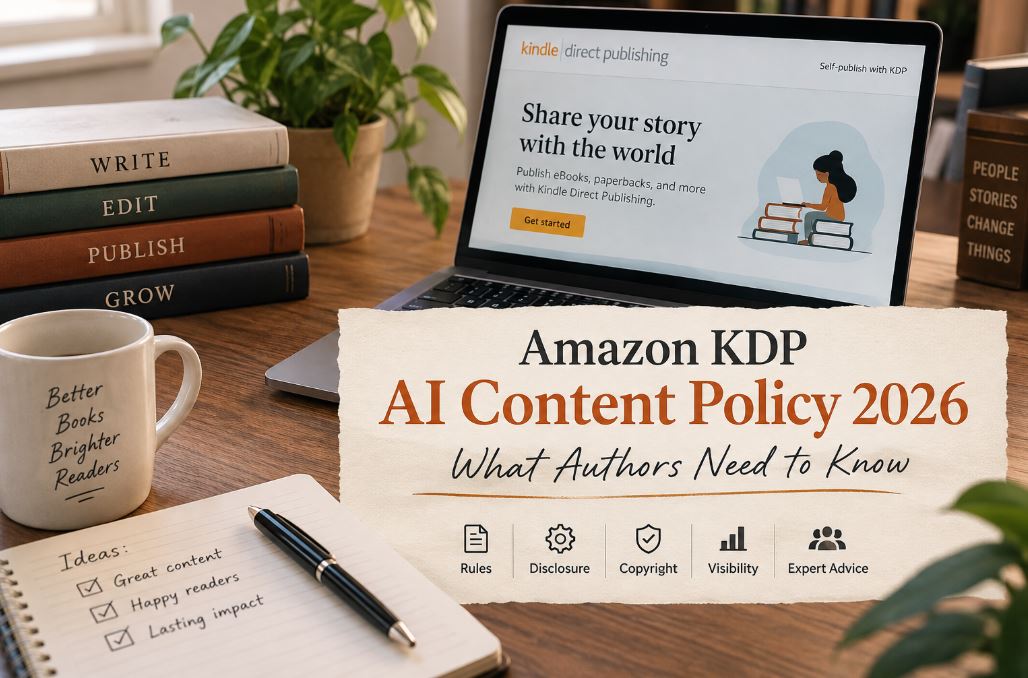
Yes, Amazon KDP allows AI-generated content in 2026. Publishers have to disclose AI-generated text, images and translations when they publish or republish a book. AI-assisted content doesn’t need to be disclosed. The line between the two comes down to who actually created the content, not how much editing happened after the fact.
We checked this guide directly against Amazon’s current KDP Content Guidelines before publishing it. Amazon states that publishers must disclose AI-generated text, images and translations, including AI-generated cover and interior artwork, and that AI-assisted content requires no disclosure at all.
Quick answer: AI-generated vs. AI-assisted on KDP
| Use of AI | Amazon classification | Disclosure required? |
|---|---|---|
| AI writes a chapter | AI-generated | Yes |
| AI writes a chapter, human heavily edits it afterward | AI-generated | Yes |
| AI generates the cover | AI-generated | Yes |
| AI generates interior illustrations | AI-generated | Yes |
| AI translates the manuscript | AI-generated | Yes |
| Human writes it, AI checks grammar | AI-assisted | No |
| Human writes it, AI helps refine the wording | AI-assisted | No |
| AI helps brainstorm ideas, human writes the actual content | AI-assisted | No |
Verify any edge case against Amazon’s current wording before you publish. Policy language shifts, and a table like this one is only as good as its last review date.
Does Amazon KDP allow AI-generated books in 2026?
Yes. Amazon’s current KDP policy doesn’t ban AI-generated books as a category. It requires publishers to disclose AI-generated text, images and translations, and it requires everything else about the book, cover, and description to comply with KDP’s other content and intellectual property rules. That’s a meaningfully different claim than “Amazon approves AI books,” and it’s worth being precise about it: allowed subject to the rules, not blessed outright.
AI-generated vs. AI-assisted content, in Amazon’s own words
This is the distinction that decides everything else in this article, so it’s worth quoting directly from the source rather than paraphrasing it into mush.
AI-generated. Amazon defines this as text, images, or translations created by an AI-based tool. If an AI tool created the actual content, whether that’s the prose, the artwork, or the translated text, Amazon calls it AI-generated. That holds true even after substantial human edits.
AI-assisted. If a human created the content and then used AI to edit, refine, error-check, or otherwise improve it, that’s AI-assisted, and it doesn’t need to be disclosed. The same goes for brainstorming: if AI helped generate ideas but a human wrote the actual text or made the actual images, that’s still AI-assisted.
The practical distinction is origin, not the amount of editing afterward. If AI generated the underlying content, substantial human editing does not change Amazon’s classification. If a human created the content and AI only refined, edited or error-checked it, Amazon considers it AI-assisted.
The myth that refuses to die: does heavy editing turn AI writing into AI-assisted?
No. This is false under Amazon’s current definition, and it’s probably the single most common misunderstanding among authors we talk to.
Amazon’s guidelines state plainly that AI-generated content is still AI-generated “even if you applied substantial edits afterwards.” A manuscript that started as an AI draft and went through three rounds of human copy editing is still AI-generated under KDP’s rules. Compare that with a manuscript a human wrote from scratch, where AI was brought in afterward to tighten sentences or catch typos. That second one is AI-assisted.
Same amount of AI involvement, different classification depending on sequence. Write it yourself and use AI to polish it afterward, and Amazon classifies it as AI-assisted, no disclosure required. Have AI write it and polish it yourself afterward, and Amazon still classifies it as AI-generated, disclosure required.
Don’t try to launder AI-generated text into AI-assisted status by editing it hard enough. It doesn’t work that way, and the checkbox in the publishing flow is asking about origin, not about your editing hours.
Does Amazon publicly label AI-generated books for shoppers?
Amazon requires the disclosure to KDP. What Amazon’s current public Content Guidelines do not state is that this disclosure then shows up as a customer-facing “AI-generated” label on the book’s product page. We looked. It isn’t there.
So the honest answer sits somewhere between two claims people love to make with more confidence than the evidence supports. It’s not accurate to say “Amazon keeps it private forever, guaranteed.” It’s also not accurate to say “Amazon publicly flags AI books for readers.” What we can say is narrower: Amazon requires disclosure to KDP, and its current public guidelines don’t describe that disclosure appearing anywhere a shopper would see it.
Audible is a useful point of contrast here, because it shows Amazon-owned platforms don’t all handle this the same way. Audible’s Virtual Voice audiobooks, Amazon’s AI narration program, are labeled “Narrated By: Virtual Voice” right on the listing, visible to readers before they buy. KDP’s text and image disclosure works differently: it’s collected in the publishing flow, and Amazon’s current guidelines don’t describe an equivalent customer-facing label for it.
Why does Amazon even ask about this, and could it affect your visibility?
Start with the plain fact: Amazon built a whole question into the publishing flow for this. Authors don’t get asked to disclose things Amazon treats as irrelevant to how a book performs. So why does the AI question exist at all, if the answer supposedly changes nothing?
Amazon hasn’t fully explained what it does with the answer. Possible reasons include compliance tracking, content quality monitoring, intellectual property enforcement, general policy enforcement, or groundwork for a decision Amazon hasn’t announced yet. All of that is reasonable guesswork, not something Amazon has confirmed, and we’d rather say so plainly than dress up a guess as an established fact.
That leaves an obvious follow-up question: could visibility be one of those reasons? Could the answer to that checkbox feed into search ranking, recommendations, merchandising placement, or discovery in any way? Honestly, we don’t know, and neither does anyone else writing confidently about this topic in either direction. Amazon hasn’t said AI-declared books get suppressed. It also hasn’t guaranteed that the disclosure is irrelevant to search, recommendations, merchandising, or discovery. Both possibilities sit in a gap Amazon hasn’t closed.
This next part is our opinion as publishers, not an Amazon policy statement, and we want to be explicit about that distinction. If Amazon specifically collects a piece of information, we wouldn’t assume it can never matter just because Amazon hasn’t spelled out every use of it. When actual sales and visibility are riding on the answer, why introduce an unknown that doesn’t need to exist in the first place?
That’s the reasoning behind our recommendation, and it has nothing to do with hiding anything from Amazon. It’s about the checkbox never carrying any uncertainty at all. Have the manuscript written by the author or a professional writer. Have it edited by professional book editors. Use AI as a tool where it genuinely helps, not as the author of the book. A manuscript built that way answers the disclosure question honestly, with nothing to weigh against sales, because the question resolves itself before you ever reach the publishing flow.
Does Amazon detect AI-generated writing?
Be careful with this one, because a lot of the content already ranking for this question overstates what’s actually known.
Amazon’s general Content Guidelines describe enforcement through “a combination of machine learning, automation, and dedicated teams of human reviewers.” That’s a statement about how Amazon enforces its content policies broadly. It is not the same claim as “Amazon runs AI-generated text through a dedicated AI-detection tool,” and Amazon’s public guidelines don’t make that second, more specific claim. Those are two different things, and conflating them is exactly the kind of unsupported leap that makes an article less trustworthy, not more.
If Amazon has a specific automated detector for AI-generated prose, it hasn’t described one publicly. Until it does, the accurate answer is that Amazon reviews content through a mix of automated systems and human reviewers, and the disclosure requirement means authors are supposed to self-report rather than rely on Amazon to catch it.
AI book covers and interior illustrations
Amazon’s disclosure requirement explicitly covers images, not just text. That includes cover art and interior artwork.
Practical result: an author can write every word of a manuscript by hand and still have AI-generated content to disclose, because the cover came from Midjourney or a similar tool. This shows up constantly with children’s book illustrators, coloring book creators, and anyone using AI for cover concepts. A human-written manuscript with an AI cover is still, in Amazon’s terms, a book containing AI-generated content, and it needs to be disclosed as such. Authors who’d rather sidestep that disclosure question on the cover entirely can work with a professional cover designer instead of an AI art tool.
AI translations
Amazon’s AI content policy names translations specifically, alongside text and images.
Human writes an English manuscript, AI produces the Spanish edition: that’s an AI-generated translation, and it needs disclosure. Human translator does the actual translation work, and AI is brought in afterward to check phrasing or catch errors: that’s potentially AI-assisted, provided a human genuinely created the translated content and AI only refined it. The same origin-versus-effort test applies here that applies to text.
Amazon itself offers generative AI tools
Worth saying clearly, because it’s easy to read this whole article as anti-AI when that’s not the point: Amazon builds AI tools into its own publishing platform.
KDP currently offers a generative AI feature for certain A+ Content modules in the United States, marked with an “AI Ready” badge. Publishers can generate text and images for eligible modules, guided by optional prompts. Amazon’s own documentation tells publishers to review the generated output carefully and states plainly that the publisher remains ultimately responsible for what shows up on the book’s detail page, and that Amazon will remove noncompliant content regardless of how it was made.
So the framing isn’t “Amazon dislikes AI.” Amazon builds AI tools for its own sellers to use. The consistent thread through everything Amazon publishes on this is narrower: use AI if it helps, but the publisher carries the responsibility for the result either way.
Can you copyright an AI-generated book?
This is a different question from whether Amazon will let you sell the book, and mixing the two up is a common mistake in articles covering this topic.
The U.S. Copyright Office’s Part 2 report, released in January 2025, concluded that generative AI outputs can receive copyright protection where a human contributed sufficient expressive elements, whether through creative selection, arrangement, or modification of the output, or through human-authored work that’s perceptible within it. Simply typing prompts, even detailed ones, isn’t enough on its own to establish authorship. The report also confirms that using AI as an assistive tool, or folding AI-generated material into a larger human-authored work, doesn’t disqualify that work from copyright protection.
The distinction to hold onto: KDP eligibility and copyrightability are governed by two entirely different systems. Amazon deciding a book can go up for sale on its platform says nothing about whether every element of that book qualifies for copyright protection under U.S. law. A book can clear KDP’s bar and still have its purely AI-generated illustrations sit outside copyright protection, while the human-written text is protected. This isn’t legal advice, and an author with real stakes riding on this, a dispute, a contract, a large advance, should talk to an actual intellectual property attorney rather than lean on a blog post.
Quality still matters, disclosure or not
Disclosing AI-generated content doesn’t exempt a book from anything else. Amazon’s guidelines are explicit that publishers remain responsible for making sure AI-generated and AI-assisted content complies with all of KDP’s content guidelines and any applicable intellectual property rights.
That responsibility doesn’t evaporate because a box got checked. Editing quality, factual accuracy, formatting, the actual reading experience, originality and rights clearance, metadata accuracy, cover quality, proofreading: none of it gets a pass just because the AI disclosure field says yes. If anything, a declared AI-generated manuscript probably needs a more careful human pass before publication, not less, because AI writing tends to introduce its own particular failure modes: confident-sounding factual errors, generic phrasing, structural repetition across chapters.
What’s actually changed in Amazon’s AI policy during 2026?
We’re not going to manufacture a dramatic “new 2026 policy” if Amazon didn’t introduce one. Based on Amazon’s current documentation as of this review, the core disclosure framework, AI-generated versus AI-assisted, the substantial-edits rule, the text-images-translations scope, reflects Amazon’s standing policy rather than a fresh 2026 overhaul.
What has changed is the ecosystem around it: wider availability of the A+ Content generative AI tools, continued growth of Virtual Voice audiobooks on Audible, and a steady stream of secondary articles that restate, and sometimes distort, the same underlying rules. If you’re reading advice elsewhere about volume caps, older account restrictions, or outdated disclosure mechanics, cross-check it against Amazon’s current help pages before you act on it. Old advice about this topic ages fast, and a lot of it is still circulating.
What we recommend to authors in 2026
If you’re writing the book yourself: write the manuscript. Use AI to brainstorm, refine, or check your own work, which falls squarely inside Amazon’s AI-assisted definition and needs no disclosure.
If you’re hiring someone to write it: work with a professional ghostwriter who produces the actual manuscript, then have it go through professional human editing. That’s the path that keeps the finished book unambiguously human-created.
If AI already generated the manuscript: don’t assume editing afterward changes its classification. It doesn’t. Disclose it according to Amazon’s current policy and move forward from an accurate starting point.
If AI generated your cover or interior illustrations: the same disclosure requirement applies to images. Check it honestly, separate from whatever you decided about the text.
If you’re not sure where something falls: check Amazon’s current Content Guidelines immediately before you hit publish. Platform policy can shift, and the version you read six months ago may not be the version in effect today. If you’d rather hand off the actual mechanics of publishing through KDP, including the disclosure step, that’s a reasonable thing to delegate.
Frequently asked questions
Does Amazon KDP allow AI-generated books in 2026? Yes. Amazon requires disclosure of AI-generated text, images, and translations, but doesn’t ban the category itself. The finished book still has to meet KDP’s other content and IP requirements.
Do I have to disclose AI-generated content on Amazon KDP? Yes, for text, images, or translations an AI tool actually created, even after substantial human editing.
Do I have to disclose AI-assisted content? No. If you created the content and used AI only to edit, refine, error-check, or brainstorm, Amazon’s current policy doesn’t require disclosure.
If I edit AI-generated text heavily, do I still have to disclose it? Yes. Amazon’s guidelines specifically state that substantial edits don’t reclassify AI-generated content as AI-assisted.
Does Amazon label AI-generated books for customers? Amazon’s current public guidelines don’t describe the disclosure appearing as a customer-facing label. Audible’s Virtual Voice audiobooks do carry a public “Narrated By: Virtual Voice” label, so the two Amazon-owned platforms clearly don’t handle this the same way.
Can checking the AI-generated box affect my Amazon ranking? There’s no public evidence either way. Amazon hasn’t said disclosure lowers visibility, and it hasn’t guaranteed disclosure plays no role in search, recommendations, or merchandising, so treat it as a genuine unknown.
Does Amazon KDP detect AI-generated writing? Amazon describes general enforcement through machine learning, automation, and human reviewers, but it hasn’t publicly described a specific AI-text detector separate from that. Authors are expected to self-disclose rather than rely on Amazon catching it.
Can I use ChatGPT or a similar tool to write a book for KDP? Yes, but the resulting text counts as AI-generated under Amazon’s policy and needs disclosure, regardless of how much you edit it afterward.
Can I use AI to edit a book without disclosing it? Yes, as long as you wrote the underlying content yourself. That’s the standard case of AI-assisted content.
Does Amazon allow AI-generated book covers? Yes, but they need to be disclosed as AI-generated images, the same as AI-generated text.
Can I publish AI-generated coloring books? Yes, with disclosure for the AI-generated artwork. A deterministic, non-AI puzzle or maze generator is a separate case and generally isn’t considered AI-generated content.
Are AI translations allowed on KDP? Yes, disclosed as AI-generated translations, unless a human did the actual translation and AI only refined it afterward.
Can AI-generated books be copyrighted? Purely AI-generated elements with no meaningful human creative input generally aren’t copyrightable under current U.S. Copyright Office guidance. Elements with sufficient human authorship, selection, arrangement, or modification can be protected, which is a separate question from whether Amazon will sell the book.
Is Audible’s AI policy the same as KDP’s? No. KDP’s disclosure is collected internally with no described customer-facing label, while Audible’s Virtual Voice narration is publicly labeled right on the listing. Same parent company, two different approaches to the same underlying issue.
This guide reflects Amazon’s KDP Content Guidelines and A+ Content documentation as reviewed in September 2026, along with the U.S. Copyright Office’s January 2025 report on generative AI and copyrightability. Amazon’s policies can change; check the current Content Guidelines before publishing.
About the Author
Author, Writing Coach & Senior Manuscript Editor
Thomas Schaffer is an author, writing coach, and senior manuscript editor with nearly two decades of professional experience. He holds a B.A. in Communications from the University of Texas at Austin and specializes in health, lifestyle, leadership, and personal-development books.
writersofthewest.net · Professional Ghostwriting Services, Book Editing & Publishing Guidance