How to Write a Book Outline: A Step-by-Step Guide With Examples
There’s no single correct way to outline a book. A thriller writer and a first-time memoirist need almost nothing in common structurally, and most generic outlining advice pretends otherwise, handing everyone the same ten bullet points regardless of what they’re actually writing. The right outline depends on what kind of book this is and what specific problem the outline needs to solve for you. Here’s the process we actually walk authors through, along with a template you can copy directly.
What Is a Book Outline?
A book outline is a working plan that maps what each part or chapter of a book needs to accomplish before drafting begins. Depending on the book, it may include chapters, scenes, arguments, evidence, character arcs, turning points, or key takeaways. A useful outline shows not only what comes next, but why it belongs there.
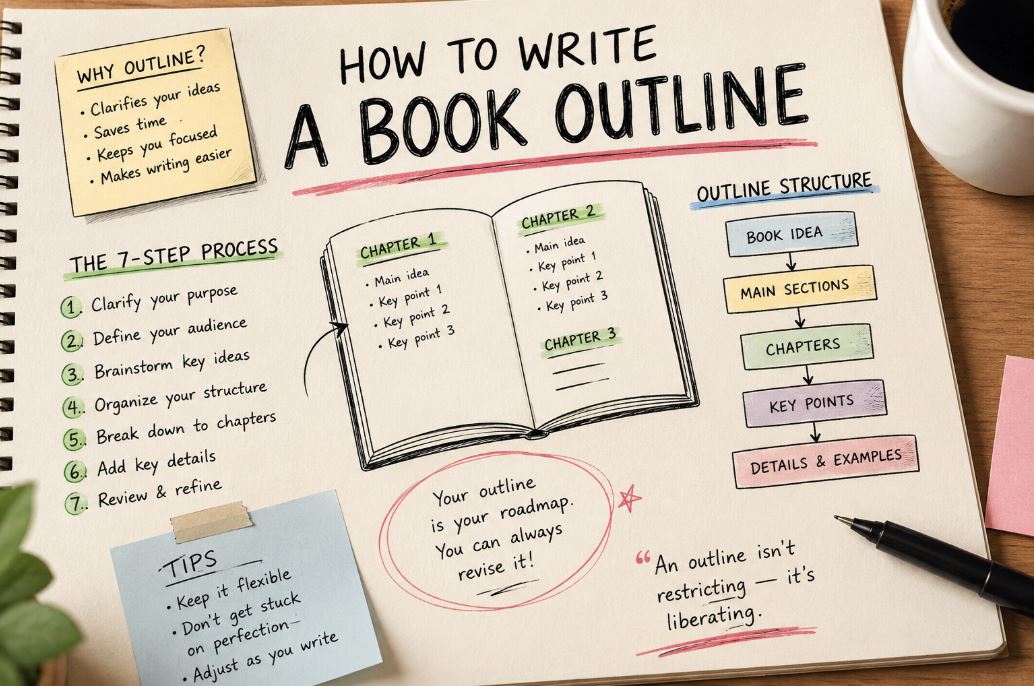
How to Write a Book Outline in 7 Steps
- Write a rough summary of the whole book, a few pages, no polish required
- Divide that summary into working chapters or parts
- Add pointers under each chapter, not finished writing, just notes
- Sit with one chapter at a time before moving to the next
- Arrange the chapters in the order that actually serves the book
- Turn each chapter’s pointers into a real working outline
- Stress-test the whole thing and revise before you start drafting
The version of this most people skip is step one, and it’s the one that actually matters most. Before you touch chapters, write the whole story or argument in rough summary form, a few pages, nothing precious about it. Not a title, not a clever hook, just get the shape of the whole thing down. You can’t intelligently divide a book you haven’t seen in full yet, and until this step, you haven’t.
From there, divide the summary into chapters. There’s no fixed number that’s correct. Ten is a reasonable starting guess for a lot of books, but a phase of your story or argument that carries more weight, more years, more complexity, earns more chapters than a phase that doesn’t. Let the material decide the count instead of forcing everything into a template.
Now go back through and add pointers under each chapter. Not paragraphs. Fragments. A memory, a data point, an example, a scene idea, anything that belongs there once you actually sit down and think about that specific stretch of the book. This is where the real work of outlining happens, and it’s also where people rush. Sit with one chapter. Think about what actually needs to live there. Write down whatever surfaces. Then, and only then, move to the next chapter. Working this way, one section at a time, produces a far more honest outline than trying to fill in every chapter at once while your attention is split six ways.
That’s the difference between an outline that’s actually usable and a topic list dressed up as one. A topic list says “Chapter 3: college years.” A real outline pointer says “the scholarship falling through, the summer working at the warehouse, the professor who told me I couldn’t write.” One of those tells you what to write. The other just tells you what era you’re in.
A Simple Book Outline Template You Can Copy
Here’s a working template. Copy it directly, no email gate, no download required.
Book premise: One sentence describing what the book is about.
Reader or story destination: Where should the reader, or the protagonist, be by the end?
Part I Purpose: Chapter 1: Chapter 2: Chapter 3:
Part II Purpose: Chapter 4: Chapter 5: Chapter 6:
And for each individual chapter:
Chapter X Purpose: Main idea or event: What changes by the end of it: Supporting material or scenes: How it leads into the next chapter:
That last line matters more than it looks like it should. A chapter that doesn’t set up the one after it is usually a chapter that could be cut or merged without anyone noticing.
Click here to download a template of a sample book’s outline: Book Outline template
How to Write a Fiction Book Outline
Fiction outlining is really about causality, not just deciding what happens next.
Start With the Story’s Central Conflict
Before chapters, before characters even, know what your protagonist wants and what’s standing between them and it. Everything else in the outline exists to complicate or resolve that one tension.
Define the Beginning, Major Turning Points, and Ending
You don’t need every scene mapped yet. You need the handful of moments where the story actually turns, the point of no return, the false victory, the real cost, the ending. Everything between those points can stay loose for now.
Map Character Change Alongside Plot
Plot is what happens. Character is why anyone cares that it happened. As you outline, note what your protagonist believes at the start of each major section and what’s cracked or confirmed that belief by the end of it.
Turn Story Beats Into Chapters or Scenes
Once you know your turning points and how your character is changing, distribute that across chapters. Not every beat needs its own chapter. Some chapters carry two or three smaller beats. Others need the whole chapter to breathe.
Here’s a short original example. Say the premise is: a small-town insurance adjuster discovers the fire she’s investigating was set by someone she trusts.
Chapter 1: She’s assigned the case, routine, unremarkable. Chapter 2: A detail in the wreckage doesn’t match the family’s story. Chapter 3: She starts quietly digging instead of closing the file. Chapter 4: The evidence points toward her business partner. Chapter 5: She confronts him, and he has an explanation that almost works. Chapter 6: A second inconsistency reopens the question. Chapter 7: She realizes closing the case honestly will cost her the business. Chapter 8: She reports it anyway, and loses more than she expected to.
Notice each chapter creates the next one. Chapter 3 doesn’t just happen alongside Chapter 2, it happens because of it.
How to Write a Nonfiction Book Outline
Nonfiction outlining runs on a different engine: problem, promise, transformation, then evidence.
Start with the problem your reader actually has. Then the promise your book makes about solving it. Then the transformation, what’s different about the reader by the last page. From there, the major questions your book needs to answer, which become your sections, which become your chapters, each one carrying its own evidence, examples, or exercises.
Say you’re writing a book teaching first-time managers how to lead a team. The problem: they were promoted for being good individual performers, and that skill set doesn’t transfer. The promise: how to actually lead people, not just do the work better than everyone else.
Part I: Becoming a Manager Chapter 1: Why Being Good at Your Job Doesn’t Prepare You to Manage Chapter 2: Moving From Doer to Leader
Part II: Managing People Chapter 3: Having the Conversations You’ve Been Avoiding Chapter 4: Giving Feedback Without Making It Weird Chapter 5: What to Do When Someone on Your Team Is Struggling
Part III: Managing Yourself Chapter 6: Letting Go of Being the Best Person in the Room Chapter 7: Where Your Time Actually Needs to Go Now
Each chapter answers a specific question the reader is stuck on, not just a topic adjacent to the book’s subject.
How to Write a Book Chapter Outline
Zooming into a single chapter, the framework changes depending on genre.
For nonfiction: chapter promise, opening hook, main argument, supporting points, evidence or story, takeaway, transition into the next chapter.
For fiction: point of view, character goal, conflict, major event, change or revelation, ending beat, and the consequence that carries into the next chapter.
Both versions share one thing: a chapter needs a job. If you can’t state in one sentence what a chapter is doing for the book, that’s usually a sign it isn’t pulling its weight yet.
Book Outline Example: From Idea to Finished Outline
Rather than explain the process again, here’s what it actually looks like in motion, using a made-up premise about a woman rebuilding her life after a late-career layoff.
Raw idea: A book about starting over professionally in your fifties.
Rough brain dump: losing the job, the shame of updating a resume after twenty years, the interviews that went nowhere, the moment she almost took a job just to stop feeling useless, the mentor who told her she was solving the wrong problem, the small consulting gig that actually worked, what she’d tell her younger self.
Grouped ideas: the fall (losing the job, the shame, the bad interviews), the turn (the mentor conversation, reconsidering what she actually wanted), the rebuild (the consulting gig, learning to sell her experience differently).
Parts: Part I: The Fall Part II: The Turn Part III: The Rebuild
Chapters within Part I: Chapter 1: The Call That Changed Everything Chapter 2: Updating a Resume for the First Time in Twenty Years Chapter 3: Applying to Jobs That Weren’t Really Available
That’s the actual arc of the thinking, not just the finished result. Most outlining guides show you the destination. Getting there is the part people actually get stuck on.
Different Ways to Outline a Book
Chapter-by-chapter planning isn’t the only legitimate method, and it isn’t automatically the right one for every writer.
The one-page outline. Best for writers who really hate detailed planning. One page, major beats only, everything else discovered while drafting.
Chapter-by-chapter outline. The default approach in this guide, and the most common fit for nonfiction and general fiction.
Three-act structure. A classic fiction framework: setup, confrontation, resolution.
The Snowflake Method. Developed by novelist Randy Ingermanson, this approach starts with a single sentence describing the novel and expands it in stages, first to a paragraph, then to character summaries, then to a full scene list.
Save the Cat-style beats. Originally a screenwriting framework from Blake Snyder’s Save the Cat!, later adapted by novelists, breaking a story into a fixed sequence of story beats.
Mind-map outline. Useful early on, when ideas aren’t sequential yet and forcing order too soon kills momentum.
Reverse outline. You outline a manuscript that already exists, chapter by chapter, to diagnose where the structure is actually failing.
| Method | Best for | Detail level | Main advantage |
|---|---|---|---|
| One-page | Discovery writers | Low | Flexible |
| Chapter-by-chapter | Nonfiction | Medium to high | Organized |
| Three-act | Fiction | Medium | Story structure |
| Snowflake | Complex fiction | High | Gradual development |
| Save the Cat beats | Plot-driven fiction | High | Pacing discipline |
| Mind map | Early ideation | Low | Finds connections |
| Reverse outline | Existing drafts | Medium | Diagnoses structure |
How to Outline Different Types of Books
How to Write a Memoir Book Outline
Chronology often isn’t the right structure for memoir, even though it feels like the obvious default. Organize around the transformation or theme instead: what did you believe at the start, and what broke or confirmed that belief by the end. We’ve written a full breakdown of that process in our guide on how to write a book about your life.
How to Write a Self-Help Book Outline
Problem, understanding, method or framework, application, transformation. The chapters exist to move a reader through that sequence, not just to cover subtopics.
How to Write a Children’s Book Outline
Character, desire or problem, attempts that don’t quite work, escalation, resolution or change. Even at picture-book length, this arc still holds.
How to Write a Business Book Outline
Central argument, supporting framework, evidence and case examples, application. A business book without a clear central argument tends to read as a collection of loosely related chapters instead of a book.
How to Write a Book Series Outline
This one needs more room than the others because it’s a fair bit more complex. You’re managing five separate layers at once: the series-wide arc, each individual book’s own arc, character arcs that span multiple books, threads you’re deliberately leaving unresolved until a later book, and continuity, names, timelines, established facts that can’t quietly shift between installments. Keep a running document tracking all five, because by book three you will not remember every detail you established in book one.
How Detailed Should a Book Outline Be?
A book outline should contain enough information that you know what each chapter is supposed to accomplish, but not so much detail that outlining becomes a substitute for actually writing the book.
Some writers need a loose outline, major turning points only, with everything between them discovered in the drafting itself. Others need a detailed outline, scene by scene, because ambiguity while drafting slows them down more than planning does. Neither is wrong. What’s wrong is outlining so exhaustively that there’s no discovery left in the writing, at which point drafting turns into transcription and loses whatever energy made you want to write the book in the first place.
How to Know Whether Your Book Outline Works
We use a version of this checklist with authors before they start drafting. Call it the 7-question outline test.
- Can you explain the purpose of the book in one sentence?
- Does every chapter contribute to that purpose?
- Would removing any single chapter make no meaningful difference?
- Does each chapter create a reason to keep reading?
- Is the information or story revealed in the right order?
- Are any two chapters quietly doing the same job?
- Does the ending actually deliver what the beginning promised?
If you can’t confidently answer #2 or #3, the problem probably isn’t your prose yet. It’s your structure, and no amount of sentence-level polish later will fix a chapter that never earned its place.
Should You Outline a Book Before Writing It?
Depends who you ask, and both camps have a real point. Some writers need a detailed outline before they can draft with any confidence. Others discover the book by writing into the unknown, and a rigid outline kills the exact energy that makes their drafting work. Neither approach is objectively superior, whatever any given writing guide insists.
A practical middle ground that works for most people: outline the destination and the major turning points, but leave the specific route between them flexible. You’ll know where the book needs to end up without pre-deciding every sentence that gets it there.
How to Write a Book Outline for a Publisher
Worth separating clearly from everything above. An outline you use privately to write your manuscript is a working document, messy, personal, full of shorthand only you understand. An outline submitted as part of a publisher or agent proposal is a different object entirely, usually a polished chapter-by-chapter summary or synopsis, written to be read by someone who’s never seen your material and needs to be convinced quickly. Publishing consultant Jane Friedman’s guide to book proposals lists a chapter outline as one of the standard required sections alongside the overview, audience, and comparable titles, distinct from the manuscript-planning outline you wrote for yourself. Check the specific submission requirements before assuming your working outline can just be handed over as is. Most can’t, not without real revision for an outside reader.
Common Book Outlining Mistakes
Making every chapter the same size. Some chapters need three pages. Others need twenty. Forcing uniform length distorts pacing.
Confusing a topic list with an outline. “Chapter 4: My Twenties” is a label, not a plan.
Planning scenes without understanding their purpose. A scene needs a job in the story, not just an event happening in it.
Refusing to change the outline once writing begins. The outline serves the book. Not the other way around.
Over-outlining until you’ve killed your desire to write. If there’s nothing left to discover once you sit down to draft, you may have already written the interesting version of the book, just not on the page.
Starting chapters independently rather than building them on one another. Each chapter should feel like the consequence of the one before it.
Outlining information instead of transformation, in nonfiction. A chapter that only delivers facts is weaker than one that moves the reader from confusion to clarity on a specific point.
Outlining events instead of cause-and-effect, in fiction. This is the single most common outlining mistake we see, and it’s worth showing directly.
Weak: John finds the letter. John visits Sarah. John goes to the police.
Better: John finds the letter, which makes him suspect Sarah. He confronts her, which reveals the police already knew and lied. So he goes to the police himself, which puts him in real danger.
The first version is a sequence. The second is a story, because each event causes the next one rather than simply following it.
Outlining a book is really just deciding, on purpose, what job every chapter has to do before you spend months writing it. If you’d rather have an experienced team build that outline and the manuscript around it with you, our ghostwriting service team works through exactly this process with authors every week, whether that ends up being a full-length book or something built for our ebook writing services.
About the Author
Senior Editor & Publishing Consultant, Writers of the West
Peter Campbell has 14 years of experience in book publishing and has overseen more than 200 author collaborations at Writers of the West across memoir, business, leadership, health, and nonfiction. Before joining the firm he held senior editorial roles at two independent publishing houses. He has worked with first-time authors, executives, physicians, and public figures on books that reached Amazon bestseller lists across multiple categories. His publishing work has been referenced in discussions hosted by the Independent Book Publishers Association (IBPA) and the Alliance of Independent Authors (ALLi).
writersofthewest.net · Professional Ghostwriting Services, Book Editing & Publishing Guidance