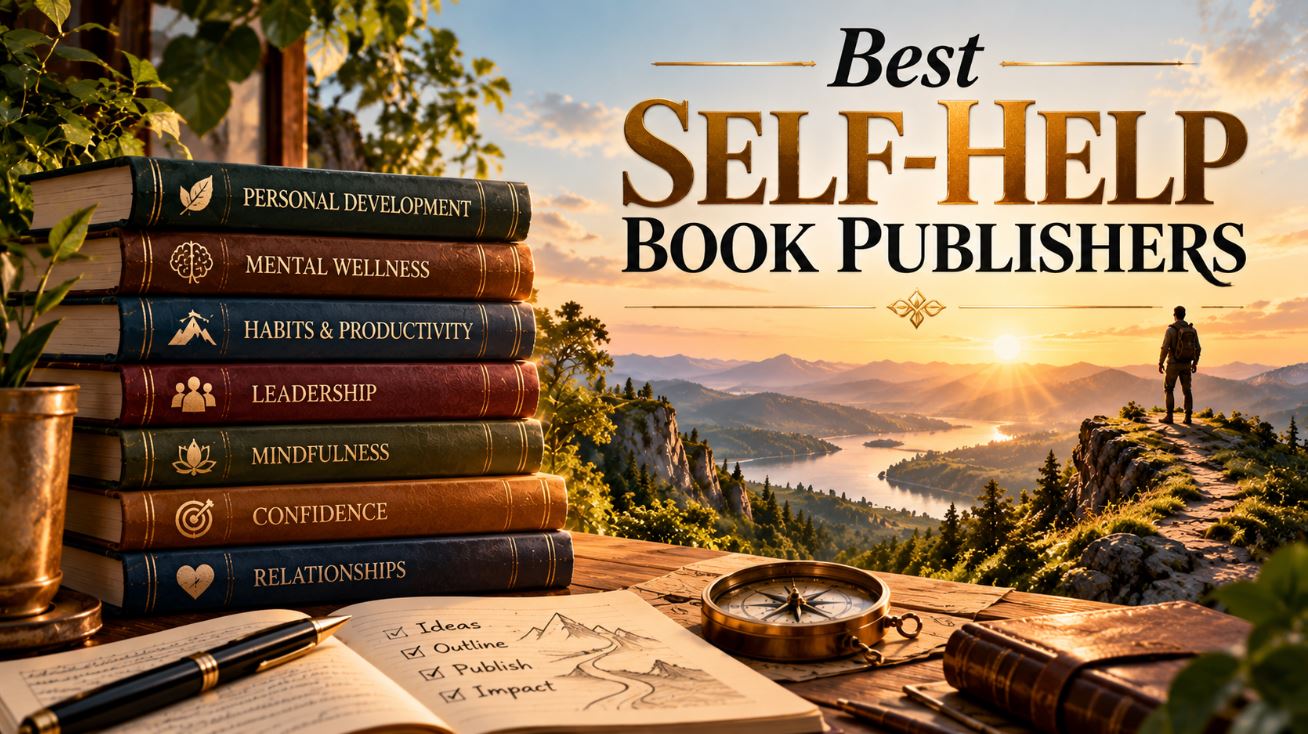
The best self-help book publishers include traditional houses Hay House, New Harbinger, Tarcher (Penguin Random House), Sounds True and Berrett-Koehler, each with its own specialty, from spirituality to evidence-based psychology. Writers of the West and Balboa Press are self-publishing self-help publishers instead: the author pays for editing, production and distribution and keeps the rights. The right choice depends on your topic, credentials and how fast you want to publish.
Traditional publishers choose which books they publish, pay for the editing, design and printing, and pay the author an advance and royalties. Self-publishing companies work the other way: the author pays to have the book prepared and published, and the contract decides who holds the rights. Either route needs a finished manuscript or a strong proposal, and authors who have the expertise but not the time to write it often start with self-help book writing services.
A good concept isn’t enough on its own. Self-help publishers look for a clear structure, advice readers can trust, practical exercises and a manuscript a reader can follow from problem to result. Most first drafts need work on exactly those things, which is why many authors use self-help book editing services before sending a proposal or publishing.
Best Self-Help Book Publishers at a Glance
The table separates traditional publishers, which pay authors, from self-publishing companies, where the author pays. If you already plan to self-publish, compare what each one includes, from Balboa’s packages to the self-publishing services at Writers of the West.
| Company | Model | Best for | Self-help topics | How to submit | Author cost |
|---|---|---|---|---|---|
| Hay House | Traditional | Authors with a platform in personal growth or spirituality | Personal growth, spirituality, wellness, mindset | UK: online synopsis form. US: generally agent or Hay House writing programs | None |
| Writers of the West | Author-funded services | Experts and coaches who want to publish now and keep their rights | All self-help topics | No acquisition; author hires services | Packages from $699 to $5,999 |
| New Harbinger | Traditional (independent) | Clinicians and researchers | Anxiety, depression, CBT, ACT and DBT workbooks | Direct, per its website guidelines | None |
| Tarcher (Penguin Random House) | Traditional | Agented authors with mainstream self-help | Relationships, communication, mental health, creativity | Through a literary agent | None |
| Sounds True | Traditional (independent) | Spiritual and mind-body teachers | Spirituality, mind-body health, spiritually oriented self-help | Direct proposal by email | None |
| Berrett-Koehler | Traditional (independent) | Leadership and personal-change authors | Personal growth, leadership, workplace change | Direct proposal by email | None |
| Balboa Press | Author-funded services (Hay House affiliated) | Authors who want the Hay House connection and accept the cost | Spirituality, personal growth | No acquisition; author buys a package | Packages from $1,099 to $14,999 |
Top Self-Help Book Publishing Companies
These publishers were chosen for how closely their lists match self-help and personal development, and for whether an author can realistically reach them. Submission rules change, so confirm on each official page before sending anything.
1. Hay House (Traditional Self-Help Publisher)
Hay House is the publisher most closely associated with self-help. Louise Hay founded it in 1984 on the success of her book You Can Heal Your Life, and its authors include Wayne Dyer, Deepak Chopra, Gabrielle Bernstein, Joe Dispenza and Mel Robbins, whose The Let Them Theory was the bestselling book of 2025 in the US.
Getting in depends on where you submit. Hay House UK accepts unsolicited projects through an online form: send a synopsis and information about yourself, not the manuscript, and it aims to reply within a month. If it sees a fit, it asks for a full proposal (Hay House UK submissions). In the US, the usual routes are a literary agent or Hay House’s own writing workshops and contests, which give attendees a way to submit without an agent.
Rights and costs: Standard traditional deal. Hay House pays the author; the author pays nothing to publish.
Self-help proof: Hay House published Mel Robbins’s The Let Them Theory in 2024.
Limitation: Hay House weighs an author’s audience heavily. A strong idea without an email list, following or speaking platform is a hard sell.
Best for: Spiritual and personal growth authors who already teach, coach or speak to a sizable audience.
2. Writers of the West (Self-Publishing Self-Help Publisher)
Writers of the West is a Houston-based company that helps authors write, edit and self-publish their books. It isn’t a traditional publisher. It doesn’t buy manuscripts or pay advances. Authors pay for what they need, which can include editing, cover design, formatting, publishing, distribution and marketing, and the book is published through the author’s own accounts.
Authors keep 100% of their rights and royalties, and Writers of the West takes no share of sales. Publishing packages run from $699 for an Amazon-only paperback to $5,999 for every format with distribution to 50+ retail channels and a marketing campaign, and payment plans are available. You can compare what each tier includes on its publishing packages page.
Self-help proof: It helped publish From Dreamer to Achiever by Pierre Poteau, Ph.D.
Limitation: There’s no advance, and no publisher sales team pitching the book to stores. Sales depend on the quality of the book and how well it’s marketed.
Best for: Coaches, therapists, consultants and speakers who already have an audience and want a professional book out quickly without giving up rights.
3. New Harbinger Publications (Traditional Self-Help Publisher)
New Harbinger is the go-to publisher for psychology-based self-help. Psychologist Matthew McKay and writer Patrick Fanning founded it in Oakland, California in 1973, and its list centers on evidence-based approaches such as cognitive behavioral therapy, acceptance and commitment therapy and dialectical behavior therapy. Titles include The Relaxation & Stress Reduction Workbook, When Anger Hurts and The Untethered Soul (source).
New Harbinger publishes its own submission guidelines on its website and accepts proposals directly. Those guidelines are aimed at what it calls “a certain kind of professional author,” and its books are the kind therapists recommend to clients.
Self-help proof: The Relaxation & Stress Reduction Workbook by Martha Davis, Elizabeth Robbins Eshelman and Matthew McKay is one of its long-running workbooks.
Limitation: The list is clinical and research-based, so authors without professional credentials in psychology or health are a hard fit.
Best for: Therapists, psychologists and researchers writing practical workbooks on anxiety, depression, relationships or emotional regulation.
4. Tarcher (Penguin Random House) (Traditional Self-Help Publisher)
Tarcher is Penguin Random House’s self-help imprint, known until March 2025 as TarcherPerigee. Its list includes The Artist’s Way, Attached, Nedra Glover Tawwab’s Set Boundaries, Find Peace and Jefferson Fisher’s The Next Conversation, and it focuses on mental health, relationships, communication, neurodiversity and creativity (Shelf Awareness).
Like other Penguin Random House imprints, Tarcher acquires through literary agents rather than unsolicited submissions.
Self-help proof: Tarcher publishes Julia Cameron’s The Artist’s Way.
Limitation: You’ll need an agent, and agents will look closely at your platform and comparable titles.
Best for: Authors with a fresh angle on relationships, communication or mental health and an agent ready to pitch it.
5. Sounds True (Traditional Self-Help Publisher)
Sounds True, based in Boulder, Colorado, publishes books and audio on spirituality, mind-body health, transpersonal psychology and spiritually oriented self-help. It accepts book proposals from unagented authors by email to acquisitions@soundstrue.com, following its nonfiction proposal outline. It doesn’t want full manuscripts, reviews proposals in two to three months, and replies only when it wants to publish (Sounds True submissions).
Self-help proof: Sounds True published Adyashanti’s The End of Your World.
Limitation: Its focus is narrow. Practical productivity or career books don’t fit, and silence means no.
Best for: Meditation teachers, spiritual teachers and mind-body practitioners.
6. Berrett-Koehler Publishers (Traditional Self-Help Publisher)
Berrett-Koehler publishes books meant to “drive positive change at personal, organizational, and societal levels,” which puts it where self-help meets leadership and work. Leadership and Self-Deception by the Arbinger Institute is one of its best-known titles.
It accepts proposals by email at submissions@bkpub.com. Its guidelines are detailed: an elevator pitch, primary and secondary audiences, your credentials, five comparable books from the last two years, a chapter outline, a timeline and a marketing plan with real numbers for your email list, social following and speaking (Berrett-Koehler proposal guidelines). Authors outside the US need an established US presence.
Self-help proof: Berrett-Koehler publishes the Arbinger Institute’s Leadership and Self-Deception.
Limitation: The proposal takes real work, and the marketing plan carries a lot of weight.
Best for: Coaches, consultants and leaders writing about personal change at work.
7. Balboa Press (Self-Publishing Self-Help Publisher)
Balboa Press is a paid self-publishing company affiliated with Hay House and operated by Author Solutions. Authors buy a package, and packages range from $1,099 to $14,999 according to a 2026 review by SelfPublishing.com. Hay House also uses Balboa packages as prizes in some of its writing contests.
Self-help proof: Balboa published Robert Kintigh’s personal growth book The Lies We Tell Ourselves.
Limitation: Publishing with Balboa isn’t a Hay House deal. The same review reports that Balboa keeps a share of author royalties and charges fees for changes after publication, and it records complaints about delayed royalties and upselling. Read the contract carefully, and see our guide to self-publishing red flags before signing with any service.
Best for: Spiritual and personal growth authors who value the Hay House association and accept the cost and terms.
Traditional Self-Help Publishers vs. Self-Publishing Companies
A traditional self-help publisher selects your book, pays for production and pays you. A self-publishing company is hired by you to produce and distribute the book, and you usually keep the rights. Writers of the West is in the second group: it doesn’t offer advances or traditional contracts.
| Traditional publisher | Self-publishing company | |
|---|---|---|
| Manuscript selection | Selective; most proposals are declined | Open to any author who pays |
| Upfront cost | Usually none | Author pays for services |
| Editing | Publisher’s editors | Hired editors, author approves changes |
| Cover design | Publisher decides | Author approves |
| Rights | Licensed to the publisher | Set by the contract; often kept by the author |
| Royalties | Advance, then a percentage once it earns out | Retailer royalties, minus any share the service keeps |
| Distribution | Bookstores, libraries, online | Mainly online and print on demand |
| Creative control | Shared | Author has the final say |
| Marketing | Some support; author platform expected | Author’s job, or bought as a service |
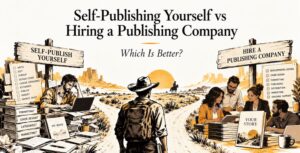
Ownership and royalty terms vary widely between services. Some keep a percentage, some publish under their own accounts, and some take neither. Our comparison of self-publishing yourself vs hiring a publishing company covers what to check in the contract.
Which Types of Self-Help Books Do Publishers Accept?
Publishers accept most self-help subjects, but each one specializes, and pitching outside a publisher’s focus is the most common reason for a fast rejection.
- Personal development, mindset and motivation: Hay House’s core list.
- Mental wellness and emotional resilience: New Harbinger for clinical workbooks, Tarcher for mainstream mental health.
- Relationships and confidence: Tarcher (Attached, Set Boundaries, Find Peace) and New Harbinger.
- Mindfulness and spiritual growth: Sounds True and Hay House.
- Leadership and career development: Berrett-Koehler.
- Habits and productivity: Major houses publish them through agents. For independent authors, this is a crowded category where self-publishing often works well.
Before you pitch, find three to five recent books like yours and check who published them. That tells you more than any list.
How to Choose the Right Self-Help Book Publisher
Match the publisher to your topic, your credentials and your platform first, then compare rights, costs and marketing.
- Specialization: Choose publishers whose recent books look like yours.
- Credibility: Clinical topics need clinical credentials. Spiritual and motivational books lean on the author’s following.
- Manuscript readiness: Traditional publishers usually want a proposal and sample chapters. Services need a finished, edited manuscript.
- Platform: Expect publishers to ask how many people you can reach through email, social media and speaking.
- Access: Sounds True and Berrett-Koehler take direct proposals. Tarcher needs an agent.
- Rights and royalties: Know what you’re licensing, and for how long.
- Distribution and marketing: Bookstore placement comes mostly from traditional deals. With a service, check whether book marketing is included or extra.
- Upfront cost: Traditional publishers don’t charge authors. With services, compare what each package actually includes.
First-time authors without a platform should either build an audience while querying agents or publish through a service and use the book to grow that audience. Established experts, such as therapists, coaches or executives, can approach New Harbinger, Sounds True or Berrett-Koehler directly, or query agents for Tarcher and Hay House.
How to Submit a Self-Help Book to Publishers
Most self-help books are sold to publishers on a nonfiction book proposal, not a finished manuscript. The proposal shows the publisher what the book is, who it’s for and why you’re the person to write it.
A typical self-help proposal includes:
- Book concept: the problem the book solves and your approach
- Readership: who will buy it, as specifically as possible
- Author credentials: your qualifications and experience on the topic
- Competitive titles: recent similar books and how yours differs
- Chapter outline: a short summary of each chapter
- Sample chapters: usually one to three
- Platform and marketing: your audience size and launch plans
Requirements differ by publisher. Hay House UK starts with a synopsis through a form. Sounds True wants a proposal by email. Berrett-Koehler adds a timeline and detailed marketing figures. Tarcher works only through agents, so see our guide on how to get a literary agent. Our guide on how to write a nonfiction book covers getting the manuscript itself into shape.
How Much Does It Cost to Publish a Self-Help Book?
Traditional publishing costs the author nothing upfront, because the publisher pays for production and pays you. Publishing through a service or on your own costs from a few hundred to several thousand dollars, depending on what you hire.
The main costs with a service or self-publishing are:
- Manuscript development: only if you need help writing the book
- Editing: at Writers of the West, $300 to $600 for proofreading up to $1,000 to $3,000 for developmental editing
- Cover design and formatting: often included in publishing packages
- ISBNs: free through Amazon KDP, or $125 for one and $295 for ten from Bowker in the US
- Distribution: free to upload to Amazon, and part of most packages for wider retail
- Marketing: optional, and the cost varies more than any other item
Publishing packages range from $699 to $5,999 at Writers of the West and $1,099 to $14,999 at Balboa Press. For a full breakdown, read how much it costs to self-publish a book.
Frequently Asked Questions About Self-Help Book Publishers
Who are the best self-help book publishers?
Hay House, New Harbinger, Tarcher, Sounds True and Berrett-Koehler are leading traditional self-help publishers, each with a different specialty. Writers of the West and Balboa Press are self-publishing companies, where the author pays for publishing instead of selling rights.
Which publishers accept self-help books?
Most nonfiction publishers accept self-help, but the best fit depends on the topic: Hay House for spirituality and personal growth, New Harbinger for psychology workbooks, Sounds True for mind-body and spiritual books, and Berrett-Koehler for leadership and personal change.
Can first-time authors publish self-help books?
Yes. Publishers do take debut self-help authors, but they expect relevant expertise and an audience. Without a platform, publishing through a service and building readers is often the faster route.
Do self-help book publishers accept unsolicited manuscripts?
Some accept unsolicited proposals, but few want a full manuscript. Sounds True and Berrett-Koehler take direct proposals, Hay House UK takes synopses through a form, and Penguin Random House imprints such as Tarcher don’t accept unsolicited submissions.
Do you need a literary agent to publish a self-help book?
Not always. You need an agent for big-house imprints like Tarcher, and usually for Hay House in the US, but you can approach Sounds True, Berrett-Koehler and New Harbinger directly.
How much does publishing a self-help book cost?
Nothing upfront with a traditional publisher. With a self-publishing company, packages run from about $699 to $5,999 at Writers of the West and higher at some other services, plus any editing or writing help you need.
Can I publish a self-help book without a completed manuscript?
Yes, with a traditional publisher you can sell a self-help book on a proposal and sample chapters. To self-publish you’ll need a finished manuscript, and authors who don’t have time to write it can get professional writing help.
Can authors retain ownership of their self-help books?
You always keep the copyright, but publishing rights depend on the contract. Traditional publishers license rights for set formats and territories. Self-publishing, or a service that publishes through your own accounts, leaves those rights with you.
What makes a self-help book attractive to publishers?
Proven demand for the topic, a distinct angle, an author with real credibility, advice readers can act on, and an author platform to sell it. Publishers look for books that clearly differ from the competing titles already on the shelf.
About the Author
Senior Editor & Publishing Consultant, Writers of the West
Peter Campbell has 14 years of experience in book publishing and has overseen more than 200 author collaborations at Writers of the West across memoir, business, leadership, health, and nonfiction. Before joining the firm he held senior editorial roles at two independent publishing houses. He has worked with first-time authors, executives, physicians, and public figures on books that reached Amazon bestseller lists across multiple categories.
writersofthewest.net · Professional Ghostwriting Services, Book Editing & Publishing Guidance