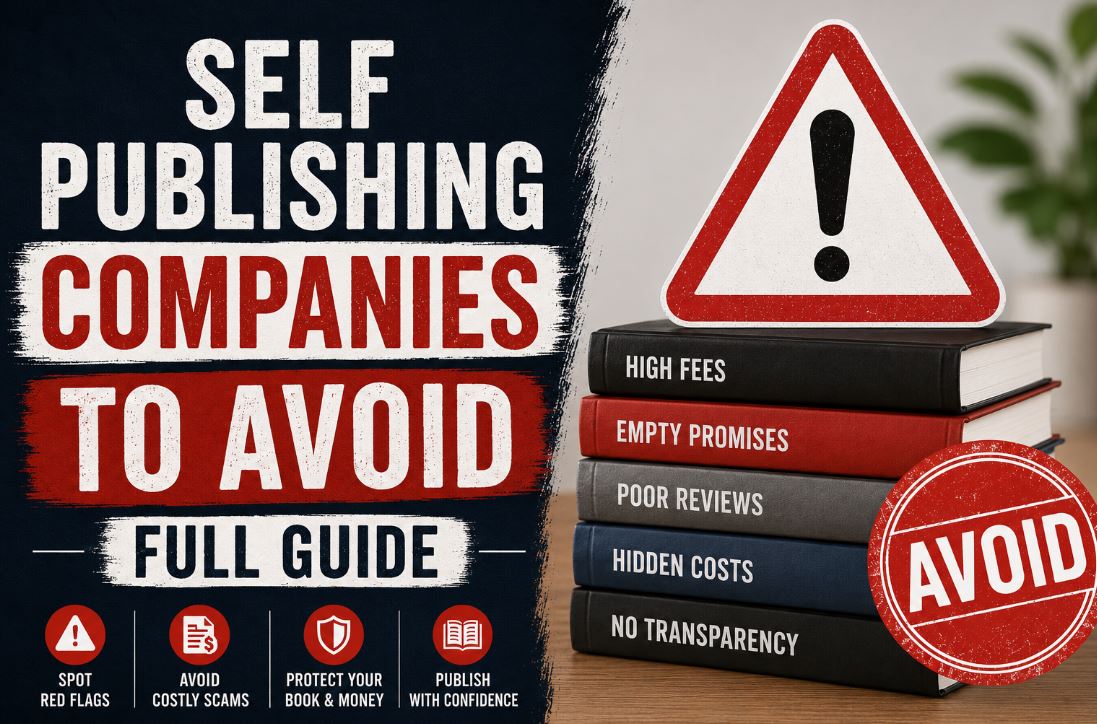
Self Publishing Companies to Avoid in 2026: Red Flags, Scams, and Who to Trust Instead
Most authors find out about publishing scams the hard way. Someone reached out with a flattering pitch, or they clicked an ad promising a $300 ghostwriting package, the website looked professional, the price seemed manageable, and somewhere between the first payment and the second it became clear nothing was going to be delivered. By then the money was gone and so was the company, usually replaced by a new name at the same virtual address.
This guide exists so that doesn’t happen to you. Beyond compiling what’s already been documented publicly, we spoke anonymously with a senior figure inside the Pakistani software house industry to understand how these operations actually work from the inside. What he described confirmed much of what public investigators have found, but with details that haven’t been reported elsewhere. That’s what you’ll find here alongside the red flags, the scam mechanics, and a short list of legitimate companies worth knowing about.
How Big are the Self Publishing Scams?
Bigger than most authors realize, and getting worse every year.
In January 2025, the US Department of Justice charged three people with defrauding elderly authors across the United States of almost $44 million by convincing them that publishers and filmmakers wanted to turn their books into blockbusters. That’s one indictment. These operations run thousands of websites simultaneously.
Investigator Danny de Hek, a New Zealand-based fraud exposer the New York Times called the Crypto Ponzi Avenger, has been tracking these publishing scam networks and shared his findings with journalist Ariella Steinhorn at Hard Reset Media. According to de Hek, these operations maintain over 1,000 website addresses pretending to be publishing houses, and even the smallest groups make between $700,000 and $1,000,000 a month, almost entirely profit. He estimates the industry collectively generates billions of dollars.
Security researcher Bruce Schneier, a fellow at Harvard’s Kennedy School, described these operations as part of a much larger international ecosystem of overseas software houses that rebrand regularly to evade detection, using emotional manipulation of vulnerable authors in ways disturbingly similar to pig butchering tactics in cryptocurrency fraud.
Where the scams actually come from, and how they really work inside
Cybersecurity journalist Brian Krebs, whose reporting is regularly cited by the DOJ and FBI, published a detailed investigation in May 2025 tracing the publishing and ghostwriting scam network to a specific group of companies and individuals based primarily in Karachi, Pakistan. The network includes Abtach Ltd., which the USPTO accused of impersonating the USPTO and overcharging filing fees, and which rebranded to Intersys Limited after being banned from filing trademark applications. It includes Digitonics Labs, which Pakistan’s Federal Investigation Agency said earned approximately $2.5 million a month through extortion of international clients. The FIA described it as the biggest money laundering case in the history of Pakistan. And the network traces back to Axact, the original Pakistani fake degree mill exposed by the New York Times in 2015, whose former employees and tactics seeded much of what exists in the publishing scam ecosystem today.
To understand what’s happening inside these operations day to day, we spoke anonymously with a senior figure within the Pakistani software house industry. What he described was a call center structure where workers receive a base salary of a couple hundred dollars a month, with the real money coming entirely from commission. Individual sales targets run from $5,000 to $30,000 per month. Workers who don’t hit those numbers have commission clawed back against their base pay. It is essentially a debt trap for the people making the calls, which is part of why they push so hard. The pressure to upsell is not optional. It’s how they survive the month.
He also described something that most guides on this topic get wrong. These operations don’t always contact authors cold. Many of their best leads come from Google PPC ads. Someone searches “affordable ghostwriter” or “publish my book cheap” and clicks an ad promising a $300 ghostwriting package or a $499 full publishing deal. They land on a professional-looking site and feel like they found the company themselves, which drops their guard entirely compared to an unsolicited email. The ad is the lure. The person clicking it thinks they’re doing their research. That’s the design.
Once someone fills out a contact form or initiates a chat, the sales process begins. The initial package is priced to convert, low enough to feel manageable. What unlocks next is the upsell. And the upsell after that. Authors who’ve already published on Amazon are specifically targeted with offers for Amazon A+ content, enhanced marketing packages, editorial reviews, and screenplay adaptations, each presented as the thing that will finally get their book in front of readers. The book itself is never the product. The upsell cycle is the product.
At Writers of the West, which has operated in the US publishing industry since 2004, we see this firsthand across client inquiries. Over 95% of companies that contact authors unsolicited, or run aggressive low-price PPC campaigns, are operating from South Asia using this model.
How to Spot Scam Book Publishers:
Exact match domains:
Exact match domains designed to look authoritative. One of the clearest signals we see, and one rarely discussed in other guides, is the use of exact match domains built around publishing-adjacent keywords. Domains like amazonbookpublishing.com, kindleghostwriters.com, bestghostwriters.net, or usabookpublishers.com are registered specifically to rank in organic search or to run PPC ads against high-intent queries. They look legitimate to someone who doesn’t know what they’re looking at, and they’re completely disposable. When the operation moves to a new name, the domain gets abandoned and a new exact match domain gets registered. Writer Beware has documented dozens of these, including operations that built entire networks of Amazon-branded domains before Amazon won a legal ruling ordering them all transferred.
Chat Pop ups:
A chat box appears the moment you land on their website. WritersWeekly flags this explicitly: almost all of the scammers on their list have an instant chat box in the lower right corner of their website. It’s almost always someone overseas using a fake American-sounding name, ready to begin the sales process the moment you arrive. If a chat box appears the moment you open a publishing company’s website, that alone is reason enough to close the tab.
Discount Countdown Timers:
Countdown timers, deep discounts, and limited-time offers. Kevin Anderson and Associates’ fraud guide documents this pattern clearly: reputable ghostwriting and publishing services rarely use high-pressure sales tactics or aggressive discount promotions. If a publishing company’s website has a banner counting down to the end of a 60% discount, it’s running a call-center operation, not a publishing company.
Generic Websites & Similar Data
Multiple company names share the same address, phone number, or website template. Writer Beware documented 29 fake publishing operations sharing identical website templates, falsely using famous writers’ names, and in some cases borrowing the names of major publishers. WritersWeekly’s database shows specific cases where five or six company names share the same phone number, and where completely different publisher websites are carbon copies of each other down to the layout and copy. Google any publisher’s phone number and address independently. If multiple company names come up, walk away.
Invisible Leadership:
The CEO or leadership is invisible or unverifiable. Legitimate publishing companies have real, named, verifiable people running them. Chris Holloway, the founder of Writers of the West, has a public LinkedIn with a verifiable educational background and two decades of documented publishing history. Search any publishing company’s founder or CEO on LinkedIn. If there’s no profile, no verifiable credentials, or a profile with no connections and no real employment history, the company is almost certainly a front. Run a reverse image search on every staff photo. Danny de Hek found that a writer on one of these sites turned out to be an actor with a public IMDB page, and a listed project manager appeared as a reviewer on a completely unrelated AI education product.
No Visible Portfolio:
The portfolio books don’t exist on Amazon, or were published by someone else before the company existed. Writer Beware documented that one major ghostwriting scam listed a book in their portfolio that was published by a completely different publisher before the scam company’s domain was even registered. WritersWeekly found multiple companies listing books that don’t appear on Amazon at all, and others displaying covers from famous authors they had nothing to do with. Search any book they claim to have published on Amazon. If it doesn’t exist, or the listed publisher is someone different, you’re looking at fraud. Check domain registration dates free at whois.domaintools.com and compare against portfolio publication dates.
You can verify a legitimate company’s work in thirty seconds. Writers of the West’s portfolio of published books lists real titles by real authors with real Amazon listings anyone can check right now.
Affordability, though not always
Price context matters more than price alone. Some guides, including those from companies that charge very high rates themselves, argue that any low-priced publishing package is automatically a scam. That’s not accurate. A large full-service publishing company that operates across hundreds of projects a year, with volume resource contracts and shared production infrastructure, can offer competitive pricing that an individual freelancer working on two projects at a time simply cannot match, because the cost structures are completely different. What matters is not the price in isolation but whether the company has a verifiable track record, independently documented reviews, real published books on Amazon, and accountability you can check through the BBB or other third parties. A company with competitive pricing and a real verifiable portfolio is not the same thing as a company with the same pricing and nothing to show for it.
Free Work, To Lure You In:
The free offer is the door opener. Derek Haines puts it directly: any company leading with a free manuscript appraisal, free marketing, or free editing is using it as a lure into an expensive package conversation. Real self-publishing platforms like Amazon KDP, Barnes and Noble Press, and IngramSpark are genuinely free. A company charging you for what those platforms provide for nothing is either adding genuine professional value or extracting your money for the appearance of it.
Fees To Give You Your Book’s Ownership:
They want rights to your book. Legitimate self-publishing companies do not ask for co-ownership of your copyright, exclusivity over your title, or a share of your royalties beyond a defined service fee. If a contract includes any of those terms, it’s a publishing deal where you’re paying instead of being paid.
Paid Book Store Placement:
They promise in-store placement for a fee. The Authors Guild states this plainly: legitimate publishers never request money in return for in-store placement. This scam has cost individual authors hundreds of thousands of dollars. If anyone promises your book will be in physical bookstores in exchange for a payment, it is a scam.
Retargetting, Same People, Different Brand:
Victim retargeting follows the first scam. The Alliance of Independent Authors’ Watchdog Desk flagged this as one of the most disturbing 2026 trends: after defrauding an author, the same operation contacts them again under a different name, posing as a law firm claiming they can recover the lost money, for another fee. If you’ve been scammed and someone contacts you claiming they can help recover your money, independently verify their identity before any further engagement.
For a maintained, regularly updated list of specific company names to avoid, Writer Beware and the Authors Guild scam alerts page are the most reliable independent resources available.
Legitimate self publishing companies worth knowing about
Writers of the West — BBB accredited A+, Houston-based since 2004, full pipeline from ghostwriting through editing, cover, formatting, global distribution to 30+ platforms including Walmart and Target, plus Amazon bestseller campaigns, press releases, influencer outreach, billboards, and video trailers. Real published portfolio with verifiable Amazon listings. Zero-interest payment plans, 24/7 project management. writersofthewest.net
Palmetto Publishing — BBB accredited A+, Charleston SC, founded 2017, 4.8 stars on Trustpilot from 1,000+ verified reviews, à la carte pricing from $1,447, authors keep 100% rights and royalties, no ghostwriting offered. palmettopublishing.com
Reedsy — curated freelancer marketplace, below 3% acceptance rate, 4.7 stars on Trustpilot from 1,800+ reviews, no project management layer, dispute resolution is a documented weak point when freelancers underdeliver. reedsy.com
Scribe Media — Austin TX, interview-based model for business nonfiction, $20,000 to $135,000, rebuilt after a 2023 ownership crisis, not BBB accredited. scribemedia.com
Gotham Ghostwriters — New York matchmaking agency, 30,000+ vetted writers, clients include former US presidents and Fortune 500 CEOs, minimum $30,000, not BBB accredited. gothamghostwriters.com
Greenleaf Book Group — Austin TX, 25+ years, 50+ NYT and WSJ bestsellers, hybrid model with up to 70% royalties, not BBB accredited, premium pricing not publicly disclosed. greenleafbookgroup.com
Kevin Anderson and Associates — New York, former Big 5 acquisitions editors, starting from $45,000, not BBB accredited, get all scope and payment milestones in writing before signing. ka-writing.com
The checklist before you pay anyone
- Search the company name alongside scam, complaint, and fraud on Google. Add their phone number and address to the same search.
- Go to their Facebook page, click About, then Page Transparency. If page managers are listed overseas while the company claims to be US-based, close the tab.
- Reverse image search every staff photo on the website.
- Check their domain registration date at whois.domaintools.com and compare against the publication dates of books in their portfolio.
- Search two or three portfolio books on Amazon and verify the publisher listed on the Amazon listing matches the company you’re looking at.
- Check their BBB profile at bbb.org.
- Ask for a full contract before paying anything. A company that won’t show you a contract before you pay is not a company you should pay.
- Check Writer Beware and the ALLi self-publishing services directory before signing with any company you found through an ad.
Your manuscript took months or years of your life. It deserves a publisher whose business model is built around getting it to readers, not getting money out of your pocket. The difference between those two things is almost always visible within the first five minutes if you know where to look.
About the Author
Senior Editor, Writers of the West
Francis Vincent is a best-selling American author and senior editor at Writers of the West. He holds both a B.A. and M.A. in English Literature, with graduate work at the University of Colorado Boulder. His editorial specialization spans productivity, habits, line editing, and dialogue refinement. He focuses on clarity, flow, and practical structure — helping authors translate ideas into polished, publishing-ready manuscripts while preserving their voice and intent.
writersofthewest.net · Professional Ghostwriting Services, Book Editing & Publishing Guidance