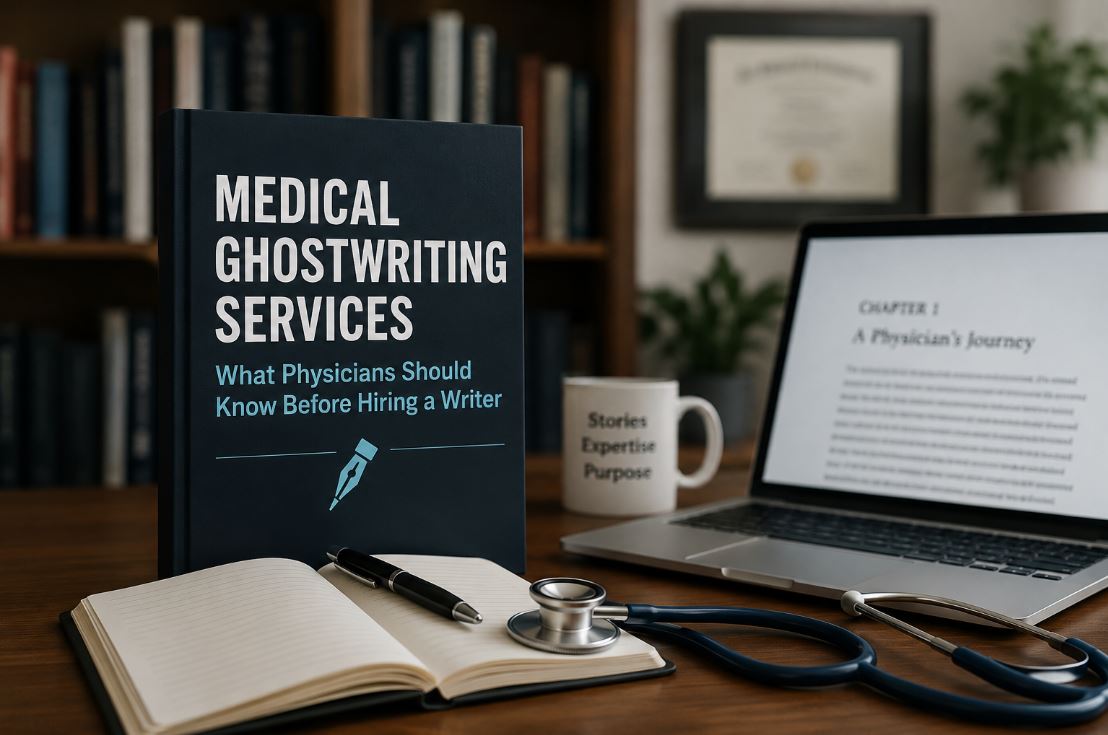
Medical Ghostwriting Services: What Doctors Should Know Before Hiring a Writer
Medical ghostwriting services help physicians turn clinical expertise into books, memoirs, patient guides, or practice-building publications. Unlike the pharmaceutical ghostwriting scandals involving undisclosed authorship in academic research, legitimate book ghostwriting is a collaborative process in which the physician supplies the knowledge, approves every page, and is credited as the author.
That distinction carries an image problem before a single word gets written, though. A cardiologist emailed me last year asking, almost apologetically, whether hiring someone to help write her memoir counted as the same thing she’d been warned about in a research ethics seminar fifteen years earlier. She wasn’t being paranoid. She’d sat through actual training on pharmaceutical ghostwriting scandals during residency, and the word had never fully lost that association for her.
She isn’t the only physician who feels that flicker of hesitation, and almost nobody selling medical ghostwriting services bothers to explain why the term carries that baggage before launching into the pitch.
Quick verdict
Medical ghostwriting services for a book, memoir, or patient-guide are nothing like the pharmaceutical ghostwriting scandals from the 2000s and 2010s. Legitimate services disclose the collaboration, credit you as the author of your own voice and expertise, and the finished book carries your name because you actually wrote it, with help. The best options are full-service shops like Writers of the West for physicians who want writing, editing, and publishing handled together, and specialist medical-writing firms if your primary need is journal manuscripts rather than a consumer book. The rest of this gets into where that scandal history actually came from, and the practical landmines nobody mentions.
Why Physicians Hesitate to Hire a Ghostwriter for Doctors
This part matters and almost nobody writing about medical book ghostwriting bothers to explain it, so here it is plainly. “Medical ghostwriting” has a specific, ugly history in academic medicine, and if you went through any research ethics training in med school, you were probably taught to view the phrase as a red flag.
The pattern goes back decades. Pharmaceutical companies would hire professional writers to draft manuscripts favorable to a drug, then hand the finished paper to an academic physician who’d sign on as author after making a few cosmetic edits, sometimes none at all. Unsealed GlaxoSmithKline documents showed the company paying ghostwriters to produce studies, editorials, and even a full textbook, all credited to physicians who hadn’t written them. Litigation involving Wyeth surfaced a similar pattern, with ghostwriters producing dozens of papers backing hormone replacement therapy that were then credited to academic authors who’d added little beyond a signature. This wasn’t a fringe problem, either. A 2008 survey of corresponding authors across six major medical journals found nearly 10 percent of published articles had a ghost author, ranging as high as 11 percent at one journal, alongside a separate and larger problem with guest authors who’d been credited despite minimal involvement.
By 2009 the situation had gotten bad enough that the Institute of Medicine’s report on conflict of interest in medicine called on academic centers to ban the practice outright, framing undisclosed ghostwritten authorship as a threat to the independence the whole field depends on.
None of that has anything to do with a physician hiring someone to help write a memoir about her career, or a patient-facing guide to managing diabetes. The scandal version is about hidden authorship in peer-reviewed research designed to move product. The book version is a disclosed collaboration where you’re the source of the expertise, the stories, and the judgment, and the writer is helping you get it onto the page. Legitimate book ghostwriters put the collaboration in the acknowledgments or the title page, not in a shredder. But the phrase collision is real, and a service that doesn’t acknowledge this to a hesitant physician client is missing an obvious trust-building conversation.
Practical Landmines Physicians Writing a Book Actually Face
Most medical ghostwriting pages talk confidentiality and credentials. Fine, table stakes. Here’s what actually trips up physicians writing books, and what I’ve watched catch people off guard.
Your employment contract might restrict this. Hospital-employed physicians frequently have non-compete or intellectual property clauses buried in their employment agreements, and some require employer review of outside publishing before it goes to print. I’ve seen a surgeon get three chapters into a book before someone mentioned this to her. Read your contract, or have someone who isn’t your ghostwriter read it, before you get attached to a manuscript.
Changing a name doesn’t make a patient unidentifiable. Every service says “we protect patient privacy” and means “we’ll rename them.” That’s not always enough. A rare condition, a specific hospital, a narrow timeframe, and a handful of other details can add up to a re-identifiable person even with a fake name attached. Even HHS’s own guidance on de-identifying health information acknowledges that neither of its accepted methods removes all re-identification risk, only reduces it. Composite characters, which most memoir contracts mention in the fine print, exist specifically to break this chain, and if your ghostwriter isn’t asking pointed questions about how identifiable your patient stories actually are, that’s worth noticing.
Your medical board doesn’t care that a ghostwriter drafted the sentence. If your book makes a health claim your board considers unsubstantiated, that’s your license exposed, not the writer’s. The ghostwriter walks away clean. This is the single biggest asymmetry in the whole arrangement and it’s almost never said out loud.
Some malpractice policies want to know about this. Rare, but worth a five-minute call to your carrier if your book makes any clinical claims or discusses specific treatment approaches. Cheaper to ask now than to find out later it mattered.
What a Legitimate Physician Book Writing Service Should Offer
Fact-checking against current literature, not just your notes from residency. Someone who asks about your employment contract before you’re three chapters deep. Real clarity in the contract about how the byline works, whether it’s ghostwritten with no credit, “with” a named collaborator, or “as told to,” because these mean different things to readers and to your own professional record. And a writer who can actually match your voice, which sounds obvious until you’ve read a physician memoir that reads like a pharmaceutical rep wrote it, because sometimes one did.
Medical Book Ghostwriting Services vs. Specialist Medical Writers
Specialist medical-writing firms exist for a reason, and if your primary need is a journal manuscript or a systematic review, that’s genuinely their lane, not a book shop’s. The two paths solve different problems, and mixing them up costs people time. Journal-side authorship has its own well-established rulebook, the ICMJE’s authorship criteria, that a consumer book was never going to be measured against in the first place.
For physicians writing a memoir, a patient-guide, or a practice-building book, Writers of the West’s book ghostwriting services built for full production, not just drafting, tend to serve better, since the HIPAA and contract questions above need to get asked at the outline stage, not after the manuscript’s done. If the plan is a shorter guide or a digital-first release rather than a full print run, ebook writing services cover that scope without the overhead of a 300-page production.
The honest con: most full-service shops, including this one, don’t staff a roster of practicing MDs the way the pharma-adjacent research-writing firms do. If your book leans heavily on citing recent clinical literature, budget for a medical fact-checker as a separate line item rather than assuming it’s automatically bundled in.
| Need | Better Fit | Why |
|---|---|---|
| Journal manuscript, systematic review, grant writing | Specialist medical-writing firm | ICMJE compliance, journal formatting, and citation standards are their daily work, not a sideline |
| Memoir, patient-guide, or practice-building book | Full-service book ghostwriting shop | HIPAA and employment-contract questions need to surface at the outline stage, and a book needs editing, design, and publishing handled alongside the writing |
| Short guide or digital-first release | Ebook-focused writing service | Lower overhead than a full print production run when the scope doesn’t call for it |
For physicians writing a memoir, a patient-guide, or a practice-building book, book ghostwriting services built for full production, not just drafting, tend to serve better, since the HIPAA and contract questions above need to get asked at the outline stage, not after the manuscript’s done. If the plan is a shorter guide or a digital-first release rather than a full print run, ebook writing services cover that scope without the overhead of a 300-page production.
The honest con: most full-service shops, including this one, don’t staff a roster of practicing MDs the way the pharma-adjacent research-writing firms do. If your book leans heavily on citing recent clinical literature, budget for a medical fact-checker as a separate line item rather than assuming it’s automatically bundled in.
Medical Book Ghostwriting: Quick Answers
Is it ethical for a doctor to use a ghostwriter for a book?
Yes, when it’s disclosed and you remain the source of the content, voice, and judgment. The ethical problem in the pharma scandals wasn’t that someone else typed the sentences. It was that the authorship was hidden and the content was shaped to sell a product rather than to reflect the credited author’s actual work.
Do I need to disclose a ghostwriter on my book?
Not legally required for a consumer memoir or guide the way it is for peer-reviewed research, but most reputable arrangements include a credit, whether that’s “with,” “as told to,” or a line in the acknowledgments. Check your specific board’s guidance if you’re citing the book as part of any professional record.
How much does a medical book ghostwriter cost?
Realistically $10,000 to $40,000 for a full-length memoir or patient-guide through a full-service shop, more if you need dedicated clinical fact-checking layered on top, less for a shorter ebook-length project.
The cardiologist from the opening finished her book. It took fourteen months, one uncomfortable conversation with her hospital’s legal department about her employment contract, and a final manuscript that reads like her, not like a scandal. That’s the whole difference, and it’s a fairly ordinary one once someone actually explains it.
About the Author
Editorial Consultant & Professor of Medicine, Writers of the West
Dr. Issac McKinney is a Professor at the School of Medicine at the University of Houston and has worked with Writers of the West as a freelance editorial consultant for over four years. His background in academic writing and medical research informs his editorial approach, which emphasizes clarity, logical flow, doctrinal precision, and actionable structure. He works across biography, self-help, Christian nonfiction, and health manuscripts, bringing analytical rigor and professional publishing standards to every project.
writersofthewest.net · Professional Ghostwriting Services, Book Editing & Publishing Guidance