The best fiction publishers in 2026 fall into two groups. Traditional houses such as Kensington, Turner and Penguin Random House buy the rights to a novel and pay the author, and Kensington and Turner still read unagented queries. Self-publishing fiction publishers such as Writers of the West, BookBaby and MindStir Media charge the author instead, and the author keeps the rights.
No traditional publisher will look at an unfinished debut novel, because editors acquire fiction on a complete manuscript. Authors who have the story worked out but not the time to write it often use fiction writing services to finish the draft before they submit anywhere. A finished draft still has to survive the first few pages of an editor’s read. Flat characters, plot holes and slow openings are the usual reasons fiction gets turned down, and they are easier to fix before querying than after a round of rejections. That is where a freelance editor or fiction editing services earn their cost.
Best Fiction Book Publishers at a Glance
This table separates traditional publishers, which buy rights and pay authors, from self-publishing fiction publishers, where the author pays, and from Reedsy, which is a freelancer marketplace. If you already know you want to self-publish, compare what each company includes and charges, from BookBaby’s packages to the self-publishing services at Writers of the West.
| Company | Type | Best-suited fiction | Direct submissions? | Main advantage | Main limitation |
|---|---|---|---|---|---|
| Kensington Publishing | Traditional, independent | Romance, mystery, thrillers, historical, westerns, SFF | Yes, query by email | Big commercial list that reads unagented queries | Replies only if interested |
| Writers of the West | Self-publishing, author-funded | All fiction genres | No acquisition; author hires services | Writing, editing, design and distribution in one place; author keeps rights | No advance or traditional contract |
| Turner Publishing | Traditional, independent | Romance, romantasy, fantasy, sci-fi, thrillers, horror | Yes, via QueryTracker | Takes full manuscripts from unagented authors | No reply unless interested |
| Penguin Random House | Traditional, Big Five | Every fiction genre across many imprints | Rarely; occasional windows | Widest bookstore and library reach | Agent needed in most cases |
| Marble Press / Taltos Books | Traditional, independent | Adult and YA thrillers, romance, literary crossover | Yes, for adult and YA fiction | Young press open to unagented fiction | Small, newer list |
| Bethany House | Traditional, Christian | Historical and contemporary Christian fiction | No | Long-running Christian fiction list | No unsolicited manuscripts |
| Graywolf Press | Traditional, nonprofit literary | Literary fiction, story collections, translation | Not for prose | Serious literary reputation | Closed to unagented novels |
| MindStir Media | Author-funded (calls itself hybrid) | Any genre | No acquisition; author buys a package | Packages bundle design, distribution and promotion | Packages start in the thousands |
| BookBaby | Self-publishing, author-funded | Any genre, finished manuscripts | No acquisition | Printing plus ebook and print distribution | You pay for services free platforms offer |
| Reedsy | Marketplace, not a publisher | Any genre | Not applicable | Choose your own editor and designer | You manage the whole project |
Best Fiction Publishers and Publishing Options Compared
Each profile says plainly what kind of company it is. Submission details were checked against official guidelines where available on October 23, 2026. Policies change often, so confirm before you send anything.
1. Kensington Publishing (Traditional Fiction Publisher)
Kensington is an independent, family-run New York publisher founded in 1974, and it’s one of the few large commercial fiction houses that openly invites unagented authors. Its imprints include Zebra for romance and women’s fiction, Kensington Cozies for cozy mysteries, Pinnacle for westerns and thrillers, Dafina for fiction centered on race and identity, Lyrical Press for digital-first fiction and Erewhon Books for speculative fiction. Its authors include Fern Michaels, Lisa Jackson and Joanne Fluke.
How to submit: Email a query in the body of the message to submissions@kensingtonbooks.com, with no attachments. Kensington accepts fantasy, historical fiction, horror, mystery, romance in all subgenres, suspense, thrillers, science fiction and westerns, but not short stories, poetry, children’s, middle grade or YA. It doesn’t accept AI-written submissions. Allow at least three months, and editors reply only if they want to see more (Kensington guidelines). Note that the Erewhon imprint isn’t currently open to unagented submissions.
Fiction proof: Kensington publishes Joanne Fluke’s Hannah Swensen mysteries, starting with Chocolate Chip Cookie Murder (Joanne Fluke at Kensington).
Limitation: Silence is the usual rejection.
Best for: Commercial genre novelists, especially in romance and mystery, without an agent.
2. Writers of the West (Self-Publishing Fiction Publisher)
Writers of the West is a Houston-based company that helps authors write, edit and self-publish their novels. It isn’t a traditional publisher. It doesn’t acquire manuscripts or pay advances. Authors hire it for the work they need, from developing and writing a novel with a genre-specialist writer to editing, cover design, formatting and distribution.
Each project has a dedicated project manager, books are published through the author’s own accounts, and authors keep 100% of their rights and royalties. Publishing packages run from $699 for an Amazon-only paperback to $5,999 for all formats with 50+ retail channels, and payment plans are available. You can compare what each tier includes on its publishing packages page.
Fiction proof: Novels it has helped publish include The Paintings by Gerald S. Passmore, a psychological thriller, and The Last Ride to Dunlap by Matt Roberts, a western. More titles are in its publishing portfolio.
Limitation: Authors who want an advance-paying traditional contract need a different route.
Best for: Novelists who want help finishing, polishing and publishing their book while keeping full ownership.
3. Turner Publishing (Traditional Fiction Publisher)
Turner Publishing is an independent traditional publisher that accepts both agented and unagented submissions. Its recent fiction wish list covers contemporary romance, upmarket fiction, romantasy, fantasy, science fiction, dystopian fiction, thrillers and horror (Authors Publish).
How to submit: Through Turner’s QueryTracker form. Fiction submissions need a query letter, synopsis, target audience, word count, genre and the full manuscript as a .doc or .docx file under 2 MB. Manuscripts should run 40,000 to 150,000 words. Simultaneous submissions are allowed. Turner doesn’t reply to every submission, but each submitter gets a personal status page. The form also asks you to disclose any AI use.
Fiction proof: Turner publishes Barbara Wood’s novel The Divining and 16 of her backlist titles (Publishers Weekly).
Watch out for: “Turner Book Writers” is a different company, a vanity operation unconnected to Turner Publishing.
Best for: Unagented authors with a finished commercial or genre novel who want a full-manuscript read.
4. Penguin Random House (Traditional Fiction Publisher)
Penguin Random House is the largest trade publisher in the US, with imprints that cover every genre, including Berkley for commercial fiction and romance, Del Rey for science fiction and fantasy, and Knopf and Riverhead for literary fiction.
How to submit: Through a literary agent. PRH says most major publishers, including itself, “have not accepted unagented submissions,” and that in most cases an agent “is still required and advisable” (PRH). The exception is occasional open windows. Berkley ran one for unagented adult fiction from May 15 to 17, 2024, and posts future windows on the same Berkley open submissions page.
Fiction proof: Del Rey publishes Pierce Brown’s Red Rising science fiction series.
Limitation: Getting an agent can take longer than writing the book.
Best for: Authors with an agent, or ready to query one, who want maximum bookstore reach. Our guide on how to get a literary agent covers that step.
5. Marble Press and Taltos Books (Traditional Fiction Publisher)
Marble Press is an independent publisher founded in 2022. In 2026 it acquired CamCat Publishing, and its adult and YA fiction is now published under the Taltos Books imprint. Taltos and CamCat focus on thrillers, romance and literary crossover fiction for adults and young adults, while Marble Books and Bulooga Books cover picture books and middle grade (Authors Publish, February 2026).
How to submit: Marble Press accepts unagented submissions for adult and YA fiction, plus works in translation through scouts and translators. All other categories must come through an agent. Follow the instructions on its submissions page.
Fiction proof: CamCat’s fiction list, now part of Marble Press, includes The Building That Wasn’t by Abigail Miles and Ghost Tamer by Meredith R. Lyons (CamCat titles).
Limitation: A newer, smaller list means less backlist evidence to judge its sales reach.
Best for: Thriller, romance and YA authors looking for an independent press that reads unagented work.
6. Bethany House (Traditional Fiction Publisher)
Bethany House, part of Baker Publishing Group and based in Bloomington, Minnesota, has published Christian fiction for decades. It publishes historical and contemporary Christian fiction by authors including Janette Oke, Beverly Lewis, Julie Klassen, Lynn Austin and Tracie Peterson.
How to submit: Through an agent. Baker Publishing Group states that it doesn’t accept unsolicited manuscripts but considers agented submissions, and its staff meet authors at writers’ conferences (Baker submission policy).
Fiction proof: Janette Oke’s first novel, Love Comes Softly, was published by Bethany House in 1979 (source).
Limitation: No direct route for unagented authors.
Best for: Christian fiction authors, especially in historical romance, who have or are seeking an agent. Catholic novelists should also see our guide to Catholic book publishers.
7. Graywolf Press (Traditional Fiction Publisher)
Graywolf is a nonprofit literary publisher in Minneapolis that releases about 30 books a year across fiction, poetry, creative nonfiction and translation. Its authors include Percival Everett, Kevin Barry and Benjamin Percy.
How to submit: Graywolf “is unable to consider un-agented prose manuscripts,” so novels and story collections must come through an agent. Its editors also find writers through magazines and conferences. It runs the African Fiction Prize alongside its poetry prizes (Graywolf submissions).
Fiction proof: Graywolf published Percival Everett’s novel The Trees.
Limitation: Closed to unagented fiction.
Best for: Literary fiction writers with an agent and a track record in literary magazines.
8. MindStir Media (Self-Publishing Fiction Publisher)
MindStir Media, founded by author J.J. Hebert, describes itself as a hybrid publisher, but the model is author-funded: authors buy a publishing package and keep their copyright and publishing rights. According to a March 2026 review by SelfPublishing.com, which sells competing services, packages ranged from $3,299 to $17,199. They include custom cover and interior design, an ISBN, distribution, and, at higher tiers, proofreading, an author website, press releases and advertising. Royalty rates rise with the package, up to 100% at the top tiers.
Fiction proof: Foreword Reviews lists MindStir novels including His Final Answer by Christopher D. White and Jennifer Curran, a story about a father’s grief, and Artefactum by J. E. Tobal, a multiverse science fiction novel (Foreword Reviews). Its full list is on MindStir Media Books.
Limitation: Proofreading only appears at the higher tiers, and promotional add-ons drive most of the price.
Best for: Authors with a finished, edited novel who want a packaged launch with promotion included.
9. BookBaby (Self-Publishing Fiction Publisher)
BookBaby is a self-publishing company in Pennsauken, New Jersey, that offers editing, cover design, ebook conversion, print-on-demand and short-run printing, plus distribution to major retailers. Its ebooks reach more than 60 stores. Reedsy’s October 2025 review listed a complete self-publishing package at $2,190, without editing, and a Deluxe package at $2,890, with editing priced per page (Reedsy). Check BookBaby’s own site for current pricing.
Fiction proof: BookBaby sells its authors’ books through its own BookBaby Bookshop, where current fiction includes Double Blind by Kathy Mathis, The Cat and the Warlock by Serg Koren and United in Chaos by Colonel Erik Krivda.
Limitation: You’re paying for distribution that free platforms like KDP and Draft2Digital also provide. The value is convenience and in-house printing, not savings.
Best for: Novelists with a finished manuscript who want physical copies for events plus wide distribution handled for them.
10. Reedsy (Fiction Freelancer Marketplace)
Reedsy is a London-based marketplace, founded in 2014, that connects authors with freelance editors, cover designers, marketers and ghostwriters. It isn’t a publisher and never publishes your book. Reedsy takes a commission on each project. Its fiction publisher directory is also a useful free research tool.
Fiction proof: Reedsy has no catalog of its own because it doesn’t publish books. Each freelancer’s profile lists the titles they’ve edited or designed, so check that a candidate has worked on published novels in your genre before hiring.
Limitation: You hire, coordinate and pay each professional yourself.
Best for: Self-publishing authors who want to choose individual specialists and manage the project themselves.
Which Fiction Publishers Accept Unsolicited Manuscripts?
Kensington, Turner Publishing, Marble Press, Entangled Publishing, Aethon Books and Baen Books all accept fiction directly from unagented authors. Penguin Random House, Bethany House and Graywolf generally don’t. Even “open” publishers usually want a query first, not a full manuscript, so read each set of guidelines before sending anything.
| Publisher | Direct submissions | Agent needed | Relevant genres | Method |
|---|---|---|---|---|
| Kensington | Yes | No | Romance, mystery, thriller, historical, SFF, westerns | Query in email body |
| Turner Publishing | Yes | No | Romance, romantasy, SFF, thriller, horror | QueryTracker form with full manuscript |
| Marble Press / Taltos | Yes, adult and YA fiction | No, for fiction | Thriller, romance, literary crossover, YA | Per official guidelines |
| Entangled | Yes | No | Romance, romantic fantasy, YA | Submittable: query and first 3 chapters |
| Aethon Books | Yes | No | Sci-fi, fantasy, LitRPG, thrillers | Email cover letter and first 50 pages |
| Baen Books | Yes | No | Science fiction and fantasy | Online form, full manuscript and synopsis |
| Penguin Random House | Only in rare windows | Usually | All fiction | Through an agent |
| Bethany House | No | Yes | Christian fiction | Through an agent |
| Graywolf Press | No, for prose | Yes | Literary fiction | Through an agent |
Policies checked October 23, 2026.
Literary presses are the hardest to reach right now. Coffee House Press has paused open submissions, and Small Beer Press closed to book submissions in 2023. Windows like these do reopen, which is why it’s worth checking a press’s official page every few months rather than relying on old directories.
Can you submit a fiction manuscript without a literary agent?
Yes. Kensington, Turner, Marble Press, Entangled, Aethon and Baen all read unagented fiction. Most Big Five imprints and many literary publishers still require an agent.
What’s the difference between an unsolicited query and an unsolicited manuscript?
A query is a one-page pitch letter. A manuscript is the whole book. Most open publishers want the query, sometimes with a synopsis or sample chapters, and request the full manuscript only if they’re interested. Turner and Baen are exceptions that ask for the full manuscript upfront. Sending a full manuscript where a query is requested, or attaching files where the guidelines say not to, often gets a submission deleted unread. A submission being accepted for review is not an offer to publish.
Traditional vs. Independent vs. Hybrid Fiction Publishing
The real difference between these models is who pays for publication and who controls the rights. “Independent” describes who owns the company, not whether authors pay: Kensington and Graywolf are independent traditional publishers that pay their authors.
| Traditional (Big Five or independent) | Hybrid | Self-publishing (alone or with paid services) | |
|---|---|---|---|
| Advance | Usually | Rarely | No |
| Upfront fees | None | Author contributes | Author pays for any services used |
| Editorial selection | Highly selective | Should be selective; varies | None |
| Copyright | Author keeps it | Author keeps it | Author keeps it |
| Publishing rights | Licensed to the publisher | Licensed per the contract | Usually kept by the author |
| Royalties | Lower percentage, paid after any advance earns out | Higher percentage than traditional | Retailer royalties to the author, minus any service share |
| Distribution | Bookstores, libraries, online | Varies; ask for specifics | Mainly online and print on demand |
| Marketing | Some publisher support | Varies | Author-led, or bought as a service |
| Production | Publisher | Shared | Author or hired professionals |
| Creative control | Shared | Shared | Author |
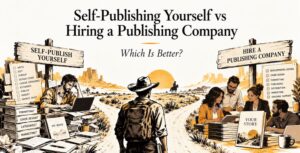
Reedsy isn’t a publishing model at all. It’s a marketplace you can use with any of the self-publishing routes. For a closer look at paying a company versus doing it all yourself, see self-publishing yourself vs hiring a publishing company.
What are the best hybrid publishers for fiction?
The best hybrid publishers for fiction are the ones that act like real publishers: they reject manuscripts that don’t fit, edit seriously, distribute to bookstores, and pay higher royalties to offset what the author contributes. The label is used loosely, so judge the contract, not the name. Before signing any hybrid deal, check:
- Does it turn down books, and what share of submissions does it accept?
- What exactly does your fee pay for, line by line?
- Is distribution only online, or does it include bookstore and library channels?
- Who edits, and can you see examples of their fiction?
- What royalty percentage do you get, on list price or on net?
- When and how do the rights revert to you?
- Can you cancel, and what happens to your files if you do?
MindStir Media calls itself hybrid, but because any author can buy a package, it works more like a premium self-publishing package. Our roundup of hybrid publishing companies for new authors compares more options.
Which Publishers Specialize in Different Types of Fiction?
Most fiction publishers specialize, and matching your genre to their list is the single biggest factor in whether a submission gets read. Use this table to see where to start.
| Fiction genre | What to look for | Publisher examples |
|---|---|---|
| Literary fiction | Editors focused on voice and prose; prize-winning backlist | Graywolf Press, Coffee House Press, Knopf (PRH) |
| Historical fiction | A historical list in your period | Kensington, Bethany House (Christian historical) |
| Science fiction | Active SF acquisitions | Baen, Aethon, Del Rey (PRH), Erewhon (Kensington) |
| Fantasy fiction | A fantasy catalog in your subgenre | Turner, Aethon, Baen; see our fantasy book publishers guide |
| Christian fiction | Faith-based imprint with clean-content standards | Bethany House, Revell (Baker Publishing Group) |
| Romance fiction | Romance-specialist imprints | Zebra (Kensington), Entangled, Berkley (PRH) |
| Thriller and mystery | Commercial suspense list | Kensington, Pinnacle, Taltos Books, Turner |
| Young adult fiction | A dedicated YA program | Taltos Books, Entangled (Mayhem and Mischief) |
| Speculative fiction | Cross-genre SFF and horror | Erewhon (Kensington), Turner |
| Urban fiction | A readership and list in the category | Kensington’s publishing partner Urban Books, and Dafina |
Before submitting, find three recent novels like yours and check who published them. That narrows the list faster than any directory.
How to Submit a Fiction Manuscript to Publishers
Finish and edit the novel, find publishers that take your genre, then send exactly what each one asks for, in the format it asks for.
- Finish the manuscript. Debut fiction is acquired on a complete book, not a proposal.
- Edit it. Fix structure, character and pacing first, then line-level problems.
- Pin down the genre and word count. Turner wants 40,000 to 150,000 words. Kensington doesn’t take YA.
- Find comparable titles. Two or three recent books like yours show where yours fits.
- Write the query letter: a hook, a short pitch, title, genre, word count, comps and a line about you.
- Write a synopsis of one to two pages covering the full plot, ending included. Our guide on how to write a book synopsis walks through it.
- Follow each publisher’s format. Kensington wants the query in the email body. Entangled wants three chapters. Baen wants the full book.
- Query agents for agent-only publishers.
- Track every submission, and respect rules on simultaneous submissions.
Self-publishing companies work differently. There’s no submission or acceptance step. You sign an agreement, share the manuscript, and the work starts on an agreed schedule.
How to Choose the Right Fiction Publisher
Decide first whether you want a traditional deal or prefer to pay for publication, then narrow by genre, agent requirements and contract terms. Check each of these:
- Traditional or self-funded: Do you want an advance and bookstore distribution, or speed and control?
- Manuscript status: Traditional publishers need a finished novel.
- Genre fit: Does the publisher’s recent list include books like yours?
- Agent requirement: If one is needed, querying agents comes first.
- Published catalog: Can you find and buy its books from major retailers?
- Editing and production quality: Look inside a few of its books.
- Money: Traditional publishers pay you. Self-publishing companies charge you. Know which you’re dealing with.
- Rights and royalties: Which formats and territories, for how long, and at what rate?
- Distribution and marketing: What happens at launch, and who pays for it?
- Exit terms: How do rights revert, and can you cancel?
Red flags: vague or shifting prices, books you can’t find for sale, names that borrow a real publisher’s brand (like the Turner lookalike above), guaranteed bestseller promises, and any contract that transfers your copyright. Our guide to self-publishing companies to avoid covers more warning signs.
Which fiction publishing route is right for you?
- Finished manuscript, want a traditional deal: Query agents for the big houses and submit directly to Kensington, Turner or a genre-matched indie press.
- No agent: Start with Kensington, Turner, Marble Press, Entangled, Aethon or Baen, depending on genre.
- Want an independent press: Match your genre to the table above and check current windows.
- Want professional self-publishing support: Compare service packages line by line, and make sure you keep your rights and royalties.
- Want to hire freelancers yourself: Use a marketplace like Reedsy and publish through KDP and other platforms.
- Have a concept but no manuscript: Finish the book first. No traditional publisher will take an unfinished debut novel.
Frequently Asked Questions
Who are the best fiction publishers?
Penguin Random House is the largest, but it requires an agent in most cases. Kensington and Turner are strong traditional options that read unagented queries, and Graywolf and Marble Press represent the independent press side. Writers of the West, MindStir Media and BookBaby are self-publishing fiction publishers, where the author pays and keeps the rights instead of selling them.
Which fiction publishers accept unsolicited submissions?
Kensington, Turner Publishing, Marble Press, Entangled, Aethon and Baen accept unagented fiction submissions as of October 2026. Policies change, so check each official page first.
Can I submit my novel to a publisher without an agent?
Yes. Kensington takes email queries, Turner takes full manuscripts through QueryTracker, and Baen takes complete manuscripts through an online form. All of them accept unagented authors.
What are the best independent fiction publishers?
Kensington, which calls itself “America’s Independent Publisher,” has one of the largest commercial fiction lists among independents. Graywolf is a well-known nonprofit literary press. Turner, Marble Press, Entangled, Aethon and Baen are smaller independents that each specialize in particular genres.
What is the difference between a fiction publisher and a self-publishing company?
A fiction publisher selects your book, pays to publish it and licenses its rights. A self-publishing company is paid by you to produce and distribute your book, and you usually keep the rights.
What are the best hybrid publishers for fiction?
The best hybrid publishers are selective, offer bookstore distribution and pay higher royalties in exchange for the author’s investment. Many companies use the label loosely, so judge the contract terms, not the name.
Do traditional fiction publishers charge authors?
No. Legitimate traditional publishers pay authors an advance and royalties and cover production costs. A “publisher” that charges you is selling a service, so read the contract carefully.
Which publishers accept literary fiction?
Graywolf, Coffee House Press and PRH’s Knopf and Riverhead publish literary fiction, but most require an agent or limit submissions to occasional reading periods. Marble Press’s Taltos imprint publishes literary crossover fiction and takes unagented submissions.
Do publishers accept science fiction, historical fiction, and fantasy novels?
Yes. Kensington accepts all three, Baen and Aethon specialize in science fiction and fantasy, and Turner takes fantasy and science fiction. For more fantasy options, see our guide to fantasy publishers.
Can I publish a fiction book without a completed manuscript?
Not with a traditional publisher if you’re a debut novelist, because fiction is sold on a finished book. Self-publishing also needs a complete manuscript, which some authors develop with a professional writer or editor.
How do I find a legitimate fiction book publisher?
Check that its books are for sale at major retailers, that its submission guidelines appear on its own website, that it doesn’t charge for traditional publishing, and that its contract spells out rights, royalties and reversion. Independent reviews and author organizations help too.
About the Author
Editor & Illustrator, Writers of the West
Trin Lucas is an American writer, editor, and illustrator who has worked with Writers of the West for over five years. She holds a BFA in Illustration from the Rhode Island School of Design and specializes in children’s books, visual storytelling, and structured nonfiction. Her editorial work focuses on rhythm between text and imagery, narrative clarity, and layout coherence — helping authors align storytelling with illustration for a cohesive reading experience.
writersofthewest.net · Professional Ghostwriting Services, Book Editing & Publishing Guidance