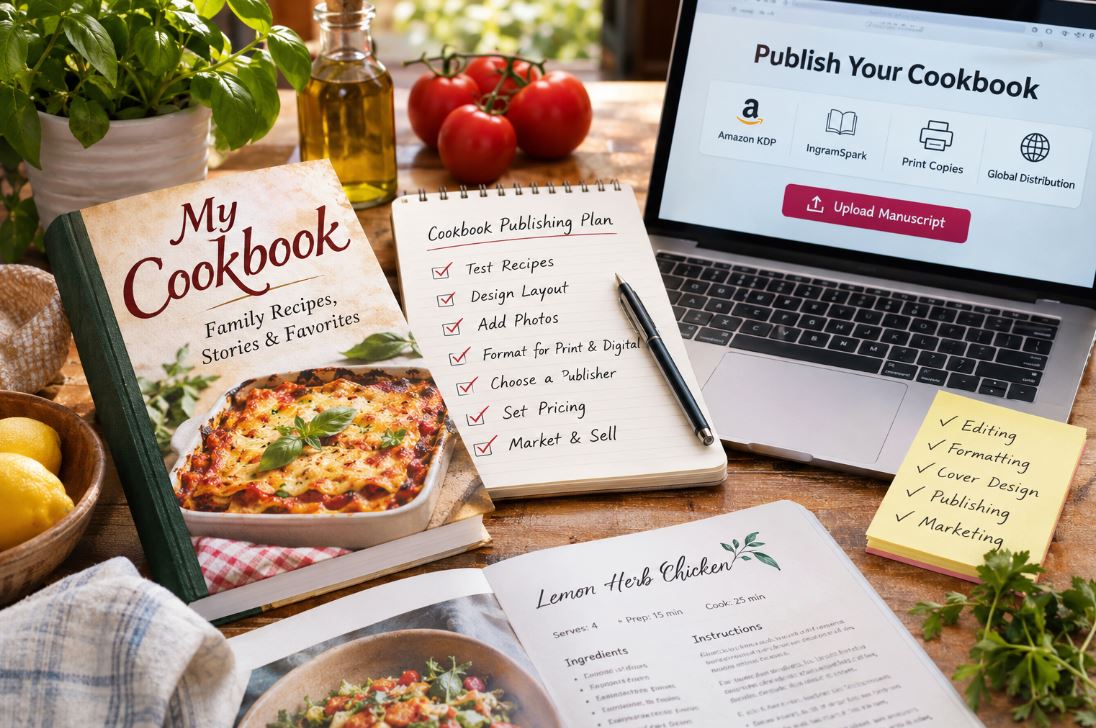
How do you self-publish a cookbook?
To self-publish a cookbook, you test and standardize your recipes, have the manuscript edited, design the recipe pages and cover, choose a binding that suits how the book will be used, and publish through a print-on-demand platform such as Amazon KDP or IngramSpark, a specialty cookbook printer, or a self-publishing company that handles production for you. In every route, you keep the rights.
Self-publishing a cookbook means publishing your own cookbook without a traditional publisher, and the upload is the easy part. Whether people cook from your book depends on what comes before it: recipes that work when a stranger follows them, pages laid out so the ingredients are easy to find mid-recipe, and a format that doesn’t snap shut on the counter. If you’d rather hand that work to a team, our self-publishing services cover editing, formatting, cover design and distribution, and our Amazon KDP publishing services set the book up in your own Amazon account.
The steps to publishing a cookbook, in order:
- Choose a concept and a reader.
- Write every recipe in one consistent format.
- Test each recipe from the written page.
- Edit the manuscript.
- Design one sample recipe page, approve it, then format the rest.
- Photograph the food at print resolution.
- Pick trim size, color and binding, and check the print cost.
- Get an ISBN, design the cover and order a printed proof.
- Publish, price and start selling.
How to make a cookbook: plan, write and test the recipes
A cookbook concept answers two questions: who is it for, and why would they buy it instead of searching for free recipes? “Weeknight Gulf Coast seafood in 30 minutes” tells a stranger exactly what they’re getting. The concept also sets the budget, since a family keepsake, a church fundraiser and a chef’s photo book need very different page counts and bindings.
Write every recipe the same way: title, servings, prep and cook time, temperature, ingredients in the order used, numbered steps with one action each, then tips or substitutions. Decide once whether it’s “tablespoon” or “Tbsp,” whether eggs are large and butter salted, and whether you give °F, °C or both. A copy editor catches the drift that creeps in across 80 recipes; our book editing services cover proofreading through developmental editing.
Test from the page, not from memory. When you’ve made a dish a hundred times, your hands fill in what the text leaves out. Give the written recipe to someone who has never cooked it and watch where they get stuck: wrong yield, times that don’t work in an ordinary oven, an ingredient listed but never used. For meat, poultry and eggs, give internal temperatures. The USDA chart lists 145°F with a three-minute rest for whole cuts of beef, pork, veal and lamb, 160°F for ground meat, and 165°F for all poultry.
How to format a cookbook (and why it’s harder than a novel)
Formatting a cookbook means arranging photos, ingredients, numbered steps, timing details and tips on every page so a cook can find what they need at a glance.
A novel is continuous text: set the font and margins, and the words flow on their own. A cookbook page is closer to a small poster. One spread might hold a photo, a headnote, an ingredient list, eight steps, prep times and a tip box, each needing its own type treatment. Then the next recipe runs four lines longer and the photo no longer fits.
Writers of the West has worked on dozens of cookbook projects, and the pattern we see most is an author who sends a document of recipes and assumes the book is nearly done. The recipes are usually good. What’s missing is presentation: no hierarchy, no white space, nothing telling the eye where to start. A plain recipe collection can look unfinished even when the food is excellent. Not every cookbook needs lavish design or a photo per page, but the layout has to suit the people using it.
How we approach cookbook formatting at Writers of the West
At Writers of the West, we don’t format a cookbook recipe by recipe from page one. We first build one complete sample recipe layout: title, ingredient list, numbered steps, photo placement, prep and cook information, tip boxes, typography and spacing, all working together on a real page. The author reviews that sample and asks for changes. Once the author approves it, our team applies the same pattern to every remaining recipe. The book stays consistent, and changes cost one page of rework instead of eighty. The method works just as well for authors formatting alone: before you lay out 80 or 100 recipes, build one representative page, fix it, then move on.
Our book formatting services handle print and Kindle interiors if you’d rather not do it yourself.
What a well-structured recipe page looks like
Illustrative example, not a client project.
| Page zone | What goes there | Example |
| Title | Name plus an optional one-line description | Smoked Paprika Chicken Thighs |
| Photo | One finished-dish shot, top half or facing page | Overhead, natural light |
| Quick facts | Servings, prep, cook, temperature | Serves 4 · Prep 10 min · Cook 35 min · 425°F |
| Ingredients | Own column, in order of use, quantities in bold | 8 chicken thighs; 2 tsp smoked paprika |
| Method | Numbered steps | 5. Roast until a thermometer reads 165°F. |
| Tip box | Substitution or technique | No smoked paprika? Use sweet paprika and a pinch of cumin. |
| Personal note | Optional short story, set apart | “My mother made this every Sunday after church.” |
Keep each recipe on one page or spread, use two or three typefaces at most, and save tip boxes for real tips. Larger trims such as 8 × 10 or 8.5 × 11 inches give photos room; smaller trims suit text-heavy, budget books.
Photos and print-ready files
Use photos you took or commissioned, or stock images licensed for a book you sell; a food photo is copyrighted even when the recipe isn’t. Amazon KDP asks for images of at least 300 DPI, and images that run to the page edge need 0.125 inch of bleed (extra image past the trim line). Screen colors usually print darker, so order a printed proof.
Proofread again after layout, since one wrong digit can ruin a recipe, and add an index once page numbers are final. For the cover, our book design services handle covers and interiors.
Why personal stories make a cookbook stand out
Personalizing a cookbook means adding your own memories, motivations and opinions around the recipes so the book has a voice nobody else could supply. Writers of the West recommends it to cookbook authors because free recipes are one search away. People buying a cookbook are usually buying a person’s perspective too: why you cook this way, what you learned getting there, what a dish meant at your family’s table.
That can be the grandmother who never measured, why you changed how you eat, how a dish ties to a region or holiday, or the burned roux that taught you a rule you still follow. Most of it fits in a short headnote or a page opening each chapter. Keep stories around the recipes, never inside the steps.
One cookbook in our public portfolio shows the idea well: Recipes of Motivation by Chef Marvin Jones. According to its Amazon listing, the author served eight years in the U.S. Marine Corps as a food service specialist, and the book pairs his recipes with motivational writing and life lessons.
How to print a cookbook: which format and binding?
Choose binding by where the book will be used. A kitchen-counter cookbook should lie flat; a gift or retail title on Amazon usually needs a standard paperback or hardcover, since those are the formats the big platforms distribute. Amazon KDP prints only paperbacks and case-laminate hardcovers. It does not offer spiral or coil binding.
| Cookbook type | Format that usually fits | Where to print | Trade-off |
| Family cookbook | Coil-bound or paperback, small quantity | Lulu, KDP | Little retail distribution, which rarely matters |
| Photo-heavy commercial cookbook | Color paperback or hardcover | KDP plus IngramSpark | High print cost per copy |
| Church, school or fundraiser | Comb, binder or coil, bulk printed | Fundraiser printers such as Morris Press | Upfront cost and minimum orders |
| Kindle cookbook | Reflowable ebook alongside print | KDP | Print layout doesn’t carry over |
| Restaurant cookbook | Color paperback or hardcover, plus stock for the counter | KDP for online, bulk printer for on-site | Two supply routes to manage |
Coil-bound books generally can’t go through Amazon’s or Ingram’s retail networks, so they sell through Lulu’s store, your website or in person. Some authors run both: a paperback on Amazon and a coil edition sold direct.
How much does it cost to self-publish a cookbook?
The cost of self-publishing a cookbook ranges from close to nothing, if you do every job yourself and publish on Amazon KDP, to a few thousand dollars with paid editing, design and photography. Who does the work, color and print quantity drive the total. For cheap or free cookbook self-publishing, design it yourself, use a free platform ISBN and print on demand so you buy no inventory. Our self-publishing cost breakdown covers all book types.
| Cost item | Do it yourself | Paying professionals |
| Publishing on KDP or IngramSpark | Free (KDP; IngramSpark dropped setup and revision fees) | Free |
| ISBN | Free KDP ISBN | $125 for one, $295 for ten from Bowker |
| Editing | Your time | $300 to $3,000 at Writers of the West, proofreading to developmental (pricing) |
| Formatting, cover, photography | Your time, camera, free tools | Quote-based; photo-heavy layouts cost more |
| Proofs and author copies | Printing cost plus shipping | Same |
| Bulk printing | Not needed with print-on-demand | Varies; fundraiser printers often require 100+ copies |
Real-world assisted cookbook publishing cost
For an approximately 80-page cookbook, Writers of the West typically quotes about $1,800 to $2,200 for a package covering professional editing, professional formatting, publishing assistance, global distribution setup and printed copies (how many depends on the package agreed). This is our own package estimate, not a market average, and the final price depends on the book’s specifications. The author publishes through their own account and keeps 100% of the royalties paid to them, which is 100% of what the platform pays out, not of the cover price; printing and platform costs still come off every sale. Marketing is priced separately. Current packages are on our pricing page.
What Amazon charges to print a cookbook
KDP’s printing cost is a fixed fee plus a per-page fee, set by ink type and trim size, and it’s deducted from each sale. On Amazon.com, your royalty is 60% of the list price minus printing at $9.99 and above, and 50% minus printing below that (KDP royalty rules).
Example: 100-page paperback, 8.5 × 11 inch trim (a “large” trim on KDP), sold on Amazon.com at $24.99, 60% royalty. Rates from KDP’s paperback printing cost page, checked November 2026.
| Interior ink | KDP formula (large trim) | Printing cost | Your royalty per copy |
| Black ink | $2.84 flat (24 to 110 pages) | $2.84 | $12.15 |
| Standard color | $1.00 + $0.0402 per page | $5.02 | $9.97 |
| Premium color | $1.00 + $0.08 per page | $9.00 | $5.99 |
Royalty = (0.60 × $24.99) − printing cost. The premium-color edition earns less than half of the black-and-white one at the same price, which is why many self-published cookbooks use standard color, limit color to a photo section, or raise the price. Rates change, so run your own page count through KDP’s calculator.
How many copies until you break even?
Break-even copies = total upfront investment ÷ net earnings per copy.
Illustrative example: a $2,000 production budget and the standard-color book above at $9.97 a copy means $2,000 ÷ $9.97 ≈ 201 copies. If you also spend about $2 in ads per copy sold, net earnings fall to $7.97 and break-even rises to about 251 copies. Subtract shipping, payment fees and event costs the same way before dividing.
Cookbook publishing companies compared: which is best?
“Cookbook publishing company” can mean four kinds of business, from self-publishing cookbook companies to traditional cookbook publishing houses, and mixing them up leads to the wrong choice. Platforms give you the tools to publish. Specialist printers print your files, often in bulk or in bindings the platforms lack. Publishing-service companies prepare and publish the book in your name. Traditional publishers buy the rights, pay an advance and royalties, and mostly acquire cookbooks through agents from authors with an established audience. There’s no single best cookbook publishing company; the right one depends on whether you’re making a keepsake, a fundraiser or a retail book.
| Company | Type | Best fit |
| Amazon KDP | Platform | Free print-on-demand paperback, hardcover and Kindle sales on Amazon |
| IngramSpark | Platform | Wholesale availability to bookstores and libraries |
| Lulu | Platform and printer | Coil-bound cookbooks sold directly |
| Morris Press Cookbooks | Specialist printer | Church, school and community fundraisers (100-book minimum; sister company Simply Cookbooks starts at 12) |
| BookBaby | Service company and printer | Design, printing and distribution from one vendor |
| Writers of the West | Service company | First-time authors who want editing, cookbook formatting, cover and setup done while keeping their own account and rights |
| Traditional publishers | Publisher | Chefs and creators with a large audience |
Amazon KDP: publishing a cookbook on Amazon costs nothing upfront. Paperbacks can use standard or premium color, but hardcovers only offer premium color, so color hardcovers are costly. Our guide to selling a book on Amazon covers keywords, categories and the description.
IngramSpark lists your print book in the wholesale catalog bookstores and libraries order from. Setup is free, revisions became free on February 1, 2026, and a 1.875% market access fee comes out of each sale through its network. Being available to order isn’t the same as being on a shelf; stocking a self-published cookbook is each store’s call.
Publishing a cookbook on Kindle
Publishing a cookbook online can mean a Kindle ebook, a PDF sold from your own site, or both. Kindle books reflow, so the two-column print layout collapses into one column; build the ebook as its own file with a linked table of contents. A PDF keeps your design but isn’t sold in the Kindle store.
Watch file size. KDP’s 70% ebook royalty covers $2.99 to $12.99 on Amazon.com (raised from $9.99 on July 7, 2026), after a $0.15-per-megabyte delivery charge. Illustrative example: a 20 MB cookbook at $9.99 pays 70% of ($9.99 − $3.00), or $4.89, while the 35% option pays $3.50.
Family, church and fundraiser cookbook publishing
Self-publishing a family cookbook. Collect recipes in writing, with who made each dish and the story behind it. Turn “a handful” and “bake until done” into real quantities, ideally by cooking beside the relative who knows the recipe. Get permission from contributors and anyone pictured, and print on demand so you only buy the copies relatives want. Most family cookbooks never need an ISBN.
Publishing a church, school or fundraiser cookbook. Contributors are your first buyers; Morris Press reports they buy an average of three copies each. Set one submission format and deadline, name an editor to standardize recipes and cut duplicates, choose a lay-flat binding, get bulk quotes, and decide who stores the boxes. The same steps apply to school and charity cookbooks.
Hypothetical example, not a real quote: a church orders 200 cookbooks at $7.00 each including shipping ($1,400) and sells them for $20.
| Copies sold | Revenue | Funds raised after printing |
| 100 | $2,000 | $600 |
| 150 | $3,000 | $1,600 |
| 200 | $4,000 | $2,600 |
It breaks even at 70 copies. Unsold boxes are the real risk, so order what you’re confident of selling; a later reprint costs more per copy but less than a closet full of books.
Cookbook publishing software, copyright and ISBNs
| Tool | Cost | Good for |
| Google Docs or Microsoft Word | Free / Microsoft 365 | Writing recipes and collecting contributions; weak at photo-heavy layouts |
| Canva | Free and paid plans | Covers, chapter openers, simple photo pages |
| Adobe InDesign | Subscription | Professional print layout for image-heavy cookbooks |
| Kindle Create and Kindle Previewer | Free from Amazon | Building and checking Kindle ebooks |
| Lulu cookbook templates | Free | Starting layouts for Lulu sizes |
Copyright. Under U.S. law, a recipe that’s only a list of ingredients isn’t protected, according to the Copyright Office’s Circular 33. Your headnotes, stories, detailed explanations, original photos and the cookbook as a whole can be. Don’t copy another author’s recipe text or photos, and credit recipes you adapted.
ISBNs. Each format of a book needs its own ISBN. KDP assigns a free one to paperbacks and hardcovers, usable only on KDP. Your own from Bowker, the U.S. agency, costs $125 for one or $295 for ten and works on every platform.
Selling your cookbook and mistakes to avoid
Publishing makes a cookbook available; selling it is separate work that usually starts with people who already know you. A clear Amazon subtitle, your best food photos, short recipe videos, an email list, restaurant customers and local markets all do more than a launch-day post. If you want help with a launch, our book marketing services are priced separately from publishing.
The mistakes we see most often are treating a recipe document as a finished book, publishing recipes nobody else has tested, mixing measurement styles, choosing premium color before checking the royalty, putting a counter-top cookbook in a binding that won’t lie flat, skipping the printed proof, and leaving the author’s own story out.
Cookbook pre-publication checklist
- Every recipe tested from the page by someone other than the author
- One house style for measurements, abbreviations and temperatures
- Internal temperatures checked against USDA guidance
- Manuscript edited, then proofread again after layout
- Sample recipe page approved before formatting the rest
- Photos at 300 DPI, with rights and permissions confirmed
- Trim, ink and binding chosen, with print cost and royalty checked
- ISBN for each format and a cover with correct spine and bleed
- Index added once page numbers are final
- Printed proof reviewed page by page
- Price, break-even and distribution decided
Cookbook publishing FAQs
Can I publish a cookbook for free?
Yes. Anyone can, with no publisher, agent or credentials. Amazon KDP and IngramSpark charge nothing to set up a title, and KDP gives print editions a free ISBN. You pay only for proofs or author copies; printing comes out of each sale.
How many recipes should a cookbook have?
There’s no required number. A focused cookbook can work with a few dozen recipes, while fundraiser books often run to a few hundred. Check what your page count does to the print cost before deciding.
How long does it take to publish a cookbook?
Recipe testing and photography take the longest. Once files are final, uploading to KDP is quick, though Amazon reviews each title before it goes live.
Do I need professional cookbook formatting?
Not always. But cookbook layouts are much harder than novel layouts, and a plain recipe document rarely reads as a finished book. If you format it yourself, approve one sample recipe page before formatting the rest.
Final thoughts
Knowing how to publish a cookbook mostly comes down to what happens before the upload. The cookbooks people keep using have tested recipes, pages designed for a cook mid-recipe, a format that fits where the book lives, and enough of the author in them to be worth buying. For the general process, see our step-by-step self-publishing guide.
Sources
- Amazon KDP: Paperback printing cost, Paperback royalty, eBook list price requirements, Print options, Format your paperback
- IngramSpark: Changes in print cost, market access fee and more
- Lulu: Cookbook printing
- Morris Press Cookbooks: Ordering and terms
- Bowker: ISBN pricing
- S. Copyright Office: Circular 33
- USDA FSIS: Safe minimum internal temperature chart
About the Author
Author & Developmental Editor, Writers of the West
Brienna Burroughs is an American author and developmental editor with years of publishing experience. She focuses on story structure, narrative development, and manuscript clarity.
writersofthewest.net · Professional Ghostwriting Services, Book Editing & Publishing Guidance