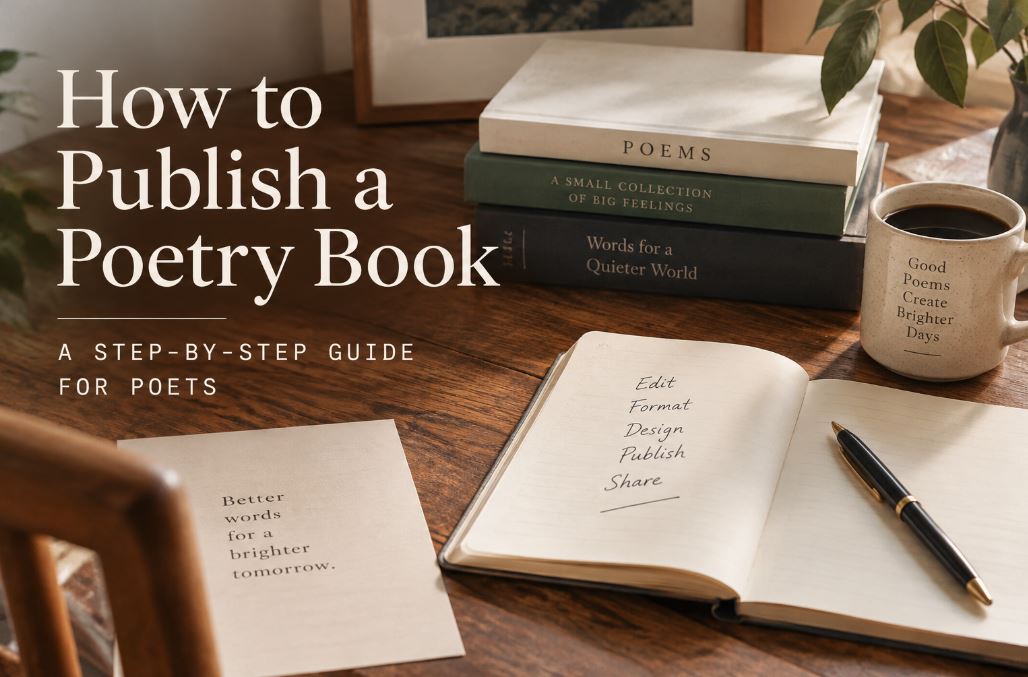
To publish a poetry book, first finalize and edit your collection, decide whether it’s a chapbook or a full-length collection, choose a publishing route, and prepare a properly formatted interior and complete book cover. You’ll then need your book’s metadata, pricing, an ISBN where one applies, and a way to get it distributed. Independent poets can publish directly through platforms like Amazon KDP, submit to poetry presses, or work with a professional self-publishing company that handles the production work.
The rest of this guide walks through every piece of that process and the decisions behind each one.
How to Publish a Poetry Book in 9 Steps
- Decide whether you have a chapbook or a full-length collection.
- Select and sequence your strongest poems.
- Edit and proofread the manuscript.
- Choose traditional, DIY self-publishing, or professional self-publishing.
- Choose a trim size and format the interior.
- Design the front, spine, and back cover.
- Prepare your ISBN, metadata, and pricing.
- Upload the files, preview them, and check a physical proof.
- Publish, distribute, and start marketing the collection.
Since the biggest decision, how you actually want to publish, shapes everything else, that’s worth covering before the finer manuscript details.
Choose How You Want to Publish
There are three routes.
Traditional / Small Poetry Press
Poetry publishing runs differently from mainstream fiction and nonfiction. Very few poetry books go through a Big Five imprint by way of a literary agent. Most poets instead submit to independent presses during open submission periods, enter chapbook or full-length manuscript contests, or respond to a press’s themed call for manuscripts. Poets & Writers’ Small Presses Database is a useful place to research presses that specifically publish poetry, along with their submission guidelines and reading periods.
The advantage is that an accepting press typically covers production costs and brings its own readership and literary credibility. The tradeoff is acceptance itself: you’re competing for limited slots, reading periods can be months apart, and the process from submission to published book often runs well over a year.
DIY Self-Publishing
You prepare and upload the book yourself, most commonly through Amazon KDP. This is the cheapest entry point, the fastest route to a finished book, and it gives you full control with no acceptance barrier at all.
The tradeoff is that everything a press handles for you now sits on your desk: formatting, cover design, metadata, proofing, and distribution. DIY doesn’t mean amateur. Plenty of self-published poets hire a formatter or a cover designer individually while still managing the overall publishing process themselves.
Professional / Assisted Self-Publishing
You keep the self-publishing model, meaning you retain ownership and control, but a company handles some or all of the production work: editing, formatting, cover design, ISBN and metadata setup, publishing, and distribution. This is where a company like WOTW fits.
It costs more than DIY, for a straightforward reason: you’re paying professionals to do the work a DIY author does themselves. It isn’t automatically the best option for every poet. It’s the option that trades money for time and technical workload.
Which Poetry Publishing Option Is Best?
| Route | Ease for Author | Upfront Cost | Speed | Author Control | Distribution | Acceptance Required |
|---|---|---|---|---|---|---|
| Traditional / poetry press | Medium once accepted | Usually low | Slow | Low to medium | Publisher-dependent | Yes |
| DIY self-publishing | Medium | Lowest potential cost | Fast | Very high | Platform-dependent | No |
| Professional self-publishing | Easiest operationally | Highest | Fast to medium | Very high | Can be broad | No |
The decision usually comes down to time, money, and control. Traditional publishing can reduce your upfront production costs but requires acceptance and patience. DIY self-publishing minimizes cost but puts the production workload on you. Professional self-publishing costs more but lets you retain control while outsourcing most of the technical work.
A few quick reference points: the lowest-cost route is generally DIY. The easiest route operationally is professional self-publishing. If your goal is simply being available on Amazon, KDP is the direct option. If you want control without wanting to personally manage formatting and file prep, that’s the case for professional self-publishing.
Do You Have a Chapbook or a Full-Length Collection?
A chapbook is a shorter collection, often built around a tight theme or a single period of work. A full-length collection has room for multiple themes and a longer arc.
There’s no universal poem count for either. Poem length varies, formatting affects page count, and presses and contests set their own requirements, usually by page count. Use whatever a specific press or contest asks for rather than a general rule.
Select and Sequence Your Poems
The order is part of the book, not an afterthought. Cut anything weaker or repetitive first. Then think about which poem opens and closes the collection, where a quieter poem needs to follow something dense, and how the last line of one poem sits against the next poem’s title, since that page turn is a real moment for the reader. Sequencing a poetry collection is closer to sequencing a record than filing poems in a folder.
Edit and Proofread Your Poetry Collection
Poetry needs the usual editing pass: unnecessary words, unintended repetition, inconsistent punctuation and capitalization, and plain proofreading.
It also needs restraint prose editing doesn’t. An unconventional line break or a stanza with no punctuation is often the point, not a mistake. Good poetry editing distinguishes an intentional choice from an inconsistency the poet didn’t mean, which look identical on the page.
Proofread again once the manuscript is laid out in its final file, not just in the word processor draft. Layout introduces its own errors. Our book editing service works from the same principle: preserve what’s intentional, fix what isn’t.
What a Finished Poetry Book Actually Needs
A publishable poetry book comes down to three things: a finished interior, a properly built cover, and accurate publishing information.
The interior includes optional front matter (title page, copyright page, dedication, epigraph, table of contents), the poems themselves in final sequence, and optional back matter (acknowledgments, notes, permissions, author bio). Not every book needs every element.
Choose your trim size before finalizing layout, not after. It sets your page dimensions, which sets your line wrapping and white space, which sets your page count and eventually your cover size. Changing it later can alter line breaks throughout the collection. 6″ x 9″ is the most common US paperback size.
Page numbering isn’t fixed either: front matter conventionally uses roman numerals, the body restarts at page 1, and whether every page shows a number is a design choice.
Formatting Poetry
A poetry book isn’t a Word document converted into a paperback. Line breaks, stanza spacing, and white space can be part of the poem itself. Generic prose layout tools assume text can reflow without changing meaning; poetry can’t always take that.
Watch for: line length against your trim size, so intended breaks don’t force-wrap; consistent stanza spacing; deliberate white space; whether a poem should start on a new page; and widows or orphans, a stanza’s line stranded alone at the top or bottom of a page.
Amazon’s Kindle Create has a dedicated Poem element built for exactly this, and it automatically reduces widows and orphans, a genre-specific acknowledgment that poetry formatting isn’t prose formatting.
Format print and ebook separately. Kindle’s reflowable text lets readers change font size, which can shift exactly where a poem’s lines break. Preview the ebook on a few screen sizes rather than assuming your print file converts cleanly.
Designing the Cover
A print-ready paperback cover is one file: back cover, spine, and front cover together. Its dimensions depend on trim size, page count, and bleed, which is why the cover waits until the interior is finalized, since page count sets spine width. Amazon’s templates and cover calculator generate the exact dimensions for your trim size, and its cover guidelines are the source to check before you build the file.
WOTW’s cover design service handles the full front, spine, and back cover as one file if you’d rather not build it yourself.
ISBN and Copyright
An ISBN identifies a specific book format. Paperbacks and hardcovers need one; ebooks and low-content books make it optional. A free KDP ISBN restricts the book to KDP and lists “Independently published” as the publisher; your own ISBN, bought through an agency like Bowker, lets you use your own publisher name. See Amazon’s ISBN guidance for specifics.
Copyright is separate from an ISBN and exists the moment you create the work. For registration questions, the U.S. Copyright Office is the authoritative source. This isn’t legal advice; talk to an attorney for anything with real stakes.
Metadata, meaning title, author, description, categories, keywords, pricing, and language, is worth finalizing alongside your files rather than as an afterthought.
Publishing and Distributing the Book
Once your manuscript, cover, ISBN, and metadata are ready:
- Choose your platform (Amazon KDP is the most common starting point).
- Upload your interior and cover files.
- Preview and fix anything that looks wrong.
- Order and check a physical proof.
- Set pricing and territories.
- Publish.
On KDP specifically, that means entering your book details, choosing print specifications, uploading files, using the previewer, and setting pricing. Verify the exact steps against Amazon’s publishing resources, since the interface changes.
Amazon and broader distribution aren’t the same goal. KDP paperbacks can enroll in Expanded Distribution free, but Amazon is direct that enrolling doesn’t guarantee any distributor, bookseller, or library actually orders the book, and it can take up to eight weeks to go live. If Amazon is your whole goal, KDP alone may cover it. If you want genuinely broader reach, weigh that against a publisher with wider channels. Writers of the West’s self-publishing service handles distribution, though no publisher can guarantee a specific store stocks a title.
Order a physical proof before calling it finished. Line wrapping and white space that look right on a screen can read differently on the actual page, so check the sequence, margins, page breaks, and cover alignment in hand, not just in a PDF.
Can You Publish a Poetry Book for Free?
Yes. Platforms such as Amazon KDP let you publish without paying an upfront platform fee. But publishing for $0 and producing a professionally edited, designed, and marketed book for $0 aren’t the same thing.
The platform fee is genuinely free. The costs that can still show up are editing, proofreading, formatting, cover design, an ISBN if you buy your own rather than use KDP’s free one, proof copies, and marketing. A poet capable of doing professional-quality work across those areas themselves can legitimately publish for very little. Most poets end up paying for at least one or two of these pieces, most commonly editing or cover design.
How Much Does It Cost to Publish a Poetry Book?
There’s no single universal number, because the answer depends on the route.
Traditional publishing: an accepting press normally covers legitimate production costs after acceptance. A company that charges an author a fee to publish their book isn’t a traditional publisher just because it calls itself one.
DIY self-publishing: the platform upload itself is free. Your actual cost depends on what you can do yourself versus what you need to hire out.
Professional self-publishing: cost depends on manuscript length, how much editing it needs, formatting complexity, custom cover art, which editions you’re producing, and whether marketing is included. For current numbers, check WOTW’s pricing page rather than relying on a figure quoted in an article, since pricing changes over time.
What Happens After Your Poetry Book Is Published?
Keep this focused rather than a full marketing plan. The main levers after launch are your Amazon product page itself (categories, keywords, your author page), securing early reviews, giving a launch audience something to act on, reading excerpts at poetry readings or events, short-form content built around individual poems, an email list if you have one, and local bookstore relationships where relevant. Paid promotion can make sense once those fundamentals are in place, not before.
Frequently Asked Questions
How many poems do you need to publish a poetry book? There’s no universal number. Chapbooks and full-length collections differ, poem lengths vary, and specific presses and contests set their own requirements, usually by page count rather than poem count.
Do I need a literary agent to publish a poetry book? Generally no. Most poetry presses accept direct submissions during open reading periods or through manuscript contests, unlike the agent-and-Big-Five route standard for commercial fiction.
Should I publish poetry as a paperback or ebook? Many poets prioritize print because the physical page layout is part of how the poem is meant to be read, but there’s no reason not to publish both, as long as the ebook edition is prepared and previewed on its own terms rather than assumed to convert cleanly from print.
What size should a poetry book be? There’s no universal trim size. The choice affects line length, white space, page count, and eventually cover dimensions. 6″ x 9″ is the most common US paperback size, but it isn’t a requirement.
How long does it take to publish a poetry book? It depends on the route. Traditional publishing, from submission to a finished book, often runs well over a year once reading periods and production timelines are factored in. Self-publishing, once your manuscript and files are genuinely ready, can move in weeks.
Final Takeaway
A publishable poetry book ultimately needs three things: a finished interior, a properly built cover, and accurate publishing information. The harder decision is how you want those pieces produced and distributed. Traditional presses trade control and speed for selection and publisher support. DIY self-publishing gives you maximum control and the lowest potential cost but puts the production work on you. Professional self-publishing lets you keep control while outsourcing most of that work.
If you’d rather have that production work handled for you, from editing through cover design, formatting, and distribution, Writers of the West can walk you through preparing and publishing your collection.
About the Author
Mindset & Transformational Nonfiction Editor, Writers of the West
Brienna Burroughs holds an M.A. in English Literature from the University of Arizona and works with Writers of the West across mindset, motivation, Christian memoir, and psychological thriller manuscripts. A lifelong lover of mind-bending fiction, she brings a strong editorial instinct for narrative clarity, emotional tension, and voice consistency. Her work helps authors refine their message into structured, impactful writing that resonates with readers seeking transformation or gripping storytelling.
writersofthewest.net · Professional Ghostwriting Services, Book Editing & Publishing Guidance