The Cheapest Way to Publish a Book in 2026 (Real Costs)
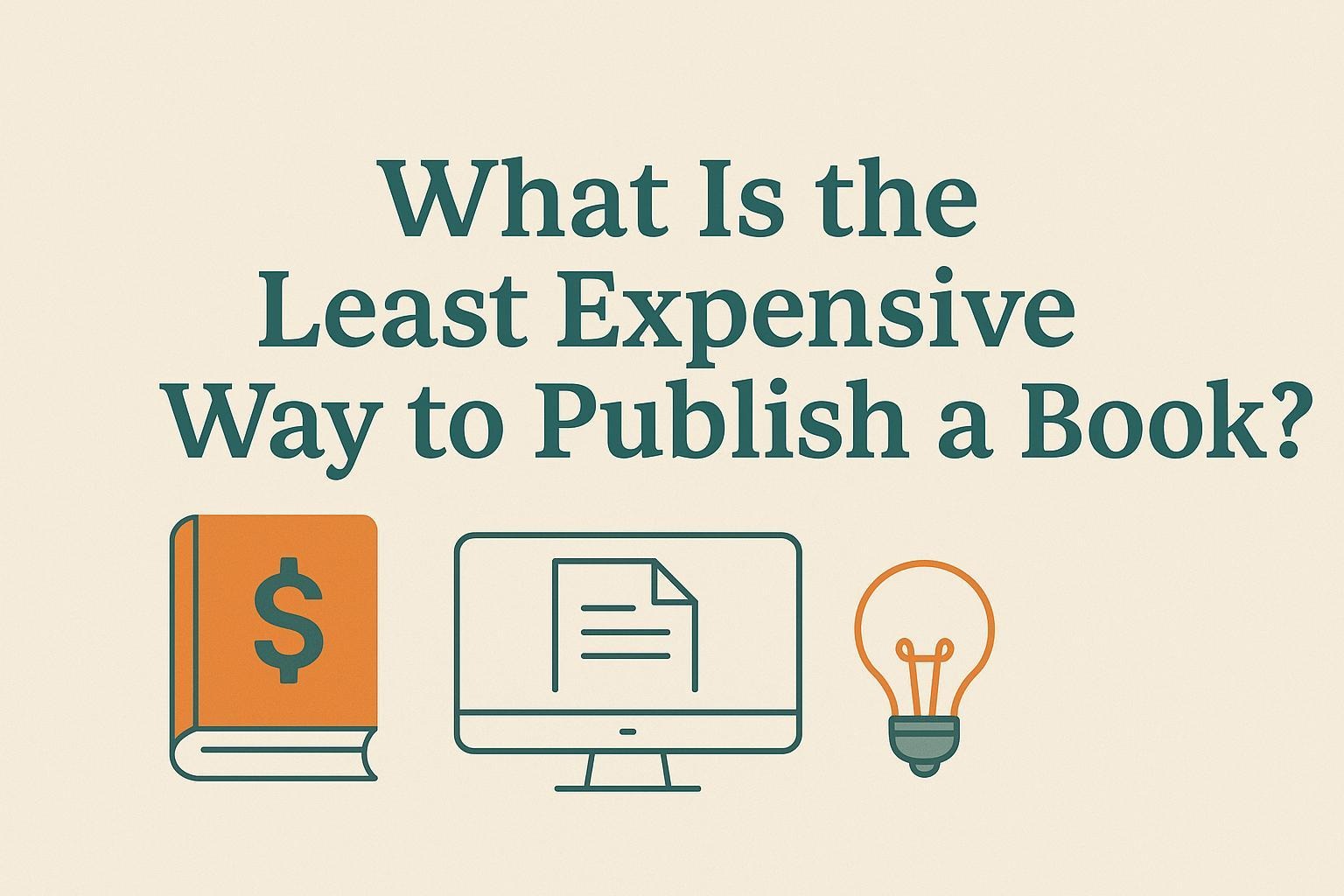
Every guide to this question gives you a range so wide it’s useless. Zero dollars. Fifteen thousand dollars. Somewhere in between, apparently, good luck. That range isn’t wrong, it’s just answering the wrong question. The cheapest way to publish a book isn’t simply choosing the platform with the lowest fee. The biggest savings come from knowing which parts of the publishing process you can realistically handle yourself and which are worth paying for.
At a Glance
The cheapest way to publish a book in 2026 is to write the manuscript yourself, limit professional help to areas you can’t handle confidently, use a free publishing platform such as Amazon KDP, and begin with organic marketing. If you want to publish cheaply yet effectively, it comes down to which of the four stages you handle yourself: writing costs $0 if you write it yourself up to $1,500–$10,000+ for a ghostwriter, editing runs $300 (proofreading) to $3,000 (developmental) depending on how rough the manuscript is, publishing is free if you self-publish on Amazon or starts at $699 for a done-for-you release across multiple platforms, and marketing is free at the low end with paid options like BookBub or Writers of the West running roughly $100 to $4,000+. There’s no single cheapest number, only a cheapest choice at each of the four stages, and the right combination depends on which ones you can actually handle yourself.
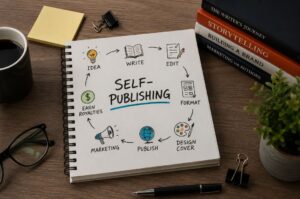
There are four stages: writing, editing, publishing, and marketing. Each one has its own cost floor, its own DIY option, and its own point where cutting corners starts costing you more than it saves.
Cheapest Ways to Handle the Writing
You’ve got three real paths, and the cost difference between them is the biggest swing in the entire process.
Write it yourself, then get it line edited. You do the heavy lifting, a professional smooths the prose. This works if your manuscript’s structure is already solid and what it needs is polish, not a rebuild. Cost: your time, plus a line edit.
Write it yourself, edit it yourself, then get a proofreader for the final pass. The cheapest real path that still produces a clean book. You’re doing both the writing and the self-editing work, and paying only for someone to catch what you can’t see in your own manuscript, typos, inconsistencies, the small stuff that’s nearly invisible to the person who wrote it. Cost: your time, plus a proofread.
Hire a ghostwriter. If writing itself is the bottleneck, not the editing, this skips the writing stage entirely. It’s also where the cost jumps the most, you’re paying for the manuscript to exist, not just to be polished. Published ghostwriting rates typically start around $1,500 for shorter projects and run up to $10,000 or more depending on length and complexity.
Cost range for this stage: $0 (self-written) to $1,500–$10,000+ (ghostwriter).
The choice isn’t really about money first. It’s about where your actual manuscript sits right now. A finished rough draft doesn’t need a ghostwriter. A blank page and no time doesn’t get fixed by a line editor.
How to Save Money on Book Editing Without Skipping It
This is the stage most cost guides get vague about, treating “editing” as one line item instead of three different jobs at three different price points, depending on what shape your manuscript is actually in.
If the manuscript is rough, structure, pacing, or plot issues, it needs developmental editing first. This is the most involved pass and the most expensive, because it’s not fixing sentences, it’s fixing the book’s bones.
If the structure is solid but the prose needs work, line by line, that’s a line edit. Style, clarity, sentence flow.
If the book is actually ready and just needs a final check, that’s proofreading. Grammar, spelling, the last pass before it goes out.
Using our own published rates as a real example: developmental editing runs $1,000 to $3,000, line-by-line editing runs $650 to $1,950, and proofreading runs $300 to $600. Formatting comes included free with any editing package, so it’s not a separate line item if you’re already getting edited. Most publishers offer payment plans on top of that, so even the higher end of developmental editing usually breaks down to a manageable monthly amount rather than one number due upfront.
Cost range for this stage: $300 (proofreading) to $3,000 (developmental editing).
One more thing worth knowing here, since it affects how much editing actually costs depending on your genre: a straightforward romance or contemporary novel edits differently than a heavily researched nonfiction book or a fantasy manuscript with a built world to keep consistent. Genre affects scope, and scope is most of what drives the price.
Publishing: The DIY Version, and the Done-For-You Version
If your goal is the cheapest way to self-publish a book, Amazon KDP is one of the simplest starting points because uploading a book is free. Getting the finished manuscript onto a platform is the cheapest stage in the whole process, if you’re only publishing on Amazon and doing it yourself. Amazon KDP is free to use, and if you want the full walkthrough, screen by screen, we’ve laid out the entire process step by step separately. If you’ve already got a book live and want it to actually sell instead of sitting there, that’s a different problem with its own guide.
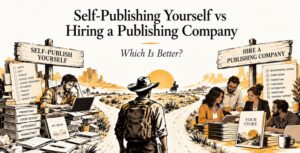
Publishing yourself on Amazon alone is cheap. Publishing well, on more than one platform, with your own imprint attached and someone else handling the distribution, is a different job. If you want a company to publish and distribute across multiple platforms rather than just Amazon, with your book carrying your own brand instead of looking like a DIY upload, our hyrbid publishing packages start at $699. That’s not the cheapest number in this article. It’s the cheapest number for not doing it yourself.
Cost range for this stage: $0 (DIY on Amazon) to $699+ (done-for-you, multi-platform).
Marketing: Free First, Paid Second
Marketing is the stage where “cheap” and “free” actually overlap the most, and also where most authors underspend on the one thing that would have moved the needle.
Free options first: social media posts, writing communities, an email list you build yourself, reader reviews you ask for directly. These cost time, not money, and they’re not nothing, consistent free marketing outperforms a one-time paid push more often than authors expect.
Paid options, roughly priced: Amazon and Facebook ads generally start around $5 to $100 a day depending on how aggressive you want to test. BookBub features, one of the more effective paid promotions in the industry, run anywhere from about $100 to over $4,000 depending on genre and list size. An author website, if you want a real one instead of a link-in-bio page, runs anywhere from a few hundred dollars for something simple to several thousand for something built out, plus a domain and hosting, which are cheap on their own, usually under $20 a month combined.
Cost range for this stage: $0 (organic/free tactics) to $100–$4,000+ (paid ads and promotions).
Some of that you can reasonably do yourself. Some of it is exactly the kind of ongoing, unglamorous work that’s easy to underinvest in because it doesn’t feel like “real” marketing the way a big ad campaign does. If you want it handled rather than juggled on top of everything else, that’s part of what our publishing packages include at the higher tiers, alongside the production side.
The Cheapest Way to Publish a Book Without Sacrificing Quality
If you’re optimizing purely for cost without sacrificing quality, here’s the combination we’d actually suggest: write the manuscript yourself, get a proofread rather than a full developmental edit if the structure is already solid, publish yourself on Amazon KDP first, and lean on free marketing before spending on ads. Realistic total: a few hundred dollars, mostly on proofreading.
Pros of this route:
- Lowest possible cost while still producing a professional-reading book
- You keep full control and 100% of the decision-making
- Nothing here requires waiting on anyone else
Cons of this route:
- It takes real time, writing, formatting, uploading, and marketing are all on you
- If your manuscript actually needs developmental work and you skip it to save money, that tends to show up in reviews later
- Discoverability on Amazon is an ongoing effort, not a one-time task, and doing it entirely free takes longer to build momentum
If any of those cons matter more to you than the savings, that’s exactly the point where paying for editing, done-for-you publishing, or paid marketing earns its cost back. There isn’t one cheapest way to publish a book, there’s a cheapest way to write it, edit it, publish it, and market it, and the right combination depends on which of those four you can actually do well yourself.
About the Author
Cell Biologist, Sociologist & Senior Editor, Writers of the West
Robert Whitehead is an American sociologist and cell biologist at the University of Virginia. He has been with Writers of the West for six years, bringing a rare combination of scientific rigor and behavioral insight to biography, fiction, and book design editorial work. His research background strengthens narrative authenticity, analytical precision, and structural coherence across a wide range of manuscript types.
writersofthewest.net · Professional Ghostwriting Services, Book Editing & Publishing Guidance