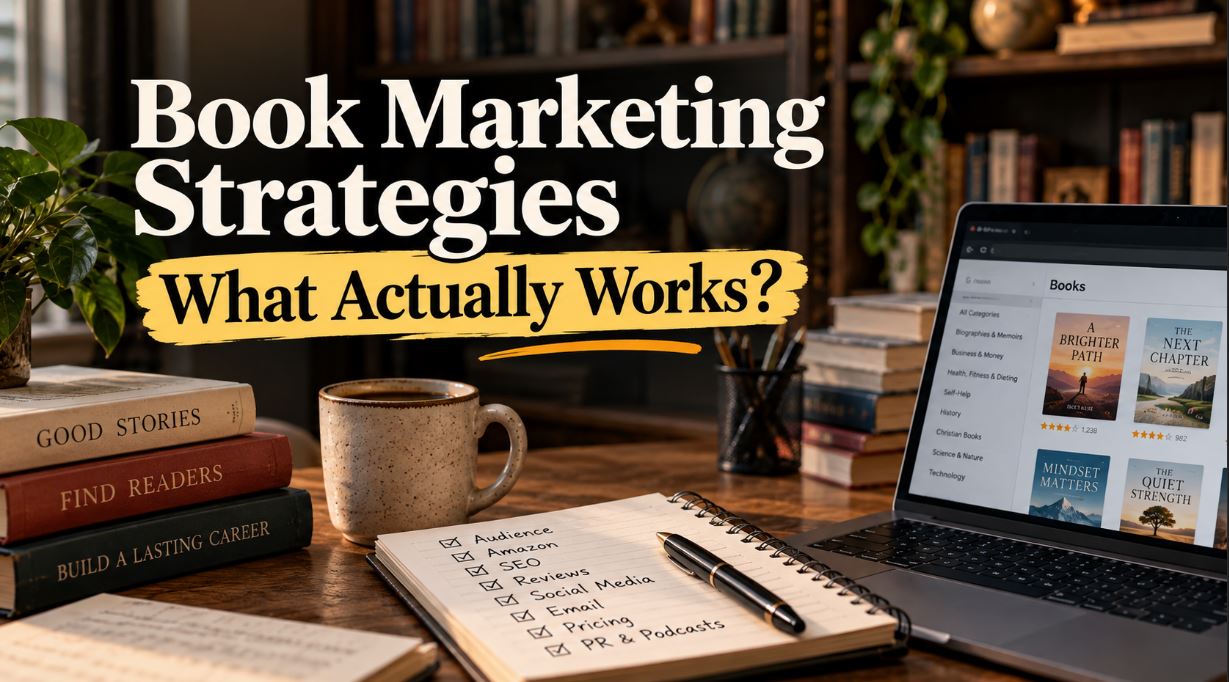
Publishing a book used to be the hard part. Now almost anyone can put one on Amazon within days, and the hard part has become creating demand. Most book marketing strategies were built for the old problem.
People still read: Pew found that 75% of U.S. adults read at least part of a book last year. Selling one is harder. The Authors Guild put median book income across all surveyed authors at $2,000 for 2022.
Below, we separate what we’ve seen in our own campaigns at Writers of the West from independent data. Every strategy comes back to one question: where is the audience, and does this tactic reach them?
Book Marketing Strategies Compared at a Glance
None of these strategies is good or bad on its own. Which book marketing strategy you should opt for depends on your goal: sales, readership, awareness or credibility. The recommendation column is Writers of the West’s view for a typical self-published author with a limited budget.
| Strategy | What it actually does | Best when | Reality check | Writers of the West’s recommendation |
|---|---|---|---|---|
| Build an audience | Creates demand | Ideally before launch | Takes time | ★★★★★ Start here |
| Assess demand | Shows whether strangers want the book | Done before spending on marketing | The answer may be uncomfortable | ★★★★★ Do this first |
| Amazon optimization | Captures existing demand | Based on real search and category research | Doesn’t create demand | ★★★★★ Top priority |
| SEO outreach | Gets discovery | Search demand exists | Requires outreach | ★★★★★ Strongly recommended |
| Price promotions | Lowers the risk of trying an unknown author | Goal is readers, not profit per copy | Less revenue per sale | ★★★★☆ Underrated |
| Reviews | Builds trust and conversion | People already find the book | Doesn’t create traffic | ★★★★☆ Essential for conversion |
| Email newsletter | Converts and retains readers | The author owns an engaged list | A database is not automatically an audience | ★★★★☆ Build your own list |
| Amazon Ads | Paid discovery | The listing converts | Can spend without selling | ★★★☆☆ Test carefully |
| Social media and BookTok | Builds an audience over time | Genre fits and content is useful | Book posts alone rarely sell | ★★★☆☆ Genre-dependent |
| Reader communities | Reaches people who care about the subject | Clear subject niche | Doesn’t scale | ★★★☆☆ Useful, small scale |
| Backlist and series | Builds read-through | The author already has readers | Useless for a first book | ★★★☆☆ Powerful once established |
| Podcasts, PR and media | Builds awareness and credibility | The audience is relevant | Placement ≠ sales | ★★☆☆☆ Check the audience |
| Influencers and Bookstagram | Borrowed recommendation | Followers act on recommendations | Follower count misleads | ★★☆☆☆ Vet before paying |
| Website and PR | Builds credibility | People research you | Branding ≠ sales | ★★☆☆☆ Credibility, not sales |
| Author collaborations | Gives access to another author’s readers | Readerships overlap | Hard to secure as an unknown | ★★☆☆☆ Only with overlap |
| Events and bookstores | Reaches people in person | Attendees can actually be sourced | Often poorly attended | ★★☆☆☆ Ask who’s coming |
| Giveaways | Gets books into readers’ hands | Goal is readership or goodwill | Weak direct return | ★☆☆☆☆ Know your goal first |
Strategies with the same number of stars follow the article’s section order. The table order no longer matches the section numbers below it, but readers can still find each strategy by name.
1. Build an Audience Before You Try to Sell a Book
The most powerful marketing advantage an author can have is an audience that already cares about them or their subject. A book is far easier to sell to people who already trust the author than to strangers seeing the cover for the first time.
Look at how the rest of the internet makes money. Creators build attention around something: expertise, entertainment, a specific problem, a hobby, a strong personality, a community. Then they sell into that attention through courses, merchandise, sponsorships, subscriptions and affiliate deals.
A book is also a product. It follows the same logic.
What doesn’t work is opening a TikTok account the week your book comes out and posting the cover over and over with some version of “buy my book.” Nobody asked. Nobody knows who you are.
The order that works looks more like this:
Subject → content → audience → trust → book.
Say someone is publishing a book about recovering financially after bankruptcy. Before the book launches, they could post useful content about rebuilding credit, budgeting after a financial collapse, the mistakes that got them there, how debt collection actually works, and what their recovery looked like month by month. People who follow that content already care about the subject. When the book arrives, it’s the deeper version of something they’re already consuming, not a cold pitch.
What this means for book launch marketing strategies
Pre-launch marketing gets recommended constantly, and it can work. It works when there’s someone to launch to. A pre-order campaign, a cover reveal or a countdown aimed at an audience of 40 people (mostly relatives) won’t behave the way launch playbooks promise. If you’re a new author with no audience yet, starting the content now matters more than any launch tactic.
Pros
- Creates demand instead of chasing it
- The audience belongs to you and carries over to future books
- Makes launches, newsletters, reviews and ads all perform better
- Content can double as search presence
Cons
- Slow; it often takes months before it pays off
- Needs consistent effort and a subject you can keep producing content about
- Starting after the book is out puts you behind
2. Figure Out Whether There’s Demand for the Book Itself
Market demand and marketing execution are different problems. A beautifully written book can still have limited commercial demand, and no campaign fully fixes that.
This is the conversation most marketing companies skip, probably because it’s uncomfortable to have with a paying client.
Authors need to separate two statements:
- “This story matters to me.”
- “A large number of strangers currently want to buy a book about this.”
Both can be true. Often only the first one is.
Things that shape demand include genre, what readers are searching for right now, cultural and news relevance, how distinctive the hook is, how large the potential audience is, and how crowded the competing titles are.
In our experience at Writers of the West, books that intersect with something readers are already worried about or talking about are usually easier to position than very general personal stories. We’ve seen subjects like survival, preparedness, self-sufficiency and dystopian themes become easier to market when public interest in them rises. That’s an observation from our campaigns, not a claim that any genre is booming right now. Check current data before betting on a trend.
None of this is a case against memoir. Books about trauma, abuse, addiction and recovery can matter enormously to the people who find them. The emotional weight of a story just doesn’t automatically create demand among strangers. For books without obvious existing demand, the other levers get heavier: audience building, positioning, pricing, and a hook that tells a stranger in one line why this book is different.
Pros
- Prevents spending heavily on a book the market isn’t looking for
- Shapes positioning, pricing and the hook before launch
- Tells you which other strategies deserve the budget
Cons
- The answer can be hard to hear
- Reader interest shifts, so it’s a snapshot, not a verdict
- Doesn’t sell a single copy by itself
3. Amazon KDP Book Marketing Strategies: Optimize With Real Data
Amazon optimization helps a book convert existing search demand; it doesn’t create demand by itself. Effective optimization starts with real reader search data, relevant categories and competitive analysis, not guessed keywords.
We recommend putting Amazon first for most self-published authors. Other retailers aren’t useless. Wider distribution can improve availability and make a book look more established. But if your time and budget are limited, focus on the marketplace where your book is most likely to be discovered and bought.
The Authors Guild’s guidance on online marketing also lists Amazon optimization, appropriate categories and keywords, advertising and strategic pricing among the fundamentals.
Here’s what optimization is not: opening ChatGPT and asking for seven keywords for your mystery novel. You’ll get seven plausible-sounding phrases that may or may not match anything a real reader types.
Keyword research
Start with what readers actually search for, using professional research tools and real search data. Guessing is how books end up with keywords like “gripping page-turner” that almost nobody searches.
Category research
First identify every category that honestly fits the book. Then look at how competitive each one is, instead of picking categories because they sound right.
Our category-positioning process at Writers of the West usually runs in this order:
- Map every relevant category.
- Run a proprietary multi-factor assessment of each one.
- Analyze roughly the top 10 to 15 competing books in the strongest candidates.
- Research buyer and search behavior.
- Decide on positioning.
- Optimize the listing.
It’s the same research our Amazon KDP publishing services team runs before a listing goes live, and it’s usually where we find the biggest gap between how an author sees their book and how Amazon shoppers search for it.
Book description
The description has two jobs. It has to sell the book to a human who’s hovering over the buy button, and it has to make the subject, genre and relevance obvious. Descriptions that read like a synopsis tend to fail the first job. Descriptions that are all atmosphere fail the second.
Metadata
Title, subtitle (where it fits naturally), keywords and categories all feed discoverability. Nobody can honestly promise you a ranking from metadata alone. Anyone who does is guessing, or selling. We’ve broken down how we position books to rank on Amazon separately, including the parts of that process an author can control and the parts nobody can.
Pros
- Reaches shoppers who are already in buying mode
- Mostly a one-time setup that keeps working
- Improves the results of Amazon Ads and every other traffic source
Cons
- Can’t create demand that isn’t there
- Proper research takes tools and time; guessed keywords do little
- No honest way to guarantee rankings
4. Amazon Ads Can Work, but Results Vary Wildly
Amazon Ads put a book in front of people who are already shopping for books, which is a real advantage. Clicks aren’t sales, though, and conversion depends heavily on the book, the listing and the price.
The appeal is obvious. Someone scrolling Amazon is already in buying mode, unlike someone scrolling a social feed.
What happens after the click is less predictable. Across campaigns we’ve managed at Writers of the West, we’ve seen click-to-sale rates of around 10% on some books, around 1% on others, and campaigns where clicks produced no sales at all. These are our own campaign observations, not industry benchmarks. We don’t know of a reliable universal figure for a “good” Amazon Ads conversion rate, and we’d be wary of anyone quoting one.
What moves the number:
- Genre
- Cover
- Price
- Number and quality of reviews
- Description
- Targeting
- Competition in the ad placement
- Budget
- Ebook versus print economics
- Whether demand for the subject exists at all
In many of our campaigns, we’ve found lower-priced ebooks easier to convert than print editions. That’s Writers of the West experience, not an industry finding. It’s why we often point ad spend at the ebook, where a reader deciding whether to gamble on an unknown author has less to lose.
Pros
- Reaches shoppers already browsing books
- Fast to launch and easy to adjust
- Clear data on clicks, spend and sales
Cons
- Clicks can cost money without producing sales
- Results swing heavily from book to book
- Amplifies a weak listing’s problems instead of fixing them
5. Price Promotions Are Underrated Self-Published Book Marketing Strategies
Temporary price promotions lower the risk of trying an unknown author. They make the most sense when the goal is more readers and more exposure rather than maximum profit per copy.
Think about what you’re asking a stranger to do: pay full price for a book by someone they’ve never heard of, on a subject they’re not sure about. Dropping that price for a limited window removes one reason to say no.
This isn’t just our opinion. In the Authors Guild survey, respondents rated three channels as most effective: Kindle Unlimited or other subscription programs, ebook discounts or promotions, and author email newsletters.
Temporary ebook prices of $0.99, $1.99 or $2.99 are common. None of them is universally best. It depends on genre norms, your list price, and what you’re trying to accomplish.
Amazon offers two built-in tools through KDP Select, Kindle Countdown Deals and Free Book Promotions. There’s a tradeoff: KDP Select requires your Kindle ebook to be exclusive to Amazon for each 90-day enrollment period. That means no ebook on Apple Books, Kobo or anywhere else while you’re enrolled.
One caution. Strategic promotional pricing is different from permanently undervaluing your work. A short discount to bring readers in is a tactic. A permanent bargain-bin price is usually a positioning problem.
Pros
- Removes the biggest barrier for an unknown author: risk
- Low cost and quick to set up
- Rated among the most effective channels by authors themselves
- Can feed reviews and read-through
Cons
- Less money per copy
- KDP Select tools require ebook exclusivity to Amazon
- Discounting too often can teach readers to wait for the next deal
6. Reviews Help Conversion More Than They Create Demand
Reviews rarely bring people to a book. They help someone who has already found the book decide whether to buy it.
The path usually goes like this: someone discovers the book somewhere, clicks through to Amazon, looks at the cover and listing, checks what other readers said, and decides.
Amazon’s own KDP documentation describes customer reviews as a way for shoppers to see what other readers think before buying. That’s a conversion role, not a discovery role.
It still matters a lot. A product page with almost no reader feedback can make a book look unestablished at the exact moment a potential buyer is deciding.
A legitimate way to build reviews
If a book is struggling to reach readers, a free or discounted ebook promotion can put it in front of more people. KDP Select Free Book Promotions let you offer a Kindle ebook free for up to five days in each 90-day enrollment period. You can then ask readers to leave an honest review.
Amazon’s rules on this are specific. Authors may give free or discounted copies, but can’t require a review in exchange or try to influence what the review says. Offering anything beyond the book itself, such as a gift card, gets the review removed.
So don’t:
- Buy reviews
- Pay or reward reviewers for positive ratings
- Make a review a condition of a free copy
- Manipulate star ratings in any way
Beyond the ethics, it’s a fast way to lose the reviews you do have.
Pros
- Builds trust at the moment of purchase
- Makes ads and promotions convert better
- Free promotions offer a legitimate way to reach first readers
Cons
- Doesn’t bring new visitors on its own
- Slow to accumulate for unknown authors
- Strict platform rules, and breaking them can cost you existing reviews
7. SEO and Online Book Marketing Strategies: Go Where Readers Are Already Searching
Instead of only trying to build search traffic from zero, find the pages that already rank for the searches your readers make and pitch your book to the people who run them.
When most authors hear “SEO,” they picture starting a blog and waiting two years for Google to notice. That can work eventually. It’s slow.
The approach we like much more at Writers of the West is third-party search placement.
Say the book is about survival. Readers looking for it might search:
- best survival books
- survival books for beginners
- best preparedness books
- books about living off-grid
Run those searches in Google and Bing and look at who ranks. You’ll find editorial sites, blogs, recommendation lists, resource pages, publications and reviewers. Those pages already get the exact traffic you want. Some of them can be pitched.
Then:
- Make a list of the pages ranking for your target searches.
- Check which ones add or update titles, and which accept suggestions.
- Find the right contact.
- Send a short, specific pitch explaining why the book deserves a place on that particular list.
- Follow up once, politely, then move on.
This is SEO, outreach and digital PR working together. The book has to earn its place, though. Mass-emailing every blogger with a template, or paying for placements disguised as editorial recommendations, damages trust and rarely lasts. It’s slow, manual work, which is why it’s a core part of our book marketing services rather than something we hand off to a template.
Pros
- Borrows search traffic that already exists instead of building it from zero
- Reaches readers actively looking for books like yours
- Placements can keep sending readers for months or years
- Creates more third-party mentions through which readers, and potentially search engines and AI tools, can discover the book
Cons
- Needs a clear niche with real search demand
- Outreach is manual work, and most pitches get no reply
- Doesn’t suit books without an obvious searchable subject
8. Social Media and BookTok: Audience First, Promotion Second
Social media works when it builds an audience around a subject or a voice. Posting pictures of an unknown book to an empty account usually doesn’t create demand.
This ties straight back to strategy 1.
The independent evidence here is interesting. In the Authors Guild survey, social media and blogging were generally rated among the least effective channels. TikTok was the exception for specific genres: romance and romantic suspense, African American fiction, poetry, YA, new adult, and erotic fiction.
That supports the middle-ground view. Social media isn’t universally useless, and it isn’t universally essential. Genre matters. Content matters. Whether anyone is watching matters most.
Pros
- Free to start, and can build an audience over time
- TikTok performs well for romance, YA and several other genres
- Content builds a recognizable author voice
Cons
- Generally rated among the least effective channels
- Promotional posts to a small following rarely sell books
- Time-consuming, with results that depend on algorithms you don’t control
9. Email Marketing Is Excellent When It’s Your Audience
An author’s own email newsletter and a third-party promotional email blast aren’t the same strategy. A newsletter reaches people who chose to hear from the author; a third-party campaign is only as valuable as the relevance and engagement of the list behind it.
Email marketing isn’t dead. An author newsletter was one of the three channels respondents rated most effective in the Authors Guild survey. That fits everything else here: an audience that opted in to hear from you is valuable.
Now compare that with a company telling you, “Pay us a few thousand dollars and we’ll email your book to our database.”
A database is not automatically an audience.
Before paying for a third-party email campaign, ask:
- Who are these subscribers?
- Why did they subscribe in the first place?
- Did they opt in to receive book recommendations specifically?
- Which genres are they interested in?
- How is the list segmented?
- When did they last engage?
- What are the actual click rates?
- What sales did comparable campaigns produce?
If nobody can answer most of those, you’ve learned something.
Pros
- You own the list; no algorithm decides who sees your message
- Among the channels authors rate most effective
- Cheap to run once it’s built
- Carries readers from one book to the next
Cons
- Worth little until you’ve built an audience to fill it
- Third-party blasts vary wildly, and many lists are poorly matched
- Needs regular, useful sends or subscribers drift away
10. Podcasts, PR and Media: Ask Who Is Actually Listening
A podcast or media appearance is only as valuable as the audience on the other end. Relevance often matters more than the name of the show.
Podcasts can help with credibility, author branding, content you can reuse, search presence, networking, and slowly building an audience. We’re not dismissing them.
But appearing on a show with a few dozen listeners isn’t the same as reaching a large, relevant audience, even if both go on the same “as featured on” list. A smaller show whose listeners care about your exact subject can beat a bigger generic one.
Smaller appearances still count as stepping stones. Just don’t expect them to move sales on their own.
Pros
- Builds credibility and author brand
- Creates reusable content and search presence
- Smaller shows are realistic stepping stones
Cons
- Placement doesn’t equal sales
- Audience size and relevance are often unclear before you agree
- Paid appearance packages can overpromise
11. Influencers and Bookstagram: Measure Influence, Not Follower Count
The question isn’t how many followers an account has. It’s whether their audience acts on their recommendations.
Things worth checking:
- How relevant the audience is to your book
- Real engagement versus inflated numbers
- Genre fit
- Actual reach per post
- Their history of recommending books
- Evidence that followers buy what they recommend
Some Bookstagram and BookTok accounts drive real sales. Others review huge volumes of books for an audience that mostly scrolls past. Both kinds exist. A micro-influencer with 4,000 followers who all read your genre can be worth more than a lifestyle account with 200,000.
Pros
- A trusted recommendation can move readers quickly
- Micro-influencers are affordable and often highly targeted
- Strong fit for visual, genre-driven fiction
Cons
- Follower counts and engagement can be misleading
- Purchasing influence is hard to verify
- Results are unpredictable from one post to the next
12. Author Websites and PR Help Branding More Than Direct Sales
An author website and professional PR make a book look serious to someone researching it. Neither one creates an audience on its own.
We build author websites and support author branding at Writers of the West, and we still say this plainly: a website existing doesn’t bring readers to it.
What a website does do:
- Adds credibility and a professional identity
- Holds book information, the author bio and retailer links
- Gives media a way to make contact
- Builds some search presence over time
- Captures emails
- Gives you a platform you own, unlike social accounts
PR and broader digital presence work the same way. When someone discovers the book elsewhere and goes looking, they find something that looks like a real professional project.
Three things get lumped together that shouldn’t be:
- Press release syndication. Your release is distributed and republished across a network of sites.
- Retailer distribution. Your book is available to buy through more stores.
- Earned editorial coverage. A journalist or editor chose to write about your book.
Only the third one means someone in the media independently judged the book worth covering. A syndicated release showing up on a news site’s feed isn’t an endorsement from that outlet, and it shouldn’t be presented as one. When we handle self-publishing services for an author, press releases and retailer distribution are part of the package, and we keep all three labeled separately in reporting for exactly that reason.
Pros
- Makes the author and book look professional
- A home base you own for bio, links, media contact and email signups
- Supports every other strategy when readers go looking
Cons
- Doesn’t generate traffic or demand on its own
- Syndicated press is often mistaken for editorial coverage
- Needs upkeep to stay current
13. Reddit, Facebook Groups and Reader Communities
Go where people already care about the subject, and mention the book only when it’s relevant to the conversation.
If your book covers military history, parenting, a specific medical condition, local history, religion, survival, a hobby or a profession, there are communities full of the exact people who might want it.
The catch is behavior. Show up, contribute, and bring up the book when someone asks something it actually answers. Drop a link into 30 groups on launch day and you’ll get banned from most of them.
Keep expectations realistic too. This can bring in some readers and some awareness. A handful of Facebook posts isn’t a scalable sales engine.
Pros
- Puts the book in front of people who already care about the subject
- Free
- Works especially well for nonfiction niches
Cons
- Doesn’t scale
- Self-promotion rules are strict, and spam gets you banned
- Needs real participation, not drive-by posting
14. Giveaways: Know What You Want From Them
Giveaways are a readership and awareness tactic, not a reliable way to make money directly.
They can make sense for readership, awareness, goodwill, launch activity, and legitimate ARC or review programs that follow platform rules.
If the plan is “spend money giving books away so I immediately make more money,” the math usually doesn’t work.
Decide the goal first. Then pick the tactic.
Pros
- Gets the book into readers’ hands
- Useful for launch buzz and legitimate ARC programs
- Builds goodwill
Cons
- Weak direct return on money spent
- Winners are often prize hunters, not target readers
- Review-related giveaways must follow platform rules
15. Events and Bookstore Appearances: Who’s Coming?
An event is only as valuable as the people who actually attend.
An event isn’t valuable just because someone booked a room and put your name on a poster.
Events can work well for local authors, nonfiction authors who speak, niche groups, and authors who already have an audience that will show up. They’re also good for networking and credibility.
Be skeptical of expensive event packages when nobody can explain how attendees will actually be found. “We’ll promote it” isn’t an answer.
Pros
- Face-to-face connection with readers
- Good for local authors, speakers and niche groups
- Builds networking and credibility
Cons
- Attendance is often low without an existing audience
- Expensive packages rarely explain where attendees come from
- Reach is limited to one room on one day
16. Author Collaborations: Audience Overlap Is the Point
A collaboration is only worth doing if it gives you access to readers who’d plausibly want your book.
Think about it from the other side first. If you’re an unknown memoir author, why would an established author say yes? Have an answer to that before you ask.
If a collaboration does happen, check whether their readers overlap with yours. The collaboration itself isn’t the result. Access to a relevant audience is.
Pros
- Borrowed trust from an author readers already know
- Low cost when both sides benefit
Cons
- Established authors have little reason to say yes to unknowns
- Useless if the audiences don’t overlap
17. Backlist and Series Cross-Promotion
Once an author has readers, every new book can sell earlier titles and every earlier title can sell the next one.
If Book 1 finds readers, later books can promote earlier titles, advertise sequels, bundle a series, link between books and build read-through. Existing readers are the easiest ones to sell to again.
It’s also useless advice for someone publishing their first standalone memoir with no readership yet. Context matters. A lot of book marketing advice is written by successful series authors and quietly assumes you’re one of them.
Pros
- Existing readers are the cheapest to sell to
- Each new release lifts the older ones
- Bundles and series linking are simple to set up
Cons
- Only works once earlier books have readers
- Irrelevant for a first or standalone book
The One Question Behind Every Effective Book Marketing Strategy
Before spending money on any book marketing strategy, ask where the audience is.
A marketing package can deliver a website, 20 social posts, an email blast, five podcast appearances, a press release and an event, and still not deliver a single reader. Activity isn’t audience. It’s easy to confuse the two when you’re looking at an invoice.
The successful book marketing strategies we’ve seen have all connected the same chain: a book people have a reason to care about, a relevant audience, a way for that audience to discover it, a product page that convinces them, a purchase that’s easy to say yes to, and eventually some trust from readers that carries into the next book.
Every tactic in this guide either strengthens one of those links or it doesn’t. That’s the whole test.
About the Author
Fiction & Speculative Narrative Editor, Writers of the West
Natalia Coldwater holds a B.A. in Creative Writing from Brooklyn College and specializes in speculative fiction, psychological storytelling, and personal development editing. Based in Brooklyn, NY, she has been with Writers of the West for over two years, working across memoir, self-help, and fiction manuscripts. Her editorial focus centers on emotional clarity, character voice, and transforming complex experiences into structured, reader-ready narratives.
writersofthewest.net · Professional Ghostwriting Services, Book Editing & Publishing Guidance