Picture books commonly run around 32 pages, but that’s a manufacturing convention for one specific format, not a rule for children’s books as a category. A board book, a picture book, and a middle-grade novel are all “children’s books,” and they don’t share a page count any more than a haiku and a novella share one just because both involve writing.
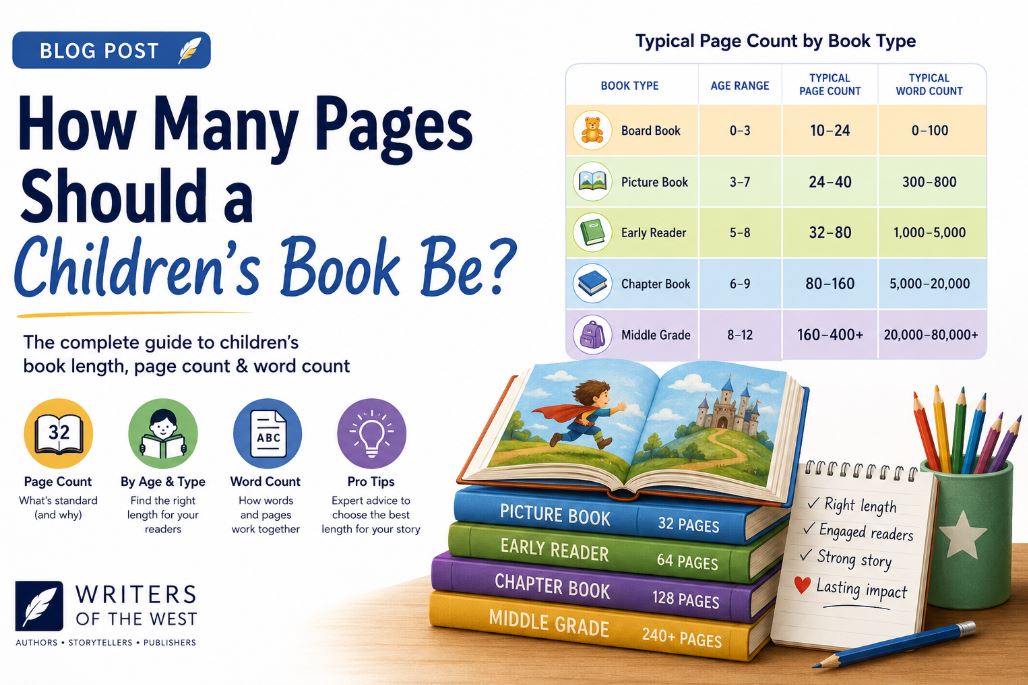
Children’s Book Page Count by Age & Type
| Age | Book Type | Typical Page Count | Typical Word Count | Illustration Level |
|---|---|---|---|---|
| 0-3 | Board book | 12-24 pages | Under 100-200 words | Very high |
| 3-8 | Picture book | 24-48 pages (32 most common) | 300-800 words | High |
| 5-8 | Early reader | 32-64 pages | 200-2,000 words | Moderate/high |
| 6-9 | Chapter book | 48-100 pages | 4,000-15,000 words | Moderate/low |
| 8-12 | Middle grade | 100-300 pages | 20,000-60,000 words | Low/occasional |
These are typical ranges, drawn from how publishers and children’s writing guides actually describe each category, not hard rules any platform or printer enforces. A picture book at 800 words isn’t broken. A middle grade novel at 90 pages isn’t automatically too short. Treat the table as a compass, not a ceiling.
How Many Pages Should a Children’s Book Be?
There’s no single answer, because “children’s book” covers formats that have almost nothing in common structurally. A 14-page board book and a 250-page middle grade novel are both children’s books. Neither page count would work for the other.
The useful question isn’t “how many pages should a children’s book be.” It’s “how many pages should my type of children’s book be,” and that depends entirely on the age group and format you’ve already chosen. Once you know that, the range narrows fast, which is exactly what the table above is for.
How Many Pages Should a Children’s Picture Book Be?
32 pages is the most common answer, but 24, 40, and 48 all show up regularly, and none of them are wrong. What connects those four numbers: they’re all multiples of 8.
Picture books are printed on large sheets that get folded and cut down into a set of pages, called a signature, and a standard signature yields pages in multiples of 8. That’s a production fact, not an aesthetic one, and it’s why 36 or 30-page picture books essentially don’t exist while 24, 32, 40, and 48 do. 32 became the default within that set because it gives most stories enough spreads to build a beginning, middle, and end without padding, while still being cheap to print at scale.
None of that makes 32 mandatory. A quieter, simpler story can work at 24. A nonfiction picture book covering more ground can stretch to 40 or 48. The number should come from what the story needs, chosen from within that set of workable options, not the other way around.
Why Are Children’s Picture Books Often 32 Pages?
Because it sits in the middle of that printing-friendly range and gives a typical picture book story enough room to breathe. Fewer than 24 pages starts to feel thin for a story with real pacing. More than 48 starts pushing into nonfiction-picture-book or early-reader territory.
It’s worth being direct about what 32 pages isn’t: it’s not a technical requirement imposed by Amazon, IngramSpark, or any retailer. It’s an inherited convention from offset printing that stuck around because it works, and self-publishing platforms happen to support it well since it’s what most submitted files already look like.
How Many Story Pages Are in a 32-Page Children’s Book?
Fewer than 32. Usually closer to 26 to 28.
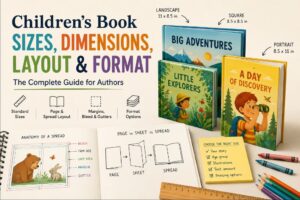
A page is one numbered side. A spread is the two facing pages a reader sees when the book is open. Out of a 32-page total, roughly 3 to 6 pages typically go to front matter (title page, copyright page, sometimes a dedication) and occasionally a small amount of back matter, leaving the story itself with somewhere around 13 to 14 usable spreads. Our companion guide on [children’s book sizes, dimensions, layout, and format] covers how pages, spreads, and gutters interact in more depth, if the trim size and layout side of this is what you’re working through next.
Example: How a 32-Page Picture Book Could Be Structured
| Pages | Possible Use |
|---|---|
| Pages 1-4 | Title, copyright, dedication (front matter) |
| Pages 5-8 | Opening, character and setting introduced |
| Pages 9-20 | Story development and escalation |
| Pages 21-26 | Climax |
| Pages 27-30 | Resolution |
| Pages 31-32 | Closing image or brief back matter |
This is one way to lay out 32 pages, not a formula every picture book has to follow. A quieter story might spend more time on the opening and less on escalation. A book built around a single big reveal might compress everything before it into far fewer pages. The point of the example is just to make “32 pages” concrete instead of abstract.
How Long Should a Children’s Book Be?
Length can mean page count, word count, or both, and which one matters more depends on the format. For an illustrated picture book, pages and words move together closely enough that publishers usually discuss both in the same breath. For a chapter book or middle grade novel, illustrations mostly drop out of the picture, so word count becomes the more useful measure of how long the manuscript actually is, since page count at that point is mostly a function of trim size and font rather than story length.
If you’re planning a picture book, 300-800 words is the range most guides converge on, closer to 32 pages once laid out. If you’re planning a chapter book or novel, word count is the number to plan around; page count follows from formatting choices made later.
What Is the Average Children’s Book Length?
There isn’t one useful average across all children’s books, and quoting a single number here would actually make this article less useful, not more. A board book averaging 50 words and a middle grade novel averaging 40,000 words would cancel each other out into a meaningless midpoint that describes neither one.
The comparison that actually helps is your book against others in the same age group and format, which is exactly what the master table above is built to show. If you’re writing a picture book, compare it to other picture books. A board book’s word count has nothing useful to say about whether your picture book manuscript is the right length.
Children’s Book Length: Page Count vs. Word Count
They’re related, but they’re not the same measurement, and treating them as interchangeable causes real confusion.
Two picture books can land at the same page count with very different word counts, because one leans on full-bleed illustration with a handful of words per spread while the other carries denser text alongside smaller art. The reverse happens too: two manuscripts with nearly identical word counts can produce different final page counts once illustration density, font size, trim size, and white space get factored in during layout.
Word count is a property of the manuscript. Page count is a property of the finished, laid-out book. They move together loosely, not in lockstep, which is part of why finalizing page count before the manuscript and illustrations are both settled tends to cause rework later.
How We Decide the Right Page Count for a Children’s Book
We don’t start by counting words and backing into a page number. That skips the part that actually matters.
What actually drives the decision: who’s reading it and at what age, what format the book is (picture book, early reader, chapter book), how many meaningful story beats the plot genuinely needs, how much of the storytelling the illustrations can carry versus the text, whether spreads are starting to feel crowded once a draft layout is roughed out, and whether the resulting page count works technically and economically on the platform it’s headed for. This is the same lens our children’s book ghostwriters work from when they’re shaping a story’s beats in the first place, since a beat that’s going to need its own spread should be identified while the manuscript is still being drafted, not discovered during layout.
One piece of editorial judgment worth having up front: if a picture-book manuscript feels overcrowded, adding pages isn’t automatically the fix. Often the better fix is fewer words, because the illustrations can carry information the prose doesn’t need to repeat. A children’s book editor catching this early, before pages get added to relieve pressure that trimming could have relieved instead, saves both a rewrite and a reformatting pass. Page count also determines how many page-turn opportunities a story gets, since a reveal built on setup, page turn, then payoff needs a spread on each side of that turn to work, so trimming or adding pages isn’t just a length decision, it’s a pacing one.
Amazon KDP Children’s Book Page-Count Requirements
Per Amazon’s own current specifications (KDP: Set Trim Size, Bleed, and Margins), KDP paperbacks require a minimum of 24 pages across nearly all trim sizes, with a couple of the larger square and letter-sized trims (8.5″x8.5″ and 8.5″x11″) capping out lower on the maximum end than smaller trims do. Hardcovers require a minimum of 75 pages, considerably higher than paperback, which matters if a short picture book manuscript is being considered for a hardcover edition: a 24-page story that works fine as a paperback may need padding, a different structure, or simply a paperback release instead, to meet that 75-page hardcover floor.
Beyond those minimums, KDP doesn’t impose a page count specific to children’s books as a category. The 32-page convention lives in publishing tradition and printing economics, not in platform policy.
How Do I Choose the Right Page Count for My Children’s Book?
- Identify the target age, specifically, not a wide range.
- Identify the book type: board book, picture book, early reader, chapter book, or middle grade.
- Check the typical page and word count range for that type against the table above.
- Break the story into its real beats, the moments that actually need space, not padding.
- Decide how much of the storytelling the illustrations will carry, since that shifts how much text each beat needs.
- Rough the beats across pages or spreads and see where the count lands.
- Check whether the text feels crowded once it’s mapped out. If it does, cutting is usually the fix, not adding pages.
- Verify your publishing platform’s page-count minimums before finalizing, especially if hardcover is part of the plan.
That process, run once, usually lands on a page count that fits the story instead of one picked first and filled in afterward.
Children’s Book Page Count & Length FAQs
How many pages should a children’s picture book be? Most commonly 32, with 24, 40, and 48 also standard, since picture books print in signatures of 8 pages. The right number depends on how much story you’re telling, not a fixed rule.
How many pages are in the average children’s book? There isn’t one meaningful average across all children’s books, since the category spans board books, picture books, early readers, chapter books, and middle grade novels with very different lengths. Compare within your specific format instead.
How long should a children’s book be? It depends on format. Picture books are best measured by both page count (24-48) and word count (300-800 words). Chapter books and middle grade novels are better measured by word count, since page count there is mostly a function of formatting choices made later.
How long is the average children’s book? Same issue as page count: no single average is meaningful across formats this different. A picture book averaging 500 words and a middle grade novel averaging 40,000 words are both “children’s books.”
What is the average children’s book length? For picture books specifically, 300-800 words is the range most publishing guides converge on. For chapter books, 4,000-15,000 words. For middle grade, 20,000-60,000 words.
Is 24 pages enough for a children’s book? Yes, for a picture book. 24 pages is a standard, printing-friendly length, just on the shorter end of the common range.
Why are children’s books often 32 pages? Because picture books print in 8-page signatures, and 32 sits in the middle of the workable range those signatures produce (24, 32, 40, 48), giving most stories enough spreads without wasting print costs.
Can a children’s book be 40 pages? Yes. 40 pages is a standard signature-based length, common for picture books with slightly more story or nonfiction picture books covering more ground.
How many words should a 32-page children’s book have? Roughly 300 to 800 words is typical, depending on how much of the story the illustrations are carrying.
How many spreads are in a 32-page children’s book? 16 total spreads, though usually only 13 to 14 are available for story once front matter is accounted for.
Does the cover count toward a children’s book’s page count? No. Trim size page counts on platforms like Amazon KDP refer to interior pages; the cover is a separate file and specification.
Does Amazon KDP have a minimum page count for children’s books? KDP doesn’t set a children’s-book-specific minimum, but its general paperback minimum is 24 pages and its hardcover minimum is 75 pages (source), which applies to any book, children’s or otherwise.
About the Author
Editor & Illustrator, Writers of the West
Trin Lucas is an American writer, editor, and illustrator who has worked with Writers of the West for over five years. She holds a BFA in Illustration from the Rhode Island School of Design and specializes in children’s books, visual storytelling, and structured nonfiction. Her editorial work focuses on rhythm between text and imagery, narrative clarity, and layout coherence — helping authors align storytelling with illustration for a cohesive reading experience.
writersofthewest.net · Professional Ghostwriting Services, Book Editing & Publishing Guidance