How to Write a Fiction Book: A Step-by-Step Guide for Beginners
Writing a fiction book means turning a premise into a structured story: a protagonist with a clear goal, a conflict that stands in their way, a plot that escalates that conflict across chapters, and an ending that resolves it. In practice, that means developing your idea into a premise, building your characters and central conflict, outlining the shape of the story, drafting it, and then revising in at least two distinct passes: structure first, prose second.
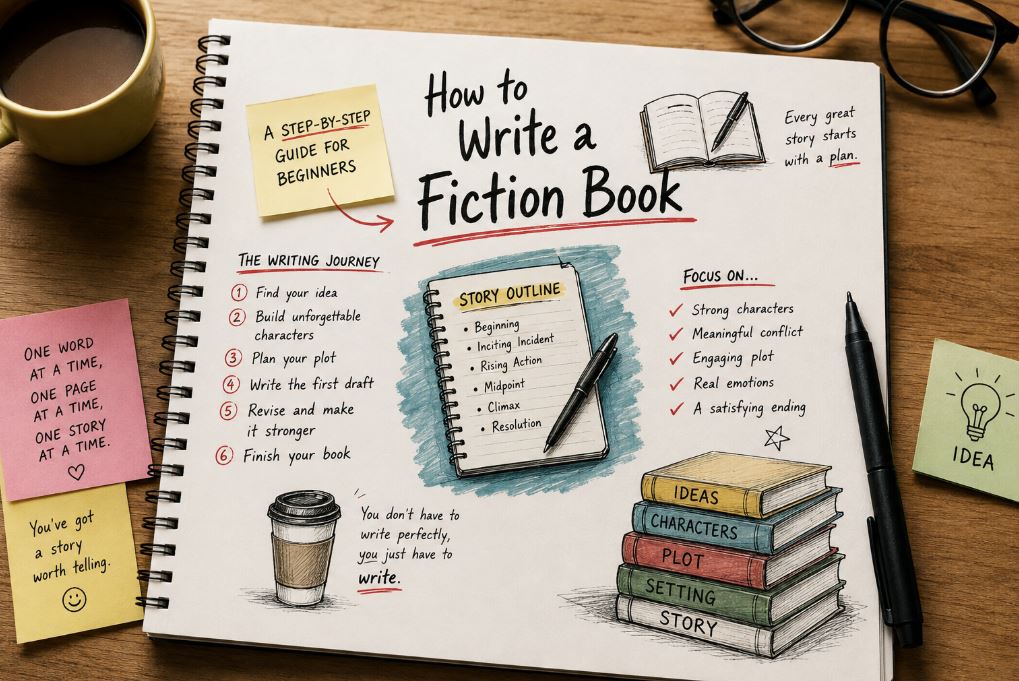
How to Write a Fiction Book Step by Step
This is the process our fiction ghostwriting team walks authors through when we’re building a novel with them from scratch, condensed into ten steps.
| Step | What You Do | What You Should Have When Finished |
|---|---|---|
| 1 | Define the story premise | One-sentence premise |
| 2 | Choose genre and audience | Clear reader and genre |
| 3 | Create your protagonist | Goal, motivation, conflict |
| 4 | Build the central conflict | Main story problem |
| 5 | Establish setting and world | Story environment |
| 6 | Outline the story | Beginning, middle, ending |
| 7 | Plan chapters and scenes | Working scene map |
| 8 | Write the first draft | Complete manuscript |
| 9 | Revise the structure | Strong second draft |
| 10 | Edit the prose | Submission-ready manuscript |
Step 1: Define the Story Premise
Not an idea. A premise. “A detective investigates a murder on Mars” is an idea. “After the first murder on a newly established Mars colony, a disgraced detective must identify the killer before the colony’s failing life-support system traps the murderer and surviving colonists together” is a premise. One sentence, but it already contains a character, a goal, and a ticking clock. We’ll build this exact book through the rest of this guide, so you can see each step applied rather than just described.
Step 2: Choose Genre and Audience
Genre sets reader expectations before they read a single page. A thriller reader wants pace and stakes. A literary fiction reader wants interiority and language. Knowing which one you’re writing for shapes every decision after this.
Step 3: Create Your Protagonist
At minimum: what do they want, what’s stopping them, and what do they believe that’s wrong. That last one is where character arcs actually come from.
Step 4: Build the Central Conflict
The single problem the whole book exists to resolve. Subplots can wander. This one can’t.
Step 5: Establish Setting and World
Enough to make scenes feel specific rather than generic. A courtroom drama needs different research than a generation ship needs worldbuilding, but both need enough concrete detail that the reader believes it.
Step 6: Outline the Story
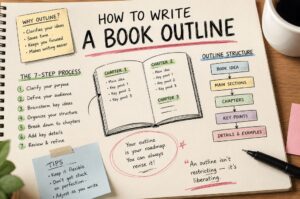
At minimum, know your beginning, your major turning points, and your ending before you draft. We cover this in full depth in our guide to how to write a book outline, including a copy-and-paste template.
Step 7: Plan Chapters and Scenes
Turn your outline into an actual working scene list. Not every scene needs to be planned in detail yet, but you should know roughly what happens in each chapter before you start writing it.
Step 8: Write the First Draft
Get the whole thing down. This is not the draft that gets published, and treating it that way is how first drafts stall out at chapter six.
Step 9: Revise the Structure
Before touching a single sentence for style, check whether the story itself works: pacing, whether chapters earn their place, whether the middle sags. If your manuscript needs this kind of structural pass and you’d rather have a second, professional set of eyes on it, this is exactly what our fiction editing team specializes in.
Step 10: Edit the Prose
Line by line: word choice, rhythm, dialogue, consistency. This comes last, after the structure is settled, not before.
Start With a Fiction Premise, Not Just an Idea
Most stalled novels started as ideas and never became premises. Compare:
Idea: A detective investigates a murder on Mars.
Premise: After the first murder on a newly established Mars colony, a disgraced detective must identify the killer before the colony’s failing life-support system traps the murderer and surviving colonists together.
The idea tells you a setting and a job title. The premise tells you who wants what, what’s working against them, and why it matters now rather than eventually. If you can’t turn your idea into something with that same shape, that’s usually the actual reason a manuscript keeps stalling, not a lack of discipline. From here, we’ll keep developing this same Mars mystery through character, conflict, structure, and the opening chapter, so you can watch one book actually take shape.
How to Create Fictional Characters Readers Care About
A protagonist needs an external goal (what they’re chasing in the plot) and an internal need (what they actually have to learn or accept, which is often different from what they think they want). The gap between those two is where character arcs live.
A quick worksheet we use with authors, filled in for our Mars mystery:
External goal: what does your protagonist want by the end of the book? For Mara Voss, our disgraced detective, it’s identifying the killer before the colony’s oxygen scrubbers fail completely. Internal need: what do they need to understand or accept, whether they realize it yet or not? Mara needs to relearn how to sit with uncertainty instead of forcing a tidy conclusion just to close a case, the exact habit that ended her career on Earth. Flaw: what’s the specific way this need shows up as a problem early on? She jumps to certainty too fast, and nearly convicts the wrong person in the setup for exactly that reason. Stakes: what actually happens if they fail? An innocent colonist gets condemned by a panicked council, or the real killer keeps sabotaging the system and everyone suffocates. Antagonist: who or what is working directly against the external goal, and why does that opposition make sense from their side too? The colony’s chief engineer, who has been quietly rationing scarce repair parts to keep one group of colonists alive longer than the official plan allows, and who killed to protect a decision he honestly believes only he is clear-eyed enough to make.
That last question matters more than it looks. An antagonist who’s simply evil is weaker than one whose goals make complete sense to them, and our engineer’s logic, however wrong, is exactly why he’s a stronger villain than a mustache-twirling saboteur would be.
How to Build Conflict and Stakes
Conflict isn’t just an obstacle. It’s an obstacle that costs something specific if it isn’t overcome. In our Mars mystery, “Mara might not identify the killer in time” is an obstacle. “Mara might not identify the killer in time, and if she accuses the wrong person, the colony council will execute an innocent colonist while the real saboteur keeps damaging the scrubbers” is conflict with real stakes attached.
Escalation matters as much as the initial conflict. Each attempt your protagonist makes to resolve the problem should either fail in a way that raises the cost of failure, or succeed in a way that reveals a bigger problem underneath. For Mara, an early suspect interview doesn’t just fail to produce a killer, it surfaces a colony-wide fight over rationed repair parts that widens the whole case. A story where every obstacle is roughly the same size from chapter three to chapter twenty reads flat, no matter how well any individual scene is written.
How to Write a Fiction Book Outline
You don’t need a scene-by-scene map before you draft, but you do need your beginning, your major turning points, and your ending decided. Beyond that, how much detail you outline is mostly a question of how you personally write: some authors need the whole shape locked down first, others need just enough structure to avoid getting lost partway through. For the complete process, including a template you can copy directly, see our full guide to how to write a book outline.
Free Fiction Book Planning Template:
Downloda it here: Fiction Book Planning Template
How to Structure a Fiction Book
The three-act structure is the most common framework: setup, confrontation, resolution. Inciting incident early in act one, rising action and a midpoint reversal through act two, climax and resolution in act three. The underlying idea is old: Aristotle’s Poetics argued more than two thousand years ago that a well-formed story needs a beginning, a middle, and an end, each following logically from what came before it, which is essentially the same principle modern three-act structure builds on.
Treat it as a framework, not a formula. It describes a shape a lot of successful stories happen to share. It isn’t a checklist you’re required to fill in exactly, and plenty of good novels bend or ignore parts of it entirely.
Mapped onto our Mars mystery:
Act one (setup): the body is found, Mara is handed the case only because she’s the one person with investigative training and everyone else is needed elsewhere, and the reader learns both her disgrace and the ticking clock on the failing scrubbers.
Act two (confrontation): Mara investigates, suspects colonists caught up in the resource conflict, and at the midpoint discovers the murder weapon was a cannibalized scrubber part, meaning the murder and the survival crisis are the same problem. Her old habit of jumping to conclusions nearly gets an innocent colonist condemned.
Act three (resolution): she identifies the engineer as the killer right as the scrubbers fail completely, has to expose him and help fix what he sabotaged in the same stretch of chapters, and finally resolves her internal arc by trusting slower, evidence-based judgment instead of a fast, confident guess.
The first five chapters might break down like this:
- The body is discovered in the scrubber room. Mara is pulled onto the case because nobody else is free.
- She examines the scene and notices the official cause of death doesn’t match the physical evidence.
- Her first suspect interview surfaces the colony’s quiet fight over rationed repair parts.
- A minor life-support alarm sounds, tying the murder investigation to a literal countdown.
- She realizes the blunt object was a stolen scrubber component, connecting the murder directly to the colony’s failing systems.
How to Write Your First Chapter
Your opening scene and your introduction aren’t the same job. The opening scene needs to establish point of view, introduce tension, and give the reader a reason to keep going, all without dumping backstory before the reader has any reason to care about it yet.
A common first-chapter mistake: explaining who everyone is and why the world works the way it does before anything has actually happened. Readers tolerate not understanding everything on page one. They don’t tolerate being bored on page one. Give them a scene with something at stake, and let the explanation catch up over the next few chapters.
For our Mars mystery, that means opening in the scrubber room at the moment the body is found, not with a page of backstory about Mara’s disgrace on Earth. Let the reader feel that something’s wrong with the air recyclers and that a person is dead, and let her damaged reputation surface through how the other colonists treat her rather than through a paragraph explaining it upfront.
How to Write Your First Draft Without Getting Stuck
Set a word count or time target you can actually hit most days, and protect the habit more than any single day’s output. Skip scenes you’re stuck on and come back later rather than stalling the whole draft on one difficult chapter. And accept that the first draft’s job is simply to exist. It gets fixed in revision, not while you’re writing it.
How to Write Good Fiction, Not Just Finish a Draft
Finishing a draft and writing well aren’t the same milestone. A few things that separate the two:
Show, don’t just tell, at least in the moments that matter most. Not every sentence needs to be a scene, but your key emotional beats usually need one.
Consistent point of view. Decide whose head the reader is in for a given scene, and stay there.
Dialogue that sounds spoken, not written. Real speech is fragmented and specific. Read it aloud if you’re not sure.
Sensory detail that’s specific, not generic. “It smelled bad” tells the reader nothing. “It smelled like wet cardboard left too long in a garage” tells them everything.
Pacing that varies. Fast scenes need short sentences. Reflective scenes can breathe. A manuscript written at one uniform pace throughout tends to flatten everything, including the parts meant to feel urgent.
How to Revise a Fiction Manuscript
Separate structural revision from line editing, and do them in that order. Structural revision asks whether the story itself works: does the middle sag, does the ending pay off what the beginning promised, does any character’s motivation stop making sense halfway through. Line editing asks whether the sentences are doing their job. The University of Nevada, Reno’s MFA program structures an entire semester of its curriculum around exactly this distinction, having students revise at the developmental level before ever moving to sentence-level craft. Polishing prose in a chapter you later cut is wasted work, which is exactly why structure comes first.
How Fiction Writing Changes by Genre
The core process holds across genres, but each one has a place where inexperienced writers commonly get it wrong.
| Genre | What Requires Extra Attention |
|---|---|
| Historical fiction | Period research, historical accuracy, voice |
| Science fiction | Worldbuilding, technology rules, internal consistency |
| Fantasy | Magic systems, worldbuilding, lore |
| Mystery | Clues, reveals, information control |
| Romance | Relationship arc, emotional progression |
| Realistic fiction | Plausibility, character psychology, authentic detail |
How to Write a Historical Fiction Book
The research has to be deep enough that it disappears. Readers of historical fiction tend to know the period, and small inaccuracies, the wrong slang for the decade, a technology that didn’t exist yet, break trust fast. The Historical Novel Society, a professional organization dedicated to the genre, exists in large part because readers and reviewers hold historical fiction to this exact standard. Voice matters just as much as fact-checking: characters still need to think and speak like people, not like a textbook footnote.
How to Write a Science Fiction Book
Whatever rules you invent for your technology or your world, apply them consistently. The specific rules matter less than internal consistency. A reader will accept almost any premise if the story stays honest to its own logic once that premise is established, and will reject even a small premise the moment the story quietly breaks its own rules to make a scene easier to write.
How to Write Fantasy Fiction
The same internal-consistency rule applies to magic systems as to science fiction technology, whatever your magic can do, it needs limits, and the limits need to hold. Worldbuilding should serve the story rather than replace it. Readers remember characters and stakes long after they’ve forgotten the specifics of a kingdom’s political history.
How to Write Mystery Fiction
Everything comes down to information control. The reader needs enough clues to make the eventual reveal feel earned rather than arbitrary, but not so many that the answer becomes obvious by chapter five. Plant your solution’s key evidence early, then bury it under enough other detail that it doesn’t stand out until the reveal makes it obvious in hindsight.
How to Write Romance Fiction
The plot is the relationship arc itself, not a backdrop for it. Track the emotional distance between your two leads scene by scene, and make sure each major beat either closes that distance or believably widens it again. A romance where the emotional progression stalls for several chapters reads slow no matter how much external plot is happening around it.
How to Write a Fiction Book With No Experience
You don’t need an English degree, a finished short story portfolio, or years of practice before starting your first novel. What actually helps: reading widely in the genre you want to write, understanding basic story structure before you draft, and accepting that your first manuscript is a learning project as much as a finished product. What you don’t need yet: a perfect prose style, since that develops through the act of finishing books, not from studying it in the abstract beforehand.
How Long Does It Take to Write a Fiction Book?
Depends entirely on manuscript length and daily output, but the math is straightforward. A 75,000-word manuscript at 500 words a day takes about 150 writing days for the first draft alone, before revision. Double your daily output to 1,000 words and that drops to roughly 75 days. Neither number includes the structural revision pass or the line edit, which for most first novels takes as long again, sometimes longer.
Length matters beyond just your own pacing, too. Writer’s Digest notes that literary agents mainly use word count as a rough sanity check, a manuscript wildly outside its genre’s expected range signals a pacing or structural problem before an agent has even read a page, more than it signals anything about quality on its own.
FAQs
Can a beginner write a fiction book? Yes. What matters more than prior experience is understanding basic story structure and finishing the first draft even when it’s rough. A first manuscript is often as much a learning project as a publishing project, and that’s normal, not a failure.
How long does it take to write a fiction book? For a 75,000-word manuscript, roughly 150 days at 500 words a day for the first draft, or about 75 days at 1,000 words a day. Add substantial additional time for structural revision and line editing afterward.
How do you write a good fiction book? Beyond finishing a draft, strong fiction needs consistent point of view, dialogue that sounds spoken rather than written, specific sensory detail instead of generic description, and pacing that varies with the intensity of each scene.
Can you write a fiction book without an outline? Yes, though most writers still benefit from knowing their beginning, major turning points, and ending before drafting. A full scene-by-scene outline is optional. Some sense of destination generally isn’t.
How many words should a fiction book be? Varies by genre, but a common general-fiction range runs from about 70,000 to 100,000 words. Genre fiction like romance or mystery often runs shorter, while epic fantasy commonly runs longer.
How do you write a fiction book about your life? That’s fictionalized autobiography, using real events as raw material while changing names, timelines, or details as needed. The core fiction-writing process still applies: you still need a clear protagonist goal and central conflict, even when the source material is your own.
How can you write a fiction book faster? Increase daily word count consistently rather than in occasional bursts, outline enough that you’re not stopping mid-draft to figure out what happens next, and resist editing while you draft. Revision is a separate pass, and doing it simultaneously with drafting is the most common reason first drafts slow to a crawl.
html
About the Author
Senior Crime & Thriller Writer, Writers of the West
Thomas Schäffer is a senior crime and thriller ghostwriter at Writers of the West, known for disciplined structure and character-focused storytelling. He brings logical plot progression, grounded character motives, and consistent pacing to mystery and thriller manuscripts. His work emphasizes believable narrative development from opening hook to final resolution, helping authors craft compelling, publication-ready crime fiction.
writersofthewest.net · Professional Ghostwriting Services, Book Editing & Publishing Guidance