Quick Verdict
The best hybrid publishing companies for new authors in 2026 are Greenleaf Book Group, She Writes Press, SparkPress and Girl Friday Production, and Writers of the West for Self Publishing. Each one vets manuscripts, publishes under its own imprint, and provides bookstore distribution. Authors pay for production in exchange for a higher royalty than a traditional deal: She Writes Press and SparkPress charge $12,000, while Greenleaf and Girl Friday Productions quote each project individually. Authors who want to keep all their royalties can also consider full-service self-publishing companies such as Writers of the West, which is not a hybrid publisher. Its packages range from $699 to $5,999, it has no submission review, and authors keep 100% of their royalties.
- Greenleaf Book Group is the longest-running hybrid here and the best fit for business and nonfiction authors who want premium production and in-house distribution.
- She Writes Press is a curated hybrid focused on women authors, with published pricing and Simon & Schuster distribution.
- Writers of the West is not a hybrid. It is a full-service self-publishing company for authors who want to keep full ownership and 100% of their royalties at a lower cost.
- SparkPress is She Writes Press’s sister imprint for commercial fiction and YA, with the same package and distributor.
- Girl Friday Productions is the most flexible model, offering hybrid or fully author-owned custom publishing with a dedicated team.
A hybrid publisher works like a traditional publisher, putting its name and ISBN on your book, but you fund the publication. The Independent Book Publishers Association (IBPA) sets 11 criteria that separate reputable hybrids from vanity presses. This guide compares each option on cost, author earnings, distribution and fit.
Writers of the West published this guide and appears at #3 as a self-publishing alternative. It is not a hybrid publisher and does not meet the IBPA hybrid criteria. Its listing includes its limitations, in the same format as the others.
Quick Checklist: Is a Hybrid Publisher Right for You?
- You have a finished manuscript. Reputable hybrids vet submissions, and some charge a fee to review yours. She Writes Press charges $40.
- You can budget at least $12,000. Jane Friedman, a widely followed publishing industry analyst, suggests $25,000 as a rule of thumb when a print run is involved.
- You want a publisher’s imprint and bookstore distribution through an established distributor.
- You accept sharing book revenue with the publisher, on top of what you pay upfront.
If the second or fourth point rules a hybrid out, see #3 and the self-publishing comparison below.
How We Compared Hybrid Publishers
We checked each company against the IBPA Hybrid Publisher Criteria, which were expanded in 2022 to 11 standards. The criteria that matter most to a new author:
- Vets submissions
- Publishes under its own imprint(s) and ISBNs
- Provides a negotiable, easy-to-understand contract
- Provides distribution services
- Pays authors a higher-than-standard royalty
We then compared each company’s published cost, what the author earns, distribution partner and who it’s built for, using each company’s own published information.
| Company | Model | Published cost | What the author earns | Distribution | Best for |
|---|---|---|---|---|---|
| Greenleaf Book Group | Hybrid (vetted) | Custom quote | 20–35% of cover price via retailers; 100% on direct sales | Self-distributed in the US | Business & nonfiction |
| She Writes Press | Hybrid (vetted) | $12,000 + $40 submission fee | Net after 40% distribution fee and print costs | Simon & Schuster | Literary fiction, nonfiction & memoir by women |
| Writers of the West | Self-publishing (not hybrid) | $699–$5,999, with installment and self-paced options | 100% of royalties | Amazon only up to 50+ retail channels, plus bookstore and library distribution on higher packages | Authors who want full ownership and royalties |
| SparkPress | Hybrid (vetted) | $12,000 | Same structure as She Writes Press | Simon & Schuster | Commercial fiction & YA |
| Girl Friday Productions | Hybrid or custom | Custom proposal | 70–80% of net (hybrid); 100% of net (custom) | Two Rivers (Ingram) | Authors wanting a hands-on team |
1. Greenleaf Book Group
Founded in 1997 and based in Austin, Texas, Greenleaf self-distributes in the US and publishes imprints including River Grove Books, An Inc. Original and Fast Company Press. Under its hybrid model, the author invests in production, earns 20–35% of the cover price on retail sales and 100% on books sold directly, and keeps the rights to the content and creative control over the cover and packaging. Greenleaf says it only accepts books that pass a rigorous submission process.
Pros
- One of the longest-established hybrids, with business-press imprint partnerships
- Its own US distribution
- Authors retain rights and earn 100% on direct sales
Cons
- You pay twice. You fund production upfront, then Greenleaf keeps most of the retail revenue: you earn only 20–35% of the cover price on books sold through stores.
- No published pricing, so you won’t know the full cost until you receive a custom quote
- Selective, so manuscripts can be declined
Best for: Business leaders, consultants and nonfiction authors using a book to build credibility.
2. She Writes Press
She Writes Press is a curated hybrid that focuses on women authors and publishes literary fiction, nonfiction and memoir. It is owned by SparkPoint Studio. Its package rose from $10,000 to $12,000 in 2026, and books are distributed by Simon & Schuster. On retail print sales, She Writes Press takes a 40% distribution fee plus manufacturing costs, and the author keeps the rest. It recommends a print run of at least 500 copies, though print-on-demand is available. Submissions cost $40 and are reviewed in two tiers, with a response in eight to ten weeks.
Pros
- Published, transparent pricing
- Simon & Schuster distribution
- Editorial feedback even if the manuscript is declined
Cons
- You pay twice. You pay a $12,000 package fee, then She Writes Press takes a 40% distribution fee plus print costs on every retail print sale before you’re paid.
- A recommended print run of at least 500 copies can add to the upfront cost
- $40 submission fee, and the press focuses on women authors
Best for: Women writing literary fiction, memoir or nonfiction who want an imprint with major distribution.
3. Writers of the West (Self-Publishing Alternative, Not a Hybrid)
Writers of the West is a Houston-based full-service self-publishing company, not a hybrid publisher. Books can carry the Writers of the West imprint, but the company does not vet submissions or take a share of royalties, so it does not meet the IBPA hybrid criteria. According to its self-publishing services page, books can be published through the author’s own account, and authors retain ownership and 100% of their royalties from the day the contract is signed.
Packages range from $699 to $5,999. The lowest tier covers an Amazon-only paperback, and seperately offer experienced Amazon KDP Publishing. Higher tiers add ebook, hardcover and audiobook formats, distribution across up to 50+ retail channels, and marketing services such as press releases, paid ads and Amazon category campaigns. From the Gold package up, books are also made available to bookstores and libraries in the U.S. and Canada. Installment plans and self-paced options are offered to eligible authors. It is BBB accredited with an A+ rating, and its self-publishing page links to a live book listing on each retailer it distributes to.
Pros
- Authors keep ownership, their publishing account and 100% of royalties
- Books can carry the Writers of the West imprint
- Published package prices, starting below hybrid entry costs
- Writing, editing, design, publishing and marketing available from one company at much affordable prices
Cons
- You still pay for the services, with packages from $699 to $5,999. Installment plans and self-paced options spread the cost, but don’t remove it.
- No manuscript vetting, which some readers and bookstores treat as a quality signal
- No distributor sales reps pitching the book to bookstore buyers. Books are made available to stores for ordering, but placement isn’t actively sold in, as Simon & Schuster or Greenleaf do.
Best for: First-time and independent authors who want to keep full ownership and royalties at a lower upfront cost.
4. SparkPress
SparkPress is She Writes Press’s sister imprint under SparkPoint Studio. It publishes mostly women authors, plus some men, and focuses on commercial fiction and young adult books. Its $12,000 package includes cover and interior design up to 100,000 words, ebook distribution to 127 retailers, proofreading, metadata, copyright filing, first-year warehousing, order fulfillment and project management. Distribution moved to Simon & Schuster in August 2024, as announced by both imprints.
Pros
- Published all-inclusive package
- Simon & Schuster distribution
- Built for commercial fiction and YA
Cons
- You pay twice. You pay a $12,000 package fee, then share retail revenue with the publisher on every sale, under the same structure as She Writes Press.
- Vets submissions on literary merit, so paying doesn’t guarantee acceptance
- Focuses mostly on commercial fiction and YA
Best for: Commercial fiction and YA authors who want an established imprint with major distribution.
5. Girl Friday Productions
Girl Friday Productions was founded in 2006 by Leslie Miller and Ingrid Emerick. It offers two paths: hybrid publishing, where authors keep 70–80% of net proceeds, and custom publishing, where they keep 100%. Each project gets a dedicated publishing manager and an in-house team. National distribution runs through Two Rivers, a selective Ingram division, and reaches Amazon, Barnes & Noble, Bookshop.org, Powell’s, Books-A-Million, libraries and indie bookstores. Expect eight to ten months from finished manuscript to books on sale.
Pros
- The highest author share among the hybrids here
- A choice of hybrid or fully author-owned publishing
- A dedicated publishing manager and in-house team
Cons
- On the hybrid path, you pay twice. You fund production, then keep only 70–80% of net proceeds, with the rest going to Girl Friday. The custom path avoids the revenue share, but you still pay for every service.
- No published pricing; every project is a custom proposal
- An 8–10 month timeline, and Jane Friedman lists it under paid publishing services rather than hybrid publishers
Best for: Authors who want premium, hands-on production and are open to either model.
Hybrid Publishing vs. Self-Publishing: Which Is Better?
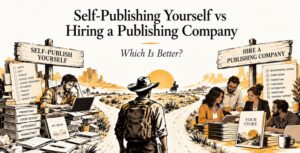
It depends on whether you value distribution muscle or ownership more. A hybrid gives you a publisher’s imprint, a distributor and, in some cases, sales reps who pitch to bookstores. In return, you pay for production and share your revenue: for example, Greenleaf’s 20–35% retail royalty or She Writes Press’s 40% distribution fee. With self-publishing, you also pay for services and usually go without distributor sales reps, but you remain the owner and no share of sales goes to a publishing company. Authors who mainly want bookstore placement lean hybrid. Authors who mainly want ownership, control and a lower upfront cost lean self-publishing.
Red Flags When Choosing a Hybrid Publisher
Each of these fails one of the IBPA’s hybrid criteria:
- It accepts every manuscript but still calls itself a hybrid (fails “vet submissions”)
- It won’t show you a clear contract before you pay
- “Distribution” means only an Amazon upload, with no named distributor
- It has no imprint or ISBNs of its own while calling itself a hybrid
- It can’t show respectable sales for the books it publishes
FAQs
What is a hybrid publisher?
A hybrid publisher publishes your book under its own imprint and ISBN, but you fund production in exchange for a higher-than-standard royalty. Reputable hybrids meet the IBPA’s 11 hybrid publisher criteria, including vetting submissions and providing distribution.
How much does hybrid publishing cost?
She Writes Press and SparkPress charge $12,000 in 2026. Greenleaf and Girl Friday Productions quote each project individually. Jane Friedman suggests budgeting around $25,000 when a print run is involved.
Is hybrid publishing worth it for first-time authors?
It can be if you have a finished manuscript, a budget of $12,000 or more, and a clear goal such as bookstore placement. Keep in mind that you pay upfront and also share your royalties. If keeping full ownership and royalties at a lower cost matters more, full-service self-publishing may be a better fit.
What is the difference between hybrid and vanity publishing?
A hybrid publisher vets manuscripts, publishes to industry standards and pays a higher-than-standard royalty, as set out in the IBPA criteria. A vanity press publishes anyone who pays while presenting itself as a selective publisher, and doesn’t meet those standards.
Do you keep your rights with a hybrid publisher?
Usually yes. Greenleaf, for example, lets authors keep the rights to their content. But the book carries the publisher’s imprint and ISBN, and the publisher shares in retail sales.
About the Author
Cell Biologist, Sociologist & Senior Editor, Writers of the West
Robert Whitehead is an American sociologist and cell biologist at the University of Virginia. He has been with Writers of the West for six years, bringing a rare combination of scientific rigor and behavioral insight to biography, fiction, and book design editorial work. His research background strengthens narrative authenticity, analytical precision, and structural coherence across a wide range of manuscript types.
writersofthewest.net · Professional Ghostwriting Services, Book Editing & Publishing Guidance