To write a biography, choose a subject and the angle you want to tell, research their life through records, interviews and published sources, build a timeline, pick a structure, then write the story in scenes and fact-check every claim. A good biography is not a list of dates. It explains why a person’s life mattered, and it proves every point it makes.
If you are thinking of writing a biography, know this first: biography writing is research first and writing second. At Writers of the West we have helped publish biographies of advocates and refugees, and the process below is the one our biography writers follow when an author comes to us for biography help.
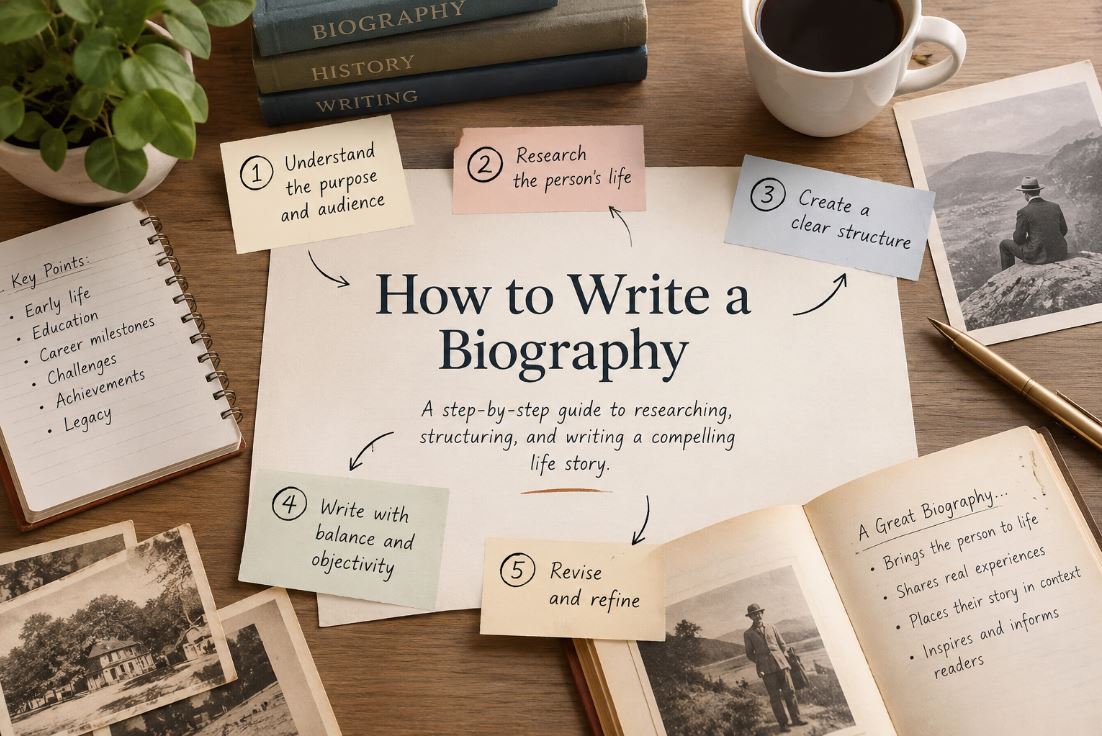
How to write a biography: quick answer
- Choose your subject and your angle. Decide whose life you are writing and what the story is really about.
- Decide whether the biography is authorized. Will the subject or their family take part?
- Research the life. Start with primary sources, then published ones.
- Interview people who knew them. Record, transcribe and date every interview.
- Build a timeline. Put every event, date and source in one place.
- Choose a structure. Chronological, thematic, or a framed story that starts at a turning point.
- Write in scenes. Show the person in moments, not summaries.
- Fact-check and source every claim. Accuracy is what separates a biography from fiction.
- Revise, edit and publish.
Tips, suggestions and best practices for writing a biography
The best tips and best practices for writing a biography, whether you are new to writing biographies or not, come down to research, honesty and storytelling.
- Find the question. Know what your biography is trying to answer about the person.
- Research more than you write. You will use only part of what you find, and that is normal.
- Keep a source log. You will need it for fact-checking and source notes.
- Open with a moment, not a birth date. Start where the story is most alive.
- Show the person, don’t label them. Let actions and quotes prove their character.
- Include flaws and failures. They make the person real and the book credible.
- Give context. Explain the time and place your subject lived in.
- Quote accurately. Never improve a quotation.
- Read great biographies. They are the best teachers
If you need experienced and affordable biography writing services get in touch with us today, if you have completed your book and need biography editors, contact us in the form below.
What is a biography?
A biography is a nonfiction account of a real person’s life written by someone else. If you are writing your own life story, you are writing an autobiography or a memoir instead.
| Biography | Autobiography | Memoir | |
|---|---|---|---|
| Who writes it | Someone other than the subject | The subject | The subject |
| Point of view | Third person | First person | First person |
| Scope | Usually the whole life, or a defining part of it | Usually the whole life | One theme or period of the author’s life |
| Main evidence | Research, records and interviews | The author’s memory and records | The author’s memory and reflection |
If you searched for “writing my biography,” what you are most likely writing is an autobiography or a memoir. The research and storytelling advice below still applies.
How we recommend writing a biography: the Writers of the West method
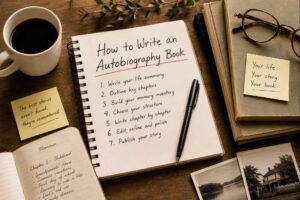
Our biography writers recommend a simple method: sum up the life in a few sentences, mark the major events, outline the story chronologically into chapters, then write one chapter a week. It works whether you are writing biographies of other people or writing your own life story.
1. Sum up the life first
Before you research or outline anything, write the whole life in one short paragraph. Who is this person, what happened to them, and why does their story matter? If you cannot sum it up, you are not ready to outline it yet. This summary becomes your compass for every decision that follows.
2. Point out the major events
List the turning points: the moves, losses, decisions, achievements and relationships that changed the direction of the life. Most lives have somewhere between a handful and a dozen events that everything else connects to. These become the pillars of the book.
3. Break the story into chapters, in chronological order
Turn your list of major events into a chapter outline. We recommend a chronological structure for most biographies, because it is the easiest for readers to follow and the easiest for you to write. Give more chapters to the parts of the life you want to emphasize. If the subject’s career is the heart of the story, it might deserve five chapters while childhood gets one.
4. Write one chapter a week
Writing biography is a long project, and a steady pace finishes books. Aim for one chapter a week. Do not stop to polish earlier chapters; keep moving forward until the full draft is done, then revise.
5. Or hire a professional biography writer
If you do not have the time to write a chapter a week, a professional biography writer can do every step above for you. They interview you or your subject, gather the story, build the outline and write the chapters, while you review each one. Our biography writing services work exactly this way.
6. Edit the finished draft
Once the draft is complete, have it edited. You can work with a professional editor, such as our biography editing services, or use AI tools, but only for proofreading.
We do not recommend using AI for line-by-line editing or developmental editing of a biography. AI tends to flatten a writer’s voice, smooth over the details that make a life feel real, and in some cases introduce facts that are not true. If you use AI for proofreading:
- Ask it to flag errors, not rewrite. Request a list of spelling, grammar and punctuation mistakes rather than a revised version.
- Check every suggestion yourself. Accept changes one at a time.
- Never let it add facts. Names, dates and events must come from your research, not from AI.
- Protect quotations. Tell the tool not to change anything inside quotation marks.
- Know the publishing rules. If you publish on Amazon, read how KDP treats AI-generated and AI-assisted content.
How to write a biography step by step
Writing a biography means moving from research to structure to story, in that order. Writers who start writing before the research is done usually end up rewriting most of the book.
1. Choose your subject and your angle
The angle is the one big question your biography answers about the person, and it matters more than the subject alone. “The life of a nurse” is a subject. “How a nurse from a small town changed how her state treated rural patients” is an angle. Every chapter should help answer that question.
2. Decide whether the biography is authorized
An authorized biography is written with the subject’s or their family’s cooperation; an unauthorized one is written without it. Authorized biographies give you access to interviews, letters and photographs. Unauthorized biographies give you independence, but you must rely on public and published sources. Walter Isaacson’s Steve Jobs (2011) was written with Jobs’s cooperation, based on dozens of interviews with him and the people around him.
3. Research the life
Good biography research starts with primary sources, meaning records created at the time, and then moves to secondary sources written later. Primary sources include:
- Letters, diaries, emails and personal papers
- Birth, marriage, military, census and court records
- Newspapers from the period
- Photographs, recordings and video
- The subject’s own writing, speeches and interviews
For historical subjects, public archives such as the U.S. National Archives and the Library of Congress’s Chronicling America newspaper collection are good places to start. Keep a source log from day one, listing where every fact came from.
4. Interview people who knew them
Interviews give a biography its life: the stories, voices and details that records leave out. Talk to family, friends, colleagues and, if possible, critics, because a biography built only on admirers reads like a tribute. Record each interview with permission, transcribe it, and note the date.
5. Build a timeline
A timeline is the backbone of every biography. List every event with its date, location and source. When two sources disagree on a date or detail, note both and keep digging; contradictions are often where the most interesting parts of a life are hiding.
6. Choose a structure
Most biographies use one of three structures:
- Chronological: birth to death, or start to finish. The clearest choice for most readers.
- Thematic: organized around roles or ideas, such as family, career and faith, rather than strict order.
- Framed: opens at a turning point, then goes back to show how the person got there.
We recommend chronological for most biographies. If you want a stronger hook, open the first chapter with a short scene from a turning point, then return to the beginning.
7. Write in scenes
Write the key moments of a life as scenes, with a place, a time, people and dialogue drawn from your sources, rather than as summaries. “She was generous” is a summary. Showing her quietly paying a neighbor’s rent, with the date and the person who remembered it, is a scene. Laura Hillenbrand’s Unbroken (2010), the life of Olympic runner and war survivor Louis Zamperini, is a good model of research written as scenes.
8. Fact-check and source every claim
Every fact in a biography should trace back to a source you can name. Check dates, names and quotations against the originals, and be careful with anything that could damage a living person’s reputation. If your subject is alive or the material is sensitive, have the manuscript reviewed for legal risk before publishing.
9. Revise, edit and publish
Revise for story first, then for accuracy, then for style. A biography usually goes through a developmental edit for structure, a line edit for clarity, and a final proofread. A professional editor can handle all three.
How to write a biography about a famous person
Here is our main suggestion if you are thinking about writing a biography of someone well known: to write a biography about a famous person, find an angle no other biography has covered, read the existing biographies first, and build your book on primary sources rather than repeating what is already published.
- Read what already exists. If three biographies already cover the person’s whole life, yours needs a new angle, new sources, or a narrower focus.
- Go back to primary sources. Speeches, letters, court records and period newspapers are more trustworthy than other books.
- Separate fact from legend. Famous people collect myths. Verify famous quotes and stories before you repeat them.
- Get permission for photographs and long quotations. Images and copyrighted text usually need permission from the rights holder.
- Be fair. Include criticism and failures as well as achievements; readers trust balanced biographies more.
Ron Chernow’s Alexander Hamilton (2004) is a strong example of a biography of a famous person that drew on the subject’s own extensive papers and letters.
How to write a biography of a family member or someone you know
To write a biography of a family member or someone in your community, start with long recorded interviews, then confirm what they tell you with records, photographs and other people’s memories.
Fifty Years in the Trenches by Schu Montgomery, a book we helped publish, is a biography of Margie Montgomery’s five decades as a pro-life advocate. Grace Under Fire: Sameth’s Journey to a New Dawn by Justin Loop tells the story of a Cambodian refugee who built a new life in Texas. Books like these depend on long conversations, personal records and a clear sense of why this life deserves a book.
- Interview the subject in several shorter sessions rather than one long one.
- Ask for specific memories, not general opinions: “Tell me about the day you arrived” works better than “What was it like?”
- Collect photographs, letters and documents early, before they are lost.
- Confirm important dates with records; memory is often wrong on dates and right on feelings.
How to write a biography book
A biography book needs the same research as a short biography, plus chapters, a narrative arc, and supporting material such as source notes, photographs and an index.
- Chapters: each chapter should cover one period or one turning point and end with a reason to keep reading.
- Arc: even a true life needs a beginning, a central struggle and a resolution.
- Front and back matter: an introduction explaining why you wrote the book, source notes or a bibliography, photo credits, and, for longer books, an index.
- Length: there is no fixed length for a biography book; let the story and the sources decide, not a word count target.
Famous biographies to learn from
Reading well-made biographies is one of the fastest ways to learn biography writing. These are widely studied examples:
| Biography | Author | Year | What to learn from it |
|---|---|---|---|
| The Power Broker | Robert A. Caro | 1974 | Depth of research; won the Pulitzer Prize for Biography |
| Alexander Hamilton | Ron Chernow | 2004 | Building a life from the subject’s own papers |
| Unbroken | Laura Hillenbrand | 2010 | Writing research as gripping scenes |
| The Immortal Life of Henrietta Lacks | Rebecca Skloot | 2010 | Combining a life story with wider history |
| Steve Jobs | Walter Isaacson | 2011 | Authorized biography built on interviews |
Common mistakes to avoid when writing a biography
The most common mistakes in biography writing are starting with the birth date, writing a tribute instead of a story, and stating facts without sources.
- Opening with “was born in.” Start with a defining moment instead.
- Writing a tribute. Praise without struggle or flaws reads like a eulogy, not a biography.
- Burying the reader in dates. Use the timeline to support the story, not replace it.
- Unsourced claims. If you cannot say where a fact came from, check it or cut it.
- Inventing dialogue. Only use dialogue someone remembered or recorded, and say so.
- Ignoring context. A life only makes sense against the history around it.
Biography help: when to hire a biography writer
Biography help makes sense when the research is bigger than the time you have, when the subject’s story deserves a professional voice, or when you want to preserve a family member’s life before memories are lost.
A professional biography writer handles the interviews, research, timeline and structure, then writes the book with you reviewing each stage. With Writers of the West, you are matched with a writer experienced in research-driven life stories, and you keep full ownership of the finished book.
Frequently asked questions about writing a biography:
What are the best practices for writing a biography?
The most important best practices for writing a biography are to research before you write, keep a source log, outline the life in chronological chapters, write in scenes rather than summaries, include the subject’s flaws as well as achievements, and fact-check every claim before publishing.
I’m thinking of writing a biography. Where do I begin?
Begin by summing up the person’s life in one short paragraph and listing the major events that shaped it. Those two steps tell you whether you have a book, and they become the outline you write from.
How do you start writing a biography?
Start by choosing your subject and the angle you want to explore, then research their life through primary sources and interviews before you write. When you begin drafting, open with a defining moment rather than the birth date.
What are the 5 main parts of a biography?
Most biographies include an introduction to the person and why they matter, their early life and background, the major events and turning points of their life, their achievements and failures, and their legacy or impact.
How do you write a biography about someone you know?
Interview them in several recorded sessions, collect photographs, letters and records, confirm important dates, and talk to other people who know them. Then build a timeline and write the key moments as scenes.
Do you need permission to write a biography?
You generally do not need permission to write about a person’s life using public information, but you usually do need permission to reproduce copyrighted material such as photographs, letters or long quotations. For living subjects or sensitive material, get legal advice before publishing.
What is the difference between a biography and an autobiography?
A biography is written by someone else, usually in the third person. An autobiography is written by the subject about their own life, in the first person.
How long does it take to write a biography book?
It depends on how much research the life requires. Personal and family biographies with willing interviewees move faster; historical biographies built on archives can take years.
About the Author
Book Writer & Senior Editor
Francis Vincent is an American writer and senior editor with over a decade of professional writing experience. He holds bachelor’s and master’s degrees in English Literature from the University of Arizona and specializes in narrative development and manuscript structure across fiction and nonfiction.
writersofthewest.net · Professional Ghostwriting Services, Book Editing & Publishing Guidance