Introduction
A lot of people feel this quiet urge to write something deeper. Not just a book, but something that carries meaning. Beliefs, personal experiences, maybe even a shift in how they see the world. The message is usually not the problem. It’s getting that message onto the page in a way that actually makes sense to someone else.
Because belief alone does not translate into good writing. That’s where things get tricky. Abstract ideas, spiritual reflections, personal truths, they can easily turn into something hard to follow. Without structure, the writing starts to drift. Readers lose the thread.
So this is what the guide focuses on. Not just what to say, but how to say it. How to shape those ideas into something clear, readable, and meaningful. And where it makes sense to bring in professional support to turn a powerful message into a book people can actually connect with.
What Are Religious and Spiritual Books?
So, what exactly falls into this category? It’s broader than most people think. These books are not tied to one belief system or a single tradition. They explore faith, personal insight, and that ongoing search for meaning that shows up at different points in life. Some lean religious, others more reflective or philosophical. The common thread is simple. They try to make sense of something bigger.
You’ll usually see a few different forms within this space.
Personal Testimony and Lived Experience
Stories rooted in real life. People sharing moments that changed how they think, believe, or see the world. Honest, sometimes messy, but easy to connect with.
Devotional and Reflective Writing
Short pieces meant for regular reading. Something you pick up daily or when you need a pause. Quiet, steady, and often more about reflection than answers.
Philosophical and Spiritual Guidance
These focus on bigger questions. Purpose, values, how to deal with uncertainty. Less about strict rules, more about helping readers think things through.
Sacred Teaching and Interpretation
This is where complex teachings get broken down. The goal is to make them easier to understand and actually apply, not just read and forget.
Spiritual Memoirs
A mix of storytelling and reflection. Personal journeys told in a way that feels relatable, often leaving the reader thinking long after they’ve finished.
| Type of Book | Purpose | Key Features | Target Audience |
| Personal Testimony / Lived Experience | Share individual spiritual journeys, inspire reflection | Narrative storytelling, introspection, personal transformation | General readers, seekers, believers of any faith |
| Devotional and Reflective Writing | Encourage daily practice and meditation | Reflection prompts, prayers, mindfulness exercises | Practitioners, spiritual coaches, devotional readers |
| Philosophical or Spiritual Guidance | Teach principles, ethical frameworks, or life wisdom | Structured explanations, illustrative examples, actionable guidance | Students, thought leaders, curious readers |
| Sacred Teaching Interpretations | Explain religious texts or doctrines for deeper understanding | Interpretation, commentary, practical application | Scholars, educators, faith communities |
| Ethical and Moral Frameworks | Explore principles of right action, conduct, and values | Scenarios, reflections, decision-making guidance | Philosophers, teachers, ethics-focused readers |
| Mindfulness and Contemplative Writing | Guide meditation, reflection, and inner exploration | Exercises, step-by-step guidance, reflective prompts | Practitioners, mindfulness learners, general readers |
| Spiritual Memoirs | Blend personal story with spiritual insight | Life events, narrative flow, lessons learned | Authors, memoir readers, those seeking inspiration |
Why Most Religious and Spiritual Books Fail to Resonate
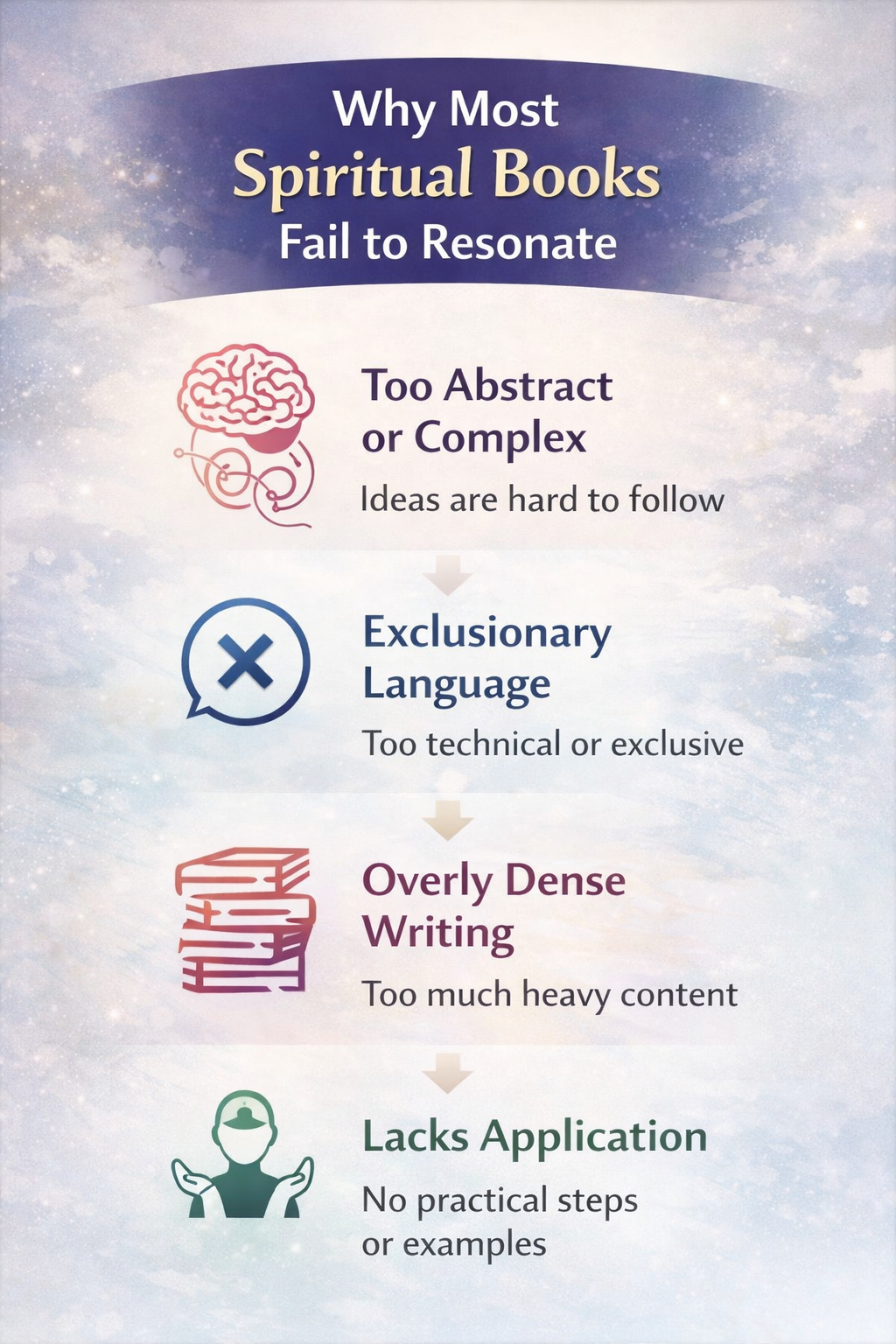
A lot of these books start with something real. Strong beliefs. Personal experiences. Big ideas that matter. So, on paper, they should work. But then you read them and… something feels off. The connection just isn’t there.
It’s rarely the message. It’s how that message shows up on the page.
Strong Message, Weak Connection
Writers often focus on what they want to say. Fair enough. But the reader gets left behind. There’s no bridge between the idea and the person reading it, so the message never quite lands.
Good Ideas, Poor Structure
Even meaningful thoughts can feel confusing when they’re all over the place. One idea leads to another, then another, and suddenly the reader is trying to piece it together on their own. Most won’t bother.
Too Abstract and Hard to Follow
This happens a lot. Big concepts, heavy language, not enough grounding. You read a few pages and think, okay… but what does this actually look like in real life?
| One manuscript focused heavily on ethical principles. It had depth, strong thinking, and clear intent. But it stayed in theory. No stories, no examples, nothing to anchor the ideas. Readers struggled to connect, and engagement stayed low.
Another author approached it differently. Instead of staying abstract, they shared their personal spiritual journey. They added small stories, everyday situations, even reflection questions. Complex ideas became easier to follow. Readers could see themselves in the content. The result? Higher engagement, stronger connection, and a book that actually stayed with people. |
No Clear Takeaway for the Reader
At some point, the reader should walk away with something. A shift in thinking. A question to sit with. Maybe even a small action. Without that, the book feels unfinished, even if it technically isn’t.
Repeating Ideas Without Moving Forward
Repetition can help, sure. But when nothing new is added, it slows everything down. The reader notices. And once they lose interest, it’s hard to get it back.
Writing Only for Yourself
This one is subtle. Writing can feel personal, almost private. But a book still needs to consider the reader. If it stays too inward, it stops connecting outward.
What Works Better
The books that actually stay with people do a few things differently. They take big ideas and make them real.
- Simple language that does not get in the way
- Stories people can see themselves in
- Clear lessons that feel useful, not forced
And honestly, this is where religious ghostwriting services can help. They take what you’re trying to say and shape it so readers can actually feel it, understand it, and stay with it.
| Common Challenge | Impact on Readers | Suggested Solution | How the Solution Improves Reading / Manuscript |
| Abstract or overly conceptual language | Confusion, disconnection, difficulty applying insights | Use clear examples, metaphors, and relatable stories | Makes complex ideas understandable and relatable, helping readers grasp meaning without frustration |
| Lack of narrative or storytelling | Readers lose interest, no emotional connection | Integrate personal anecdotes, case studies, or reflective exercises | Keeps readers engaged and emotionally connected to the content |
| Repetition without progression | Boredom, perception of redundancy | Structure ideas progressively, build themes chapter by chapter | Creates a sense of movement and development, maintaining reader attention |
| Writing for self-expression, not readers | Messages feel heavy, readers disengage | Focus on audience understanding, include reflection prompts and applications | Aligns the content with reader needs, making the book more meaningful and actionable |
| Overly symbolic or doctrinally dense passages | Inaccessibility for general readers | Simplify language, offer context, and provide practical examples | Makes the content approachable while retaining depth and authenticity |
| Non-linear or scattered ideas | Difficulty following the argument or theme | Outline core message, organize chapters logically, use thematic anchors | Guides readers smoothly through ideas, improving comprehension and retention |
How to Structure a Religious or Spiritual Book
If your book doesn’t have a clear structure, even the best ideas can get lost. The key is simple: define your core message, anchor it with a story or theme, map out chapter flow, and give readers something they can actually take away.
| Turning Abstract Ideas into a Readable Book We once received a spiritual memoir full of rich ideas but no clear structure. Our writer at Writers Of The West reorganized it around three life stages: discovery, challenge, and transformation. Each chapter followed a simple, repeatable pattern:● Experience: real-life events or challenges● Insight: spiritual or philosophical lessons learned ● Reflection: prompts to help readers relate it to their own journey ● Application: practical ways to bring the insight into daily life The result? Abstract beliefs became relatable, coherent, and actionable. Readers could follow the narrative, see their own growth mirrored, and walk away with practical takeaways. |
Core Message Definition
Start with your main idea, belief, or teaching. This becomes the backbone of the book. Every chapter, story, or example should point back to it so readers know what they’re gaining and why it matters.
Narrative or Thematic Anchor
Anchor your ideas in something tangible: a story, a principle, a metaphor. Concrete examples make abstract concepts easier to understand and keep readers engaged.
Chapter Flow Structure
Keep chapters consistent: introduce the idea, explain it, give an example, invite reflection, and suggest practical application. This step-by-step flow keeps readers moving without feeling lost.
Reader Transformation Layer
Think about what the reader walks away with. Reflection prompts, exercises, or questions make ideas stick. If they can apply it, it stops being just theory.
Cohesion Across the Manuscript
Consistency matters. Use recurring themes, examples, and metaphors so the book feels unified. Avoid random repetition and keep the message strong throughout.
Balancing Spiritual Depth with Readability
Writing about spirituality isn’t just about having big ideas. It’s about getting those ideas onto the page so people actually get them. Go too heavy or too abstract, and your reader can drift away. So you should keep it light enough to follow and deep enough to matter to your reader.
Here’s how to hit that sweet spot:
- Simplify complex ideas
Big spiritual or philosophical concepts can feel like a maze. Use simple explanations, small stories, or metaphors. Keep the depth, lose the confusion. - Use inclusive, clear language
Skip the heavy jargon and technical terms. Talk to people, not textbooks. Your audience will include both seasoned practitioners and curious newcomers. - Avoid overly dense writing
Too many abstract words, too many symbols, and readers drift. Break ideas into bite-size chunks and link them with examples, reflection questions, or short anecdotes. - Write for a broad audience
Your book should connect with different perspectives. Clear writing lets readers reflect, apply, and find meaning in their own way. - Combine reflection with application
Prompts, exercises, or real-life examples help readers do more than understand. They apply it. They experience it.
A good balance makes your book meaningful, readable, and actually usable. Otherwise, all that depth just sits on the page.
When to Consider Professional Writing and Editing Support
Writing something spiritual feels personal. It should. But at some point, you step back and think, okay… does this actually make sense to someone else? That’s usually when professional help starts to matter.
Ghostwriting and Development Support
If your ideas are strong but scattered, this is where ghostwriting helps. You bring the message. They bring order. Everything gets shaped into a clear manuscript without losing your voice. Especially useful when your content is based on personal experience and real stories.
Refining Structure and Clarity
Spiritual writing can get complicated fast. One idea leads to another, and suddenly the reader is lost. Developmental support steps in to organize chapters, simplify what needs simplifying, and keep the flow steady.
Line Editing and Manuscript Polishing
This is where the writing gets cleaned up. Book editing services are doing more than correcting grammar here. They’re making sure your message lands properly. Any loose sentences or inconsistencies in tone are taken care of promptly.
Preparing for Publication
Then comes the final stretch. Formatting, readability, making sure everything looks and feels complete. No loose ends. Just a manuscript that’s ready to go out into the world and actually reach people.
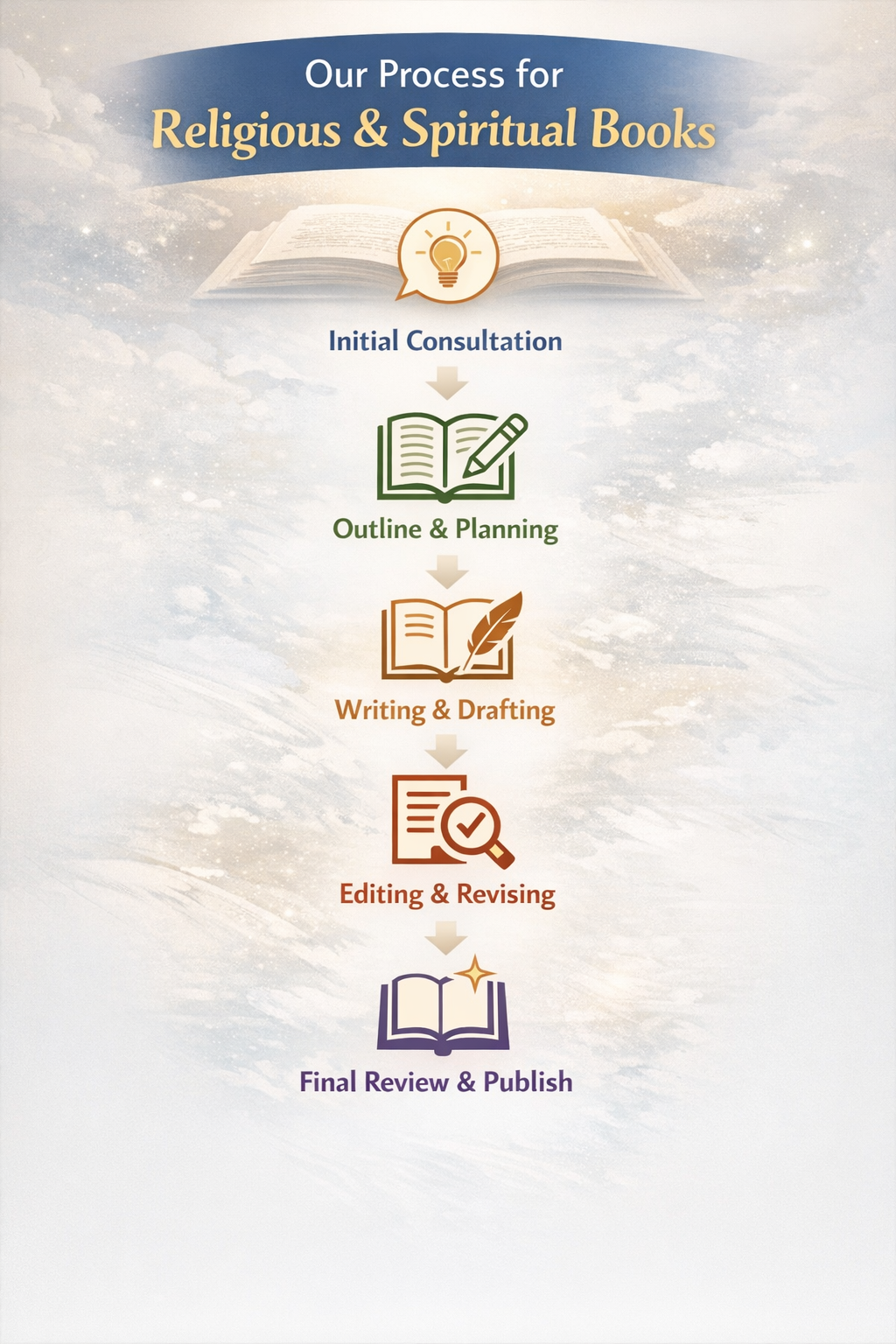
Our Process for Religious and Spiritual Books
Alright, so here’s how we approach this. The goal is simple. Take complex ideas, beliefs, and experiences, and turn them into something clear, structured, and actually readable. Not just meaningful, but understandable.
Understanding Belief Systems and Intent
We always start here. What do you believe? Why does this book matter to you? And what do you want it to do for the reader?
This stage clears up a few things early:
- The core message
- Who the book is really for
- The tone and overall direction
Skip this, and the manuscript usually drifts. It happens more often than you’d think.
Extracting Core Message and Themes
Most authors don’t come in with one idea. It’s usually a mix of thoughts, experiences, and half-formed themes. So the first job is to sort that out. What stays, what goes, what actually matters.
This step helps to:
- Cut unnecessary noise
- Bring forward the strongest insights
- Make the message easier to follow
For spiritual memoir writing, this part is huge. It turns personal moments into a story that holds together.
Structuring Content Logically
Once the ideas are clear, we build the structure. Not complicated, just logical. One idea leads to the next, chapters follow a natural order, and nothing feels out of place.
This usually involves:
- Deciding the chapter flow
- Mapping how ideas build on each other
- Adding examples and moments for reflection
When this works, the reader doesn’t have to work hard to keep up.
Writing and Refining for Clarity
Now we write. Then we rewrite. Then we tighten things up again.
The focus here is simple:
- Make complex ideas easier to read
- Improve flow so it feels natural
- Keep the tone consistent
The message stays yours. It just becomes clearer, sharper, and easier to connect with.
Preparing for Publication
Last step. This is where everything gets cleaned up and ready.
We focus on:
- Clean formatting and consistency
- Final edits that catch what’s left
- Making sure the whole book reads smoothly
At this point, it’s no longer just a draft. It’s something you can actually put out there and feel confident about.
Who This Is For
Religious and spiritual books aren’t one-size-fits-all. They can connect with all kinds of readers, but only if you understand who’s reading. Knowing your audience shapes tone, structure, and the way you deliver your ideas.
This is especially useful for:
- Religious scholars and teachers
Sharing teachings or ethical ideas? Structure helps you turn complex concepts into something clear and actionable. Readers get it, remember it, and can actually apply it. - Spiritual practitioners and coaches
Writing about personal growth, reflection, or guidance? Organized content helps readers transform ideas into real-life habits, not just something they nod along to. - Individuals sharing personal journeys
Memoirs or belief-driven stories need a clear thread. Structuring your narrative turns lived experiences into something readers can relate to and feel invested in. - Thought leaders exploring philosophy and ethics
Big, abstract ideas? Use examples, stories, and clear flow to make them practical and understandable. Otherwise, your brilliance risks going over people’s heads. - Organizations creating belief-based content
Groups sharing values, teachings, or guidance benefit from professional structure and clarity. Publishing services for spiritual writers ensures your message isn’t just out there, it actually lands.
FAQs
Can anyone write a religious or spiritual book?
Yes. Anyone with meaningful insights or experiences can write one, provided the message is clear and structured.
How do I make my writing more engaging?
By combining ideas with stories, examples, and reflection, making the content more relatable.
Do I need formal training?
No. Clear thinking and structured communication are more important than formal education.
How should I structure the book?
A logical progression of ideas, supported by examples and reflection, creates a strong framework.
What makes a book impactful?
Clarity, relatability, and practical application. This applies across traditions, including Islamic book writing and other belief systems.
Conclusion
Writing a religious or spiritual book isn’t just about putting your beliefs on paper. It’s about making sure readers actually get it, think about it, and can use it in their own lives. Structure matters. Simple language matters. Real-life examples matter. Without them, even the smartest ideas feel abstract and distant.
A good book keeps the reader front and center. It walks them through your ideas step by step, giving insight, prompts for reflection, and something practical to take away. Whether it’s your personal journey, philosophical musings, or teachings, clarity is what turns words into connection.
Focus on structure, readability, and purpose, and your book won’t just be read, it’ll resonate. Thoughtful religious book writing lets your message stay authentic, reach more people, and actually leave a mark.
About the Author
Cell Biologist, Sociologist & Senior Editor, Writers of the West
Robert Whitehead is an American sociologist and cell biologist at the University of Virginia. He has been with Writers of the West for six years, bringing a rare combination of scientific rigor and behavioral insight to biography, fiction, and book design editorial work. His research background strengthens narrative authenticity, analytical precision, and structural coherence across a wide range of manuscript types.
writersofthewest.net · Professional Ghostwriting Services, Book Editing & Publishing Guidance