Master the art of editing with this complete guide to the four levels of book editing; developmental, line, copyediting, and proofreading. Learn what each stage involves, when to hire, and how to prepare your manuscript to save time and costs.
Introduction
You’ve finished your draft. You’re exhausted, proud, a little dizzy. You’ve climbed the mountain of words and now you’re standing at the edge, staring into the next abyss: editing.
And suddenly, everyone has advice.
“Get a proofreader.”
“No, you need a copyeditor first.”
“Skip straight to line edits, developmental comes later.”
It is noise. Confusing, contradictory noise. And if you’re like most writers, you’re thinking: I just want to make my book the best it can be without wasting money or time.
Here’s the truth: editing does not happen in one giant sweep. It happens in layers. Stages. Four distinct levels of book editing that move from the big, structural issues all the way down to the last sneaky typo. Miss a step and you will either burn cash or publish a book that was not ready.
That is what you will get here. By the end, you will not only know the four levels, you will know exactly which one fits your manuscript right now.
Quick Answer: What Are the Four Levels of Book Editing?
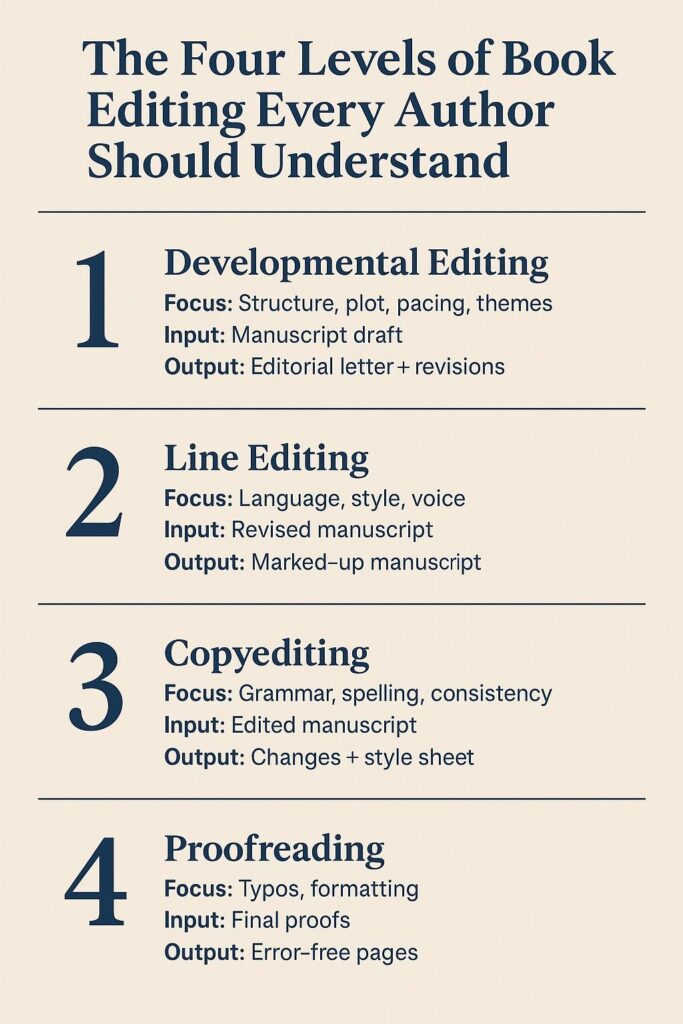
The four main levels of book editing are developmental editing, line editing, copyediting, and proofreading.
-
Developmental editing addresses the book’s structure, plot, pacing, character development, and overall direction.
-
Line editing improves the clarity, flow, voice, tone, and effectiveness of individual sentences and paragraphs.
-
Copyediting corrects grammar, punctuation, spelling, usage, and inconsistencies throughout the manuscript.
-
Proofreading catches remaining typos and formatting errors after the book has been edited and laid out.
This is the usual order because major structural changes should happen before sentences are polished and technical errors are corrected. Not every manuscript needs four separate editing rounds, however. Some editors combine line editing and copyediting, while stronger manuscripts may only require copyediting and proofreading.
Which Type of Editing Does Your Manuscript Need?
The right type of editing depends on what feels unfinished in your manuscript.
-
Choose developmental editing if the plot feels weak, chapters need reorganizing, characters lack depth, the pacing drags, or beta readers struggle to understand the book.
-
Choose line editing if the structure works but the writing feels repetitive, awkward, unclear, or inconsistent in voice and tone.
-
Choose copyediting if you are satisfied with the story and prose but need help correcting grammar, punctuation, spelling, factual inconsistencies, and style.
-
Choose proofreading if the manuscript has already been edited and formatted and only needs a final check for typos, missing words, spacing problems, and layout errors.
If you are still unsure, ask an editor to review a sample and explain what level of work it requires. Focus on the tasks included in the service rather than the label alone, since some editors combine line editing and copyediting.
The Four Levels of Book Editing Compared
| Editing level | Main focus | When you need it | Typical deliverable |
|---|---|---|---|
| Developmental editing | Structure, plot, pacing, characters and overall direction | When the story or organization still needs major work | Editorial letter and manuscript comments |
| Line editing | Voice, clarity, rhythm, tone and sentence flow | When the structure works but the prose needs improvement | Tracked sentence-level revisions and comments |
| Copyediting | Grammar, punctuation, usage, consistency and style | When the content and prose are settled | Corrected manuscript and style sheet |
| Proofreading | Typos, formatting and final layout errors | After editing and typesetting are complete | Marked PDF or final correction list |
Level 1: Developmental Editing
The big picture stage
Developmental editing is where the real heavy lifting begins. This is the stage that asks the hardest questions. Does your story actually work? Does it keep a reader hooked? Are the themes clear? Is the structure strong enough to carry the weight of your ideas?
If the answer to any of these is shaky, this is where you fix it. Forget about commas or clunky sentences for now. At this level, the focus is on story architecture, pacing, plot holes, and overall cohesion.
What you actually receive
When you hire an editor for this stage, you do not just get a few tracked changes in the margins. You usually receive an editorial letter that can run anywhere from five to twenty pages. Alongside it, you will see in-document comments pointing out weak scenes, character inconsistencies, or chapter flow problems. Sometimes you will also get a revised outline or even a call with the editor to walk through the changes.
When to do it
This is the stage to consider right after you have a complete draft. Not an idea. Not three chapters. A full draft from beginning to end. Even if it feels rough, the book needs to exist in full before anyone can judge its bones. If you dive into line or copyediting first, you will waste money because entire chapters could be rewritten after this process.
Typical deliverables
- An editorial letter with big picture notes
- Margin comments for specific scenes
- A reshaped outline if the structure needs major work
- Sometimes multiple rounds of feedback
Why it matters
Think of developmental editing as the equivalent of a structural engineer inspecting a bridge before cars drive across. The bridge might look nice, but if the support beams are weak, it will collapse under pressure. In the same way, your manuscript might have pretty sentences, but without strong structure, it will not hold a reader.
Writers often get confused about developmental editing vs copyediting. The difference is huge. Developmental looks at story and structure, while copyediting looks at correctness and consistency. Mixing them up leads to frustration and wasted budget.
Level 2: Line Editing
The craft of the sentence
Once the foundation of your book is solid, it is time to zoom in closer. Line editing is about the artistry of language. This is where an editor looks at the rhythm of your prose, the clarity of your sentences, and the consistency of your voice.
Think of it as tuning an instrument. The notes are already written, but now they need to sound right together. A line edit makes your writing sing.
What you actually receive
This stage can feel intense because your manuscript often comes back drenched in tracked changes. An editor will suggest rewrites, rephrasings, and adjustments to imagery. They will point out clunky transitions and highlight where your voice drifts out of tune. You also get style notes that explain the reasoning behind their changes so you can learn from them.
When to do it
Line editing comes after the developmental stage. By this point, your structure should be firm. Characters are where they belong, chapters are in the right order, and scenes are locked in. Now the focus shifts to how well those scenes read on the page.
Typical deliverables
- Heavily marked manuscript with tracked changes
- Notes on tone, imagery, and voice consistency
- Suggestions for smoother transitions between paragraphs and chapters
Why it matters
This is often the stage that transforms clunky drafts into professional-quality prose. It is not about nitpicking grammar. It is about whether your words feel alive, whether your descriptions land, whether your dialogue flows with authenticity.
Many authors confuse line editing with copyediting because both work at the sentence level. The difference is purpose. Line editing shapes beauty and clarity. Copyediting enforces correctness and rules. Together, they cover two very different types of editing in books.
Level 3: Copyediting
The polish of correctness
Once your story works and your sentences flow, copyediting takes over. This stage is not about rewriting scenes or fine-tuning imagery. It is about making sure the text is correct, consistent, and professional. A copyeditor is the guardian of rules and standards. They are the person who spots the missing comma, the misused word, the style inconsistency that distracts readers.
Copyediting may not feel as dramatic as a developmental edit, but it is essential. Readers notice mistakes. Typos, inconsistent character names, and incorrect grammar pull them out of the story. If line editing is music, copyediting is the tuning fork that ensures every note is in key.
What you actually receive
A copyedit comes back as a tracked document where corrections are made directly in the text. You will see commas adjusted, words shifted, and grammar corrected. Alongside this, you receive a style sheet. This is a document that tracks all your spelling decisions, hyphenation choices, capitalisation rules, and specific terms unique to your book. For example, if your fantasy novel uses “grey” instead of “gray” or capitalises the word “Order” for a magical group, the style sheet makes sure those decisions are applied consistently from start to finish.
Some copyeditors also make light line edits where necessary. They may rephrase awkward sentences if the meaning is unclear, but their primary task is accuracy and adherence to the agreed style guide, such as the Chicago Manual of Style.
When to do it
Copyediting comes after line editing. By this stage, the prose is locked in place. You are not moving chapters or rewriting dialogue. The creative choices are set. Now it is about ensuring that what you have written is correct and consistent.
Typical deliverables
- A tracked document with all grammar and usage fixes
- A style sheet that records decisions on spelling, hyphenation, and terminology
- Notes where clarity issues or factual questions arise
Why it matters
Skipping copyediting is a gamble. Even the strongest writers miss errors in their own work. A fresh set of trained eyes will always catch mistakes you did not see. And when readers encounter too many errors, they begin to doubt the quality of the book as a whole.
Think of the four levels of book editing as a ladder. Developmental editing gave you the structure. Line editing gave you the style. Copyediting gives you correctness. Each step builds on the last, and by the time you reach this one, your manuscript should be close to professional quality.
Copyediting is where a draft stops looking like something you wrote alone and starts looking like something ready for readers.
Level 4: Proofreading
The last defence
Proofreading is the final stage of editing. By the time you arrive here, the structure is set, the sentences flow, and the grammar is correct. What remains are the smallest surface errors that can still slip through: a missing period, a repeated word, or a typo that escaped notice in earlier stages. Proofreading is the last defence before your book goes out into the world.
What you actually receive
Proofreaders usually work on a PDF or galley version of your book, not a Word document. This matters because they are not only checking words. They are also scanning the layout itself. Page numbers, spacing, headers, and even awkward breaks like widows and orphans (where a single word is stranded at the top or bottom of a page) are all caught here.
The deliverable is a marked-up proof, either with digital comments or a list of corrections keyed to page and line numbers. At this stage, the changes are minor, but the impact is huge. A single typo can jolt a reader out of immersion, and too many errors can make a book feel rushed or unprofessional.
When to do it
Proofreading always comes after copyediting and typesetting. It is not a replacement for deeper editing. A proofreader will not tell you if a scene feels weak or if your dialogue drags. Their job is to sweep the final surface, not to reshape the house beneath. If you try to skip earlier steps and jump to proofreading, you will waste money because the text is still unstable.
Typical deliverables
- A marked PDF or proof copy with corrections
- Notes on layout issues such as spacing or page breaks
- A final checklist of typos, punctuation errors, and formatting inconsistencies
Why it matters
Readers rarely notice when a proofread is done well. They notice when it is skipped. That is the invisible power of this stage. A proofreader makes sure your book feels smooth, polished, and trustworthy. The smallest detail can make the difference between a book that feels amateur and one that feels professional. Many authors discover this stage through book editing services that package all four levels together. Whether you buy them as a bundle or individually, proofreading should never be ignored. It is the last polish before your book stands in front of its audience, and it is what ensures all the work you put into the earlier stages shines without distraction.
DIY Prep to Reduce Costs Before You Hire
Why self-prep matters
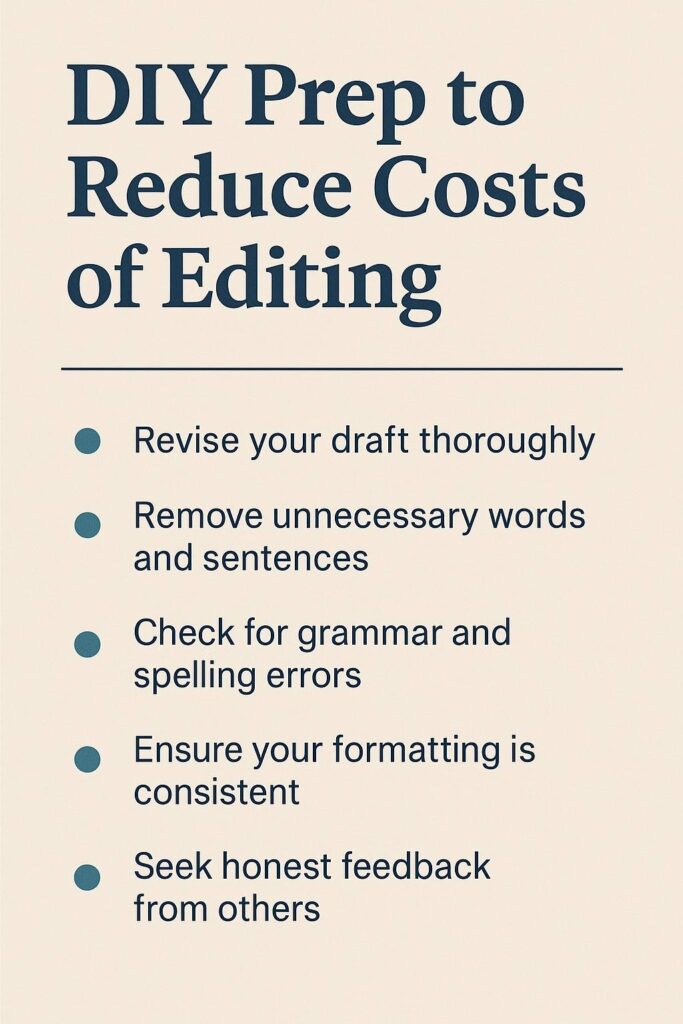
Hiring an editor is an investment, and the cleaner your draft, the less time they need to spend on obvious issues. That means lower costs for you. Think of it like handing your car to a mechanic. If you have already topped up the oil, pumped the tyres, and replaced the wiper blades, the mechanic can focus on the real repairs. The same principle applies to editing.
Start with clarity
Before you send your manuscript off, make sure you know what your book is really about. Can you summarise the central theme or argument in one or two sentences? If not, tighten your focus. Editors can guide you, but if your core vision is too foggy, developmental edits will take longer and cost more.
Fix the obvious
Every draft has easy-to-spot issues that you can handle yourself. Look for plot holes, dangling subplots, or characters that vanish halfway through. Clean these up before an editor has to spend hours flagging them. Run a spell check. Correct repeated words. Catch the small errors now and save the editor’s time for higher-value work.
Use a style guide
Pick a standard like the Chicago Manual of Style or AP Style and apply it yourself. Decide early on whether you will spell it “grey” or “gray,” whether you will hyphenate “well-being” or not, and whether your fantasy kingdom capitalises every title. Consistency saves your editor from chasing basic decisions and lets them focus on polishing the manuscript.
Check your names and terms
Proper nouns, invented languages, and specialised terminology are fertile ground for mistakes. Create your own list of names, places, and terms with consistent spelling. That way, when your editor builds a style sheet, they will have a head start.
Run a self-edit pass
Read your work aloud. Awkward phrasing leaps out when spoken. Tighten sentences. Cut filler words. Rearrange clunky dialogue. The closer your manuscript gets to readable prose, the less heavy lifting your editor needs to do.
The payoff
The four levels of book editing exist to protect your book and guide it step by step toward publication. But you can lighten the load by doing your part before handing the draft over. Every fix you make on your own is one less correction on the invoice. More importantly, it shows your editor you take the process seriously, which often leads to a stronger partnership.
FAQs
1. What are the four main levels of book editing?
The four core stages are developmental editing, line editing, copyediting, and proofreading. Each one builds on the last, moving from big-picture story structure to fine detail.
2. In what order should the book editing happen?
Always follow the sequence: developmental first, then line editing, then copyediting, and finally proofreading. Skipping ahead usually means wasted money and missed opportunities to strengthen the manuscript.
3. What is the difference between line editing and copyediting?
Line editing focuses on style, voice, rhythm, and clarity at the sentence level. Copyediting enforces correctness by checking grammar, punctuation, usage, and consistency. Both matter, but they serve different purposes.
4. Is an editorial assessment the same as developmental editing?
No. An editorial assessment is a lighter report on strengths and weaknesses. It is useful if you want an overview before investing in a full developmental edit, but it will not give the same depth of feedback.
5. When should I proofread during book editing?
Proofreading comes last, only after copyediting and typesetting. It is the final sweep for typos, layout errors, and surface-level mistakes.
6. Do all books need all four levels of book editing?
Not always. Some manuscripts are already strong and may only need copyediting and proofreading. Others need all four. The right path depends on your draft’s readiness and your budget.
7. How much will book editing cost?
Costs vary by level, word count, and the quality of your draft. Most editors charge per word. Developmental and line editing are usually the most expensive, while proofreading is the least. Always gather multiple quotes.
8. How long does each level of book editing take?
It depends on length and scope. Developmental edits can take weeks or months, especially with multiple rounds. Line edits take a few weeks. Copyediting is faster, and proofreading is usually the quickest.
9. Can line and copyediting be combined?
Some editors bundle them, but you should clarify the scope. Make sure that style and flow do not overshadow correctness, or vice versa.
10. What do I receive from a developmental edit?
You will usually receive an editorial letter, margin notes throughout the manuscript, and sometimes a revised outline or follow-up call.
Conclusion
Editing is not one hurdle to clear. It is a journey with stages, each one designed to make your book stronger than the last. Developmental editing strengthens the foundation. Line editing shapes the sentences until they sing. Copyediting enforces correctness and consistency. Proofreading sweeps up the last surface errors so the book is ready for readers.
The mistake many authors make is thinking they can skip steps. But every stage has a purpose, and the four levels of book editing exist to protect both your story and your readers’ experience. Follow the sequence, and your manuscript grows sharper, clearer, and more professional at every turn. Ignore it, and you risk releasing something unfinished into the world.
Wherever you are in your draft, take a step back and ask yourself: What does my book need right now? Structure? Style? Accuracy? Or the final polish? Once you answer that honestly, you will know exactly which level is your next move. Editing can feel overwhelming, but it does not have to be. With the right knowledge and the right editor, it becomes a process of transformation. Page by page, draft by draft, your book will evolve into the version you always hoped it could be.
About the Author
Speculative Fiction Writer & Emotional Narrative Editor
Natalia Coldwater is a Brooklyn-based writer and editor with a Bachelor of Fine Arts (B.F.A.) in Creative Writing from Brooklyn College and more than two years at Writers of the West. She focuses on psychological storytelling, character voice, and emotional clarity in fiction and personal-development manuscripts.
writersofthewest.net · Professional Ghostwriting Services, Book Editing & Publishing Guidance