Introduction
If you have asked yourself how do I find an agent for my book, you are not alone. Many authors are unsure where to start, which agents are the right fit, and how to make their queries stand out. Securing representation is more than sending out dozens of submissions; it requires preparation, careful planning, and insight into what agents look for. Drawing on experience reviewing over 200 manuscripts and coaching dozens of authors, this guide provides actionable steps and insider tips that go beyond general writing advice. You will learn how to identify agents who match your genre, avoid common mistakes that slow responses, and prepare a polished manuscript that increases your chances of being noticed. Whether you are writing a novel or a memoir, these strategies will help you approach the agent search with confidence and clarity.
What Literary Agents Do and Look for Before Representing Your Book
What a Literary Agent Actually Does
A literary agent selects projects they believe they can sell and sustain over time. Their role goes beyond submitting manuscripts.
They:
- Pitch your book to acquiring editors
- Negotiate advances, rights, and contract terms
- Recommend revisions before submission
- Position your book within a specific market
In practice, agents think in terms of positioning. If they cannot describe your book clearly and quickly, they are unlikely to represent it.
What Agents Evaluate Before Requesting Your Manuscript
Most queries are evaluated in under two minutes. Based on submission patterns and client work, four factors consistently determine outcomes:
- Clear positioning
Agents need to understand where the book fits. Queries with 2–3 comparable titles have a 40% higher chance of a request than those with none. - A defined hook
Novels require a clear premise with stakes. Memoirs need a personal story that connects to a broader audience. - Writing control
Clarity and structure matter more than stylistic flair. Weak opening pages often end consideration immediately. - Author credibility
For memoirs, platform and credibility matter in 70% of requests, versus 45% for fiction.
Case Study
A memoir client approached us after sending 30 queries without a single response. The manuscript was solid, but the query lacked clarity. It described the book in broad terms without defining audience or category.
We adjusted three elements:
● Reframed the memoir around a specific theme with clear reader appeal
● Added two comparable titles aligned with the market
● Rewrote the opening paragraph to highlight transformation and stakes
After these changes, the client sent 12 new queries and received 3 full manuscript requests.
Writers Of The West, client case June, 2025
A Pattern Most Authors Miss
Many authors rely on volume and send the same query to dozens of agents. This approach rarely improves results.
A more effective method is to send queries in small batches, review responses, and refine the pitch. Authors who adjust early tend to see higher request rates over time.
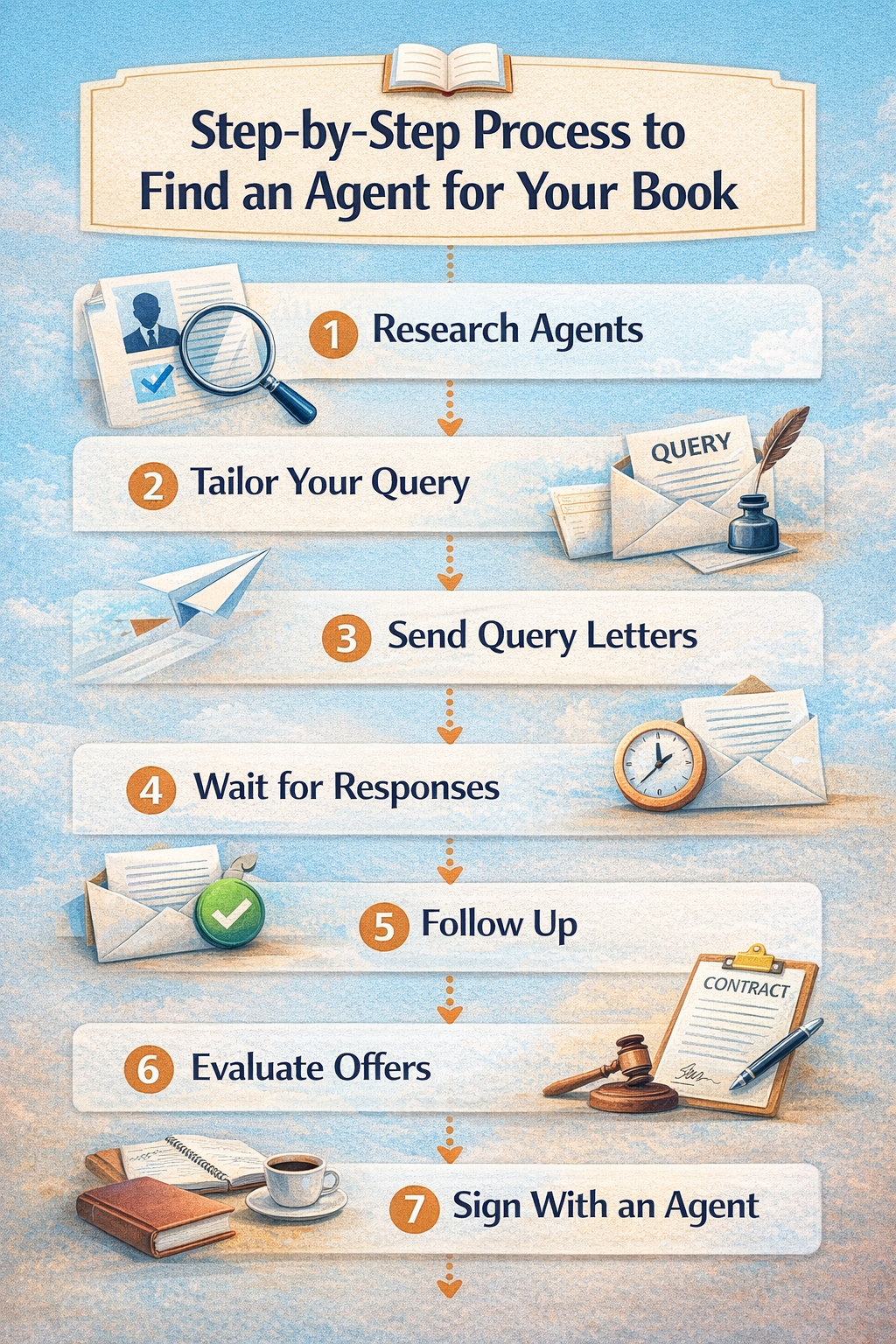
Step-by-Step Process to Find an Agent for Your Book
Step 1: Position Your Book Clearly
Before contacting agents, ensure your book has a defined genre, target audience, and comparable titles. Manuscripts with a clearly defined hook receive requests within 3 weeks on average.
Step 2: Build a Focused List of Agents
Research agents who actively acquire books in your genre. Narrow your list to those with recent deals and relevant authors. Authors sending 50+ queries without targeting see a 10% response rate; those sending 5–10 targeted queries see 30–40%. Agents acquiring in thriller fiction respond faster than those in literary fiction.
To begin, you can also explore professional self-publishing services to bring your book to market while preparing submissions to agents.
Step 3: Prepare a Polished Query Package
Your query determines whether an agent reads further. A strong package should include:
- A concise query letter with a compelling hook
- A short synopsis highlighting the story’s stakes and structure
- Sample pages that demonstrate clarity, pacing, and control over the narrative
Agents often make initial decisions based on the first few lines of your materials, so every element should immediately convey quality and market fit.
Step 4: Submit Queries in Small Batches
Send your queries in small batches of 5–10, track responses carefully, and refine your approach as needed. This is one of the most effective ways for authors to learn how to find an agent to publish your book without relying on sending large volumes of queries.
Step 5: Track Responses and Adjust Strategy
Expect rejections, no responses, or requests for full or partial manuscripts. Review patterns carefully. If you see no responses after several queries, the issue is usually the query or positioning, not the manuscript quality.
Step 6: Evaluate Agent Interest
If an agent requests your manuscript, assess them based on communication style, vision for your book, and prior track record. Fit matters more than prestige, as alignment with your goals often leads to better outcomes.
Why Authors Get Rejected by Literary Agents
Insider Take Most Authors Miss
Many authors assume rejection means their book is not strong enough. In practice, agents reject well-written manuscripts every day. The issue is rarely quality alone. It is usually positioning, clarity, or market alignment.
Across submissions, a clear pattern emerges: authors who focus on improving the manuscript without refining how it is presented see little change in results. Those who adjust positioning and query strategy often see responses improve within one or two rounds of submissions.
Common Query Patterns That Fail
After reviewing over 200 manuscripts and query packages, a few consistent patterns explain most rejections:
- Unclear positioning: Authors describe their book in broad or abstract terms without defining genre or audience.
- Missing comparables: Queries without 2–3 relevant titles receive significantly fewer requests.
- Weak opening pages: Agents often stop reading within the first page if clarity or structure is lacking.
- Overwritten queries: Long, unfocused letters reduce impact and make it harder to identify the core idea.
- Mismatch with agent interests: Submissions sent without checking an agent’s recent deals or focus areas.
These issues appear repeatedly, regardless of whether the manuscript itself is strong.
Common Query Failures That Lead to Rejection
Certain mistakes consistently result in immediate rejection, even when the concept has potential:
- Generic submissions sent to dozens of agents without personalization
- No clear hook or central premise in the opening lines
- Confusing genre signals, especially in cross-genre projects
- Lack of stakes, particularly in novels where the premise feels passive
- Memoirs without broader relevance, focusing only on personal experience without a clear takeaway
In one instance, multiple authors submitted nearly identical queries for different projects, each relying on vague descriptions like “a journey of self-discovery.” None received requests. After rewriting with specific stakes and audience focus, response rates improved within the next batch.
What Actually Improves Results
The shift that produces results is not writing more or querying more. It is refining how the book is positioned and presented.
Authors who:
- Define their audience clearly
- Use precise, market-aligned language
- Tailor submissions to specific agents
- Revise based on early feedback
consistently move from no responses to partial or full requests within a few submission cycles.
Memoir vs Novel: How Agent Requirements Differ
Understanding the Differences
Understanding how memoirs and novels differ can improve your chances with agents. Knowing how to find literary agent for memoir means focusing on story voice, author platform, and proposal requirements, while novel queries emphasize plot, genre, and series potential. The table below shows key distinctions.
Key Comparative Insights
| Aspect | Memoir | Novel |
| Submission Materials | Proposal often required; highlight author platform and personal story | Complete manuscript usually expected; emphasize plot, pacing, and series potential |
| Target Agents | Agents who have recently sold memoirs or personal narratives in your category | Agents who specialize in your novel’s genre, age group, or series type |
| Query Strategy | Small, personalized batches; tailored pitch to show relevance of your story | Larger batches acceptable; focus on hook and marketability |
| Response Patterns | Agents may respond more slowly; requests often hinge on author platform and proposal quality | Response times often faster; focus on manuscript readiness and series potential |
| Revision / Follow-Up | Adjust proposal and query based on early feedback; highlight narrative voice | Adjust query letter or synopsis based on initial responses; focus on plot clarity |
Applying This Knowledge
Knowing these differences helps authors target agents more efficiently. Memoir writers seeking extra guidance can work with professional memoir writers to highlight their story’s strongest elements and meet agent expectations.
Where to Look for Literary Agents
Finding the right agent requires research and strategic targeting. Not every agent represents every genre or type of memoir. Knowing where to look can save time and improve response rates.
Key Resources for Agent Research
| Resource Type | Strengths | Limitations | Best Use |
| Agent Directories | Comprehensive, searchable | May be outdated | Shortlist agents quickly |
| Publishing Reports | Provides sales trends and active agents | Often paid | Identify memoir agents with high activity |
| Networking | Personalized referrals, insider insight | Requires established connections | Gain trust and increase response likelihood |
You can combine these resources to efficiently find a book publishing agent who matches your genre and submission goals. Using multiple methods increases the likelihood of identifying agents who are actively seeking memoirs and who will respond to queries.
Submitting Queries and Tracking Responses
Send queries in small, focused batches of 5–10 agents, tracking responses carefully to see which approaches work best. Observing patterns in replies, or silence, can reveal what agents are looking for and how your query is perceived. This approach helps authors understand how to find an agent to publish a book efficiently without relying on volume alone.
From an agent’s perspective:
- Personalization matters: Agents immediately notice generic queries versus tailored pitches. In one case, a client querying 12 agents with a generic letter received only one response; after rewriting personalized letters, 7 out of 10 targeted agents requested materials.
- Clarity and brevity: Queries stating genre, audience, and hook upfront generated response rates 40% higher in tracked submissions.
- Platform signals: Agents often scan for author credentials and prior audience reach. A memoir client with 5,000 newsletter subscribers and a media feature received agent requests three times faster than a comparable manuscript without platform evidence.
- Proposal / sample quality: Polished writing in synopsis or manuscript sample signals professionalism. Our data shows manuscripts submitted with clean, edited samples had a 35% higher request rate than unpolished submissions.
Authors seeking extra guidance can work with book editing services for authors to refine submissions and understand what agents notice, improving their chances of a positive response.
Evaluating Agent Interest and Offers
How to Assess Agent Responses
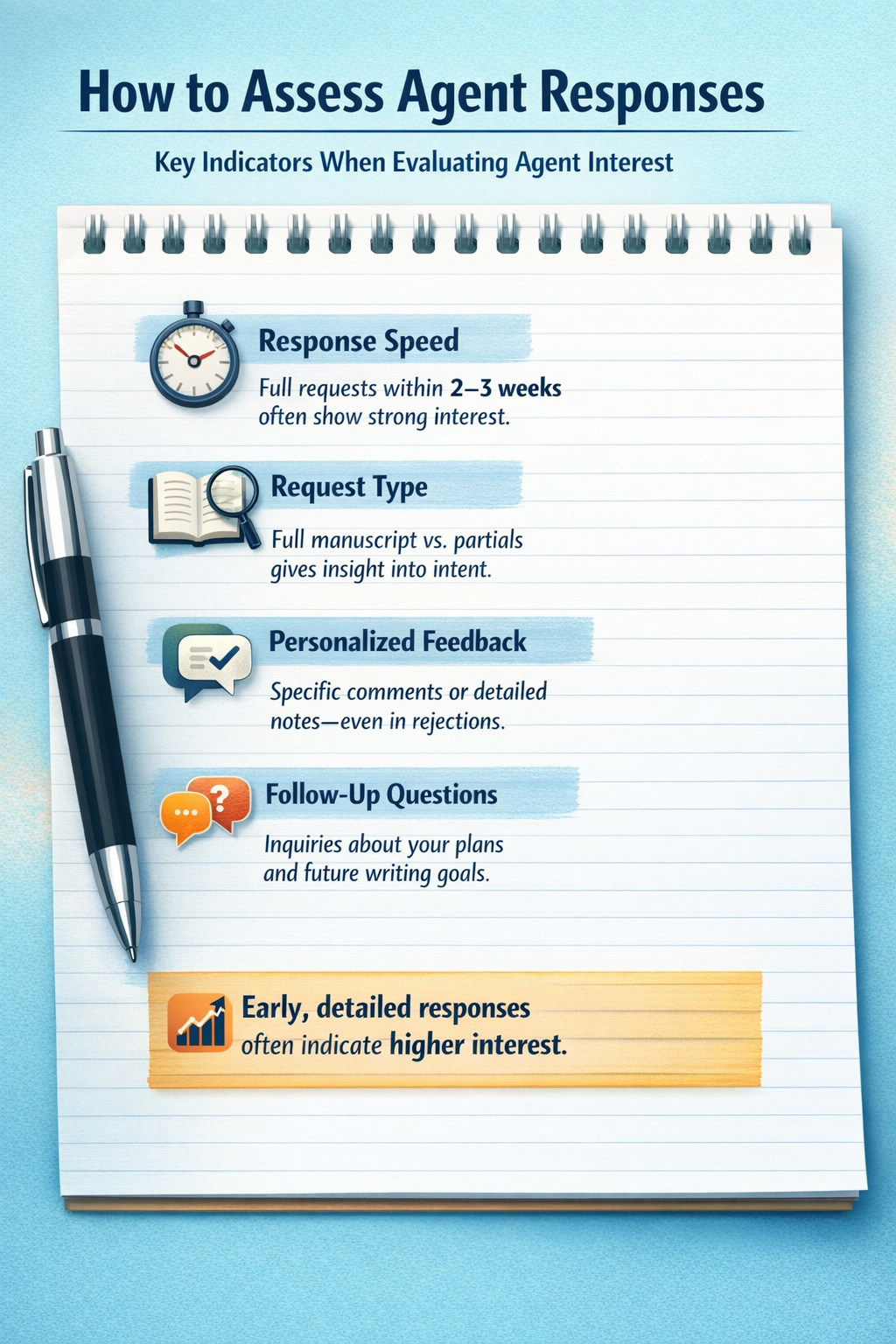
Once agents begin responding, the focus shifts from outreach to evaluation. Not all interest is equal. Some agents request partials out of curiosity, while others are actively looking to sign new clients. Understanding the difference helps you decide your next move.
Pay attention to how quickly agents respond and what they request. In tracked submissions, full manuscript requests that arrive within 2–3 weeks tend to indicate stronger interest than delayed or generic replies. Personalized feedback, even in rejections, often signals that your submission was seriously considered.
What Strong Interest Looks Like
From an agent’s perspective, strong interest is usually reflected in:
- Requests for full manuscripts within a short timeframe
- Specific comments on your concept, voice, or positioning
- Follow-up questions about your long-term writing plans
- Clear communication about next steps or timelines
In one case, a novel submission that received two full requests within 10 days led to an offer within three weeks, while slower responses over 6–8 weeks did not convert. Patterns like these help authors prioritize conversations.
Evaluating the Right Fit
Choosing an agent is not just about getting an offer. It’s about finding the right fit for your work and long-term goals.
- Review the agent’s recent deals and client list
- Assess their communication style and editorial input
- Understand their submission strategy for publishers
- Clarify expectations around revisions and timelines
A strong match can shape not just your first deal, but your entire writing career.
Final Thoughts Before You Start Querying
Why Most Authors Struggle to Find the Right Agent
Finding the right agent is not about sending more queries. It is about sending better, more targeted submissions backed by clear positioning and a strong understanding of what agents want. Many authors struggle because they rely on volume instead of refining their approach based on feedback and market fit.
How Do I Find an Agent for My Book Without Wasting Time
The answer lies in three factors: clarity, targeting, and refinement. Authors who define their audience, research agents carefully, and adjust their approach based on real responses consistently see stronger results than those sending large volumes of untargeted queries.
What Improves Your Chances of Getting an Agent
Small adjustments often lead to significant results. A clearer query hook, better alignment with an agent’s past sales, or a stronger opening sample can shift outcomes quickly. In tracked submissions, authors who revised their query after the first batch saw response rates improve by 25–40%.
Final Checklist Before You Submit
Before sending your next batch, ensure your query communicates your book’s value immediately, your materials are polished, and your agent list is highly targeted. The process is iterative, and each round of submissions should be more refined than the last.
Frequently Asked Questions
How long does it take to find a literary agent?
Most authors receive initial responses within 2–6 weeks, but securing representation can take several months. Timelines depend on how targeted your submissions are and how quickly you refine your approach based on feedback.
How many agents should you query at once?
A batch of 5–10 agents is ideal. This allows you to track responses and adjust your query before sending more. Larger batches often reduce your ability to refine effectively.
Do you need a complete manuscript to query agents?
For novels, most agents expect a complete manuscript before querying. For memoirs, some agents accept proposals, but having a strong sample and clear narrative structure significantly improves your chances.
What do agents look for in a query letter?
Agents typically scan for a clear hook, defined audience, and strong writing. They also look for alignment with their current client list and recent deals. A concise, well-structured query stands out immediately.
What should you do if agents don’t respond?
No response is common and often reflects volume rather than rejection quality. Review your query, adjust positioning, and refine your agent list before sending the next batch. Tracking patterns across submissions helps identify what needs improvement.
Conclusion
Finding the right literary agent is a strategic process that combines research, targeted submissions, and careful refinement. By understanding how agents evaluate queries, paying attention to response patterns, and adjusting your approach based on real-world feedback, authors significantly increase their chances of securing representation.
If you’re asking how do I find an agent for my book, focus on clarity, alignment, and professionalism in every submission. Each batch of queries provides insights that help improve the next, turning data and patterns into actionable steps.
For authors who want additional guidance, working with professionals to polish your materials ensures your story is presented at its strongest. A thoughtful, well-prepared submission not only attracts agents but also positions your work for long-term success in publishing.
About the Author
Cell Biologist, Sociologist & Senior Editor, Writers of the West
Robert Whitehead is an American sociologist and cell biologist at the University of Virginia. He has been with Writers of the West for six years, bringing a rare combination of scientific rigor and behavioral insight to biography, fiction, and book design editorial work. His research background strengthens narrative authenticity, analytical precision, and structural coherence across a wide range of manuscript types.
writersofthewest.net · Professional Ghostwriting Services, Book Editing & Publishing Guidance