Introduction
If you have ever googled “how much does it cost to publish a book?” after staring down your half-finished manuscript, you already know the panic that creeps in. One site says you need thousands. Another tells you it is free. And somewhere in the middle is you, excited and hopeful, holding your draft like it is both a dream and a financial risk. That tension is familiar to every indie author. You want your work in the world, but you do not want to wreck your budget to make it happen.
Here is the part most people avoid saying. You are not afraid of spending money. You are afraid of wasting it. Editing, cover design, formatting, distribution. It all sounds expensive, confusing, and wildly inconsistent. This is where many writers freeze. They do not need a motivational speech. They need clarity, real numbers, real tradeoffs, and a path they can trust.
This is why you are here. I have spent years helping writers navigate the maze of cheap book publishing without accidentally sabotaging their book. I have seen successful zero dollar launches and I have also seen expensive launches that fell flat, which means I know what actually matters.
In this guide, you will learn how to publish your book for the least amount of money possible while still protecting the quality that helps a book sell. You will see budget breakdowns, step by step workflows, example scenarios, and straightforward answers to the questions every cost conscious author asks.
By the time you finish reading, you will know the smartest and most affordable way to bring your book to life on your terms and within your budget.
Ready to begin? Let us make publishing simple, strategic, and achievable.
Understanding Your Publishing Path Options
When you begin exploring how to publish your book, it can feel like you have stepped into a maze with three main paths. Each one has different costs, timelines, and expectations. If you understand how these paths work before you decide, you can protect both your budget and your confidence.
Traditional Publishing and Its Cost Implications
Traditional publishing often looks like the most affordable option because you do not pay upfront. The publisher handles editing, cover design, formatting, and distribution. That sounds ideal until you realize what you trade for that financial cushion. You need an agent, you wait months for responses, and approval is never guaranteed. Even if you do get a deal, you earn lower royalties and have very little control over deadlines or creative decisions.
For some authors, this path is perfect. For others, especially new writers who want speed and ownership, it can feel slow and limiting.
Hybrid and Assisted Publishing Models
Hybrid models sit between traditional and indie publishing. They offer professional support but require upfront payment. These companies often package editing, design, and distribution into one bundle. The convenience is appealing, but the price is usually higher than hiring freelancers yourself. Some hybrid companies also add unnecessary upsells or long-term contracts that catch beginners off guard.
This is why authors need to read the fine print. A polished sales page does not always reflect the true cost or the actual value delivered.
Why Self Publishing Offers the Most Flexibility
For authors who want to control their budget and timeline, self publishing remains the most adaptable option. You choose what to do yourself, what to outsource, and how much to spend. You decide when the book goes live. You own your rights. You keep most of the royalties.
You can take a DIY approach for many tasks, or you can hire specific help through self publishing services that match your price range. The key is understanding that this path gives you options rather than obligations. If your budget is tight, you can start lean, launch your book, and upgrade pieces later.
The Core Cost Components You Must Consider
No matter which path you choose, certain parts of the publishing process affect quality. Editing influences how readers experience your writing. Cover design influences whether they click. Formatting influences whether they trust you as an author. Distribution influences where your book appears. Marketing influences whether it sells.
Once you understand these components, you can make realistic choices instead of guessing and hoping. That clarity becomes the foundation of a budget friendly strategy that still produces a professional book.
Setting a Budget and Priorities
Before you dive into tools, platforms, or publishing checklists, you need a clear sense of what you can spend and where that money will actually move the needle. Many new authors skip this step because they assume budgeting equals limitation. In reality, budgeting gives you freedom. It keeps you from spending where you do not need to and helps you invest with intention where it matters most.
How to Evaluate What You Can Afford
Start by looking at your current income, savings, and comfort level with risk. Publishing a book is an investment, but it should never feel like a financial gamble. Some authors set a strict cap, such as one hundred or three hundred dollars. Others treat their first book as a learning experience and keep spending minimal so they can scale up later.
Your budget is not a measure of your seriousness. It is simply a tool for clarity.
Choosing What to DIY and What to Outsource
The biggest question you will face is what to handle yourself and what to pay someone else to do. Some tasks reward personal effort, especially if you are willing to learn. Other tasks can undermine your book if done poorly.
Most authors discover that editing and cover design are the two areas where quality makes the biggest difference. A strong edit improves readability. A solid cover improves click through rates. If you decide to publish on Amazon, these two elements shape your first impression in a highly competitive marketplace.
Formatting and marketing can be done on a tight budget if you choose the right tools. Distribution can be free depending on the platform. The real trick is understanding which tasks are craft driven and which are process driven. Craft driven tasks often benefit from professional support. Process driven tasks can be learned quickly.
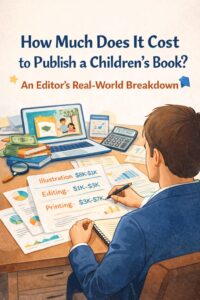
Bare Minimum, Lean, and Moderate Budgets
Here is a simple way to think about cost levels.
Bare Minimum Budget:
You do almost everything yourself. You rely on free editing tools, beta readers, free formatting programs, and a DIY cover template. Your cost might be between zero and one hundred dollars. It requires effort and patience but is entirely possible.
Lean Budget:
You pay small amounts for the essentials. This often includes light editing or proofreading, a budget friendly cover designer, or a premade cover. You may spend between two hundred and five hundred dollars.
Moderate Budget:
You invest in a more polished edit, a professional cover, and paid formatting help. You may also set aside a small marketing budget. This level often ranges from five hundred to fifteen hundred dollars.
Each tier has tradeoffs in time, quality, and stress. None of them are wrong. What matters is choosing the one that aligns with your goals and your current resources.
DIY and Low Cost Approaches to Key Publishing Steps
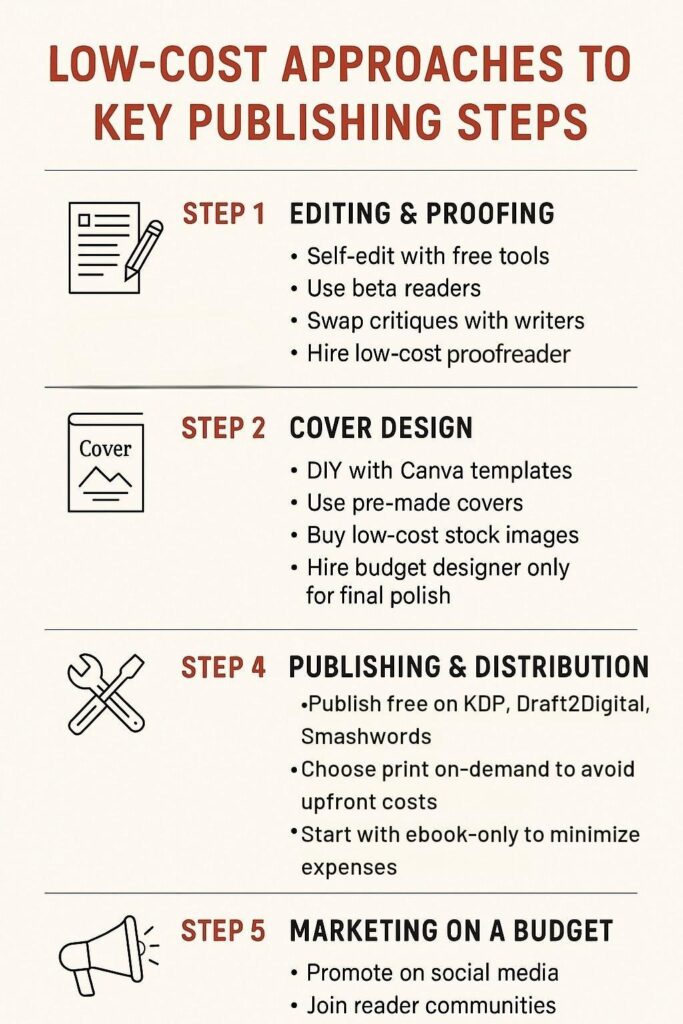
Cheap book publishing becomes realistic when you know exactly which tasks you can handle yourself and which ones benefit from small, strategic investments. These steps walk you through each core phase of the publishing process and show you how to approach it without draining your budget.
Step 1: Manuscript Editing and Proofreading
Editing shapes the readability and professionalism of your book. Even if you cannot afford a full professional edit, you still have strong low cost paths.
Start with free tools
Grammarly, Hemingway Editor, and ProWritingAid help you clean up grammar, reduce clutter, and smooth awkward sentences. They will not replace a human editor, but they give your manuscript a solid baseline.
Lean on writing communities and beta readers
Search for critique partners in writing groups on Facebook, Reddit, Discord, or local meetups. Beta readers can highlight plot issues, pacing problems, or unclear sections. Their feedback is often just as valuable as early stage editorial input.
Hire an affordable editor only if needed
If you want more polish, look for newer freelancers who offer budget friendly proofreading or sample chapter edits. Even a partial professional review can elevate your writing without requiring hundreds of dollars.
Step 2: Cover Design
Your cover is your book’s first handshake with a reader. It must convey genre, tone, and professionalism, even on a small budget.
DIY with simple tools
Canva offers templates that you can customize with high quality stock photos, clean typography, and consistent branding. Minimal design is often more effective than ambitious but clumsy artwork.
Choose a premade cover for affordable quality
Premade designs cost far less than custom illustrations. They still give your book a polished, unique look and often include print and ebook versions.
Step 3: Formatting and Layout
Formatting determines how your book looks on the inside, which influences reader trust and reviews.
Use free formatting tools
Reedsy Book Editor creates clean ebook and print layouts with very little technical effort. You can also use free templates in Word or Google Docs. These options work well for first time authors who want something simple and professional.
Hire a formatter if print layout feels intimidating
A one time formatting service can be surprisingly affordable. It removes the stress of margin settings, chapter breaks, and file exports while still keeping your budget intact.
Step 4: Choosing Publishing Platforms
Where you publish affects cost and visibility. Fortunately, many high quality platforms require no upfront payment.
Use free or low cost self publishing platforms
Amazon KDP, Draft2Digital, and Smashwords allow you to upload ebooks at no cost. Print on demand gives you physical copies without paying for inventory. Aggregators such as PublishDrive help you distribute widely while staying within budget.
Choose whether you want ebook only, print and ebook, or print only. Each option has different levels of work but does not require heavy spending.
Step 5: Marketing on a Budget
Marketing does not have to be expensive. It simply has to be consistent.
Begin with free strategies
Start with social media posts, writing communities, blog content, and email newsletters. These channels help you build visibility over time without paying for ads.
Use small paid boosts only when strategic
Low cost promotions or targeted ads work well once you understand your audience. Even a modest spend can help your book gain early traction.
Trade Offs and Risks of the Cheapest Publishing Approach
Choosing the lowest cost path can feel empowering, especially when you are just starting out and every dollar matters. It gives you control, flexibility, and the freedom to experiment. Still, even the most strategic budget plan comes with trade offs worth understanding before you fully commit. You can absolutely build a strong foundation in self publishing, but the cheapest route is not always the smoothest or the most forgiving.
Quality Can Slip Without You Noticing
When money is tight, it is tempting to lean heavily on free tools and DIY solutions. Many of them work well, but they also have limits. Automated editing tools miss nuance. Homemade covers often look homemade. Formatting mistakes can slip through until a reader points them out in a public review. None of these errors make you a bad writer, but they can weaken your credibility before your book has a chance to find its audience.
Your Time Investment Grows Significantly
Doing everything yourself saves money but costs hours. Editing, design, formatting, keyword research, metadata setup, and marketing are all learnable skills, though each one requires time and trial and error. Some authors enjoy this process because it gives them full control. Others feel overwhelmed because it pulls energy away from what they truly want to do, which is writing the next book.
Cheapest Does Not Always Equal Effective
Publishing a book for very little money is possible. Publishing a book readers trust is a different challenge. A bare bones approach can lead to:
- Covers that do not match genre expectations.
- Editing gaps that frustrate readers.
- Formatting errors that disrupt the reading experience.
- Limited marketing reach because the book never gets enough visibility.
The issue is not that these choices are wrong. The issue is that each shortcut has a cost you may not see until after launch.
Opportunity Cost Matters More Than People Expect
Every time you decide to DIY something, you delay your timeline, spend mental energy, and possibly limit your results. Every time you choose to invest a small amount in the right service, you save hours and improve quality. Neither approach is inherently better. What matters is choosing intentionally rather than reactively.
The Balance You Want To Aim For
The goal is not perfection. It is sustainability. You want a process that fits into your life, not one that drains it. You want a book you are proud of, not one you rushed out because you were afraid to spend anything. The budget path works best when you know exactly where to economize and where a small investment transforms the entire outcome.
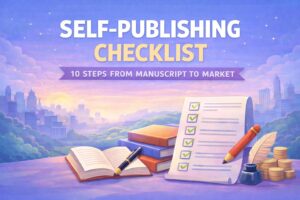
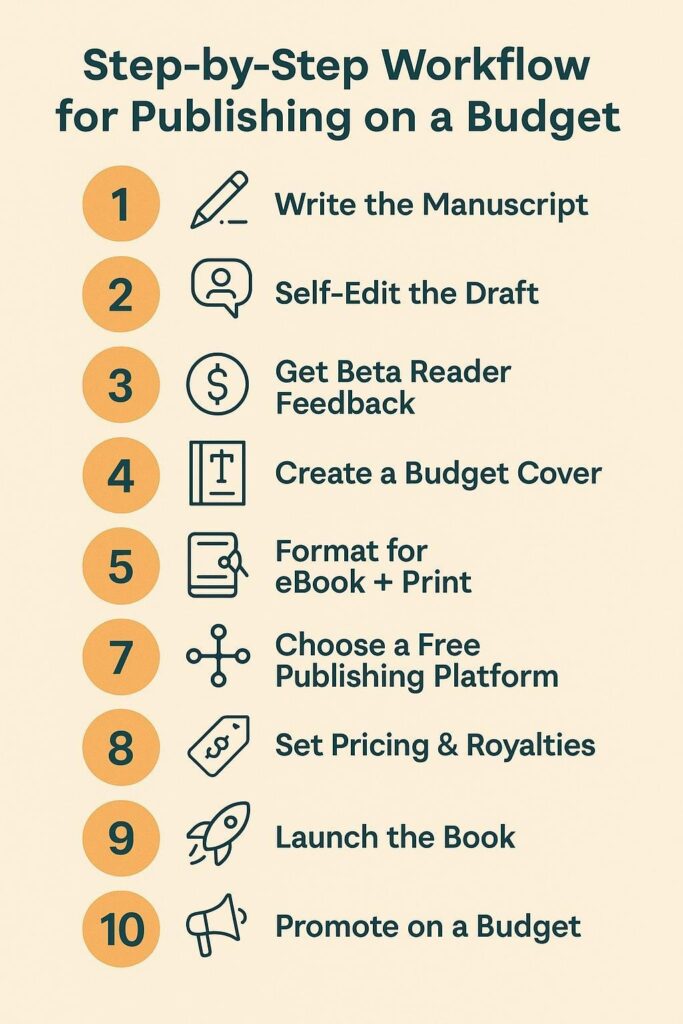
Step by Step Workflow for Publishing on a Budget
A clear workflow helps you stay organized, avoid unnecessary expenses, and move from draft to published book without wondering what comes next. This step by step approach gives you a simple roadmap you can follow whether this is your first book or your fifth. It is designed for practical action so you can publish confidently and keep costs low, especially if you are navigating self publishing for the first time.
Step 1: Write Your Manuscript and Define Your Goal
Start by completing your draft and identifying your purpose. Are you writing to build a career, share personal experience, publish a passion project, or test the waters with a small audience? Your goal influences how much you spend and how polished your book needs to be at launch.
Step 2: Self Edit and Gather Feedback
Use free editing tools to clean up grammar and clarity. After your own edits, bring in critique partners or beta readers. Their feedback is incredibly helpful and costs nothing. Aim for clarity, flow, and consistency rather than perfection.
Step 3: Establish a Realistic Budget
Decide exactly how much you can spend and where that money will matter most. Many authors choose to invest in editing or cover design first because these two elements directly influence whether readers take the book seriously. Even a modest budget works as long as it is intentional.
Step 4: Create or Commission Your Cover
Choose between a DIY template, a premade cover, or a budget friendly designer. Make sure the design clearly signals your genre and appeals to your target reader. A strong cover can improve visibility before you spend anything on marketing.
Step 5: Format Your Book for Ebook and Print
Use free tools to prepare clean files for your chosen format. Reedsy Book Editor works well for beginners. If you need help with print formatting, you can hire a freelancer without spending much. A professional looking layout improves reader trust and reduces returns.
Step 6: Select a Publishing Platform
Decide whether you want to publish only an ebook, both formats, or print only. Platforms like Amazon KDP, Draft2Digital, and Smashwords allow you to upload at no cost. Print on demand eliminates the need for bulk printing and keeps risk low.
Step 7: Set Pricing and Royalties
Choose a competitive price within your genre and decide whether to enroll in exclusive or wide distribution programs. Consider how royalties vary between ebook and print editions. Pricing your book thoughtfully helps you earn more while still appealing to readers.
Step 8: Launch and Promote
Publish your book, then share it across your online presence. Use social media posts, email lists, blogging, or reader communities to build early interest. You can add small paid promotions later once you understand which channels work for your audience.
Step 9: Update and Improve Post Launch
Monitor reviews, track feedback, and adjust your strategy. You can revise formatting, refresh your cover, or update your blurb without republishing from scratch. Small improvements often boost long term visibility.
Step 10: Build Momentum by Writing Your Next Book
One book gets attention, but a collection builds an audience. The more you publish, the more efficient and affordable your process becomes. Many authors reinvest small profits into improving their future releases.
Comparative Budget Scenarios
Publishing on a budget is not a one size fits all process. Your costs depend on what you choose to handle yourself and what you decide to outsource. These examples give you a realistic sense of what different spending levels look like so you can choose the path that fits your goals, skills, and financial comfort. They also help you see how cheap book publishing can work without sacrificing every element of quality.
Scenario A: Minimal Budget
This is the closest you can get to a zero cost launch. You rely on free tools, free platforms, and your own willingness to learn.
What you handle yourself:
- Editing with free software
- Feedback from beta readers
- DIY cover using Canva templates
- Free formatting tools
- Free publishing platforms such as Amazon KDP or Draft2Digital
- Marketing through social media and writing communities
Estimated cost: zero to one hundred dollars.
Effort level: high.
Quality risk: moderate to high depending on your skill level.
Outcome: ideal for testing a concept, learning the process, or publishing a personal project.
Scenario B: Lean Budget
This level offers a balance of affordability and professionalism. You spend selectively on the areas that matter most.
What you invest in:
- Light proofreading or a sample edit
- Budget friendly or premade cover
- Optional low cost formatting service
What you still do yourself:
- Most marketing
- Uploading and platform setup
- Basic editing before professional review
Estimated cost: two hundred to five hundred dollars.
Effort level: medium.
Quality risk: moderate, but significantly reduced with professional support.
Outcome: suitable for authors who want a polished book without overspending.
Scenario C: Moderate Budget
This tier focuses on producing high quality work while still avoiding the steep costs of full service publishing.
What you invest in:
- Professional editing or a combination of developmental feedback and proofreading
- Fully custom or high end premade cover
- Paid formatting for both ebook and print
- Small marketing budget for ads or promotional features
What you handle yourself:
- Final manuscript checks
- Reader engagement
- Ongoing marketing
Estimated cost: five hundred to fifteen hundred dollars.
Effort level: moderate.
Quality risk: low.
Outcome: strong choice for authors who plan to build a long term catalogue and want consistent professionalism.
How to Choose the Best Scenario for You
Think about your goals, your timeline, and your comfort with DIY learning. A personal memoir for friends and family requires far less investment than a commercial series you hope will generate long term income. What matters most is choosing the tier that supports your vision without straining your budget.
Case Studies and Real World Examples
Seeing how other authors navigate budget publishing can give you clarity and confidence. These examples show what works, what does not, and how different choices shape the final outcome. Every author starts with uncertainty, but the ones who succeed learn to work with the resources they have and optimize along the way.
A Shoestring Success Story
One author I worked with wanted to release a short nonfiction guide but had almost no budget. She focused on clarity and kept the entire process simple. She used free editing tools to polish her draft, shared it with three beta readers, and created her own cover with a clean Canva template. She formatted her ebook inside Reedsy Book Editor and chose to publish on Amazon using Kindle Direct Publishing.
Her total cost: zero dollars.
Her major investment: time and patience.
Was her book flawless? No. But it was clear, helpful, easy to read, and packaged in a clean, professional looking design. Within the first month, she earned enough royalties to invest in a better cover for her second book. Within a year, she had three books out and a small but loyal audience. Her biggest takeaway was that momentum matters more than perfection.
A Lean Budget That Paid Off
Another author had a modest budget and wanted to improve quality without overspending. He paid for a light proofreading pass and purchased a premade cover that matched his genre. He formatted his own ebook, hired a freelancer for print formatting, and used social media to build interest before launch.
His total investment was under four hundred dollars. The book performed well because the cover looked professional and the writing was polished. He did almost all the marketing himself, which saved money but required consistency. Within a few months, he had enough visibility to make back his spending and reinvest in his next project.
A Cautionary Tale About Overspending
A beginning author once bought a publishing “package” that promised editing, cover design, formatting, and marketing. The price looked reasonable at first, but the quality of each service was far below what was advertised. The editing introduced new errors, the cover looked generic, and the marketing consisted of a few social media posts. He ended up paying more to fix the problems than he would have spent hiring a few reliable freelancers.
His story is a reminder that low cost and good value are not always the same. Research matters, and transparency matters even more.
Why These Examples Matter
Budget publishing works when you choose strategically. You can start with nothing and scale up, or begin with a modest budget and aim for a polished final product. The authors who succeed are the ones who stay flexible, keep learning, and reinvest in their craft over time.
When It Is Worth Investing More (and Why)
Even if your goal is cheap book publishing, there are moments when spending a little extra creates a sharper, more competitive book. Publishing is not only about getting your words into the world. It is also about earning trust from readers who decide whether to give your work a chance. Small, well placed investments can dramatically change how your book performs, both at launch and over the long term.
When You Aim for Significant Sales
If you want your book to compete in a crowded marketplace, strategic spending becomes a long term advantage. A professional edit improves clarity and strengthens your voice. A strong cover increases your click through rate, which directly affects sales. Even a modest investment can place your book on equal footing with titles from small presses and established authors.
When You Plan Wide Distribution
Some authors want their book available in bookstores, libraries, or international markets. This often requires higher quality production and sometimes additional formats. Paperback and hardcover editions benefit from expert formatting, and retailers trust books that look polished and industry ready. Spending in these areas can expand your reach far beyond ebook marketplaces.
When You Want a Strong Author Brand
If you plan to write multiple books, every title becomes part of your reputation. A better cover, clear typography, clean formatting, and consistent branding all support your future work. Readers notice when an author invests in presentation. They also notice when a book looks rushed or unfinished. Professional quality increases the chance that early readers stay with you for future releases.
When Marketing Needs a Boost
Free marketing is powerful, but sometimes a small paid push increases momentum. Promotional sites, newsletter features, or low cost ads can bring in early visibility that leads to organic sales. These boosts do not need to be expensive. They simply need to be targeted and intentional.
When You Want to Save Time and Reduce Stress
DIY is empowering, but it also adds pressure. Editing, designing, formatting, and promoting all require time you could spend writing your next book. Paying a freelancer for one or two key tasks can reduce frustration and keep your publishing timeline moving. Time saved often leads to faster releases, which increases your long term earning potential.
When You Are Building a Career Rather Than a One Time Project
If you want to become a recognizable, reliable author, readers need to see consistency. Professional support helps you maintain quality across multiple books. You do not need to outsource everything. You simply need to invest where it makes the biggest difference for your goals.
FAQs
How much does it cost to publish a book?
The cost varies widely. If you handle everything yourself, you might spend almost nothing. Many authors launch for under one hundred dollars by using free tools and DIY methods. A lean budget might fall between two hundred and five hundred dollars. A more polished setup with editing, design, formatting, and light marketing can range from five hundred to several thousand dollars. It all depends on your goals and how much help you choose to hire.
Can I publish a book for free?
Yes. Platforms like Amazon KDP, Draft2Digital, and Smashwords allow you to upload and distribute your ebook without upfront fees. You can create your cover, format your book, and market through free channels. Just remember that while publishing can be free, quality requires effort.
What are the cheapest publishing platforms?
Most major ebook platforms cost nothing to use. Amazon KDP, Draft2Digital, and Smashwords all allow free uploads. Print on demand services also remove the need for large print runs. These platforms make cheap book publishing possible even for first time authors.
Which parts of publishing should I avoid cutting too much?
Editing and cover design are the two areas where cutting too aggressively can hurt your book. A clean, readable manuscript and a professional looking cover influence whether readers click, buy, and leave positive reviews. If you can invest anywhere, start with these two elements.
If I spend very little, will my book still sell?
It can, especially if your writing is strong and your cover attracts readers. Many budget friendly books perform well because the authors focused on clarity, genre fit, and consistent marketing. Still, sales are never guaranteed. Treat your first book as a learning experience and reinvest as you grow.
Are there ongoing costs after publication?
Yes. Marketing, website hosting, domain renewals, and occasional book updates all require small ongoing expenses. You may also want to refresh your cover, run promotions, or update your metadata to keep the book visible.
How do royalties work for budget self publishing?
Ebook royalties can be quite high. For example, Amazon KDP offers up to seventy percent depending on your book’s price and region. Print royalties are lower because printing costs are deducted first. Distribution platforms usually keep a percentage in exchange for reach.
Are there hidden costs I should watch out for?
Be cautious with vanity presses or publishing packages that promise everything for one price. Many of these include unnecessary upsells or deliver low quality services. Hidden costs often come from fixing poor work, rushing into ads that do not pay off, or buying tools you do not actually need.
Should I plan to write a series instead of a single book?
Many indie authors find that sales improve once they have multiple books available. A series helps you build a long term readership, and each release amplifies the others. You do not need to start with a series, but planning for one can increase your future income.
How can I test publishing with minimal cost?
Start with an ebook. Use free editing tools, a DIY cover template, and a free distribution platform. Track how readers respond, then improve your next book based on what you learn. This approach lets you experiment cheaply while still producing real work.
Conclusion
Publishing a book on a tight budget is not only possible. It is practical, empowering, and often the smartest way to begin your writing journey. With the right tools and a clear plan, cheap book publishing does not have to look or feel cheap. It simply means you are choosing intentionally, spending where it matters, and learning skills that will serve you for every book you write.
You have seen how different budget levels work, how DIY approaches can save money, and how small investments in editing or cover design can elevate your book’s quality more than anything else. You have also seen where the biggest risks hide and how to avoid the common traps that drain money and motivation.
Your path forward is simple. Set a budget that matches your current reality. Decide what you want to handle yourself. Choose one or two areas where a small upgrade will genuinely improve your final product. And if you need help, look for affordable book marketing services that offer clarity and value rather than complicated packages or unnecessary extras.
Remember that publishing is not a single moment. It is a process that grows easier and more efficient with every book you release. You do not need perfection on your first attempt. You only need progress. Launch your book, learn from your readers, adjust what you need to, and move forward with confidence.