Introduction
Most ghostwriting horror stories start the same way. Not with obvious scams or cartoonish villains, but with optimism.
You decide it is finally time to hire a ghostwriter. The idea feels overdue. This project has been sitting on your shoulders for years, quietly demanding attention. You expect the hard part to be the writing itself. Instead, the moment you start talking to writers and agencies, uncertainty creeps in. The promises sound impressive. The timelines feel aggressive. The pricing swings wildly. And without warning, you are wondering whether you are being careful or simply being sold to.
That discomfort is not paranoia. It is instinct.
Hiring a ghostwriter is a high stakes decision. You are trusting someone with your ideas, your voice, and often your reputation. In some cases, you are also sharing sensitive business information or deeply personal stories. If things go wrong, the damage is not limited to money. It can affect your credibility, your legal rights, and your willingness to ever attempt this project again.
The challenge is that most people do not know what a legitimate ghostwriting process actually looks like. That makes it difficult to separate normal industry practices from genuine warning signs. It is why so many capable professionals miss the red flags when hiring a ghostwriter until they are already committed.
This article will help you see clearly. You will learn how to tell the difference between a bad fit and an unethical operator, what to watch for before you sign anything, and how to protect yourself without becoming cynical or suspicious of everyone you meet.
What “Hiring a Ghostwriter” Really Means (So You Know What to Expect)
Before you can spot problems, you need a clear picture of what is normal. A lot of anxiety around hiring a ghostwriter comes from not knowing what the relationship is supposed to look like in the first place. When expectations are fuzzy, even legitimate professionals can feel risky.
Ghostwriter vs editor vs book doctor vs collaborator
A ghostwriter is not just an editor who cleans up your words. A true ghostwriter creates original material on your behalf, based on your ideas, voice, interviews, and source material. They write as you.
An editor works with existing drafts. A book doctor diagnoses and restructures what is already written. A collaborator often shares credit publicly and may have more creative control. In real projects, these roles can blur, but the key difference is authorship. If someone is writing from scratch in your voice and you will be listed as the sole author, you are in ghostwriting territory.
Understanding this distinction matters because misunderstandings here lead to disappointment, scope creep, and misplaced ghostwriter scam warnings that are really about mismatched expectations.
What a normal ghostwriting engagement includes
While every writer has their own process, most professional engagements follow a predictable rhythm.
It usually starts with discovery. This can include interviews, questionnaires, reviewing existing material, and clarifying goals. From there, you should see an outline or roadmap before full drafting begins. Drafting happens in stages, not all at once, with check ins along the way. Revisions are expected and built into the process. Approval points are clearly defined so both sides know when something is complete.
If someone skips straight to “we will deliver the full manuscript by X date” without walking you through how they get there, that is a sign to slow down and ask questions.
Typical cost ranges and why “too cheap” raises concern
Ghostwriting is time intensive and labor heavy. A serious project can involve dozens of hours of interviews, research, drafting, and revision. That is why professional rates can feel high.
Prices vary widely depending on experience, scope, and genre, but extremely low quotes often signal corners being cut. That can mean recycled content, outsourced writing, or minimal collaboration. This is not about shaming budgets. It is about understanding that sustainable, original work has a real cost.
When you know what a normal engagement looks like, you are far less likely to be swayed by unrealistic offers or frightened by perfectly reasonable ones. That foundation makes the real red flags easier to see when they appear.
The Two Types of Red Flags
Not every warning sign means you are about to be scammed. This is where many people get tripped up. They sense something is off, assume the worst, and either walk away from a legitimate professional or push forward with the wrong expectations.
To make smart decisions, you need to separate two very different categories of risk.
Bad Fit Red Flags
These signal misalignment, not misconduct. The writer is real, but wrong for your specific project.
Skill Mismatch
Not every good writer is right for every job. A writer who excels at business or thought leadership may struggle with memoir. A journalist may write beautifully but fail to sustain a book length narrative. If the samples do not match your genre or emotional depth, take that seriously.
Voice Mismatch
Voice is not style alone. It is rhythm, tone, and point of view. If you keep thinking, “This sounds polished, but it does not sound like me,” that gap matters. Voice can be adjusted, but it cannot be rebuilt from scratch.
Schedule or Process Mismatch
Some writers need long gaps between interviews and drafts. Others work in tight weekly cycles. If your availability, feedback speed, or deadlines are misaligned, the relationship will strain even if the writing is solid.
These are legitimate red flags when hiring a ghostwriter, but they are about fit. Not fraud.
Scam or Unethical Red Flags
These signal real risk. Money, rights, and reputation can all be damaged here.
Fake or Unverifiable Identities
Be cautious of vague bios, stock photos, and no verifiable presence beyond a polished website. A legitimate ghostwriter should be able to show a consistent professional footprint, even under NDA constraints.
Bait and Switch Assignments
If a sales representative sells you on one writer but avoids introducing the person who will actually do the work, pause. Being unable to speak with the assigned writer before payment is a classic warning sign.
Plagiarism and Patchwork Writing Risk
Extremely fast turnaround times often come at a cost. That cost is originality. When drafts appear too quickly, you should ask how the work is being produced and what safeguards are in place.
Contract Language That Creates Traps
Unclear ownership, vague scope, or contracts that quietly retain rights for the writer or agency are serious problems. If the language is confusing, it is not accidental.
These are not issues to rationalize away. When you see them, your responsibility is to stop, clarify, and protect yourself before moving forward.
The Biggest Red Flags Before You Sign Anything
Most damage happens before the contract is ever signed. This is the phase where excitement is high, skepticism is low, and pressure quietly builds. If you know what to watch for here, you can avoid problems that no amount of talent can fix later.
Early conversations are not just about information. They are a preview of how the entire project will feel. How questions are answered, how clearly expectations are set, and how comfortable you feel pushing back all matter more than people realize.
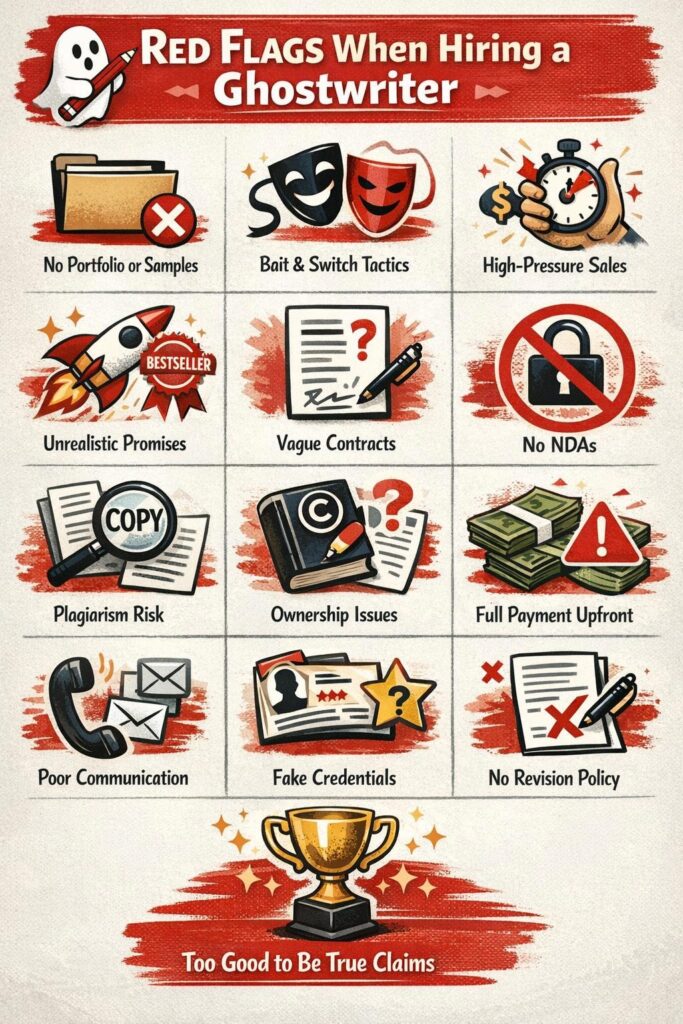
They Will Not Show Credible Samples
A professional ghostwriter should be able to demonstrate capability, even under NDA.
Red flags include no portfolio at all, samples that wildly vary in quality, or work that does not resemble your genre in tone or structure. Another warning sign is outright refusal to provide any proof of skill, even anonymized excerpts.
You are not asking for private client names. You are asking for evidence that the writer can actually do the work you are hiring them to do. If someone reacts defensively to that request, that reaction itself is information.
You Cannot Speak to the Actual Writer
If a salesperson handles everything and avoids introducing the writer who will be doing the work, slow down.
This is one of the most common bait and switch tactics. You buy based on one person’s experience, then discover after payment that someone else has been assigned. If you cannot ask process, timeline, and voice questions directly to the writer, you are taking an unnecessary risk.
A legitimate operation will welcome that conversation because it reduces misunderstandings later.
High Pressure Sales Tactics or Artificial Urgency
“Today only” pricing is a warning sign. So are countdowns, disappearing discounts, or sudden threats of losing your spot.
Legitimate professionals do not need to manufacture urgency. They rely on clarity and fit, not fear. Pressure is often used to move you past your instincts before they fully form.
Unrealistic Promises
Guaranteed bestsellers do not exist. Writing a full book in a weekend is not realistic. Error free drafts without editing are a myth.
When someone promises outcomes they cannot control, they are either inexperienced or deliberately misleading you. In both cases, you are being set up for disappointment.
Communication Problems From Day One
Pay attention to how things feel now, not how you hope they will improve later.
Slow replies, vague answers, missed calls, and messy intake processes often predict messy delivery. Professional book writing requires ongoing collaboration. If basic communication already feels strained, that friction will compound over months.
This is where a simple ghostwriter vetting checklist can save you. Not a complicated system. Just clear questions, written answers, and a willingness to walk away if something does not add up.
The goal is not to find perfection. It is to avoid preventable regret.
Contract and Rights Red Flags
This is where most people get burned. Not because the writing is bad, but because the paperwork is vague, rushed, or misunderstood. A friendly writer and a smooth sales process will not protect you if the contract leaves gaps.
You do not need a legal background to spot problems here. You just need to know what should be clearly spelled out.
Vague Scope of Work
If the contract does not define what is being delivered, you are agreeing to a moving target.
A solid scope includes an approved outline, chapter or section deadlines, draft lengths, and what counts as completion. Without this, disputes become subjective. One person thinks the project is done. The other thinks it has barely started.
This is one of the most overlooked red flags when hiring a ghostwriter because it feels technical, not emotional. But it directly affects cost, timeline, and quality.
No Clear Revision Policy
“Unlimited revisions” sounds generous, but it often creates frustration on both sides. The writer feels trapped. You feel hesitant to ask for changes.
On the other extreme, contracts that allow no revisions at all leave you exposed. A professional agreement defines how many rounds are included, what a revision means, and how feedback is handled.
Clarity here protects the relationship, not just the manuscript.
Missing Confidentiality or NDA Language
If your story, business data, or identity matters, confidentiality is not optional.
The contract should clearly state that your information, interviews, and materials will not be shared or reused. If this language is missing or brushed off as unnecessary, that is a serious concern.
Unclear Copyright and Ownership
You should understand exactly who owns the manuscript, drafts, and any research materials.
In most ghostwriting arrangements, ownership transfers to you upon payment. If rights remain with the writer or agency, or the language is vague, you could face problems publishing or reusing your own work later.
Risky Payment Terms
Be cautious of contracts that demand full payment upfront without milestones or deliverables.
Reasonable deposits are normal. What matters is that payments are tied to progress, invoices are clear, and refund or exit terms exist. If money flows one way with no accountability, you are taking on all the risk.
Contracts are not about mistrust. They are about alignment. A good agreement makes expectations visible and protects both sides before anything goes wrong.
Quality and Ethics Red Flags
Even when the process looks professional and the contract seems solid, quality and ethics still matter. This is the layer that protects your name long after the project is finished. If something feels off here, it is worth paying attention.
Plagiarism Risk and Patchwork Writing
One of the quietest risks in ghostwriting is plagiarism. Not always blatant copying, but patchwork writing pulled from articles, books, or online sources and stitched together.
This often shows up when drafts arrive unusually fast or feel oddly generic. Your work should sound specific to you, not like it could belong to anyone. To protect yourself, contracts should include representations and warranties that the work will be original and free of third party claims.
Ignoring this is one of the most expensive ghostwriter scam warnings because plagiarism rarely surfaces until your name is already attached.
Comfort With Ethically Risky Requests
Pay attention to what a writer is willing to do without hesitation.
If someone seems comfortable with academic cheating, contract cheating, or misrepresenting authorship in regulated environments, that is not flexibility. It is a signal that ethical boundaries are thin. You may not be asking for anything unethical, but their standards still matter because they reflect how they operate.
Unverifiable Famous Credits
Claims like “I wrote for a celebrity” or “I ghostwrote a bestseller” are common marketing lines. On their own, they mean nothing.
A legitimate professional can usually provide some form of corroboration. This might be publisher context, timeframes, or indirect proof that does not violate NDAs. When claims stay vague and defensive under basic questioning, take note. Your reputation is the final deliverable in any ghostwriting project. Protecting it requires paying attention not just to what a writer produces, but how they think about responsibility and risk.
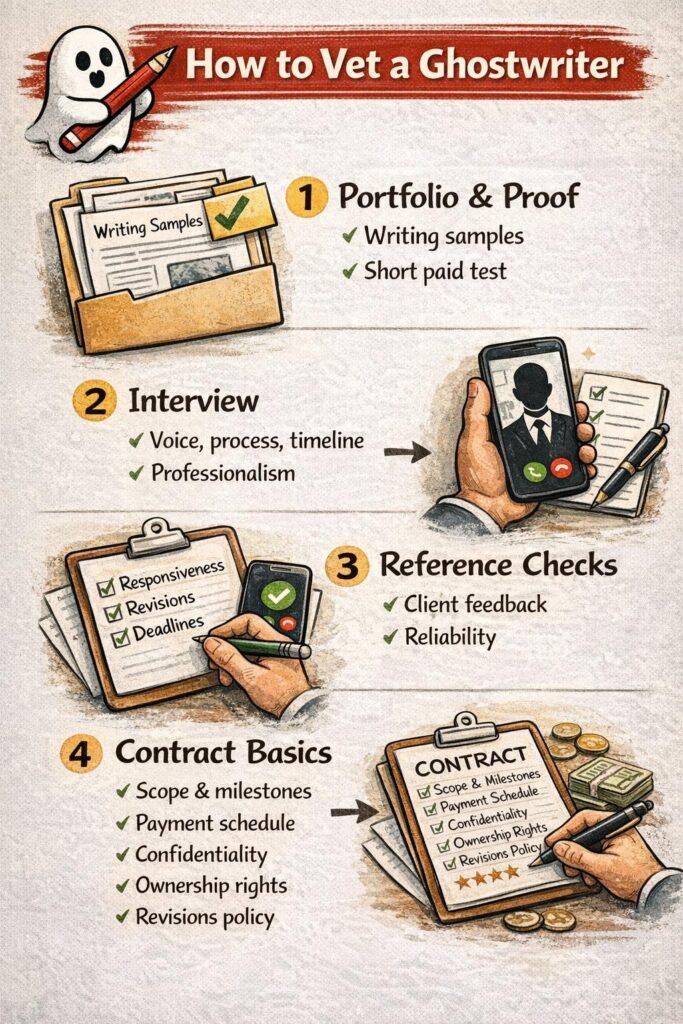
How to Vet a Ghostwriter: A Simple Due-Diligence Checklist
Vetting does not have to be complicated or adversarial. In fact, the best ghostwriters expect it. Clear questions protect both sides and surface issues early, before money and momentum make things awkward.
Think of this as a filter, not an interrogation.
Portfolio and Proof, the Right Way
Start with work, not promises.
Ask for samples that are relevant to your genre and goal. If NDAs are involved, anonymized excerpts are normal. What matters is consistency. You are looking for control of voice, structure, and clarity, not flashy prose.
In some cases, a short paid test can make sense. Not speculative free work, but a defined, compensated sample that shows how the writer thinks and collaborates.
Interview Questions That Reveal Professionalism Fast
How a writer answers questions often matters more than the answers themselves.
Ask process questions like how they capture voice, how interviews are run, and how feedback is handled. Ask logistics questions about timelines, availability, and what they need from you week to week. Ask risk questions about confidentiality, revisions, and ownership.
A professional will answer calmly and specifically. Vague or defensive responses are information.
Reference Checks and What to Listen For
If references are available, use them.
You are not looking for perfection. You are listening for patterns. Did deadlines hold? How were revisions handled? What happened when there was disagreement or friction? The way conflict was managed tells you more than praise ever will.
Contract Basics to Insist On
Before signing, make sure the essentials are clearly documented. You want a defined scope with milestones, a payment schedule tied to deliverables, confidentiality language, clear copyright ownership, and a reasonable revision policy. If any of these are missing or unclear, pause.
A simple ghostwriter vetting checklist is not about mistrust. It is about alignment. When expectations are visible, good relationships get easier and bad ones reveal themselves quickly.
What to Do If You Spot Red Flags Mid-Project
Not every issue appears at the beginning. Sometimes problems surface after momentum has already built and money has changed hands. By then, emotions are involved and walking away can feel heavier than it should.
Step Back Before You Escalate
Your first instinct may be to push harder or explain yourself more clearly. Resist that.
Take a brief pause to assess what is actually happening. Is the issue quality, communication, missed deadlines, or shifting expectations. Naming the problem accurately prevents unnecessary conflict and helps you choose the right response.
Document the Pattern, Not Just the Incident
One late draft is an inconvenience. Repeated delays are a pattern.
Write down what has occurred, when it occurred, and how it compares to what was agreed upon. This is not about building a case against the writer. It is about creating clarity for both sides and grounding the conversation in facts rather than frustration.
Renegotiate Scope and Milestones
Many mid project breakdowns come from scope drift. Revisit the original agreement and restate deliverables in plain language. Adjust timelines, chapter counts, or revision cycles if needed. A reset can sometimes salvage a relationship that is strained but still workable.
If you notice red flags when hiring a ghostwriter during an active project, the goal is not to react emotionally. The goal is to regain control of the process.
Use the Kill Fee or Exit Clause Intentionally
Exit clauses exist for a reason.
A kill fee allows you to end the project while compensating the writer fairly for completed work. Using it early is often cheaper and cleaner than dragging a project forward out of hope or guilt.
Secure Your Materials and Maintain Continuity
Before closing the loop, recover everything you paid for.
Request drafts, outlines, notes, recordings, and research files in an organized format. Confirm ownership in writing. This protects your ability to continue the project without starting over.
Decide Without Self Blame
Ending a project does not mean you failed at hiring. It means you recognized a risk and acted. That decision often saves more time, money, and energy than pushing forward despite growing doubt.
Red Flags vs Reality
Not everything that feels uncomfortable is actually a warning sign. Ghostwriting is an unusual industry, and many perfectly normal practices get mislabeled as risky simply because they are unfamiliar.
Knowing the difference protects you from walking away from good professionals for the wrong reasons.
No Public Bylines Is Not Automatically a Red Flag
Many legitimate ghostwriters cannot publicly claim their work.
Non disclosure agreements are standard in this field, especially for executives, founders, and public figures. A lack of visible bylines does not mean a lack of experience. What matters is whether the writer can still demonstrate skill through anonymized samples, process clarity, and references where possible.
Price Ranges Vary Widely for Real Reasons
There is no single “correct” price for ghostwriting.
Rates vary based on experience, genre, research depth, interview load, and turnaround time. A higher price is not proof of quality, and a lower price is not proof of a scam. Context matters. The real question is whether the scope, process, and protections match the cost.
Some people assume that if they hire professional book editors later, they can fix any writing issue cheaply. Editing can improve clarity and structure, but it cannot replace missing voice, original thinking, or ethical process.
Newer Writers Can Still Be Legitimate
Everyone starts somewhere.
A writer without decades of experience can still be a strong fit if their samples are solid, their process is clear, and their contract protects both sides. Experience reduces risk, but it is not the only signal of professionalism.
The goal is not to eliminate uncertainty completely. That is impossible. The goal is to understand what is normal, what is negotiable, and what is genuinely dangerous. When you have that clarity, fear loses its grip and good decisions become much easier to make.
FAQs
What Is the Number One Red Flag When Hiring a Ghostwriter?
The biggest red flag is vagueness. Vague answers, vague contracts, vague samples, vague timelines. When someone cannot or will not explain how the work gets done, how success is defined, or how risk is handled, you are operating in the dark. Clarity is the baseline for trust.
Should a Ghostwriter Always Provide Samples If They Are Under NDA?
Not always publicly, but they should provide something. Anonymized excerpts, genre relevant samples, or controlled proof of capability are standard. A blanket refusal to show any evidence of skill is not normal, even with strict NDAs.
Is It Normal to Pay a Deposit? How Much Is Reasonable?
Yes, deposits are normal. What matters is structure. A reasonable deposit is tied to milestones and followed by payments based on progress. Full payment upfront without strong proof, safeguards, or deliverables increases your risk significantly.
What Should a Ghostwriting Contract Include at Minimum?
At minimum, the contract should clearly define scope, milestones, payment terms, revision policy, confidentiality, and copyright ownership. If any of these are missing or unclear, pause before signing.
How Do I Know I Will Own the Rights to My Book?
The contract should explicitly state that copyright transfers to you upon payment. Do not assume this is automatic. If ownership language is vague or missing, ask for clarification in writing before moving forward.
How Many Revision Rounds Should Be Included?
There is no universal number, but there should be a defined number. Most professional agreements include two to three revision rounds per section or draft. Unlimited revisions often create tension, while zero revisions leave you exposed.
What Are Signs a Ghostwriting Agency Is Actually a Scam?
Common signs include pressure driven sales tactics, refusal to introduce the actual writer, inconsistent samples, and contracts that retain rights or avoid specifics. Legitimate agencies are transparent about process and accountability.
Can I Hire a Ghostwriter for a Memoir Without an Outline?
Yes. Many memoir projects begin with interviews rather than outlines. A professional ghostwriter will help you shape structure through discovery and conversation before drafting begins.
What Is a Fair Timeline for a Nonfiction Book?
Most nonfiction books take several months from discovery to final draft. Timelines depend on length, research, interview load, and revision depth. Promises that ignore these factors should be questioned.
What Should I Do If I Suspect Plagiarism in a Draft?
Pause the project immediately. Ask for an explanation, run plagiarism checks, and refer to the contract language around originality. If concerns are confirmed, protect your materials and consider exiting using the contract’s termination terms.
Good ghostwriting relationships are built on clarity, ethics, and communication. When those are present, the process feels grounded instead of risky.
Conclusion
Hiring a ghostwriter should feel clarifying, not disorienting. Yes, it is a creative partnership. Yes, it involves trust. But trust does not mean blind faith, and professionalism does not require secrecy or urgency.
Most problems do not start with bad writing. They start with skipped steps. Rushed decisions. Assumptions that no one pauses to check. When you understand what normal looks like, pressure loses its power.
Pay attention to how people answer questions, not just what they promise. Notice whether clarity increases over time or decreases. Watch how boundaries are handled. These signals matter more than charm, confidence, or flashy claims.
If you remember nothing else, remember this. Feeling uneasy is not the same as being negative. It is data. When something feels off, slow down and look for specifics. Most of the serious red flags when hiring a ghostwriter reveal themselves early, long before a manuscript exists.
The goal is not to avoid risk entirely. That is impossible. The goal is to make informed decisions that protect your work, your reputation, and your peace of mind. When you do that, hiring a ghostwriter stops feeling like a gamble and starts feeling like a strategic move.