Introduction
For many authors finishing a manuscript, the next question arrives quickly: where should the book actually be published? The conversation almost always turns into a comparison of publishing on Apple Books vs Amazon, two platforms that dominate the modern ebook ecosystem in very different ways. Amazon offers unmatched scale and built-in discoverability, while Apple Books emphasizes pricing flexibility and a tightly integrated device environment.
After reviewing hundreds of manuscripts and guiding authors through real publishing launches, one pattern becomes clear. Platform choice is rarely just about uploading a file. It influences royalties, reader reach, marketing visibility, and long-term distribution strategy. Some authors benefit from Amazon’s massive marketplace. Others discover that Apple’s storefront and international pricing control provide unexpected advantages.
Understanding how these platforms actually function in practice helps authors avoid common strategic mistakes and choose the publishing path that supports their book’s long-term success.
Apple Books vs Amazon KDP
Authors often assume Apple Books and Amazon KDP function as interchangeable storefronts. In reality, they operate inside very different publishing ecosystems. One is built around the world’s largest online bookstore, while the other is embedded in a tightly controlled device ecosystem used by hundreds of millions of Apple customers.
Understanding these differences early can prevent strategic confusion. In many publishing projects we review, authors choose a platform based on assumptions rather than how the systems actually function. Some believe Apple Books will provide the same discovery engine as Amazon. Others assume Amazon automatically guarantees visibility simply because it has the largest audience.
Neither assumption is entirely accurate. Each platform offers advantages depending on the author’s goals, pricing strategy, and long-term distribution plan.
How Amazon KDP and Apple Books Differ for Self-Publishing Authors
At the highest level, the platforms differ in their marketplace structure. Amazon KDP operates as part of the largest online retail ecosystem in the world, while Apple Books functions as a curated digital bookstore integrated directly into Apple devices. This difference shapes how readers discover books and how authors approach distribution strategies.
Apple Books vs Amazon KDP Marketplace Structure
Amazon behaves like a search-driven marketplace. Books are surfaced through ranking algorithms, reader behavior, keyword metadata, and advertising systems. Visibility often depends on how well a book performs within Amazon’s internal ecosystem.
Apple Books works differently. Discovery tends to rely more on editorial merchandising, curated collections, and device-based browsing rather than algorithm-driven rankings.
Key Platform Differences That Influence Publishing Strategy
Before analyzing royalties, marketing tools, or exclusivity programs, it helps to look at how the two platforms compare side by side.
Table 1: Apple Books vs Amazon KDP Comparison
| Feature | Amazon KDP | Apple Books |
| Audience reach | Largest ebook marketplace globally with millions of active readers | Smaller but highly engaged audience within the Apple device ecosystem |
| Ebook royalties | 35% or 70% depending on pricing, region, and delivery fees | Standard 70% royalty across most price ranges |
| Print support | Yes. KDP Print allows paperback and hardcover production | No native print-on-demand publishing |
| Exclusivity options | KDP Select offers promotional benefits but requires 90-day exclusivity | No exclusivity requirements |
| Delivery fees | Applied to books in the 70% royalty tier based on file size | No delivery fees deducted |
| Marketing tools | Amazon Ads, Kindle Unlimited, algorithm-driven rankings | Apple merchandising placements and curated storefront features |
| Upload process | Straightforward web dashboard with rapid publishing timeline | Requires Apple Books account approval and validation |
| Best suited for | Authors seeking maximum marketplace visibility and scale | Authors pursuing flexible pricing and wider retailer distribution |
Why Understanding These Differences Matters for Authors
Looking at the platforms side by side reveals an important reality experienced publishers recognize quickly. Amazon’s advantage lies in scale and algorithm-driven discovery. Apple Books, meanwhile, offers greater pricing flexibility and a retail environment that is less dependent on ranking mechanics.
In practice, most authors eventually discover that platform choice is not about which retailer is universally “better.” It is about how each platform fits into a broader publishing strategy, something that becomes clearer as we examine royalties, discoverability, and distribution decisions in the sections ahead.
Apple Books vs Amazon KDP for Self-Publishing
At first glance, Apple Books and Amazon KDP seem to promise the same thing: upload a manuscript and sell ebooks worldwide. In reality, they operate very differently. Amazon functions like a massive retail marketplace driven by algorithms and rankings, while Apple Books behaves more like a curated bookstore built into Apple’s device ecosystem.
How Apple Books Works for Self-Published Authors
Apple Books lives inside the Apple ecosystem, so readers usually browse through iPhones, iPads, or Macs. Discovery relies more on curated storefront placements than aggressive algorithms. The royalty structure is simple, roughly seventy percent on ebook sales with no delivery fees. The trade-off is that Apple Books focuses only on ebooks, so print editions require another platform.
How Amazon KDP Works for Independent Authors
Amazon KDP behaves more like a search engine for books. Titles appear through sales activity, keywords, and reader engagement. When a book gains traction, the algorithm often pushes it further through rankings and recommendations. Amazon also integrates print-on-demand through KDP Print, allowing authors to publish both ebooks and physical books in one system.
Can Authors Publish on Both Platforms?
Yes, unless the ebook is enrolled in KDP Select. That program requires ninety days of exclusivity with Amazon. Outside of that, many authors publish across both retailers to expand reach.
Apple Books vs Amazon Royalties
When authors compare platforms, the first question is predictable: Which one pays more?
The answer is usually less exciting than people hope. The percentages look attractive, but the real story lives in the fine print.
Apple Books Royalty Model
Apple keeps things simple. Most ebooks earn 70 percent, and there are no delivery fees quietly nibbling away at earnings. Pricing is also flexible, which can help nonfiction or higher-priced titles.
Amazon KDP Royalty Structure
Amazon runs two tiers: 35 percent and 70 percent. The higher rate only applies within a specific price range, usually $2.99 to $9.99. Step outside that window and the royalty drops.
There’s also the small detail of delivery fees, deducted from the 70 percent tier. For simple text books it’s minor. For image-heavy files, it can add up.
Table 2: Apple Books vs Amazon Royalty Comparison
| Factor | Amazon KDP | Apple Books |
| Ebook royalty rate | 35% or 70% depending on pricing | Standard 70% |
| Delivery fees | Deducted from 70% tier based on file size | No delivery fees |
| Pricing restrictions | 70% tier requires specific price range | Flexible pricing |
| Print royalties | Available through KDP Print | Not available |
| Payment timeline | About 60 days after sale | About 45 days after sale |
Which Platform Pays Authors More?
Apple Books offers a cleaner royalty model. Amazon offers something far larger: a marketplace capable of selling far more books.
In practice, the platform generating the most revenue usually isn’t determined by percentages alone. It’s determined by how many readers the platform can reach and how effectively a book is positioned within that ecosystem.
Apple Books vs Amazon Reach
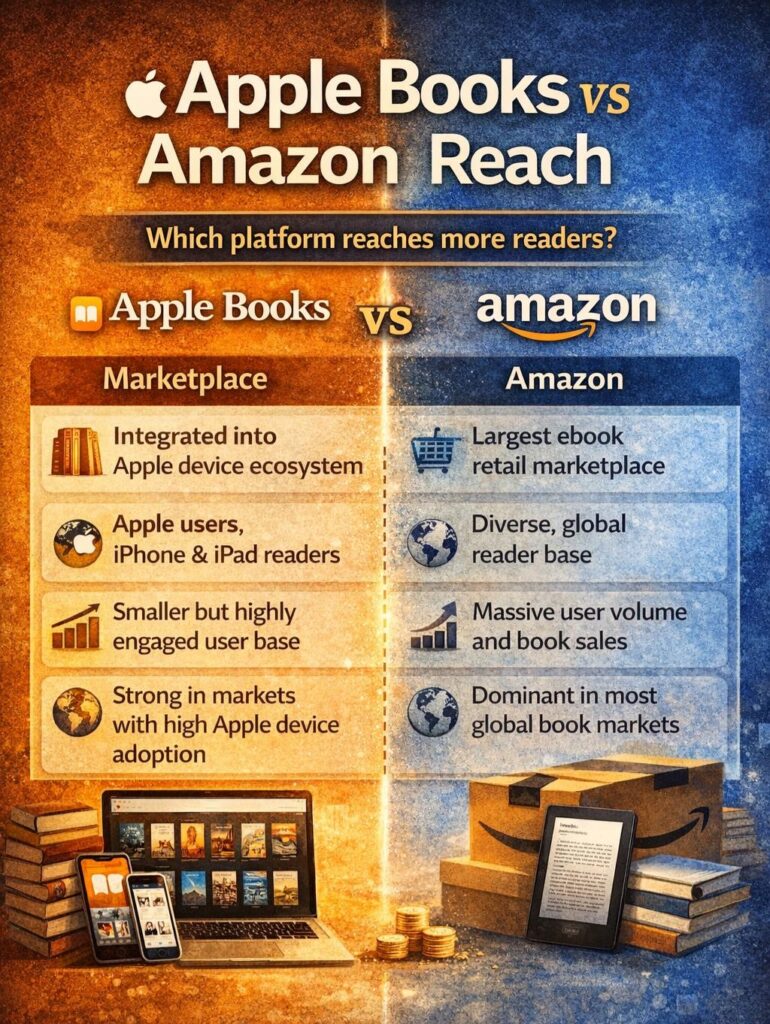
When authors evaluate publishing platforms, reach is usually the deciding factor. A platform might offer attractive royalties or flexible pricing, but none of that matters if the book never reaches readers. This is where the scale difference between Apple Books and Amazon becomes impossible to ignore.
In practical publishing terms, Amazon’s marketplace simply moves more books. The Kindle store has become the default destination for millions of readers searching for new titles across nearly every genre. For many independent authors, this environment effectively functions as the primary amazon publishing spot, where visibility and reader traffic are already concentrated.
Amazon’s Marketplace Dominance
Amazon’s real advantage is scale. Readers arrive every day already looking for books, and the Kindle store pushes titles through rankings, searches, and recommendations. When a book gains traction, the system tends to amplify it. That’s why many indie authors see their first real sales on Amazon, the platform quietly funnels readers toward books that are already moving.
Apple Books’ Device Ecosystem Audience
Apple Books works differently. Instead of a massive marketplace, it lives inside the Apple device ecosystem. Readers browse through iPhones, iPads, and Macs, creating a quieter, more controlled storefront. The audience is smaller but often highly engaged, and discovery leans more on curated placements than algorithm-driven chaos.
Global Distribution and International Readers
Both platforms reach international readers, just in different ways. Amazon expands through global Kindle stores, while Apple Books rides on the back of Apple’s worldwide device presence.
Which Platform Reaches More Readers?
Amazon still delivers the larger audience. That’s simply where most digital book buyers are. Experienced publishers, though, rarely treat reach as a one-platform decision. Apple Books often works best as a complement to Amazon, extending distribution rather than replacing it.
Publishing on Apple Books vs Amazon for Discoverability
Publishing a book and making it discoverable are two completely different things. Many authors assume that once a book appears in an online bookstore, readers will naturally find it. In reality, digital bookstores function more like enormous retail platforms where visibility depends on how the system surfaces titles to readers.
Amazon and Apple Books approach this problem in very different ways. One relies heavily on algorithm-driven discovery tied to sales activity. The other depends more on curated storefront placement and merchandising. Understanding how each platform exposes books to readers can make a significant difference in how authors plan their launch and promotion strategies.
Discoverability Comparison: Apple Books vs Amazon
Table 3: Discoverability Comparison for Apple Books vs Amazon
| Discoverability Factor | Amazon KDP | Apple Books |
| Discovery system | Algorithm-driven rankings | Editorial merchandising |
| Visibility triggers | Sales velocity, keywords, advertising | Curated placements and featured collections |
| Marketing tools | Amazon Ads, Kindle Unlimited | Apple Books promotional features |
| Category browsing | Extensive Kindle category ecosystem | Curated storefront categories |
| Launch momentum impact | Strong influence on rankings | Less dependent on rapid early sales |
How Amazon’s Algorithm Influences Book Discoverability
Amazon works less like a bookstore and more like a search engine that sells books. Visibility comes from signals such as sales activity, reader engagement, keywords, and category rankings.
When a book starts selling quickly, the algorithm assumes readers are interested and pushes it further into charts, recommendations, and “also bought” lists. That early momentum can make a huge difference. A book that catches traction often gets amplified. One that doesn’t… quietly sinks.
How Apple Books Uses Merchandising Instead
Apple Books plays a different game. Instead of chasing ranking signals, the platform leans heavily on curated storefront placements and themed collections.
Editors feature titles in category lists, seasonal promotions, and recommendation sections. When a book lands in one of those spots, it can gain visibility without needing the rapid sales spikes Amazon tends to reward.
The result is a calmer discovery system, less algorithm frenzy, more curated exposure.
Which Platform Is Easier to Market for Authors With an Audience?
Authors who already have readers, whether through newsletters, social media, or professional networks, can often direct their audience to either platform successfully. In these cases, discoverability depends less on algorithms and more on how effectively authors guide their readers to the book’s storefront.
Many authors eventually combine platform visibility with broader promotional strategies, including professional book marketing services, to expand their reach beyond a single retailer’s discovery system.
Why Discoverability Often Surprises First-Time Authors
A common question during publishing consultations is simple: which platform makes it easier for readers to find a book?
The honest answer is that discoverability rarely depends on the platform alone. Amazon amplifies books that gain traction through its algorithm, while Apple Books relies more on curated exposure within its device ecosystem.
In practice, visibility comes from positioning, promotion, and choosing the platform strategy that best fits the book’s audience.
Amazon as the Dominant Amazon Publishing Spot
Every few years someone confidently announces that Amazon’s dominance is about to collapse. Usually right before thousands of authors upload new books to Kindle the same week.
Reality tends to be less dramatic. For independent authors, Amazon is still the main amazon publishing spot where most digital books compete for attention. Not because the platform is perfect, but because that’s where the readers already are.
Why Many Self-Published Authors Start With Amazon
The explanation is not complicated. It’s traffic.
Millions of readers open the Kindle store every day looking for something to read. That behavior creates the one thing every author hopes for: an active marketplace.
When a book lands in a store full of readers, it at least has a chance of being discovered. When it lands somewhere quieter, the experience can feel like opening a bookstore on an empty street and politely waiting for customers who never arrive.
How Amazon’s Marketplace Drives Book Visibility
Amazon doesn’t really behave like a traditional bookstore. It behaves more like a search engine that sells books.
Titles appear through ranking signals: sales activity, reader engagement, keywords, and recommendations. When a book begins selling, the algorithm often pushes it further into category charts and recommendation feeds. In other words, the system rewards books that already look interesting to readers.
When Amazon’s Scale Becomes the Real Advantage
Amazon’s biggest advantage is simple scale. No other digital bookstore currently matches the number of readers browsing for books.
That doesn’t mean every title suddenly becomes a bestseller. Plenty of books still vanish quietly into the catalog. But when a book gains traction, Amazon has the ability to expose it to a far larger audience than most platforms can deliver.
KDP Select vs Wide Distribution
Many authors discover KDP Select the same way: they tick the enrollment box during upload and only later realize they just agreed to exclusivity.
KDP Select requires that the ebook remain exclusive to Amazon for ninety days. During that period, the book cannot appear on Apple Books or any other retailer. In exchange, Amazon offers access to Kindle Unlimited readers and promotional tools that can boost visibility inside the Kindle ecosystem.
What KDP Select Exclusivity Actually Means
Once enrolled, the ebook lives entirely inside Amazon’s ecosystem. Readers can borrow the book through Kindle Unlimited, and Amazon rewards titles that generate strong reading activity.
For certain genres, this can work surprisingly well.
When Amazon Exclusivity Works Best
Fast-moving fiction categories like romance, fantasy, and thrillers often perform well inside Kindle Unlimited because heavy readers consume multiple books each month. Series authors especially benefit when one book leads readers directly into the next.
When Wide Distribution Is the Smarter Strategy
Nonfiction authors usually approach the decision differently. Business books, guides, and professional titles often benefit from appearing across multiple retailers where readers browse different ecosystems.
Is Apple Books or Amazon Easier for First-Time Authors to Use?
Many first-time authors assume uploading a book is the complicated part of publishing. It isn’t. The real confusion usually begins after the upload screen, when categories, metadata, pricing, and formatting decisions start appearing.
In practical terms, Amazon tends to be easier for beginners. The dashboard is straightforward, the instructions are clear, and most authors can move from manuscript to published ebook in a single afternoon.
Table 4: Ease of use comparison for Apple Books vs Amazon
| Ease-of-Use Factor | Amazon KDP | Apple Books |
| Account setup | Fast self-service account | Requires Apple Books approval |
| Upload process | Simple dashboard workflow | Slightly more technical setup |
| File formats | Accepts DOC, EPUB, and Kindle formats | EPUB preferred |
| Print publishing | Built-in through KDP Print | Not supported |
| Learning curve | Beginner-friendly | Slightly steeper |
Amazon KDP Upload Process for Beginners
Amazon’s system is built for speed. Authors upload a file, choose categories, set pricing, and the book usually appears within a day.
Apple Books Publishing Setup Requirements
Apple Books is not difficult, but it is less forgiving for beginners. The platform prefers clean EPUB files and a properly configured publishing account.
Formatting and File Preparation Differences
Formatting mistakes are common during first releases. Many authors eventually turn to professional professionals once they realize that file formatting, metadata, and pricing decisions affect how the book performs after launch.
Which Platform Is Easier for First-Time Authors?
For most beginners, Amazon wins on simplicity. Apple Books becomes easier once authors gain some publishing experience.
Apple Books vs Amazon Publishing Strategy by Book Type
Choosing a platform is rarely just about royalties or ease of use. In practice, the type of book often determines where it performs best. After reviewing hundreds of launches, patterns start to appear quickly.
Fiction and Series Authors
Amazon tends to favor fast-moving fiction. Genre readers live inside the Kindle store, and series titles benefit from Amazon’s recommendation engine pushing readers from one book to the next.
Nonfiction and Professional Books
Nonfiction authors sometimes benefit from wider distribution. Business guides, professional books, and specialized topics often reach readers across multiple platforms rather than a single retailer.
Illustrated and Design-Heavy Books
Apple Books can perform well for visually rich ebooks. The platform handles formatting cleanly and avoids the delivery fees that sometimes affect large files on other platforms.
Print-Focused Titles
If print matters, Amazon still has the advantage. KDP Print allows paperback and hardcover editions to launch from the same system as the ebook.
Apple Books vs Amazon by Author Goals
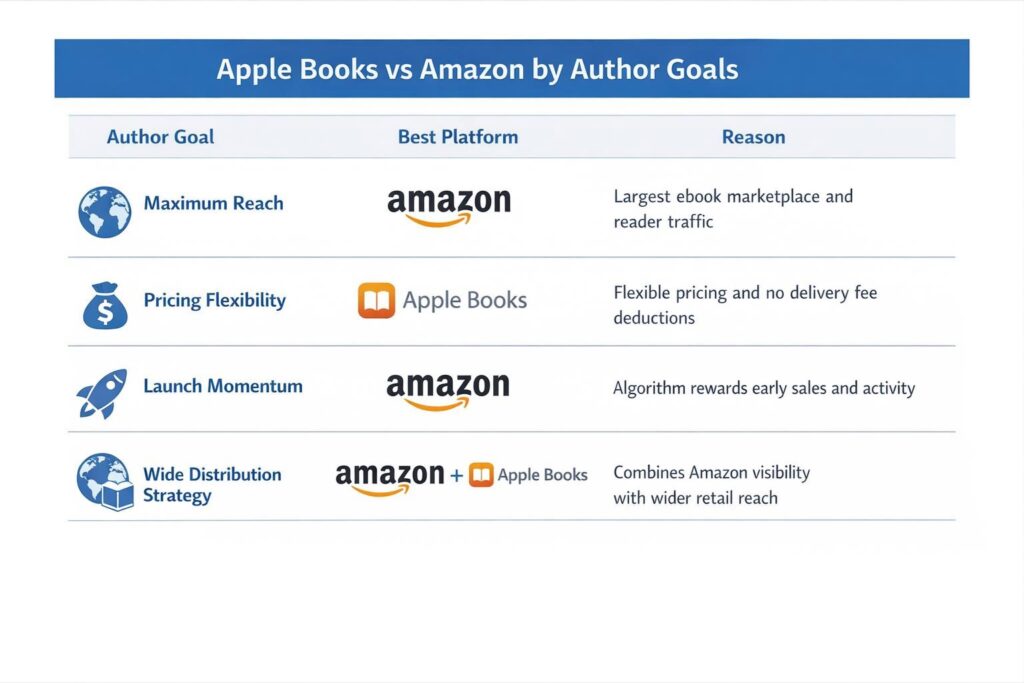
Authors often approach platform decisions as if there’s one universally correct answer. There isn’t. The better question is usually: what is the book trying to achieve?
Different goals tend to point toward different platforms.
Best Platform for Maximum Reach
If the goal is simply reaching the largest number of readers quickly, Amazon usually wins. The Kindle store still attracts the biggest pool of active ebook buyers.
Best Platform for Pricing Flexibility
Apple Books allows more freedom with pricing. Authors who want to experiment with higher price points or international pricing sometimes find the platform easier to manage.
Best Platform for Launch Momentum
Amazon’s algorithm rewards activity. A book that gains early sales and reviews can climb category rankings and suddenly become visible to far more readers.
Best Platform for Wide Distribution
Authors thinking long term often use both platforms. Amazon provides momentum, while Apple Books helps expand reach beyond a single ecosystem.
When Authors Turn to Amazon Book Publishing Services
Most authors discover something interesting about self-publishing around the same time: uploading the manuscript is the easy part. Everything that happens after that is where things get messy.
Formatting issues, category mistakes, pricing confusion, weak covers, and poorly timed launches quietly sabotage many first releases. The platform works exactly as designed. The book simply isn’t positioned correctly.
Why Authors Use Amazon Book Publishing Services
This is where professional Amazon Book Publishing Services often enter the picture. Not because the upload process is impossible, but because successful publishing involves dozens of small decisions most new authors never see coming.
Common Self-Publishing Mistakes First-Time Authors Make
Incorrect categories, weak metadata, and poorly formatted files are some of the most common issues editors see during early publishing attempts. These small details can determine whether a book becomes visible or disappears quietly into the catalog.
How Professional Publishing Teams Improve Book Launches
Experienced teams handle the technical details authors usually underestimate: preparing clean files, positioning books within the right categories, structuring pricing, and planning a launch that actually gives the book a chance to gain traction.
Uploading a book is simple. Launching it strategically is where publishing becomes a craft.
Direct Publishing vs Using a Distributor?
Sooner or later most authors run into another publishing decision that sounds technical but is really strategic: publish directly to retailers or let a distributor handle it.
Both approaches work. The difference usually comes down to how much control an author wants versus how much complexity they’re willing to manage.
Publishing Directly to Apple Books
Publishing directly to Apple Books gives authors full control over pricing, metadata, and promotions. The trade-off is that setup can feel slightly more technical, particularly for authors unfamiliar with EPUB formatting and Apple’s publishing portal.
Publishing Directly Through Amazon KDP
Amazon KDP is designed for direct publishing. The dashboard is straightforward, updates are immediate, and authors maintain full control over categories, pricing, and advertising tools.
When Draft2Digital or Other Aggregators Make Sense
Aggregators like Draft2Digital simplify distribution by pushing a book to multiple retailers at once. Instead of managing several dashboards, authors work from a single platform.
Convenience increases. Control decreases slightly.
Table 5: Direct Publishing vs Distributor
| Feature | Direct Publishing | Aggregator |
| Control | Full control over pricing and metadata | Some control handled by distributor |
| Reporting | Separate dashboards for each retailer | One unified reporting dashboard |
| Payment simplicity | Multiple retailer payments | One consolidated payment |
| Metadata flexibility | Maximum flexibility | Limited adjustments |
| Speed | Changes appear quickly | Updates may take longer |
| Ideal user | Authors comfortable managing platforms | Authors who prefer simplicity |
Apple Books vs Amazon Pros and Cons for Self-Publishing Authors
Every platform looks great in marketing pages. The real differences appear once a book actually enters the marketplace.
Amazon offers the largest audience and the strongest discovery engine. Apple Books offers simpler royalties and a cleaner publishing environment. Each platform solves a different problem for authors.
The decision usually comes down to whether an author prioritizes reach or flexibility.
Apple Books vs Amazon Platform Comparison
Table 6: Apple Books vs Amazon Platform
| Factor | Amazon KDP | Apple Books |
| Audience size | Largest ebook marketplace | Smaller but engaged reader base |
| Discoverability | Algorithm-driven rankings and recommendations | Curated storefront placements |
| Royalty structure | 35% or 70% depending on pricing and delivery fees | Standard 70% with no delivery deductions |
| Print publishing | Paperback and hardcover through KDP Print | Ebook only |
| Pricing flexibility | Limited range for 70% royalty tier | Greater pricing flexibility |
| Competition level | Extremely competitive marketplace | Less crowded storefront |
In simple terms, Amazon offers scale and discovery, while Apple Books offers simplicity and pricing freedom. Most experienced publishing teams eventually use both rather than treating them as rivals.
Why Many Authors Eventually Search for the Best Self Publishing Company
Most authors begin publishing convinced they can handle everything themselves. And technically they can. Modern platforms make uploading a book look almost effortless.
The complication appears later when the book enters a marketplace full of professionally produced titles.
The Hidden Complexity Behind Professional Book Publishing
Writing the manuscript is only one part of the process. Successful books require careful editing, clean formatting, strong cover design, and precise metadata. Miss one of these details and the book may still publish. It simply will not compete very well.
Editing, Design, and Production Standards That Shape Competitive Books
Readers may not consciously analyze editing quality or typography, but they notice when something feels off. Professional publishing standards exist for a reason. They help books look credible beside competing titles already occupying the same category.
When Professional Publishing Support Becomes Necessary
This is usually when authors begin searching for the best self publishing company to guide the process. Not because publishing platforms are difficult to use, but because releasing a competitive book requires more coordination than most first-time authors expect.
At that stage publishing stops feeling like a simple upload process and starts looking more like a professional production project.
Which Platform Should You Choose for Self-Publishing Success?
By this point many authors hope for a simple answer. Pick one platform, publish the book, and watch the readers arrive.
Publishing rarely works that neatly. The better choice usually depends on the author’s experience level and the long-term strategy behind the book.
Best Platform for First-Time Authors
For most new authors, Amazon is the easier starting point. The platform has the largest reader base and a straightforward publishing dashboard. That combination makes it easier for beginners to launch a book and observe how the marketplace behaves.
Best Platform for Experienced Indie Authors
Experienced independent authors often expand beyond a single retailer. Once a book has momentum on Amazon, distributing to additional platforms such as Apple Books can broaden reach and stabilize long-term sales.
Best Platform for Authors Building a Wide Publishing Strategy
Authors focused on long-term publishing strategy often treat platforms as complementary rather than competitive. Amazon provides strong discovery potential, while Apple Books expands distribution into a different reader ecosystem.
Table 7: Best Platform by Author Scenario
| Author Type | Best Platform |
| First-time novelist | Amazon KDP |
| Nonfiction expert | Amazon + Apple Books |
| Series author | Amazon KDP |
| Children’s / illustrated book | Apple Books |
| Print-focused author | Amazon KDP |
| Author with email list | Amazon + Apple Books |
| Author with no audience | Amazon KDP |
Frequently Asked Questions About Publishing On Apple Books vs Amazon
Authors comparing platforms often return to the same practical questions. The answers are usually less dramatic than online debates suggest.
Can I Publish My Ebook on Apple Books and Amazon at the Same Time?
Yes. Authors can publish on both platforms simultaneously. The only exception is Amazon’s KDP Select program. Books enrolled in KDP Select must remain exclusive to Amazon for a ninety-day period.
Does Apple Books Pay More Than Amazon?
Not necessarily. Apple Books offers a consistent seventy percent royalty without delivery fees. Amazon offers similar royalties within a specific pricing range but deducts delivery costs based on file size. Actual earnings depend more on pricing strategy and sales volume.
Is Apple Books Better Than Kindle Unlimited?
They serve different purposes. Kindle Unlimited works well for fast-moving fiction and series because readers consume large numbers of books through the subscription model. Apple Books operates as a traditional retail store rather than a reading subscription.
Can Authors Sell Print Books Through Apple Books?
No. Apple Books focuses exclusively on digital ebooks. Authors who want paperback or hardcover editions typically publish print versions through platforms such as Amazon KDP Print.
Should New Authors Start With Amazon and Expand Later?
Many publishing teams recommend starting with Amazon because of its large reader base. Once the book gains traction, expanding to additional retailers like Apple Books can broaden distribution.
Conclusion
The debate around publishing on Apple Books vs Amazon often sounds like a contest where one platform must win. In practice, experienced publishing teams rarely treat the decision that way.
Amazon offers the largest marketplace and strong discovery potential. Apple Books provides flexible pricing and a simpler royalty structure. Each platform serves a different role depending on the book and the author’s goals.
Many writers eventually realize that publishing success involves more than uploading a manuscript. Editing quality, professional cover design, positioning, and launch strategy all influence whether a book gains visibility. For authors who want guidance through that process, the publishing strategists at Writers of the West help authors develop competitive manuscripts and structured release strategies designed to reach the right readers.