Introduction: How to Assess Manuscript Readiness Before Hiring Developmental Editing Services
Most writers start looking for developmental editing services at the wrong time.
Some arrive with a half-built manuscript and hope structure will magically assemble itself. Others come after querying agents, receiving vague rejections, and realizing too late that the issue was not grammar but architecture.
After years inside publishing workflows, across agented submissions, independent Amazon launches, and full-scale ghostwriting projects, I can tell you this with certainty: structure is what determines whether a manuscript survives professional scrutiny.
Not voice. Not clever phrasing. Not even concept alone.
Structure.
When authors invest in a professional structural manuscript evaluation, what they are really paying for is a strategic assessment of narrative logic, pacing, positioning, and reader expectation. They are asking whether the manuscript can compete in its category.
In-house editors do this instinctively. They read for escalation, coherence, emotional payoff, and market clarity. If the manuscript fails those tests, it never moves forward.
This guide will show you how to assess readiness with the same lens professional editors use every day.
What Is Developmental Editing?
Developmental editing services evaluate narrative structure, pacing, character arcs, and market positioning before line-level refinement begins.
What Developmental Editing Includes and How It Differs From a Manuscript Critique
Most writers misunderstand what they are buying.
They assume structural editing means “make my book better.” That is vague. In professional publishing, vague is expensive.
Big-picture manuscript editing focuses on architecture. Not grammar. Not commas. Not surface polish. Structure.
When I review a manuscript at this level, I am not scanning for typos. I am evaluating stability. I am asking questions that determine whether the book can withstand agent scrutiny, editorial board review, or market competition.
- Does the narrative escalate logically?
- Is the protagonist forced into irreversible decisions?
- Does each act shift stakes meaningfully?
- Is there tension embedded in the structure, not just in the prose?
- Does the ending feel inevitable rather than convenient?
If those elements are unstable, sentence-level refinement is irrelevant.
Writers often confuse this process with a manuscript critique or a structural manuscript assessment. They are not interchangeable services, and misunderstanding the difference leads to wasted budget and stalled progress.
Let’s break this down the way an acquiring editor would inside a publishing house.
How Developmental Editing Differs From a Manuscript Critique
A manuscript critique is diagnostic. It provides professional distance and strategic commentary.
It typically includes:
- A broad evaluation of strengths and weaknesses
- Observations about pacing and clarity
- Commentary on character depth or thematic cohesion
- General revision direction
What it does not include in most cases:
- Scene-by-scene restructuring
- Detailed revision mapping
- Comprehensive margin annotations
- A prioritized reconstruction plan
A critique tells you what is wrong.
Full-scale manuscript development tells you how to fix it.
There is a meaningful difference between “your middle sags” and “chapters 9 through 14 repeat emotional beats without escalation; combine 10 and 11, raise stakes at midpoint, and remove subplot B.”
That difference is where professional value lives.
How a Story Structure Analysis Fits Into the Editorial Process
A structure analysis is narrower in scope but powerful when the core framework feels unstable.
It focuses on:
- Inciting incident timing
- Midpoint transformation
- Escalation pattern
- Climax logic
- Resolution integrity
This type of review isolates mechanical breakdowns in narrative architecture.
It is particularly useful in genre fiction and memoir where pacing drives reader retention.
Quick Comparison: Choosing the Right Level of Structural Review
| Editorial Service | Scope | Depth | Best Timing | Primary Outcome |
| Developmental Editing | Full manuscript architecture, pacing, positioning | Deep editorial letter plus annotated guidance | After draft is complete | Strategic reconstruction plan |
| Manuscript Critique | High-level strengths and weaknesses | Summary report | Early or unstable draft | Directional clarity |
| Story Structure Analysis | Plot framework and escalation logic | Focused architectural diagnostics | When pacing feels broken | Structural correction |
| Line Editing | Sentence clarity and style | Line-by-line refinement | After structure is stable | Prose polish |
Notice the order.
Structure first. Language later.
In professional publishing workflows, reversing that order creates compounding inefficiencies. I have seen authors invest heavily in stylistic refinement only to remove entire chapters during structural revision.
That is not progress. That is rework.
This is also why writers researching broader professional book editing services often struggle to identify what they actually need. Editing is not a single service. It is a sequence.
Understanding that sequence is the difference between polishing and publishing.
How to Know If Your Manuscript Is Structurally Ready for Professional Editorial Review
Most writers do not struggle with effort. They struggle with timing.
They revise sentences when they should be rebuilding structure.
They query agents when the midpoint still collapses.
They publish independently before testing escalation logic.
Structural readiness is not about polish. It is about stability.
Before investing in professional editorial review, you need evidence that the manuscript can withstand scrutiny at the architectural level.
Below is the same framework I use when assessing whether a project is ready to move forward.
How to Confirm Your Draft Is Complete and Structurally Stable
A manuscript is not ready for structural evaluation if it is still evolving.
You must be able to answer yes to these questions:
- Is the draft fully written from beginning to end?
- Is the ending stable, even if imperfect?
- Are you no longer rewriting major plot decisions weekly?
- Does the core premise remain consistent throughout?
If the foundation is still shifting, any structural assessment will be premature.
Professional review assumes stability. It does not create it.
How to Evaluate Story Escalation and Midpoint Strength
The midpoint is where most manuscripts fail.
Writers often confuse activity with escalation. Events happen, but stakes do not increase.
Ask yourself:
- Does something irreversible occur at the midpoint?
- Are consequences higher after that moment than before?
- Does the protagonist face a more difficult choice in Act Two than in Act One?
If tension plateaus, readers disengage. This is particularly visible in commercial publishing and Amazon reader behavior, where sample retention drops when escalation stalls.
Structural readiness requires narrative pressure.
How to Assess Character Arc and Emotional Movement
A structurally sound manuscript forces change.
Look at your protagonist objectively:
- Are they fundamentally altered by events?
- Does their belief system shift?
- Is their final decision different from what they would have chosen in Chapter One?
Static protagonists create flat narratives.
Even in plot-driven genres, emotional progression must exist. Structural integrity includes psychological movement.
How to Identify Structural Red Flags Before Hiring an Editor
Writers often sense something is wrong but cannot articulate it.
These are the most common red flags I see across submissions:
| Readiness Indicator | What It Signals | If Missing |
| Complete draft | Structure can be evaluated | Finish manuscript first |
| Clear midpoint shift | Escalation exists | Rework stakes |
| Defined audience | Market alignment present | Clarify positioning |
| Cohesive ending | Arc resolution intact | Strengthen final act |
| Consistent theme | Narrative focus maintained | Remove episodic drift |
If multiple areas in this table feel unstable, the manuscript likely requires structural revision before deeper editorial engagement.
This is also where some authors begin with a professional manuscript evaluation to determine the appropriate level of intervention.
Clarity at this stage prevents unnecessary expense.
How to Decide If You Need Structural Revision or Pre-Submission Editing
There is a meaningful difference between a manuscript that is unfinished and one that is structurally complete but strategically unpolished.
If you are preparing to query agents, pre-submission editing becomes relevant. This phase ensures:
- Opening chapters establish immediate stakes
- Genre expectations are unmistakable
- Positioning aligns with comparable titles
- The narrative begins with momentum
However, pre-submission work assumes that architecture is already sound.
If structural instability remains, tightening will not solve the problem.
Agents do not reject manuscripts because sentences are imperfect. They reject them because pacing collapses, stakes diffuse, or positioning is unclear.
Knowing which problem you have is the difference between revision and refinement.
How to Measure Emotional and Narrative Momentum Objectively
Momentum is measurable.
Review your manuscript chapter by chapter:
- Does each chapter increase risk, tension, or consequence?
- Are scenes performing multiple functions or repeating emotional beats?
- Does conflict intensify toward the final act?
Repetition without escalation is the most common structural weakness I encounter.
Writers often protect scenes because they are well written. Professional editors protect momentum.
If you can track rising tension across the manuscript, you are closer to structural readiness than most.
How to Recognize When You Are Personally Ready for Developmental Editing
There is a practical dimension to readiness that few discuss.
Are you prepared to:
- Cut chapters you love?
- Combine characters?
- Shift narrative focus?
- Rebuild the final act?
Developmental editing is not validation. It is recalibration.
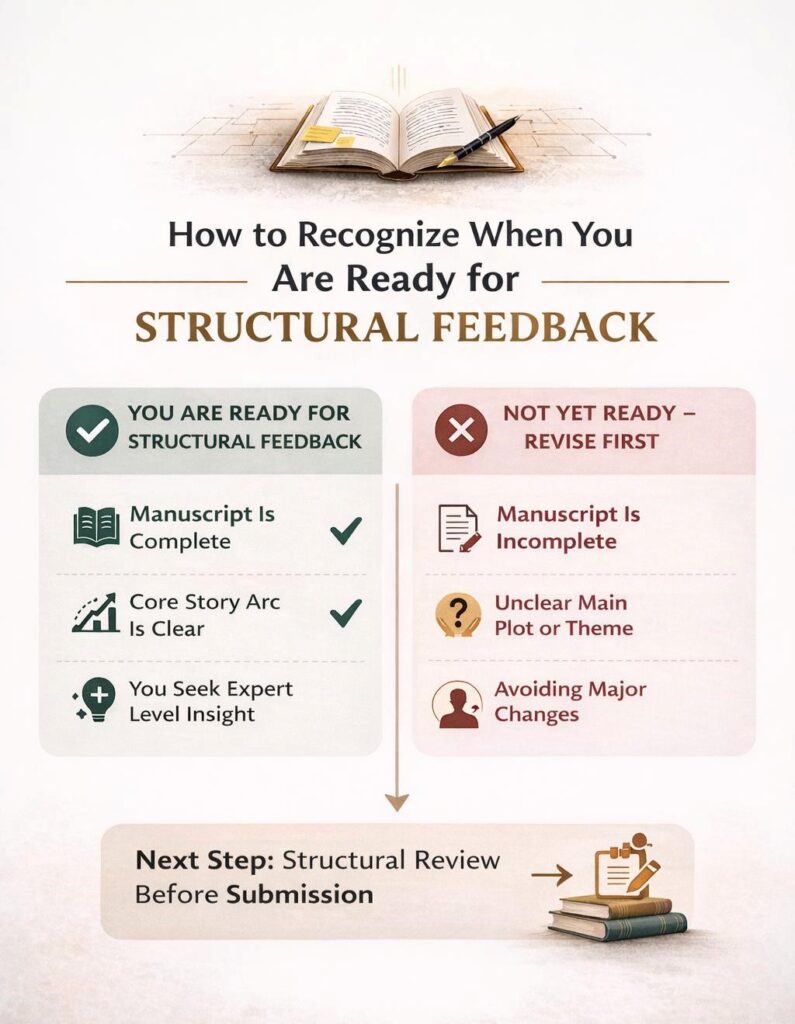
If you are still emotionally attached to every scene, you may resist the level of change required for meaningful improvement. Professional review demands objectivity from both sides.
Structural readiness is not about perfection. It is about durability. If your manuscript can withstand these questions without collapsing under scrutiny, it may be ready for professional structural review.
If it cannot, that is not failure. It is simply the next stage of development.
Understanding where you stand is the most strategic decision you can make before moving forward.
How Developmental Editing Fits Into the Full Publishing Workflow
Writers often treat editing as a single event.
In professional publishing, it is a sequence.
Developmental editing sits at the top of that sequence because it determines whether the manuscript is fundamentally viable. Every other editorial stage depends on its stability.
When authors bypass structural work and move directly to sentence-level refinement, they create rework. Entire chapters get removed after line editing. Subplots collapse. Endings are rewritten from scratch.
That is not efficiency. That is misordered process.
Understanding where structural editing fits protects both your time and your budget.
Developmental Editing vs Line Editing: Why Structure Must Come First
Line editing refines expression. Copy editing corrects technical error. Proofreading cleans residue.
None of those services fix narrative architecture.
If escalation is weak, sentence polish cannot compensate. If the midpoint fails, better adjectives do not rescue it. If the protagonist does not change, grammar will not create transformation.
In publishing houses, manuscripts that require structural rebuilding do not move to copyediting. They return to the author with editorial notes.
The hierarchy is deliberate.
Structure first. Style second.
How Traditional Publishers Evaluate Manuscript Structure Before Acceptance
Inside traditional publishing, structural evaluation happens early and quickly.
Editors look for:
- Clear narrative direction within the first 10 to 20 pages
- Escalation by the midpoint
- Emotional or intellectual payoff by the final act
- Consistent thematic throughline
Manuscripts that drift structurally are filtered out long before grammar becomes a discussion. Independent authors often underestimate this stage because they never see the internal rejection process.
But the market still performs that evaluation.
Readers abandon books for structural reasons, not typographical ones.
Why Structural Weakness Hurts More in Amazon Publishing Than Traditional Submissions
On retail platforms, readers preview before purchase. If pacing stalls in the opening chapters, conversion drops. If the inciting incident arrives too late, engagement declines. If the stakes are unclear, reviews mention confusion.
Unlike traditional submissions, there is no editorial buffer. Structural instability becomes public immediately.
That is why authors exploring broader editing services often misunderstand the order of operations. They assume any editing improves the book.
In reality, structural clarity is what determines whether subsequent refinement has impact.
When Does Developmental Editing Happen in the Professional Publishing Process?
Here is the correct order of professional manuscript development:
| Stage | Primary Focus | When It Occurs |
| Developmental Editing | Architecture, pacing, positioning | After full draft completion |
| Major Revision | Author rewrites based on structural notes | Immediately after structural review |
| Line Editing | Clarity, rhythm, sentence refinement | After structure stabilizes |
| Copy Editing | Grammar, consistency, technical accuracy | After prose is locked |
| Proofreading | Final surface corrections | Before publication |
Skipping steps weakens outcomes.
Reordering steps increases cost.
Writers who respect the hierarchy produce stronger manuscripts with fewer revision cycles.
Developmental editing is not an accessory to publishing. It is the foundation beneath it. Once structure is stable, every subsequent stage becomes efficient and purposeful. When structure is unstable, everything after it becomes temporary.
Understanding this sequence prepares you for the next decision: whether your manuscript is strong enough to move forward toward submission or publication.
How to Avoid Structural Mistakes Before Querying Agents or Self-Publishing
Writers rarely lose momentum because of weak prose.
They lose it because of structural missteps made too early in the publishing process.
Querying agents before the manuscript is stable.
Uploading to Amazon before escalation is tested.
Investing in copyediting before architectural flaws are corrected.
These mistakes are not cosmetic. They are strategic.
Understanding where authors miscalculate protects your manuscript from premature exposure.
Structural Errors That Lead to Agent Rejection
Agents read quickly. Not carelessly, but efficiently.
They look for:
- Immediate narrative direction
- Escalating stakes
- A clear genre promise
- A controlled midpoint
- A satisfying final act
If the inciting incident arrives late, the manuscript feels slow.
If stakes remain flat through Act Two, the manuscript feels repetitive.
If the ending resolves too easily, the manuscript feels unearned.
Recently, we reviewed a 92,000-word thriller where the inciting incident did not occur until Chapter 8. The opening chapters were well written, but they functioned as backstory rather than escalation. After restructuring the opening and moving the catalytic event forward, reader engagement improved dramatically during beta testing. Nothing about the prose changed. The structure did.
Rejection letters rarely explain structural breakdown in detail. They use phrases like “not the right fit” or “didn’t connect.”
In most cases, the issue is pacing, positioning, or escalation.
Those are structural failures.
Why Early Self-Publishing Locks in Weak Structure
Independent authors face a different risk.
On retail platforms, structural weakness becomes public immediately.
If early chapters lack momentum, readers do not finish the preview.
If character arcs feel static, reviews mention flatness.
If subplots drift without resolution, credibility drops.
Unlike traditional publishing, there is no editorial gatekeeper filtering structural issues before release.
Once reviews accumulate around pacing or confusion, recovery becomes difficult.
Publishing too early does not save time. It multiplies revision later.
When Pre-Submission Editing Becomes Necessary
There is a difference between structural instability and strategic refinement.
If your manuscript is architecturally sound but you are preparing to query, pre-submission editing becomes relevant.
This stage focuses on:
- Strengthening the opening chapters
- Tightening narrative drive
- Clarifying positioning
- Ensuring escalation begins early
It does not rebuild structure. It sharpens it.
Authors often confuse this stage with foundational revision. If core pacing problems remain, tightening will not compensate.
You cannot polish instability into strength.
The Cost of Moving Forward Too Soon
In professional publishing workflows, developmental missteps create compounding consequences:
- Agents pass on projects that could have been salvaged
- Amazon launches stall due to poor retention
- Editorial budgets increase because chapters require removal after polish
- Author confidence declines after public feedback
The strongest manuscripts I see were not rushed. They were stabilized before exposure.
Structural patience is not hesitation. It is strategy.
What Professional Developmental Editing Includes in a Manuscript Review
Writers often imagine developmental editing as vague commentary.
It is not.
Professional developmental editing is specific, organized, and actionable. It does not say “the pacing feels slow.” It identifies where escalation stalls, why it stalls, and how to correct it.
When done properly, it transforms confusion into a revision plan.
What an Editorial Letter Covers in Developmental Editing
The editorial letter is the core deliverable in developmental editing.
It typically addresses:
- Narrative arc and escalation
- Character transformation and motivation
- Midpoint strength
- Climax effectiveness
- Thematic cohesion
- Market positioning
A strong editorial letter does not overwhelm with theory. It prioritizes issues in order of structural impact.
First foundation. Then reinforcement.
Authors often say the most valuable part is clarity. Once the architecture is mapped, revision becomes deliberate rather than reactive.
How Developmental Editing Evaluates Story Structure and Escalation
Developmental editing isolates mechanical weaknesses in plot construction while also addressing broader positioning.
This includes:
- Inciting incident timing
- Act break alignment
- Midpoint transformation
- Escalation pattern
- Resolution payoff
Instead of general comments, professional feedback pinpoints:
- Which chapters diffuse tension
- Where stakes plateau
- Which subplots distract from the central arc
- Where character motivation weakens narrative drive
This level of precision prevents cosmetic revision.
Developmental editing is architectural, not decorative.
What Margin Notes and Scene-Level Feedback Reveal
Beyond the editorial letter, developmental editing often includes targeted margin commentary.
These notes highlight:
- Repetitive emotional beats
- Redundant exposition
- Scenes that do not advance the plot
- Dialogue that delays escalation
When authors see patterns repeated across chapters, structural gaps become visible.
Revision shifts from guesswork to strategy.
How a Developmental Editing Revision Plan Is Built
Professional developmental editing does not stop at diagnosis.
It produces a roadmap.
A revision plan may include:
| Revision Priority | Structural Focus | Intended Outcome |
| Rework midpoint | Increase irreversible stakes | Stronger narrative escalation |
| Combine subplots | Remove distraction | Tighter pacing |
| Clarify protagonist goal | Strengthen motivation | Clearer emotional arc |
| Restructure opening | Accelerate inciting incident | Higher reader engagement |
This roadmap ensures that authors revise in the correct order.
Rewriting randomly wastes energy.
Rebuilding strategically produces measurable improvement.
What Developmental Editing Does Not Do
It does not:
- Polish grammar
- Correct commas
- Rewrite every sentence
- Replace the author’s voice
Its function is clarity and structural alignment.
Once developmental editing stabilizes the manuscript, every later editorial stage becomes more efficient.
Without structural clarity, refinement remains temporary.
How to Decide If You Need Developmental Editing Services Before Publication
By this stage, the question is no longer theoretical.
You understand structural hierarchy.
You understand agent expectations.
You understand the cost of premature publishing.
Now the decision becomes practical.
Do you need professional intervention, or can you revise independently?
Here is the distinction.
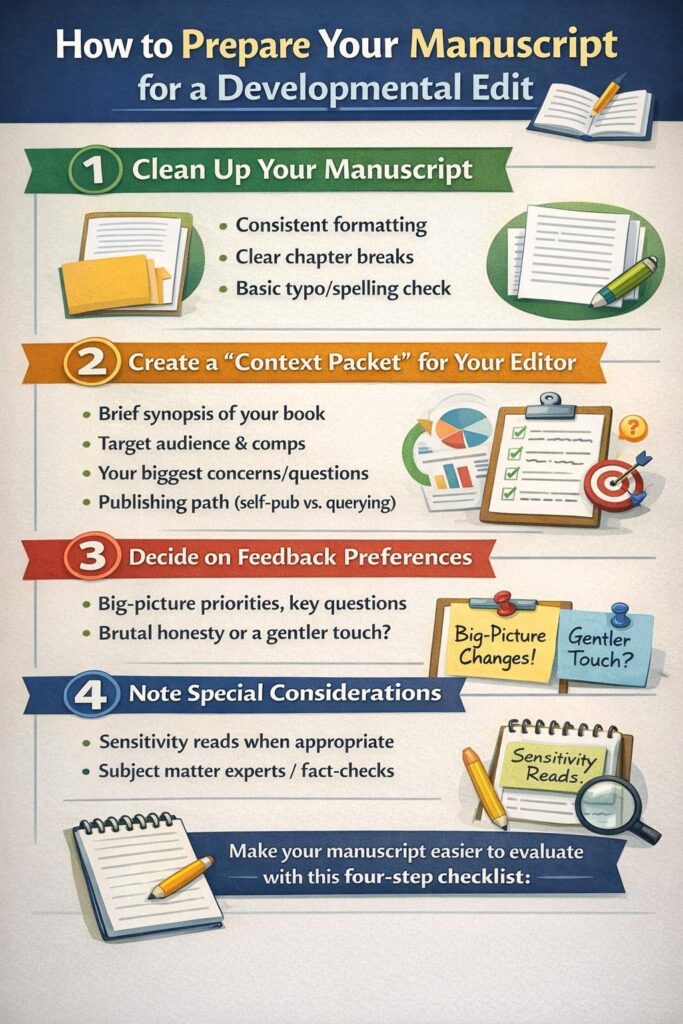
Signs You Are Ready to Invest in Developmental Editing
You may be ready if:
- The manuscript is complete and stable
- The ending holds under scrutiny
- Beta readers report confusion you cannot diagnose
- You sense pacing issues but cannot isolate them
- You are preparing to query or publish within a defined timeline
At this stage, revision without professional guidance often becomes circular.
You rewrite chapters without clarity.
You adjust scenes without confirming whether they advance escalation.
Developmental editing converts uncertainty into direction.
Signs You Should Revise Independently First
You may not need professional intervention yet if:
- The manuscript is incomplete
- The ending changes weekly
- Core character motivations are still evolving
- Major plot points remain undecided
Professional feedback works best on stable foundations.
If the architecture is still shifting, stabilize it first.
How Developmental Editing Changes the Outcome of Publication
When done at the correct stage, developmental editing:
- Prevents premature querying
- Strengthens early reader engagement
- Improves narrative momentum
- Reduces costly late-stage revisions
The difference between a manuscript that “almost works” and one that commands attention is rarely stylistic.
It is structural.
If your manuscript can withstand scrutiny but still feels strategically uncertain, this is the stage where serious authors move forward.
What Most Writers Get Wrong About Developmental Editing
Experience teaches you patterns.
After reviewing hundreds of manuscripts, the same misconceptions appear again and again. These misunderstandings do not just create confusion. They delay progress.
Developmental editing is powerful. It is not magical.
Here is where expectations often go off track.
Developmental Editing Is Not Ghostwriting
Some writers assume an editor will “fix” the book by rewriting it. That is not how this level of work operates.
A developmental editor diagnoses, maps, and guides. The author rebuilds.
If a manuscript requires complete reconstruction of voice, premise, or execution, that becomes a different service category entirely. Developmental editing strengthens your architecture. It does not replace authorship.
It Will Not Rescue an Incomplete Draft
Editors cannot evaluate architecture that does not yet exist.
If the final act is unwritten or the midpoint shifts weekly, structural analysis becomes speculative.
Professional feedback assumes stability. Without a complete draft, revision notes become temporary.
It Does Not Guarantee Agent Representation
Even a structurally strong manuscript can fail to secure representation.
Why?
Because representation depends on:
- Market timing
- List fit
- Current publishing trends
- Agent preference
Developmental editing improves craft and clarity. It increases competitiveness. It does not override market realities.
Serious authors understand the difference between preparation and guarantee.
It Requires Author Participation
Developmental editing is collaborative.
Writers who resist structural changes often stall their own progress. Chapters may need removal. Subplots may need consolidation. Openings may require acceleration.
If an author is unwilling to revise substantially, the investment loses impact. Strong outcomes require willingness to rebuild.
It Is About Positioning as Much as Craft
Many manuscripts are technically functional but commercially misaligned. The narrative may be coherent, yet the genre promise is unclear. The voice may be strong, yet the audience undefined.
Developmental editing addresses positioning alongside structure. A manuscript that works internally must also work externally.
That is where professional experience matters.
Writers who approach developmental editing with realistic expectations see measurable improvement. Those who expect effortless transformation often misinterpret the process. Clarity about what the service does and does not do protects both the manuscript and the author.
What Comes After Structural Readiness in the Publishing Process
Structural clarity is not the final stage. It is the threshold.
Once a manuscript is architecturally sound, the focus shifts from correction to execution. Positioning, distribution strategy, metadata optimization, launch planning, and long-term discoverability begin to matter.
A structurally stable manuscript gives you leverage. Without it, publishing strategy is premature.
Authors who reach this stage often move beyond revision questions and start thinking about the full path to market. That is where comprehensive book publishing services become relevant, guiding the manuscript from refined draft to strategic release.
Structure prepares the manuscript. Publishing strategy prepares the book.
Understanding that distinction keeps your momentum aligned with your goals.
Frequently Asked Questions About Developmental Editing and Manuscript Readiness
What is the difference between developmental editing and line editing?
Developmental editing focuses on structure, pacing, character arcs, and overall manuscript architecture. Line editing focuses on sentence clarity, rhythm, tone, and stylistic refinement.
One evaluates whether the book works. The other refines how it reads.
Structure must be stable before line-level polish becomes effective.
Is my manuscript ready for developmental editing?
A manuscript is ready when:
The draft is complete from beginning to end
The core premise is stable
The ending is written and unlikely to change
You are prepared to revise substantially
If major plot decisions are still evolving, stabilize them first.
How long does developmental editing take?
Timeline depends on word count and complexity.
Most full-length manuscripts require several weeks for professional review. Revision time varies based on the scope of recommended structural changes.
Rushed structural work produces shallow feedback. Depth requires time.
Do I need developmental editing before querying agents?
If your manuscript has not been professionally evaluated for pacing, escalation, and positioning, serious consideration should be given before querying.
Agents assess structural integrity quickly. Weak architecture often results in fast rejection.
Preparation improves competitiveness.
Can I self-edit instead of hiring a developmental editor?
Self-editing is valuable and necessary.
However, authors often struggle to diagnose structural blind spots in their own work. Familiarity reduces objectivity.
External perspective identifies patterns the author may not see.
What happens after developmental editing?
After structural revision is complete, the manuscript typically moves to:
Line editing
Copy editing
Proofreading
Each stage builds upon stabilized architecture.
Skipping order creates inefficiency.
Conclusion
Completing a manuscript is a milestone. Preparing it for publication is a professional standard.
Readers respond to momentum. Agents respond to structure. Markets respond to clarity. When architecture is unstable, those weaknesses surface quickly. When structure is deliberate, the writing has room to perform.
This is where developmental editing services become a strategic investment rather than a cosmetic choice. They clarify escalation, strengthen narrative cohesion, and align the manuscript with real publishing expectations before it faces external scrutiny.
If your draft is complete but you sense that pacing, positioning, or structural integrity could be stronger, it may be time to step back and evaluate it at a deeper level.
Writers of the West works with authors who are serious about structural precision and long-term publishing outcomes. If you are ready to examine your manuscript through a professional lens, begin the conversation and determine whether your book is truly prepared for the next stage.