Introduction
Amazon is not a place where readers browse slowly. They click, sample, decide, and move on. If your story does not earn attention fast, it disappears. That is why short stories can work so well here when they are written with intent instead of hope.
Short fiction on Amazon is a production format, not a passion project. It is a way to publish faster, test ideas, and learn how readers actually respond to your writing without spending a year on a novel that may never find its audience. When done right, a short story can pull its weight and sometimes outperform longer books because it respects the reader’s time.
If you are trying to figure out how to write a story that fits Amazon rather than fighting it, you need to think differently about structure, pacing, and payoff. What works in a workshop or a literary journal is not always what works on a retail platform built around previews, algorithms, and genre expectations.
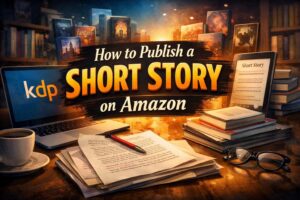
This guide breaks the process down in plain terms. You will learn when a short story makes sense on Amazon, whether KDP or Kindle Vella is the better path, and how to write something that feels complete, professional, and worth clicking buy on. The goal is not to romanticize short fiction. The goal is to help you publish something that actually works.
Why Amazon Short Stories Are a Smart “Fast Publish” Format (And What Success Actually Looks Like)
Amazon Favors Momentum Over Length
Amazon rewards speed and clarity. Readers click fast, sample fast, and decide fast. Short stories fit that behavior better than most longer projects because they respect the reader’s time and the platform’s rhythm.
This is where writing short stories becomes a strategic decision instead of a creative compromise. You are shortening the feedback loop. You write. You publish. You learn. That cycle helps you improve faster than spending months polishing a single manuscript in isolation.
Success Looks Smaller but Smarter
A successful short story on Amazon does not have to generate massive income. More often, success means finishing cleanly, earning honest reviews, confirming your genre fit, and learning how readers respond to your openings and endings.
Sometimes that means modest sales with clear signals. Sometimes it means strong read-through into a series. Sometimes it means discovering an idea does not land and moving on quickly. Each outcome saves you time and sharpens your instincts.
Short Fiction Lowers Creative Risk
Short stories remove the pressure for every project to be a career-defining release. With a tighter scope, you make clearer choices and finish more often. That consistency builds confidence and skill at the same time.
Some writers try to bypass this phase entirely by outsourcing, even considering hiring best book writers to speed up production. That approach can work for certain goals. But if you want to understand Amazon and your own writing strengths, short fiction gives you direct feedback with far less risk.
The real advantage is not speed alone. It is control. Short stories let you test ideas, improve craft, and publish with intention instead of waiting for the perfect moment that never arrives.
The Two Main Paths: KDP eBooks vs. Kindle Vella
Before you write a single scene, you need to decide where this story will live. Amazon offers two very different paths for short fiction, and the choice affects structure, pacing, and even how you end the story.
Kindle eBooks Through KDP
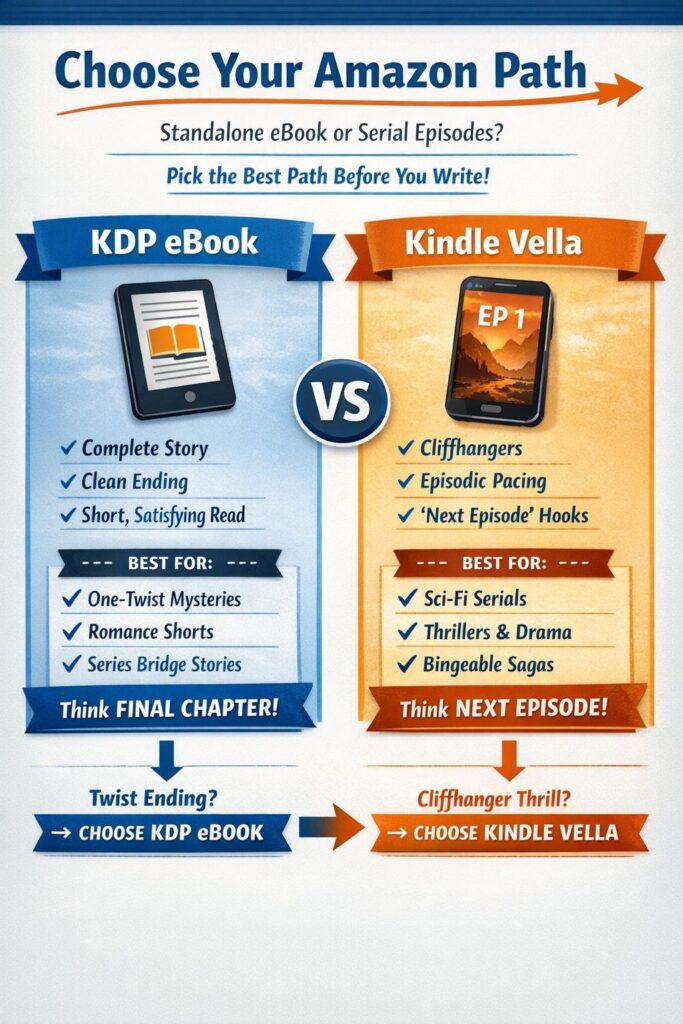
Publishing through KDP means you are creating a complete product. Readers expect a finished arc, a clear genre promise, and an ending that delivers on what the opening sets up. Even if the story connects to a series, it still needs to stand on its own.
This path works especially well for short stories for Kindle that are designed as standalone reads, bridge stories between novels, or bundled later into collections. You are optimizing for satisfaction in one sitting, not suspense over time.
Serialized Episodes on Kindle Vella
Kindle Vella is built around momentum. Stories are released in episodes, and readers unlock them one at a time. That changes everything. Each episode needs a reason to keep going, which usually means sharper hooks and controlled cliffhangers.
Vella favors binge pacing. You are not resolving the full story right away. You are rewarding curiosity and anticipation, episode by episode, until the larger arc pays off.
The Strategic Difference That Matters
The key difference between these paths is reader expectation. KDP readers want closure. Vella readers want continuation. When writers ignore this and force the wrong structure onto the wrong platform, stories underperform. Choosing the right path first simplifies every decision that comes after. It tells you how long scenes should run, where tension belongs, and whether your ending should resolve or provoke. Get this choice right, and the rest of the writing process becomes much easier.
Choose Your Amazon Path First (Because It Changes How You Write)
Where you plan to publish determines how you should approach the story itself. Structure, pacing, and even tone shift depending on the path you choose. If your goal is to write short stories for money, this decision matters more than most craft choices.
Option A. Publish as a Kindle eBook Through KDP
This option works best when your story delivers a full emotional arc in one sitting. Readers expect a beginning, middle, and end that resolves cleanly, even if the story connects to a larger universe.
Standalone short reads perform well here, especially when the genre promise is clear and the ending feels earned. Bridge stories between novels and small collections also fit naturally into this format because readers know exactly what they are buying.
The writing challenge is discipline. You cannot rely on delayed payoff. Every scene needs to move toward resolution, and the final pages must feel complete rather than suggestive.
Option B. Publish as a Serial on Kindle Vella
Kindle Vella rewards anticipation over closure. Stories are broken into episodes, and each episode must justify the next one. That means sharper hooks, quicker turns, and deliberate cliffhangers.
This format suits concepts that thrive on suspense, character tension, or slow reveals. You are writing with continuation in mind, not finality. Resolution comes later, after momentum has done its job.
A Simple Decision Check
If your story depends on a twist ending that recontextualizes everything, KDP is the safer choice. If your story gains power from the reader wanting more, Vella is the better fit.
Choose the path first. It will quietly guide every writing decision you make after that.
Pick a Marketable Concept (Without Killing Your Creativity)
A short story lives or dies on its concept. You do not have room for indulgence, slow discovery, or vague intent. The idea needs to be clear, focused, and easy to communicate before you ever start drafting.
If you are trying to figure out how to write short story concepts that actually work on Amazon, start by thinking in promises instead of themes. Readers are not buying an exercise in mood. They are buying an experience.
Start With a One-Sentence Promise
The fastest way to test a concept is to compress it into a single sentence. That sentence should tell you who the character is, what problem they face, what is at stake, and what kind of emotional ride the reader is signing up for.
If you cannot explain the story in one clean sentence, the scope is probably too big for short fiction.
Match Genre Expectations on Amazon
Amazon readers shop by genre first and curiosity second. Romance readers expect romance. Thriller readers expect tension. If the concept is unclear or mixed, the right readers will never find it.
This does not limit creativity. It channels it. Clear genre signals allow you to innovate inside expectations instead of confusing your audience.
Keep the Scope Intentionally Small
Short stories work best when they focus on one main problem, one meaningful change, and one emotional payoff. Extra subplots, side characters, and worldbuilding details dilute impact.
A tight scope gives your story weight. It also makes the ending feel earned instead of rushed. When everything points in one direction, even a brief story can feel complete and satisfying.
Nail the Short Story Structure (So It Feels Complete, Not Rushed)
Structure is the difference between a short story that feels sharp and one that feels unfinished. You have limited space, which means every beat needs to earn its place. This is where many writers struggle, especially when they bring novel habits into short fiction.
When writing short stories, simplicity wins. You are not compressing a novel. You are designing a focused experience with a clear beginning, escalation, and payoff.
A Simple Three-Act Framework
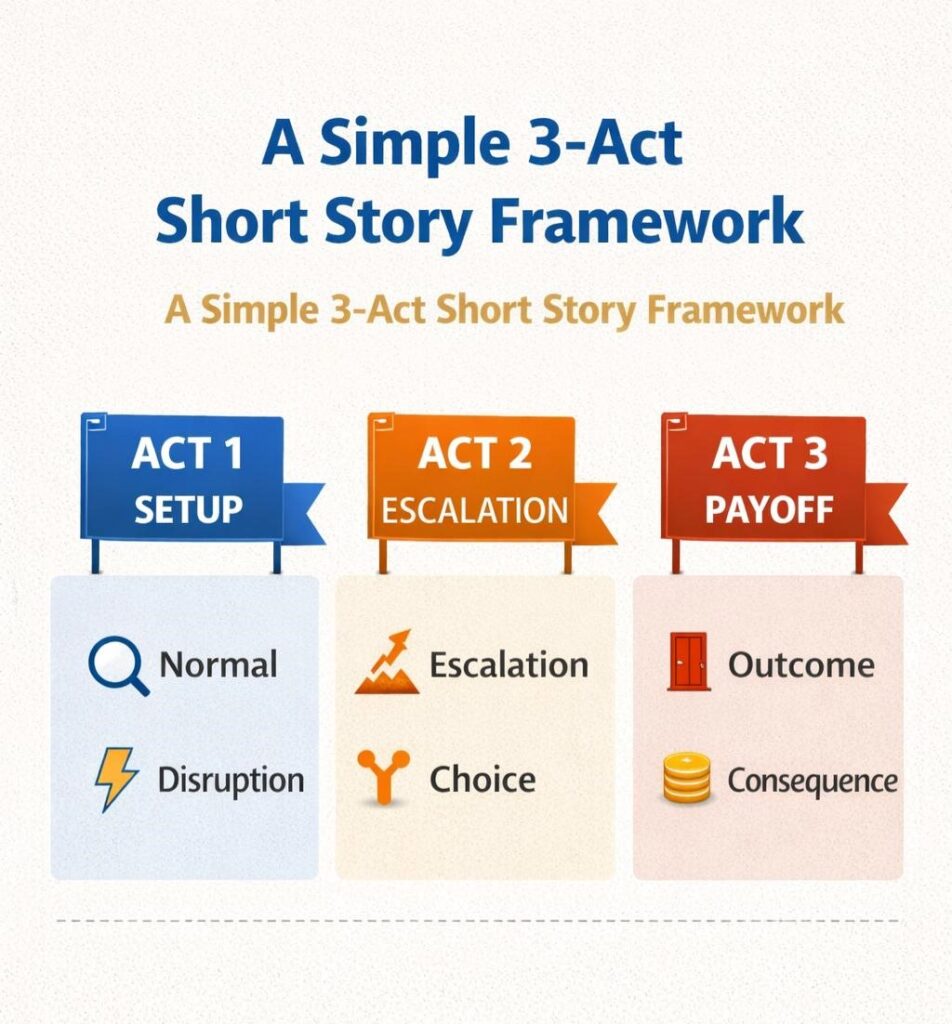
A three-act structure gives short fiction shape without overcomplicating it. You are not outlining a novel in miniature. You are creating forward motion, clear tension, and a meaningful end in a limited space. When used intentionally, this framework prevents short stories from feeling either rushed or unfinished.
Act One: Setup and Disruption
Act one establishes the character’s normal world quickly. You show who they are, what they want, and what matters to them with minimal explanation. There is no room for backstory dumps or slow orientation.
The most important job of this act is disruption. Something changes that the character cannot ignore. It can be an external event, a realization, or a problem that demands attention. Once this disruption happens, the story is in motion. If nothing truly changes in act one, the rest of the story will struggle to generate tension.
Keep this section lean. Introduce only what the reader needs to understand the conflict that is coming.
Act Two: Escalation and Choice
Act two is where pressure builds. The initial problem becomes more complicated, more costly, or more dangerous. The character tries to navigate the situation, but easy solutions fail.
This is the act where choice matters most. The character must decide how to respond, and that decision should carry risk. Passive characters weaken short fiction. Readers need to see the character actively engaging with the problem, even if they make the wrong call.
Every scene in act two should raise the stakes or narrow the options. If the story stalls here, it usually means the conflict is not strong enough.
Act Three: Payoff and Consequence
Act three delivers the result of the character’s choice. The central problem resolves, either successfully or unsuccessfully, but it resolves clearly.
This does not mean everything has to end happily. It means the reader sees the consequence of the actions taken. The emotional payoff comes from understanding what changed and what it cost.
Avoid rushing this act, even in short fiction. A brief but grounded ending allows the story to land. When the reader can see the outcome and feel its weight, the story feels complete, regardless of length.
A strong three-act structure does not add bulk. It adds clarity. And clarity is what allows short stories to leave a lasting impression.
Pacing Rules That Keep Stories Tight
Short fiction benefits from entering late and leaving early. Cut warm-up scenes. Start where something is already happening.
Every scene must change something. That change can be information, emotion, or a decision. If nothing shifts, the scene does not belong.
Endings That Satisfy Amazon Readers
Endings do not need to be loud, but they do need to be clear. A closed ending resolves the main conflict and works well for standalone stories. An open ending hints at more while still delivering emotional payoff, which suits series-friendly projects.
Amazon readers want to feel finished, not confused. If the ending delivers consequence and meaning, brevity becomes a strength instead of a flaw.
Write a First Page That Hooks Amazon Browsers
On Amazon, your first page is not just part of the story. It is a sales tool. Readers sample quickly, often on small screens, and decide within seconds whether to keep going. If the opening does not earn the next scroll, the story ends there.
This matters even more for short stories for Kindle, where readers expect immediate engagement and have little patience for slow starts.
The First Paragraph Carries More Weight Than You Think
Amazon’s preview feature means your opening lines are doing double duty. They introduce the story and prove competence. Awkward phrasing, vague setup, or delayed conflict signals risk to the reader.
A strong first paragraph shows control. It tells the reader they are in safe hands.
Opening Approaches That Work Well for Short Fiction
The strongest openings create movement immediately. They pull the reader forward without explanation or warm-up. Below are four approaches that consistently work for short fiction on Amazon.
A Decision in Motion
Starting with a decision drops the reader straight into consequence. The character is choosing, acting, or committing to something that cannot be undone. This creates instant tension because the reader wants to see whether the decision was right or catastrophic.
Avoid explaining how the character arrived at the choice. Let the decision speak for itself and allow the meaning to emerge through action.
A Sharp Contradiction
Contradictions create friction fast. Put two ideas together that do not belong and force the reader to reconcile them. A peaceful moment paired with a violent intention. A confident statement followed by immediate doubt.
This works best when the contradiction hints at the core conflict of the story rather than existing for shock value alone.
A Specific Sensory Moment
Concrete sensory detail grounds the reader immediately. A sound, smell, texture, or physical sensation makes the scene feel real and present.
The key is restraint. Use one strong detail that connects to the conflict. Atmosphere without direction slows the opening and weakens momentum.
A Question With Stakes
Questions hook when the reader senses risk. The opening can raise an explicit or implied question, as long as the answer matters.
Avoid vague curiosity. The reader should feel that something will be lost, exposed, or changed if the question is answered the wrong way.
The goal of these approaches is the same. Create forward motion. If the first page moves, the reader keeps going.
Hit the “Right” Short Story Length for Amazon
Length is not just a craft decision on Amazon. It is a value signal. Readers may not check word counts, but they feel when something is padded or thin. The goal is to deliver a complete experience that matches the promise on the product page.
If you are learning how to write a short story for Amazon, think in terms of payoff rather than numbers. The story should end when the problem resolves, not when you hit an arbitrary target.
What Counts as a Short Story on Amazon
Short stories on Amazon commonly fall between 1,000 and 10,000 words, with wide variation by genre. Romance and fantasy readers often prefer the higher end of that range, while thrillers and horror can work much shorter.
What matters most is that the length feels intentional. A tight 3,000-word story that delivers is more satisfying than an 8,000-word story that wanders.
When Bundling Becomes the Better Choice
Single short stories can struggle with perceived value at higher prices. Bundling multiple stories into a collection often solves that problem. Readers feel they are getting more, even if the total word count stays modest.
Collections also allow stronger branding through cover design and presentation. This is where professional visuals can make a difference. Some authors handle this themselves, while others explore top book design services to ensure the package signals quality and genre at a glance.
The right length is the one that leaves the reader satisfied, not suspicious. When the story feels complete and the value feels fair, Amazon readers are far more likely to finish, review, and come back for more.
Revision: Make It Feel Professionally Written (Even If It’s Short)
Short stories are unforgiving. There is nowhere to hide weak logic, rushed choices, or sloppy sentences. Revision is where a decent draft becomes something readers trust, which matters if your goal is to write short stories for money rather than just practice.
A Practical Editing Pass Order
Start with story logic. Check that character decisions make sense and that the conflict escalates cleanly. If something feels confusing, it usually is.
Next, move to line-level clarity. Tighten sentences. Remove filler. Cut throat-clearing phrases that delay meaning. Short fiction benefits from precision more than flourish.
Finally, proofread carefully. Typos signal carelessness and lead directly to bad reviews. Even a strong story can be undermined by small errors.
A Tightness Checklist for Short Fiction
Look for repeated beats where the same emotion or idea is restated without escalation. One strong moment is better than three weak ones.
Replace summary with a single vivid scene whenever possible. Showing one concrete moment often does more work than paragraphs of explanation.
Remove extra characters or settings that do not pay off. If they do not change the outcome, they dilute impact.
Revision is not about polishing for perfection. It is about respect. Respect for the reader’s time, attention, and money. When a short story feels tight and intentional, readers notice.
Format It the Way Amazon Readers Expect
Formatting is invisible when it is done right and painfully obvious when it is not. Readers may not know the rules, but they feel the friction immediately. Clean formatting signals professionalism and trust, which matters just as much as the writing itself.
If you are serious about learning how to write a short story for Amazon, you also need to learn how to present it in a way that feels native to Kindle and print.
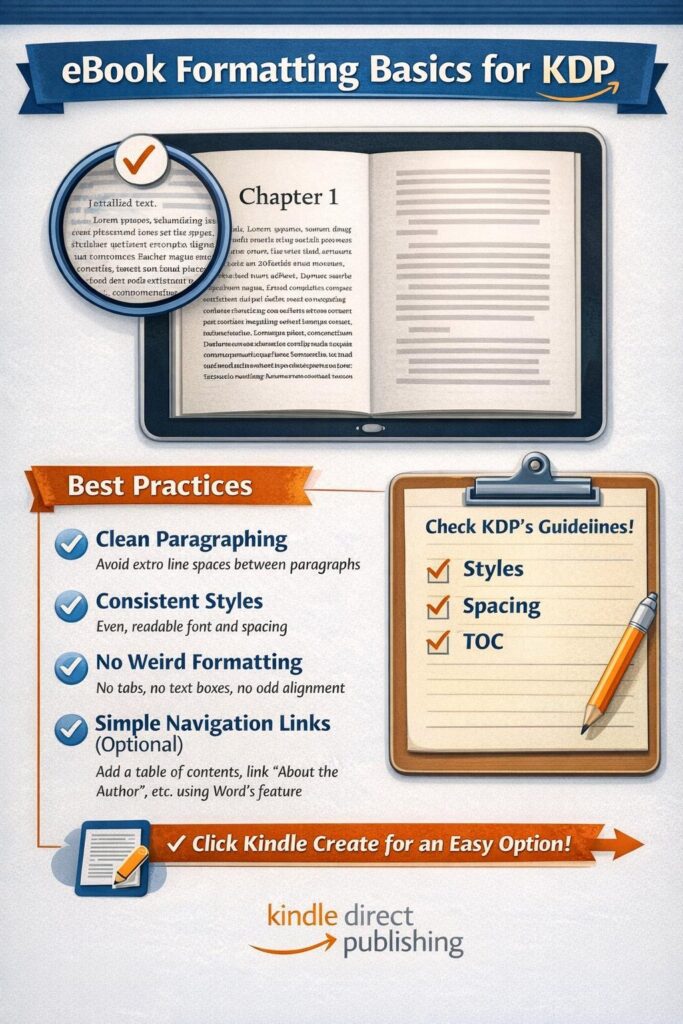
eBook Formatting Basics for KDP
Kindle readers expect clean paragraphs, consistent spacing, and readable font flow. Avoid extra line breaks, forced spacing, or manual indentation. These shortcuts often break across devices and create an uneven reading experience.
Use simple paragraph styles, standard scene breaks, and consistent chapter formatting. Amazon’s manuscript guidelines exist for a reason. Following them prevents technical issues and reduces the chance of negative feedback tied to readability.
Paperback Formatting Considerations
Print introduces stricter rules. Trim size, margins, and page numbers all need to be set correctly. A file that works perfectly as an eBook can fail in print if these details are ignored.
Paperback is optional for short stories, but if you choose to offer it, accuracy matters. Sloppy margins or awkward page breaks immediately make the book feel amateur.
Tools and Help That Make Formatting Easier
Many writers handle formatting themselves using Word with proper styles or Kindle Create for eBooks. These tools are usually sufficient for short fiction when used correctly.
Others prefer outsourcing, especially when time is limited or frustration sets in. In those cases, professional book formatting services can help ensure the final product meets Amazon’s standards without unnecessary trial and error.
Formatting is not about decoration. It is about removing friction so the story can do its job. When the reading experience feels smooth, readers stay focused on the words, which is exactly where you want them.
Prepare Your Amazon Listing (So Your Story Can Actually Be Found)
You can write a strong story and still fail on Amazon if the listing does not do its job. The product page is not an afterthought. It is how readers decide whether your story is worth their time and money.
Learning how to write a short story for Amazon also means learning how to frame it clearly for the marketplace.
Title and Subtitle Basics for Short Fiction
Clarity beats cleverness, especially if you are not a known author. The title should signal genre, tone, and promise without forcing the reader to guess.
A subtitle can help, particularly for short fiction. It gives you room to clarify what the story is and who it is for. Confusion at this stage leads to missed clicks or disappointed readers.
Writing a Book Description That Sells Without Spoiling
Your description should be easy to scan. Short paragraphs. Clean spacing. A strong first line that sets the hook.
Focus on the central conflict and stakes. Tease the experience rather than summarizing the plot. Readers want to know how the story will make them feel, not every turn it takes.
Avoid vague language. Specifics build trust. Spoilers kill curiosity.
Categories and Keywords That Actually Work
Categories and keywords are not about clever positioning. They are about alignment. When these elements match reader intent, Amazon can do its job and put your story in front of people who are already looking for something like it.
Think Like a Reader, Not a Writer
Writers tend to describe their stories in abstract or thematic terms. Readers search in concrete ones.
Instead of asking how you would explain the story to another writer, ask what a reader would type when they are in the mood to read. Genre, tone, tropes, and emotional outcome matter more than originality at this stage. Readers are not searching for innovation. They are searching for satisfaction.
Simple language usually wins here. Clear beats clever every time.
Choose Categories That Match the Actual Reading Experience
Categories are promises. When a story is placed in the wrong category, readers feel misled before they even finish the first page.
Choose categories based on what the story delivers, not what you wish it were. If the romance is secondary, do not list it as romance. If the story is quiet and reflective, marketing it as high-action will backfire.
Refunds and negative reviews often stem from this single mistake. Honest categorization protects both the reader and the story.
Use Keywords to Support Discovery, Not Identity
Keywords exist to help Amazon understand who to show your book to. They are not a place to showcase clever phrasing or personal branding.
Focus on phrases readers are likely to search. These often include genre combinations, familiar tropes, or clear descriptors. Relevance matters more than volume. A smaller number of well-matched readers will always outperform broad exposure to the wrong audience.
Avoid stuffing keywords or using misleading terms. Short-term visibility is not worth long-term damage.
Let the Listing Set Expectations Clearly
A strong listing does one thing exceptionally well. It attracts the right reader and sets the right expectation.
When the title, description, categories, and keywords all point in the same direction, the reader knows what they are buying. That clarity increases completion rates, improves reviews, and gives the story a real chance to succeed.
On Amazon, alignment beats reach. The more honest and specific your listing is, the better the outcome tends to be.
Common Mistakes That Tank Short Stories on Amazon
Most short stories do not fail because the writer lacks talent. They fail because the story and the marketplace are misaligned. Knowing how to write a short story is only part of the equation. Knowing how not to sabotage it on Amazon matters just as much.
Mismatched Genre Signals
Genre is a promise. When the cover, description, and categories signal one thing and the story delivers another, readers feel misled. A romance without a satisfying romantic arc, a thriller without real tension, or a literary piece marketed as genre fiction almost always leads to frustration.
Amazon readers reward clarity. They punish confusion. Even a well-written story can earn poor reviews if it shows up in the wrong place or attracts the wrong audience.
Weak Openings That Do Not Convert
On Amazon, the opening is doing the work of a salesperson. If the first page feels slow, abstract, or overly descriptive, readers stop sampling.
This does not mean every story needs explosions or shock. It means something needs to be happening. A decision, a contradiction, a risk. Without movement, the reader has no reason to continue.
Formatting That Breaks Trust
Formatting errors quietly erode confidence. Extra spaces, inconsistent paragraph breaks, or strange indentation pull readers out of the experience.
Many readers will not complain directly. They will simply leave or skim. In short fiction, that loss of immersion is fatal because you have so little time to earn trust.
Confusing Product Page Copy
Your product page sets expectations. If the description is vague, overwritten, or clever at the expense of clarity, readers hesitate.
Short fiction already asks readers to take a chance. Do not make that decision harder by hiding the premise or tone behind flowery language.
Choosing the Wrong Publishing Path
Some stories are built around resolution. Others are built around anticipation. Publishing a serial-style story as a standalone leads to disappointment. Publishing a tightly resolved story as a serial kills momentum.
When the format does not match the idea, the story feels wrong even if the writing is strong. Matching concept to platform is one of the most underrated skills in publishing short fiction on Amazon.
FAQs
Can I Publish a Short Story on Amazon KDP?
Yes. Amazon KDP allows you to publish short fiction the same way you would publish a longer book. You upload a manuscript, add a cover, choose categories and pricing, and publish. There is no minimum word count requirement as long as the content is original and properly formatted.
Most short stories perform best as eBooks, though paperback is also an option if you want to bundle stories or offer print.
How Long Should a Short Story Be for Amazon?
There is no single correct length. Many Amazon short stories fall between 1,000 and 10,000 words, depending on genre and reader expectations.
What matters more than word count is whether the story feels complete. Readers are forgiving of brevity. They are not forgiving of stories that feel unfinished or padded.
Should I Use Kindle Vella or KDP for Short Fiction?
Use KDP when your story has a complete arc and a clear ending. This works well for standalone reads, bridge stories, and collections.
Use Kindle Vella when the story naturally breaks into episodes and benefits from cliffhangers or ongoing tension. If the concept thrives on “just one more episode,” Vella is usually the better fit.
Do I Need Special Formatting to Publish on KDP?
You do not need advanced tools, but you do need clean, consistent formatting. Proper paragraph spacing, readable structure, and correct file setup are essential.
KDP provides manuscript guidelines that are easy to follow. Ignoring them often leads to display issues and poor reader experience.
What Should I Write in My Amazon Book Description?
Your description should be clear, concise, and genre-specific. Start with a strong hook, introduce the central conflict, and hint at the stakes.
Avoid spoilers and vague language. The goal is to help the right reader quickly understand what kind of story they are buying.
Can I Publish a Paperback Version of a Short Story?
Yes, but paperback comes with stricter requirements. You will need to pay attention to trim size, margins, and layout.
For many authors, paperback makes the most sense when stories are bundled into a collection. As a single short story, eBook formats usually perform better and require less setup.
Conclusion
Publishing short fiction on Amazon is not about shortcuts. It is about leverage. Short stories let you practice finishing, learn reader behavior, and build confidence without betting everything on a single massive project.
If you take anything away from this guide, let it be this. Knowing how to write a short story for Amazon means thinking beyond the page. It means choosing the right format, shaping the idea with intention, respecting reader expectations, and presenting the work professionally.
You do not need permission to start. You do not need a perfect plan. You need one solid idea, a clear path, and the willingness to finish.
Publish one story. Learn from it. Then do it again.
That is how real progress happens on Amazon.