Introduction
Most writers dread synopses because they feel brutally reductive. You are asked to compress months or years of work into a document that feels cold, technical, and oddly powerful. It can feel unfair that such a small piece of writing carries so much weight. Yet agents, editors, and judges continue to rely on it for a simple reason. It works.
A good synopsis tells industry readers what they need to know quickly. It shows whether your story has a clear beginning, a purposeful middle, and an ending that pays off. It also reveals whether you understand your own narrative at a professional level.
This is where many writers get tripped up. A synopsis is not your query letter. It is not your back-cover blurb. It is not about atmosphere or intrigue. It is about structure, causality, and clarity. That is why the importance of a good book synopsis goes far beyond “checking a box” in the submission process.
When it is done well, a synopsis does one quiet but powerful thing. It proves your story delivers, and that you are in control of it from start to finish.
What a Book Synopsis Actually Is (and What It Isn’t)
What a Book Synopsis Is
A book synopsis is a concise summary of your story’s full narrative arc. It covers the beginning, the major turning points, and the ending. In most professional submission contexts, the resolution is not optional. It is expected.
The goal is simple. You are showing how the story functions as a whole. Each major event appears because it changes the direction of the narrative, not because it is beautifully written or emotionally intense on the page. A synopsis answers the question industry readers care about most: What happens, and why does it unfold this way?
What a Book Synopsis Is Not
A synopsis is not a back-cover blurb meant to create intrigue. It is not a sales pitch or a mood piece. It is also not a chapter-by-chapter recap that walks the reader through every scene in order.
It is equally not a thematic essay. Explaining what your book “means” does not replace showing what actually happens. Theme may emerge through the summary, but plot and causality always come first.
Where You’ll Be Asked for One
You will see synopsis requests in more places than you might expect. Literary agents and acquiring editors use them to evaluate submissions efficiently. Contest judges rely on them to assess completeness and craft at a glance. Developmental editors use them to understand structure before suggesting changes.
They are also essential in collaborative work. A co-writer, editor, or ghostwriter for hire needs a clear, shared map of the story before any serious work can begin. In every case, the purpose is the same. The synopsis exists to make your story clear, coherent, and easy to evaluate on a professional level.
Why a Strong Synopsis Matters So Much
Fast Evaluation
Agents and editors read under intense time pressure. A strong synopsis gives them a clear, high-level view of your entire story in minutes. Much like a book summary, it allows them to evaluate structure, momentum, and payoff without reading hundreds of pages first.
When the arc is clear, they can immediately see that your story has a real beginning, a middle that develops rather than stalls, and an ending that delivers on the promise of the premise.
A Working Ending
Many manuscripts start strong and lose control in the final act. A synopsis makes that impossible to hide. By laying out the full arc, you show that the ending is not an afterthought but a direct result of earlier choices.
Editors want to see resolution that feels earned. A strong synopsis demonstrates that the climax answers the central question of the book and that the consequences make sense.
Structural Clarity
Polished prose can hide serious problems. Logic gaps. Coincidences that exist only because the author needs them. Characters who act without clear motivation. A middle that drifts instead of builds.
A synopsis strips the story down to cause and effect. With the language removed, the structure has nowhere to hide.
Professional Control
Being able to summarize your story cleanly signals professional-level understanding. It shows that you grasp your protagonist, your stakes, and the decisions that drive the plot forward.
This matters to more than just agents. Editors, marketers, and collaborators rely on clarity and consistency when positioning and shaping a book.
Smoother Collaboration
A synopsis gives everyone the same map. Editors, co-writers, and beta readers all work from a shared understanding of the story.
That alignment saves time, reduces confusion, and keeps the focus on what actually matters in the narrative.
Who Uses a Synopsis (and What They’re Looking For)
A synopsis is not read by one kind of gatekeeper. It moves through many hands, and each reader brings a different set of priorities. Understanding those priorities helps you shape a document that works beyond a single submission.
Literary Agents
Agents read synopses to understand trajectory. They want to see where the story starts, how it escalates, and whether the ending delivers. Clarity matters more than cleverness. They are checking that the premise sustains a full arc, that the cast is manageable, and that the resolution feels earned. If the synopsis shows control and momentum, it signals a manuscript worth their time.
Acquiring Editors
Editors are thinking at both the story and list level. They look for a strong narrative engine, clear differentiation, and a defined audience promise. A clean synopsis helps them imagine how the book fits alongside others on their list and whether it can stand out in a crowded market. It also reassures them that the story behind the pages of the good book actually works from start to finish.
Contest Judges
Judges often read synopses before or alongside sample pages. They are looking for completeness, coherence, and craft at a glance. A strong synopsis allows them to quickly assess whether the story has direction and purpose, even if they only read part of the manuscript.
Editors, Collaborators, and Marketers
Freelance editors, co-writers, and collaborators use a synopsis as a shared reference point before deep work begins. It ensures alignment on plot, arc, and intent. Marketing teams also rely on it when shaping positioning, messaging, and launch strategy. Even book marketing services need a clear understanding of the full story in order to present it accurately and consistently to readers.
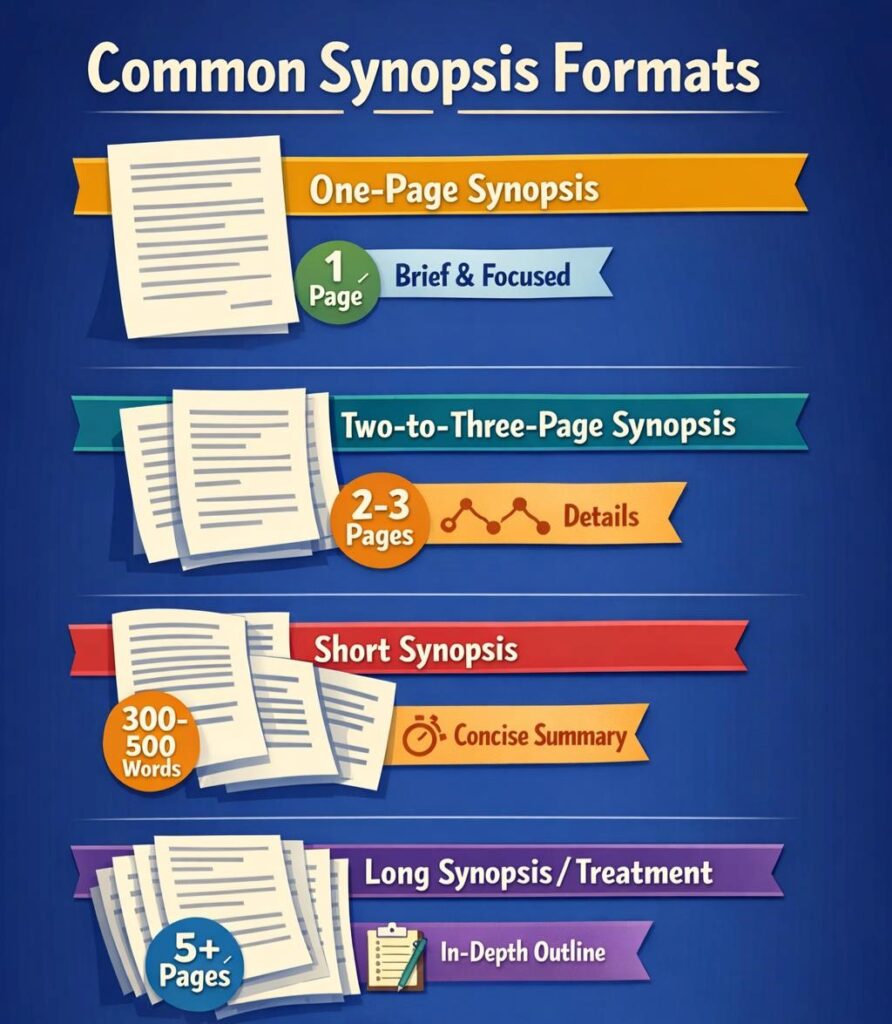
Common Synopsis Formats (Pick the Right One)
There is no single “correct” synopsis format. What matters is matching the document to the context in which it is being requested. Length, detail, and emphasis all change depending on who is reading and why. Understanding these differences reinforces the importance of a good book synopsis, because even a strong summary can fail if it is delivered in the wrong format.
One-Page Synopsis
This is the most common request from agents. It is tight, high-level, and focused on the core arc. You are expected to cover the full story, including the ending, while keeping the cast controlled and the pacing sharp. Every sentence has to earn its place.
Two-to-Three-Page Synopsis
This version allows more room for major turning points and character development. You can clarify motivations, deepen the antagonist’s role, and show how subplots feed into the climax. This format is often requested by editors or contests that want a clearer sense of execution.
Short Synopsis (300–500 Words)
Short synopses are common in competitions, pitch materials, and some submission portals. The challenge here is compression. You still need a full arc, but you must prioritize only the most consequential events and decisions.
Long Synopsis or Treatment
This is closer to a beat-driven document. It lays out the story in more detail and is often used in development, collaboration, or adaptation contexts. While it is longer, it still focuses on structure rather than scene-by-scene recap.
A Note on Length and Guidelines
Different agents, editors, and organizations define these formats differently. Always defer to the guidelines provided. Format is not just a technical detail. Choosing the right one shows professionalism and respect for the reader’s process.
The Core Ingredients of a “Good” Synopsis
A strong synopsis is not about elegance or flair. It is about function. When it works, it reads like a clear, purposeful book summary that tracks the logic of the story from start to finish. Use the elements below as a practical checklist.
Protagonist and Desire
Who is the story about, and what do they want more than anything else? The protagonist’s goal should be concrete and active. If the desire is vague, the entire synopsis will feel unfocused.
Inciting Incident
This is the moment that disrupts the status quo and forces the protagonist into motion. It answers the question, “Why does this story start here?”
Stakes
What does it cost if the protagonist fails? Stakes can be personal, relational, professional, or global, but they must be clear. The reader should always understand what is at risk.
Major Turning Points
These are the irreversible decisions and events that change the direction of the story. Turning points show momentum. Without them, the plot feels flat.
Antagonistic Force
Conflict does not exist in a vacuum. Identify the primary force working against the protagonist, whether that force is a person, a system, or the protagonist’s own limitations.
Climax and Resolution
The synopsis should clearly show how the central conflict comes to a head and how it is resolved. This is where the story proves it can deliver on its promise.
The Through-Line
Beyond events, the synopsis should track change. How does the protagonist evolve, and why do their final choices make sense given what they have experienced? This through-line is what makes the story feel cohesive rather than episodic.
How to Write It (A Practical Step-by-Step Method)
Writing a synopsis is easiest when you treat it as a process rather than a single task. The steps below help you move from chaos to clarity without losing the spine of the story.
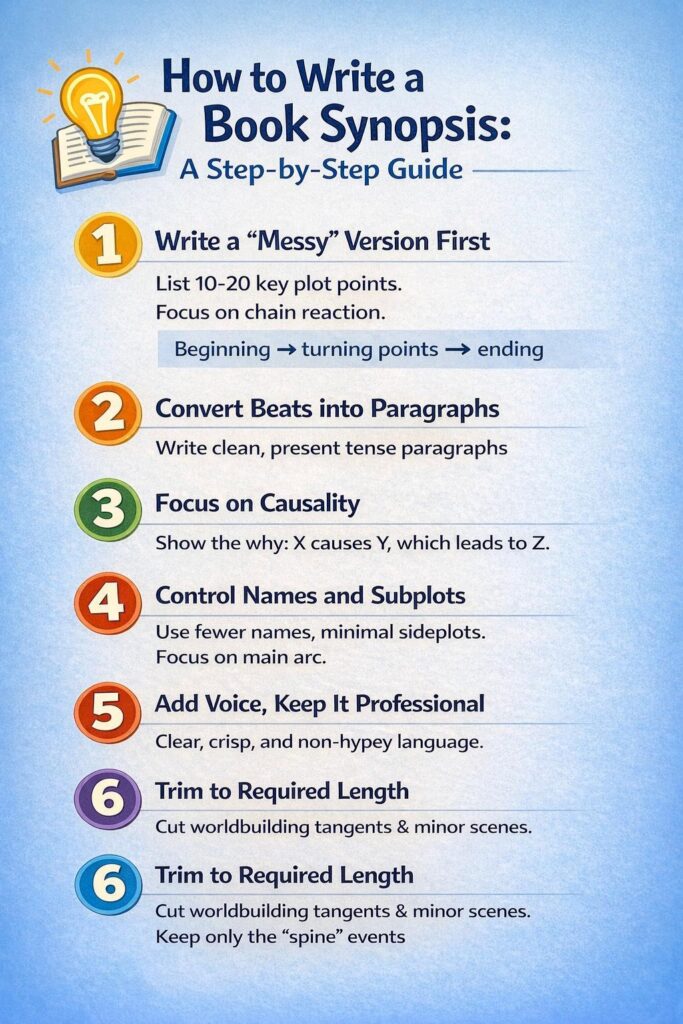
Write a Messy First Version
Start with 10 to 20 bullet points that map the story from beginning to end. Focus only on moments that change direction. If a scene does not alter a decision, raise the stakes, or force a consequence, leave it out. At this stage, you are building the skeleton of the good book, not polishing sentences. Think of this as problem-solving, not writing. You are testing whether the story actually works before worrying about how it sounds.
Turn Beats into Narrative Paragraphs
Once the beats are clear, convert them into short, clean paragraphs. Present tense and third person are common professional norms unless guidelines say otherwise. Keep the language straightforward and factual. Each paragraph should represent a clear movement in the story, not a cluster of loosely related events. If a paragraph feels crowded, something likely needs to be cut or merged.
Emphasize Cause and Effect
Avoid simply listing events. Make the logic explicit. Because one thing happens, the protagonist reacts, which leads to the next problem. Clear causality makes the story feel intentional rather than coincidental. This is where many weak synopses fail. If motivations are not stated plainly, actions feel random, even when the manuscript itself is clear.
Control Characters and Subplots
Limit named characters to those who are essential to the core arc. Combine roles where possible. Only include subplots that directly affect the climax or resolution. Extra names slow the reader down and dilute focus. If removing a character does not change the ending, that character does not belong in the synopsis.
Add Voice Sparingly
A synopsis should be readable, not bland, but it should never sound like marketing copy. Light voice is enough. Clarity always comes first. Let the story’s tension and decisions do the work rather than clever phrasing. Professional readers want understanding, not persuasion, at this stage of the process.
Trim to the Required Length
Cut travel sequences, worldbuilding tangents, and minor conflicts. What remains should be the spine of the story. If removing a detail does not change the ending, it likely does not belong in the synopsis. Trimming is not about losing depth. It is about sharpening focus and respecting the reader’s time.
What to Avoid (The Fastest Ways to Weaken a Synopsis)
Even strong stories can be undermined by weak synopsis choices. Most rejections at this stage are not about taste. They are about confusion, overload, or missing information. Understanding the importance of a good book synopsis means knowing not only what to include, but what to leave out. A synopsis should reduce friction for the reader, not create more questions than it answers.
Hiding the Ending
If the synopsis is meant to summarize the full story, withholding the ending works against you. Agents and editors are not looking to be surprised. They are looking to see whether the resolution is logical, earned, and aligned with the premise. An incomplete synopsis reads as evasive or inexperienced, and it often suggests that the writer lacks confidence in the ending itself.
Too Many Characters and Side Plots
Overloading the synopsis with names, relationships, and secondary arcs makes it harder to follow. Each added element competes for attention and drains momentum. Professional readers want to track a clear through-line. If a character or subplot does not directly influence the climax or resolution, it weakens the document rather than enriching it.
Vague, Theme-Heavy Summaries
Summaries that focus on atmosphere, themes, or emotional tone without clearly stating what happens tend to frustrate professional readers. A synopsis built on “vibes” leaves too much work for the reader and raises doubts about whether the plot actually functions when stripped of prose.
Backstory and Worldbuilding Dumps
Long explanations of history, politics, magic systems, or past events slow the synopsis down. Worldbuilding should appear only where it directly affects choices or outcomes. If it does not change what the protagonist does next, it does not belong here.
Scene-by-Scene Retelling
A synopsis is not a condensed manuscript. Retelling events one scene at a time creates clutter and hides the larger arc. This approach often signals uncertainty about which moments truly matter. Focus on turning points, decisions, and consequences instead.
Passive Language and Soft Stakes
Phrases like “things happen” or “they begin to realize” blur agency and tension. Active language clarifies who is making choices and why those choices matter. This is often the first issue flagged by editors and editing services for writers because passive summaries usually reflect deeper structural problems in the manuscript itself, not just in the synopsis.
Mini Examples (So Readers Can See the Difference)
Abstract advice only goes so far. What makes synopses click is seeing how clarity changes everything on the page. Below is a simple comparison that shows how small shifts in specificity and causality dramatically improve a synopsis.
Example A: Weak Synopsis Paragraph
After strange events disrupt her life, Ava sets out on a journey to uncover the truth. Along the way, she faces challenges, meets new people, and begins to understand herself better. As tensions rise, she must decide what matters most and confront the consequences of her choices.
This version sounds fine at first glance, but it leaves key questions unanswered. What are the strange events? What does Ava want? What happens if she fails? What choice actually drives the ending? The reader cannot see the engine of the story.
Example B: Improved Synopsis Paragraph
When unexplained power outages isolate Ava’s coastal town, she discovers the failures are linked to her missing father’s research. Determined to expose the truth, she follows his trail despite warnings from local officials who want the project buried. As pressure mounts and her brother is threatened, Ava must choose between protecting her family and releasing the research, a decision that leads directly to the town’s collapse and her public reckoning with its leaders.
Here, motivation leads to action, action leads to consequence, and consequence leads to climax. The story moves because the character makes decisions.
Simple Fill-In Template
When [inciting incident], [protagonist] must [clear goal], but [antagonistic force] pushes them toward [hard choice], leading to [climax], where [resolution or ending].
This template is not meant to replace thinking. It is meant to reveal whether the spine of your story is actually there.
Final Checklist: “Ready to Submit” Synopsis Test
Before you send your synopsis anywhere, slow down and run it through one last filter. This is where a solid draft becomes a professional document. Taking time here reinforces the importance of a good book synopsis as more than a submission requirement. It is a proof-of-competence check.
Core Clarity
Ask whether a complete stranger could answer the fundamentals after a single read. Who is the protagonist? What do they want? Why does the story begin now and not earlier or later? What happens if they fail? How does the story end? If you hesitate when answering any of these questions, the synopsis is not yet doing its job.
Causal Flow
Look closely at how each paragraph connects to the next. Events should not simply follow one another in time. They should cause one another. Every major action needs a clear motivation, and every decision should create a consequence that propels the story forward. If you can rearrange paragraphs without changing meaning, the structure is too loose.
Motivation at Turning Points
Pay special attention to moments where the story shifts direction. Are the protagonist’s choices understandable, even when they are flawed or risky? Strong synopses make motivations explicit so the reader never has to guess why a character acts. This clarity often reveals weak spots in the manuscript itself.
Cast and Focus Control
Review the number of named characters and subplots. Are all of them essential to the climax or resolution? Extra names slow comprehension and dilute tension. A focused synopsis keeps attention on the central conflict and the forces that truly matter.
An Earned Ending
Finally, reread the ending in isolation. Does it feel like a natural result of what came before, or does it rely on coincidence or convenience? The ending is the moment agents and editors often check first. If it works here, the rest of the synopsis carries far more weight.
FAQs
What is the difference between a synopsis and a back-cover blurb?
A synopsis explains the full story, including the ending. Its job is clarity and evaluation. A back-cover blurb is a marketing tool. It teases tone, conflict, and intrigue without revealing resolution. One informs decision-makers. The other entices readers.
Do I have to reveal the ending in a synopsis?
In most professional contexts, yes. Agents, editors, and judges expect to see how the story resolves. Hiding the ending usually creates frustration, not suspense, and can signal inexperience or lack of confidence in the payoff.
How long should a book synopsis be for agents?
Most agents ask for one to three pages, single-spaced, though some specify word counts. Always follow the guidelines on an agent’s website. When in doubt, a tight one-page synopsis is usually safest.
Why do some agents ask for a synopsis and others don’t?
Every agent has a different evaluation process. Some rely heavily on sample pages to judge voice and execution. Others prefer to confirm structure and resolution upfront. Neither approach is better. They are simply different workflows.
Should my synopsis be written in first person or third person?
Third person is the industry standard, even if the manuscript itself is written in first person. It creates distance, clarity, and consistency for professional readers unless submission guidelines explicitly say otherwise.
Should I write my synopsis in present tense or past tense?
Present tense is most common for fiction synopses. It keeps the summary immediate and clear. That said, the most important rule is consistency. Do not switch tense mid-document.
How many character names should I include?
Only name characters who are essential to understanding the core arc. Too many names slow the reader down and create confusion. Minor characters can often be referred to by role rather than name.
Do I need to include every subplot?
No. Include only subplots that directly affect the climax or resolution. If removing a subplot does not change the ending, it does not belong in the synopsis.
How do I write a synopsis for multiple points of view without confusion?
Anchor the synopsis around the primary through-line. Introduce each POV clearly and explain how their arcs intersect. Avoid equal weight unless the story truly depends on it. Clarity matters more than balance.
Can writing a synopsis actually improve my manuscript?
Yes. Writing a synopsis often reveals plot holes, weak motivations, and structural issues faster than revising chapters. Many writers discover what is not working only after trying to summarise the story cleanly.
Should nonfiction and memoir synopses follow the same rules as novels?
The principles of clarity, structure, and progression still apply, but nonfiction synopses focus more on argument, scope, and takeaway than on plot mechanics. Memoir sits somewhere in between and often benefits from a narrative arc similar to fiction.
What’s the biggest synopsis mistake that gets submissions rejected?
Lack of clarity. Whether it comes from vague stakes, hidden endings, or overloaded casts, confusion is the fastest way to lose a professional reader’s confidence.
Conclusion
A synopsis may be short, but it carries disproportionate power. It is often the first place a professional reader decides whether your story is worth more time, attention, and investment. That is why clarity, structure, and causality matter more here than anywhere else.
When you write a strong synopsis, you are not dumbing your story down. You are proving that it works. You are showing that your protagonist’s choices make sense, that the stakes escalate with purpose, and that the ending grows naturally out of what came before. You are also demonstrating that you can step back from your own pages and see the story as a complete system.
This is the real lesson behind the importance of a good book synopsis. It is not just a submission document. It is a diagnostic tool, a collaboration map, and a professional signal all at once. When you can explain your story cleanly on one or two pages, everything else gets easier. Queries sharpen. Revisions focus. Conversations with agents, editors, and collaborators move faster and go deeper.
Treat the synopsis with the respect it deserves, and it will do what it is meant to do. Open doors.