Introduction
Authors often arrive with the same question: how to write a children’s book and get it published without making the costly mistakes that stall most first manuscripts. After reviewing hundreds of children’s book projects over the years, one pattern becomes clear. Writing the story is only the beginning. The real work involves understanding category expectations, shaping the manuscript through professional editing, preparing the book for illustration and layout, and navigating the publishing route that actually fits the project.
Many aspiring authors assume children’s books are simple because they are short. In reality, they are among the most structurally demanding forms of storytelling. The authors who succeed usually approach the process strategically. They learn the art of children’s book writing by treating the project like a professional publishing venture rather than a casual writing exercise.
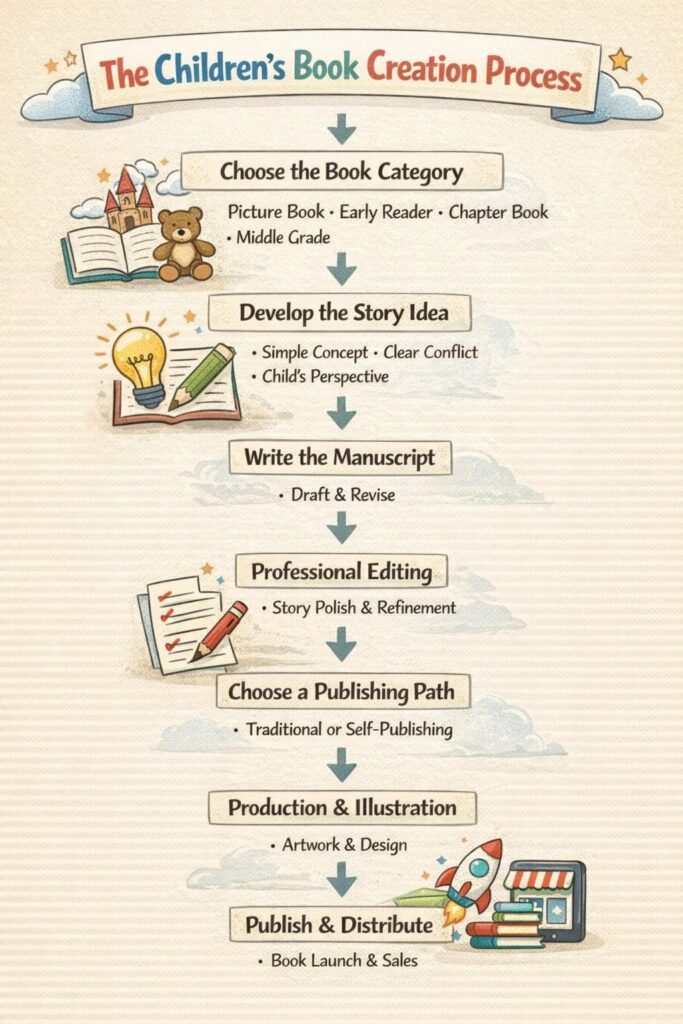
Quick Overview of the Children’s Book Writing and Publishing Process
Authors often assume the process is complicated, but professional publishing workflows for children’s books are actually quite structured. Across hundreds of editing and publishing projects, the same sequence tends to repeat. The difference between manuscripts that succeed and those that stall usually comes down to how carefully each stage is handled.
When a project struggles during editing or production, the problem often traces back to one of these stages being rushed or misunderstood.
Step 1: Choose the Right Children’s Book Category
Before writing begins, the manuscript must fit a specific category. Picture books, early readers, chapter books, and middle grade titles all follow different expectations for word count, pacing, and illustration.
Step 2: Develop a Story Idea That Works for Young Readers
Children’s stories succeed when the core concept is simple and emotionally engaging. Strong manuscripts usually focus on one central conflict, one clear character perspective, and a satisfying resolution.
Step 3: Write and Revise the Manuscript
First drafts rarely resemble the final book. Revision strengthens pacing, clarifies character perspective, and ensures the language fits the intended reading level.
Step 4: Prepare the Manuscript for Professional Editing
Before illustration or production begins, the manuscript should undergo structural editing to refine story clarity and narrative flow.
Step 5: Choose a Publishing Path
Authors typically choose between traditional publishing and independent publishing. Each route comes with different timelines, expectations, and levels of creative control.
Step 6: Prepare the Book for Production
Once the manuscript is finalized, the project moves into illustration, layout, cover design, and formatting. In children’s books, visuals are not decorative. They are part of the storytelling structure.
Step 7: Publish and Distribute the Book
The final stage prepares the book for distribution through publishing platforms, retail channels, or traditional publishing partners.
Understanding Children’s Book Categories and Industry Standards
One of the most common problems editors encounter in early manuscripts is not weak writing. It is category confusion.
Authors frequently write a manuscript they believe is a picture book, only to discover it reads more like an early reader. Others attempt middle grade stories with picture book length. When a manuscript does not align with category expectations, it becomes difficult to position in the market.
Professional children’s publishing operates around clear category standards. Word count, page length, language complexity, and illustration use are shaped by the developmental stage of the reader. Understanding these distinctions early prevents major restructuring later in the publishing process.
Common Children’s Book Categories and Industry Standards
| Category | Typical Age Range | Recommended Word Count | Typical Page Count | Illustration Role |
| Picture Book | 3–7 years | 400–800 words | 24–32 pages | Illustrations carry much of the storytelling |
| Early Reader | 5–8 years | 1,000–2,500 words | 32–64 pages | Light illustrations support comprehension |
| Chapter Book | 7–10 years | 5,000–10,000 words | 80–120 pages | Occasional illustrations |
| Middle Grade | 8–12 years | 25,000–50,000 words | 150–300 pages | Primarily text-driven storytelling |
Picture Books (Ages 3–7)
Picture books are the category most new authors attempt first, and they are deceptively difficult to write well. A typical picture book runs between 400 and 800 words and is usually structured across 24 to 32 pages.
Because illustrations carry much of the narrative, the text must leave space for visual storytelling. One mistake editors frequently encounter is manuscripts that attempt to explain everything through words. In successful picture books, the text and illustrations work together rather than competing for attention.
Picture books are also designed to be read aloud. Rhythm, pacing, and sentence flow matter more here than in many other forms of storytelling.
Early Readers (Ages 5–8)
Early readers are designed for children who are just beginning to read independently. The language becomes simpler, sentence structures are shorter, and vocabulary remains familiar.
Most early reader books range between 1,000 and 2,500 words. Illustrations are still present but play a supporting role rather than driving the entire story.
The primary goal of this category is reading confidence. Stories must remain engaging while still being easy for developing readers to follow.
Chapter Books (Ages 7–10)
Chapter books represent the transition from heavily illustrated stories to longer narrative reading. Word counts typically range between 5,000 and 10,000 words, divided into short chapters that maintain a steady pace.
Illustrations may appear occasionally, but they no longer dominate the storytelling. Instead, the narrative itself begins carrying the reader forward.
Many successful chapter books introduce recurring characters or series concepts. Young readers often return to familiar characters, which is why series formats are common in this category.
Middle Grade (Ages 8–12)
Middle grade books are where storytelling expands significantly in scope. These manuscripts often range between 25,000 and 50,000 words and focus more deeply on character development and plot structure.
At this stage, readers expect engaging conflicts, emotional stakes, and immersive storytelling. The writing style becomes more complex while still remaining accessible to younger audiences.
Why Category Alignment Matters
In professional publishing environments, editors evaluate category alignment quickly because it determines whether a manuscript fits the expectations of the marketplace.
A manuscript written for a five-year-old reader will struggle if it uses vocabulary and narrative complexity suited for older readers. Similarly, a picture book manuscript that runs far beyond standard length becomes difficult to position with publishers or retailers.
Authors who understand these standards early tend to move through the publishing process much more efficiently. Category awareness is one of the first things editors evaluate when reviewing new projects in children’s books writing.
How to Come Up With a Children’s Book Idea That Works
Many aspiring authors researching how to write and publish a children’s book begin with a message rather than a story. They want to teach a lesson about kindness, sharing, or courage. The intention is good, but manuscripts built around a lesson rarely hold a child’s attention.
Children respond to story first, meaning second.
When editors review early drafts, a common pattern appears. The manuscript explains what the character should learn instead of letting the story reveal it naturally. Strong children’s books begin with a clear situation, a relatable character, and a simple problem that drives the narrative forward.
Start With a Simple, Clear Concept
The strongest children’s book ideas are usually built on a single, easy-to-understand premise.
A lost puppy trying to find home.
A shy monster learning to make friends.
A child determined to ride a bicycle without help.
The concept should be simple enough for a child to grasp quickly but engaging enough to sustain curiosity through the entire story.
Many manuscripts fail not because the writing is weak but because the concept tries to do too much at once.
Focus on One Main Character
Children’s books rarely benefit from large casts of characters. Younger readers follow stories best when the narrative centers on one clear protagonist.
Editors often see manuscripts introducing multiple characters within the first few pages. This makes it difficult for young readers to form a connection with the story.
Successful children’s books keep the focus tight. One main character, one central goal, and one challenge that must be resolved.
Write From the Child’s Perspective
Another common editorial issue appears when stories are written from an adult perspective. The language may be polished, but the emotional experience does not feel authentic to a child.
The most effective stories place the reader inside the child’s world. The problems feel immediate, the emotions are clear, and the resolution feels meaningful.
This shift in perspective is what separates a story written for children from a story written about children.
Test the Idea Before Writing the Full Manuscript
Experienced editors often recommend testing the core concept before committing to a full draft.
Can the idea be explained in one or two sentences?
Does the story contain a clear beginning, conflict, and resolution?
Would a child understand the main situation immediately?
If the concept passes these tests, the manuscript usually has a stronger foundation for development.
How to Structure a Children’s Book
Many manuscripts struggle not because the idea is weak, but because the story lacks clear structure. In children’s publishing, structure is what keeps young readers engaged from the opening page to the final resolution.
Beginning: Introduce the Character and the Problem
The opening should quickly establish who the story is about and what challenge the character faces. Young readers need to understand the situation immediately, so long introductions or backstory usually weaken the opening. Effective stories place the character directly inside a situation that invites curiosity.
Middle: Escalate the Challenge
Once the problem is introduced, the middle of the story builds tension. The character attempts to solve the problem but encounters obstacles along the way. Each attempt should move the story forward and keep the reader interested in the outcome.
Ending: Deliver a Clear Resolution
Children’s books benefit from concise endings. The resolution should address the original problem and give the character a meaningful outcome without extending the story unnecessarily.
Why Page Turns Matter
In picture books, page turns create moments of anticipation. Each new spread should reveal something that advances the story or deepens the conflict, helping maintain the reader’s attention.
Do You Need Illustrations for a Children’s Book?
Illustrations are often the first thing people associate with children’s books, but in professional publishing they are more than decoration. They function as part of the storytelling structure.
How Illustrations Support the Story
In strong children’s books, the text and illustrations work together. Instead of describing every detail, the writing leaves space for the artwork to reveal emotions, actions, and visual context.
This balance keeps the story concise while making the reading experience more engaging.
When Authors Should Secure Illustrations
Many first-time authors believe they must hire an illustrator before pursuing publication. In traditional publishing, publishers usually select illustrators after acquiring the manuscript so the visual style fits the market.
For independent publishing, authors typically work with illustrators during the production stage, developing character sketches and page layouts before final artwork is completed.
Treat Illustrations as Storytelling Tools
The most effective children’s books treat illustrations as part of the narrative. When the visuals and text complement each other, the story becomes clearer and more memorable for young readers.
What Publishers and Editors Actually Look for in a Children’s Book
Many authors assume that if a story is imaginative, it will naturally find a publisher. In reality, editors evaluate manuscripts through a much more practical lens. After reviewing hundreds of submissions, a few patterns become clear. The manuscripts that move forward usually share several structural qualities that make them work both creatively and commercially.
A Clear Emotional Arc
Editors often look first at the emotional journey of the story. Children’s books are short, but they still need a clear progression from problem to resolution.
The character should face a recognizable challenge, struggle with it, and reach a meaningful outcome. When that emotional arc is missing, even a creative premise can feel flat.
A Strong Child-Centered Perspective
Stories that succeed in children’s publishing almost always reflect the world from the child’s perspective. Manuscripts sometimes drift into an adult viewpoint, explaining situations rather than letting the character experience them.
Editors tend to favor stories where the reader can immediately connect with the character’s feelings, frustrations, and small victories.
Language That Fits the Target Age
Another factor editors evaluate quickly is whether the language matches the intended age group. Vocabulary, sentence length, and pacing must align with the developmental stage of the reader.
When manuscripts use language that is too advanced or overly complex, the story becomes harder for young readers to follow.
A Concept That Parents Will Also Buy
Children may be the readers, but adults are often the buyers. A strong concept usually resonates with both audiences.
Stories that combine engaging storytelling with themes parents appreciate tend to perform better in the marketplace.
Editorial insight: One pattern appears repeatedly during manuscript reviews. The stories that stand out rarely attempt to be complicated. They focus on one clear idea and execute it well. Simplicity, when handled with precision, is often what makes a children’s book memorable.
Should You Self-Publish or Traditionally Publish a Children’s Book?
Once the manuscript is complete, authors reach the next major decision: how the book will enter the market. In most cases, the choice comes down to traditional publishing or independent publishing.
Both paths can lead to successful books, but they operate very differently in terms of timelines, creative control, and financial structure. Authors researching self publishing children’s books often discover that the decision is less about prestige and more about how much involvement they want in the publishing process.
Traditional Publishing: Industry Gatekeepers and Long Timelines
Traditional publishing involves submitting a manuscript to literary agents or publishers who evaluate whether the project fits their catalog.
If accepted, the publisher typically handles editing, illustration assignment, design, printing, and distribution. The advantage is that experienced publishing teams guide the process and cover most production costs.
The drawback is time. The process from manuscript acceptance to bookstore release can take one to two years, and many submissions never reach acquisition.
Self-Publishing: Control and Faster Publication
Independent publishing allows authors to bring their books to market without waiting for publisher approval. Authors oversee the production process, including editing, illustration, formatting, and distribution.
The timeline is significantly faster, often allowing a book to move from final manuscript to publication within a few months.
However, self-publishing also requires authors to manage the business side of publishing, from production decisions to marketing strategy.
Comparing the Two Publishing Paths
| Factor | Traditional Publishing | Self-Publishing |
| Timeline | Often 12–24 months | Usually a few months |
| Creative Control | Publisher-led decisions | Author retains full control |
| Upfront Costs | Typically covered by publisher | Author funds production |
| Royalties | Lower percentage | Higher percentage |
| Distribution | Established retail channels | Online platforms and print-on-demand |
Choosing the Path That Fits Your Goals
In practice, the right publishing path depends on the author’s goals, resources, and timeline. Some writers prefer the structure and support of traditional publishing, while others value the speed and creative independence of self-publishing.
From an editorial standpoint, the most important factor remains the same regardless of the path chosen: a strong manuscript supported by professional production. When those elements are in place, both publishing routes can lead to successful children’s books.
How to Prepare Your Children’s Book for Publication
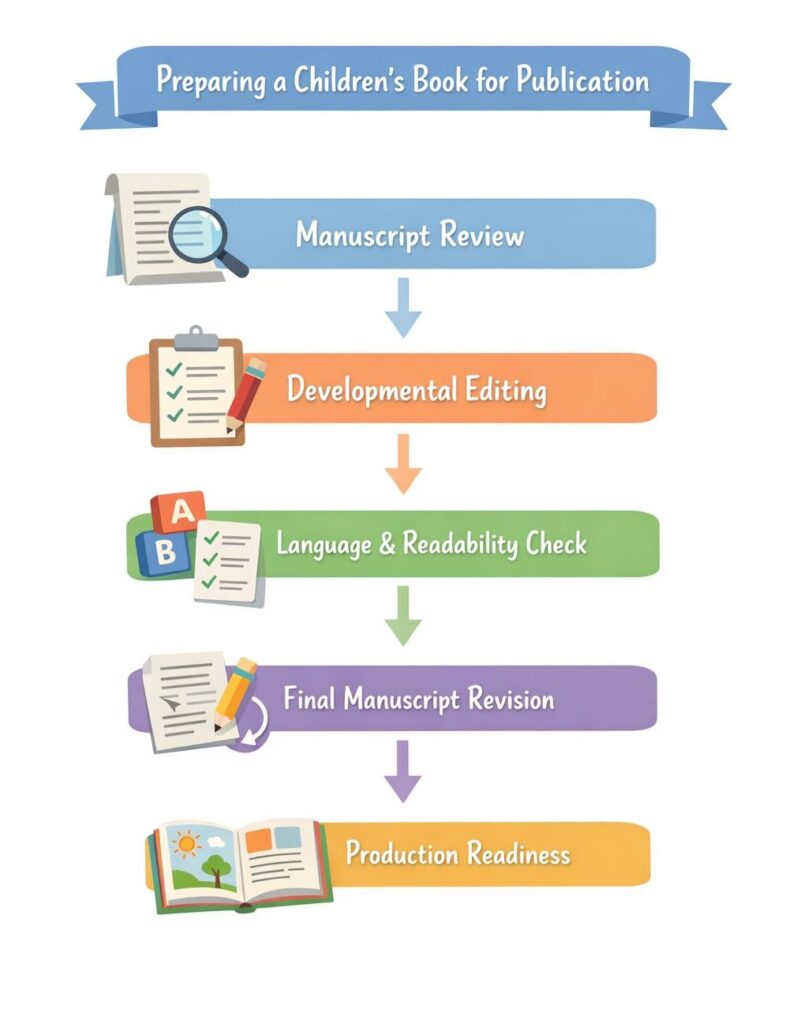
Completing the manuscript is a major milestone, but in professional publishing it marks the beginning of the refinement stage rather than the end of the process. Before a children’s book moves into illustration, layout, or distribution, the manuscript usually goes through several rounds of editorial review.
At this point many authors realize that early drafts still contain structural weaknesses. Story pacing may need tightening, character motivations may require clarification, or the language may need to be simplified for the intended age group. This is often where writers seek professional children’s book editing services to help refine the manuscript before production begins.
Developmental Editing and Story Structure
The first stage of editorial work typically focuses on structure. Developmental editing evaluates whether the story flows clearly from beginning to resolution, whether the character arc feels satisfying, and whether the pacing matches the expectations of the category.
For picture books, this stage often involves reducing unnecessary explanation and allowing the illustrations to carry more narrative weight.
Language and Readability
Once the structure works, the next step focuses on language clarity. Sentence length, vocabulary, and rhythm must align with the target age group. Even small adjustments can significantly improve readability for young audiences.
Editorial Reality Check
Editorial insight: One of the most common patterns editors see is manuscripts that move too quickly toward production. Authors are often eager to begin illustration or publishing, but unresolved story issues become much harder to correct once the visual design process begins.
Manuscripts that undergo thorough editorial revision almost always move through the later publishing stages more smoothly.
How Much Does It Cost to Publish a Children’s Book?
One of the most common questions new authors ask is how much publishing a children’s book actually costs. The answer varies depending on the publishing path, the complexity of the illustrations, and the level of professional support involved.
In traditional publishing, most production costs are covered by the publisher. For authors pursuing self book publishing, however, the investment typically includes editing, illustration, design, and formatting before the book reaches the market.
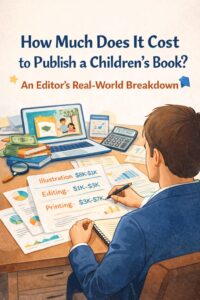
Typical Cost Breakdown for Children’s Book Publishing
| Publishing Stage | Typical Cost Range |
| Developmental Editing | $500 – $3,000 |
| Illustration (Full Picture Book) | $2,000 – $10,000+ |
| Book Cover Design | $200 – $800 |
| Interior Layout & Formatting | $200 – $700 |
| ISBN & Distribution Setup | $100 – $300 |
Illustration is often the largest investment for picture books because a full manuscript may require between twenty and thirty individual illustrations. Pricing varies depending on the illustrator’s experience, style, and the level of detail required.
Editing is another area where experienced authors rarely cut corners. Structural feedback, language refinement, and proofreading help ensure the manuscript is ready for production.
Budgeting for the Publishing Process
In practice, many independent children’s book projects fall somewhere between $3,000 and $12,000, depending on the services involved. Simpler projects with minimal illustrations may cost less, while fully illustrated picture books with detailed artwork can require larger budgets.
Approaching the process with a clear budget helps authors move through editing, illustration, and publishing with fewer complications.
How to Publish a Children’s Book Step by Step
Once the manuscript and illustrations are complete, the project moves into the publishing stage. Authors researching how to write and publish a children’s book often discover that publication involves more than simply uploading a file. Formatting, layout, and category placement all influence how the book appears in the marketplace.
Prepare the Final Manuscript
Before publication, the manuscript should be fully finalized. The text must be edited, illustrations completed, and the story should flow clearly from beginning to end. At this stage, the written and visual elements are prepared to function together.
Complete Illustration and Layout
For picture books, layout becomes part of the storytelling. Illustrations must align with the pacing of the narrative, and page spreads should guide the reader naturally through the story.
Format the Book for Publishing Platforms
The book must then be formatted to meet the technical requirements of modern publishing platforms. This includes preparing print-ready files and ensuring the layout displays correctly across devices.
Many authors publish through Amazon because it provides global distribution and print-on-demand production. In these cases, teams specializing in Amazon KDP publishing services often assist with formatting, metadata preparation, and platform setup.
Upload and Launch the Book
After formatting is complete, the book can be uploaded to the publishing platform. Authors select categories, set pricing, and submit the book for approval before it becomes available to readers.
How to Market a Children’s Book After Publishing
Publishing a book is a major milestone, but it is rarely the moment when readers discover it. In children’s publishing, visibility usually develops through consistent exposure rather than a single launch event.
Many first-time authors assume that listing a book on retail platforms automatically leads to readership. In reality, discoverability depends on how clearly the book is positioned and how easily parents, teachers, and librarians can find it.
Focus on the Right Audience
Children may be the readers, but adults are usually the buyers. Parents, educators, and librarians often determine which books children encounter.
Successful authors therefore focus on communities where these decision-makers spend time. School visits, classroom readings, and library programs often introduce a new book to its first group of readers.
Build Visibility Gradually
Children’s books often grow through steady exposure rather than aggressive marketing campaigns. Word-of-mouth recommendations, educator networks, and community events frequently play a larger role than paid advertising.
For many writers, this stage also reveals how important the foundation of the story really is. Books with a clear concept and strong narrative tend to travel farther through reader recommendations than books that rely only on promotional efforts.
Some authors recognize this earlier in the process and begin their projects with children’s book ghostwriting services when they need help developing a story that resonates with young readers.
Author Insight
Publishing insight: After reviewing hundreds of children’s manuscripts, a pattern becomes clear. The books that gain traction are rarely the ones pushed hardest through marketing. They are the ones built on a strong idea and executed clearly from the beginning.
This is also why some writers want affordable ghostwriting services while planning a book project, especially when they want experienced guidance shaping the story before it reaches the market.
Common Mistakes Authors Make When Learning How to Write a Children’s Book and Get It Published
Many first-time writers begin the journey excited about their story idea but underestimate how demanding children’s publishing can be. The creative side of storytelling often receives the most attention, while the structural expectations of the market are overlooked.
After reviewing hundreds of children’s manuscripts, several patterns appear repeatedly during editorial evaluation.
Writing for Adults Instead of Children
One of the most frequent issues editors encounter is manuscripts written from an adult perspective. The language may sound polished, but the emotional experience does not feel authentic to a child.
Successful children’s books usually present situations from the child’s viewpoint, allowing young readers to recognize their own feelings within the story.
Ignoring Category Expectations
Another common mistake involves mismatching the story with the intended age group. A picture book manuscript may contain vocabulary suited for older readers, or a chapter book concept may be written with picture book length.
Understanding category standards early helps prevent major structural revisions later.
Explaining Too Much
Children’s stories work best when they allow readers to experience the narrative rather than being told what it means. Manuscripts sometimes explain the lesson directly instead of letting the story reveal it naturally.
Editors often encourage authors to trust the narrative and allow readers to discover the meaning on their own.
Rushing the Publishing Stage
Another pattern appears when authors move too quickly toward publication before the manuscript is fully refined. Writing, editing, illustration, and layout all influence how the final book feels to readers.
Projects that move carefully through each stage of development tend to perform far better once they reach the market.
Frequently Asked Questions About Writing and Publishing a Children’s Book
How long should a children’s book be?
The length of a children’s book depends on the age group it targets. Picture books typically contain 400–800 words across 24–32 pages, while early readers may range between 1,000 and 2,500 words. Chapter books and middle grade titles are longer because they support more complex storytelling and character development.
Do I need illustrations before submitting a children’s book?
In traditional publishing, authors usually submit only the manuscript. Publishers often select illustrators after acquiring the book so the visual style matches the intended market. Authors pursuing independent publishing, however, typically collaborate with illustrators during the production stage.
Can I publish a children’s book without a publisher?
Yes. Independent publishing allows authors to bring their books to market without a traditional publishing contract. Many authors choose this path because it provides greater creative control and faster timelines, though it also requires managing production decisions and distribution.
How long does it take to publish a children’s book?
Timelines vary depending on the publishing route. Traditional publishing can take one to two years from acceptance to release. Independent publishing can move much faster, especially once the manuscript, illustrations, and layout are finalized.
What makes a children’s book successful?
Successful children’s books usually combine a clear concept, relatable characters, and language that matches the reading level of the audience. Stories that resonate emotionally with young readers, and the adults who purchase the books, tend to perform best in the long term.
Conclusion
Learning how to write a children’s book and get it published involves far more than completing a manuscript. Successful children’s books emerge from a thoughtful process that includes understanding the target age group, shaping a clear narrative structure, refining the manuscript through professional editing, and navigating the publishing path that best fits the project.
Authors who approach the process strategically tend to avoid many of the common challenges that slow new writers down. When story concept, structure, illustrations, and publishing preparation align, a children’s book has a far greater chance of connecting with its intended audience. For writers who want guidance at different stages of the process, the editorial team at Writers of the West works closely with authors to develop manuscripts, refine story structure, and prepare books for publication. Whether an idea is still forming or a manuscript is ready for production, professional publishing support can make the journey from concept to finished book far more efficient.