Introduction
One of the most common questions authors ask after finishing a piece of short fiction is simple but surprisingly complex in practice: how to sell short stories on Amazon Kindle without getting lost among millions of titles already competing for attention.
From the outside, Kindle publishing appears straightforward. Upload a manuscript, add a cover, set a price, and within hours the story is available worldwide. The technical process is not particularly difficult. The challenge begins after publication, when most short stories quietly disappear into the enormous catalog of the Kindle marketplace.
After reviewing hundreds of manuscripts and assisting authors through real Amazon publishing projects, a consistent pattern emerges. Stories fail far less often because of writing quality alone and far more often because the book was positioned incorrectly for the platform. Genre expectations, pricing strategy, metadata, and discoverability all play a larger role than many new authors realize.
Understanding how the Kindle marketplace actually works changes the way authors approach short fiction publishing entirely.
Can Authors Really Make Money Selling Short Fiction on Kindle?
The honest answer is yes, but not in the way most new authors expect.
When writers begin researching how to sell short stories, they often encounter two very different narratives. One promises easy passive income through Kindle publishing. The other insists that short fiction never sells on Amazon at all. Both perspectives misunderstand how the Kindle marketplace actually works.
Short stories do sell on Amazon. Readers buy short fiction every day, particularly in genres like romance, mystery, thriller, science fiction, and horror. But the success of a short story rarely depends on the story alone. It depends on how the book is positioned inside the marketplace.
After reviewing hundreds of manuscripts and Kindle publishing projects, a clear pattern appears. Authors often assume that once the story is uploaded, Amazon will somehow deliver readers automatically. In reality, most short stories fail because the book was never positioned correctly for the platform.
Understanding this difference is the first step toward approaching Kindle publishing strategically rather than casually.
Why Some Short Stories Sell on Amazon While Others Disappear
Readers browsing Kindle rarely search for “short stories” as a broad category. They search for experiences.
They look for:
- a quick mystery to read during a commute
- a short romance with an emotional payoff
- a suspense story with a twist ending
- a fast science-fiction adventure
This means successful Kindle short fiction usually shares several characteristics:
- A clearly defined genre
- A strong premise visible in the description
- A cover that signals the genre instantly
- A price aligned with reader expectations for short works
When those elements align, short stories can perform surprisingly well.
How Genre Positioning Influences Short Story Sales on Kindle
Genre clarity is one of the biggest factors in whether short fiction gains traction.
Many manuscripts arrive with strong ideas but unclear positioning. A story might blend thriller, literary fiction, and speculative elements in ways that confuse the marketplace. Readers browsing Amazon make decisions within seconds. If they cannot instantly understand what type of story they are looking at, they simply move on.
Genres that historically perform well for Kindle short fiction include:
- Romance and romantic suspense
- Mystery and detective fiction
- Psychological thrillers
- Science fiction and dystopian concepts
- Horror and supernatural stories
These genres work well partly because readers in these categories are comfortable with shorter works.
Why Pricing and Length Affect Short Story Performance
Another pattern visible across Kindle publishing projects involves pricing expectations.
Many authors assume that pricing a short story too low will increase sales. In practice, readers interpret price as a signal of value. Pricing that feels inconsistent with the length or genre of the work can create hesitation.
Typical patterns seen in successful short fiction include:
- Short standalone stories priced around $0.99
- Longer short fiction or novellas priced between $1.99 and $2.99
- Collections priced higher depending on total length
These expectations vary by genre, but ignoring them often leads to weak sales even when the story itself is strong.
How Successful Authors Use Short Stories Strategically
One of the most interesting trends among experienced Kindle authors is that short fiction is rarely their only publishing strategy.
Instead, many writers use short stories to:
- introduce readers to a larger series
- maintain reader engagement between full-length novels
- experiment with new characters or concepts
- build an early audience before releasing longer books
Seen this way, short fiction becomes less about immediate revenue and more about building momentum within the Kindle ecosystem.
Understanding how the marketplace works is the foundation for approaching Kindle short fiction strategically rather than treating it as a simple upload-and-wait experiment.
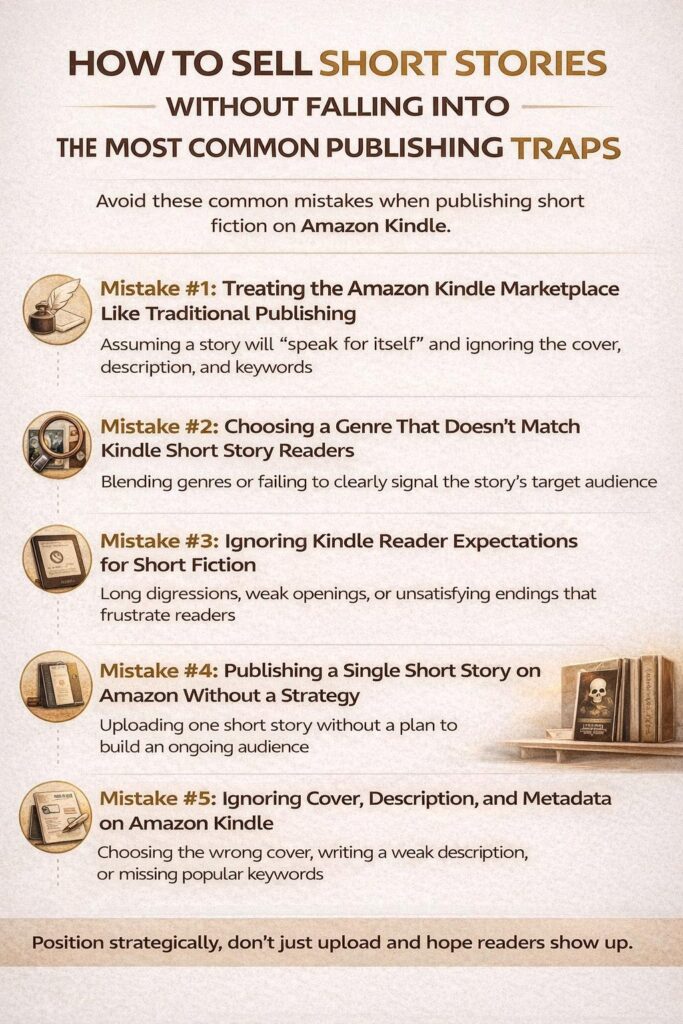
How to Sell Short Stories Without Falling Into the Most Common Publishing Traps
Many authors begin exploring Kindle publishing with genuine enthusiasm. They write a story, create a cover, upload the manuscript, and assume the platform will take care of the rest. A few weeks later the listing has barely moved.
Understanding how to sell short stories requires recognizing the difference between simply publishing a story and positioning it strategically inside a digital marketplace. The Kindle store contains millions of titles competing for attention, and short fiction is particularly sensitive to positioning mistakes.
After reviewing numerous Kindle manuscripts and assisting authors through real publishing projects, several patterns appear repeatedly. The stories themselves often contain strong ideas, but small strategic decisions quietly undermine the book’s chances of finding readers.
Below are some of the most common traps that prevent short fiction from gaining traction on Kindle.
Mistake #1: Treating the Amazon Kindle Marketplace Like Traditional Publishing
Many authors approach Kindle the way they might approach submitting a story to a literary magazine. The focus remains entirely on the writing, with the assumption that the story will speak for itself.
In the Amazon ecosystem, however, readers encounter the book long before they encounter the story. They see the cover, title, price, and description first. Those elements determine whether a reader even clicks on the listing.
Experienced Kindle authors understand that publishing is not just about writing. It is about presentation. A short story must signal its genre and promise clearly from the moment it appears in search results.
Mistake #2: Choosing a Genre That Doesn’t Match Kindle Short Story Readers
Another issue editors frequently encounter involves unclear genre positioning. A manuscript might contain elements of suspense, literary fiction, and speculative themes, but the listing does not clearly communicate which audience the story is meant for.
On Amazon, readers browse within familiar categories. They gravitate toward recognizable experiences. If a short story appears difficult to categorize, readers often move on rather than trying to interpret the premise.
Common symptoms of weak genre positioning include:
- Covers that do not visually match the intended genre
- Descriptions that summarize the plot without emphasizing the core hook
- Category selections that scatter the book across unrelated sections
When a story clearly belongs to a recognizable genre, both readers and Amazon’s recommendation system understand where the book fits.
Mistake #3: Ignoring Kindle Reader Expectations for Short Fiction
Short fiction comes with different expectations than full-length novels. Readers purchasing a short story typically expect a focused narrative experience that delivers a clear payoff in a relatively short amount of time.
From an editorial perspective, several elements tend to influence reader satisfaction:
- A compelling opening that establishes the premise quickly
- Tight pacing without unnecessary subplots
- A strong narrative hook that keeps readers engaged
- A satisfying resolution or twist
Stories that feel incomplete or underdeveloped often generate disappointing reviews, even when the core idea is promising.
Mistake #4: Publishing a Single Short Story on Amazon Without a Strategy
Another common pattern involves what might be called the “single-story experiment.” An author publishes one short story on Amazon to see what happens.
When the story fails to gain traction, the author concludes that short fiction does not work on the platform.
In reality, most successful Kindle authors approach short fiction as part of a broader publishing strategy. They release multiple stories within the same genre, gradually building a recognizable catalog. Others bundle shorter works into collections or use short fiction to introduce readers to a longer series.
Momentum on Kindle rarely comes from a single release. It tends to build through consistent publishing within a clearly defined niche.
Mistake #5: Ignoring Cover, Description, and Metadata on Amazon Kindle
Packaging determines whether readers notice a book at all. Even strong stories struggle when the surrounding presentation fails to communicate what the reader can expect.
The most influential elements of packaging typically include:
- the visual clarity of the cover
- the effectiveness of the book description
- the categories chosen during publication
- the keywords used for discoverability
When these elements align with the story’s genre and premise, readers immediately understand what type of experience the book offers. Avoiding these common traps creates a much stronger foundation for the next step in the publishing process: understanding what actually sells in the Kindle short fiction marketplace.
What Actually Sells in the Kindle Short Fiction Market
One of the most revealing moments in editorial consultations happens when authors begin examining the Kindle marketplace itself. Many writers assume that strong storytelling alone determines success. In reality, the Kindle store behaves much more like a digital retail environment than a traditional literary ecosystem.
Readers browsing Amazon are rarely searching for “short stories” in general. Instead, they are searching for a specific experience: a quick mystery before bed, a suspenseful thriller during a commute, or a romantic escape that can be finished in a single sitting.
Understanding what readers are actively buying changes how short fiction should be written, packaged, and positioned.
Genres That Consistently Sell Short Stories on Amazon Kindle
Across hundreds of Kindle publishing projects, a few genres repeatedly outperform others when it comes to short fiction. These categories work particularly well because readers already expect faster pacing and shorter narratives.
| Genre | Why It Works Well for Short Fiction | Typical Reader Expectation |
| Romance | Emotional payoff can be delivered quickly | Fast romantic tension and satisfying ending |
| Mystery | Investigations fit well within compact storytelling | A clear puzzle and twist resolution |
| Thriller | High tension keeps readers engaged in shorter formats | Suspenseful pacing and dramatic stakes |
| Science Fiction | Concept-driven stories work well at shorter length | Imaginative premise explored efficiently |
| Horror | Fear and atmosphere translate well into short narratives | A strong buildup leading to a chilling twist |
When a story clearly fits one of these recognizable categories, both readers and Amazon’s recommendation system can understand where the book belongs.
How Kindle Readers Actually Discover Short Fiction
Another pattern becomes clear when analyzing reader behavior on Amazon. Most readers do not discover short stories through direct search alone.
Instead, discovery typically happens through:
- category browsing within a preferred genre
- algorithm recommendations based on previous purchases
- reader suggestions displayed under related titles
- series discovery, where one story leads to the next
Because of this, how the book is categorized and presented matters enormously. A well-positioned story has a far greater chance of being recommended to readers who already enjoy similar titles.
Short Story Length Expectations on Kindle
Length also plays a practical role in how readers evaluate short fiction. While Amazon does not impose strict rules, successful Kindle stories tend to fall within recognizable ranges.
| Story Type | Typical Word Count | Reader Perception |
| Flash Fiction | 3,000 – 7,000 words | Quick reading experience |
| Standard Short Story | 8,000 – 15,000 words | Full narrative arc |
| Novella | 15,000 – 30,000 words | Deeper story with higher perceived value |
Stories significantly shorter than expected may leave readers feeling that the purchase offered limited value, while stories approaching novella length often support slightly higher pricing.
This alignment between length, pricing, and reader expectations plays a surprisingly important role in reader satisfaction.
Why Series Starters Often Outperform Standalone Short Stories
One of the most effective strategies used by experienced Kindle authors is designing short fiction as an entry point into a larger narrative world.
Instead of publishing a single isolated story, they release short fiction that introduces readers to characters, settings, or conflicts that continue in later books.
This approach works well for several reasons:
- it creates a clear path to the next book
- it increases reader retention
- it builds momentum within a genre niche
- it strengthens Amazon’s recommendation signals
In practice, many successful authors treat short fiction as part of a broader publishing ecosystem rather than a one-time experiment.
During editorial reviews, this is often the moment when authors realize that even a strong story benefits from structural refinement before entering such a competitive marketplace. Many writers choose to work with professional book editing services at this stage, not because the story lacks creativity, but because pacing, narrative clarity, and reader expectations become far more critical in shorter formats.
When these elements align, short fiction can become one of the most flexible tools available for attracting readers and building a long-term Kindle audience.
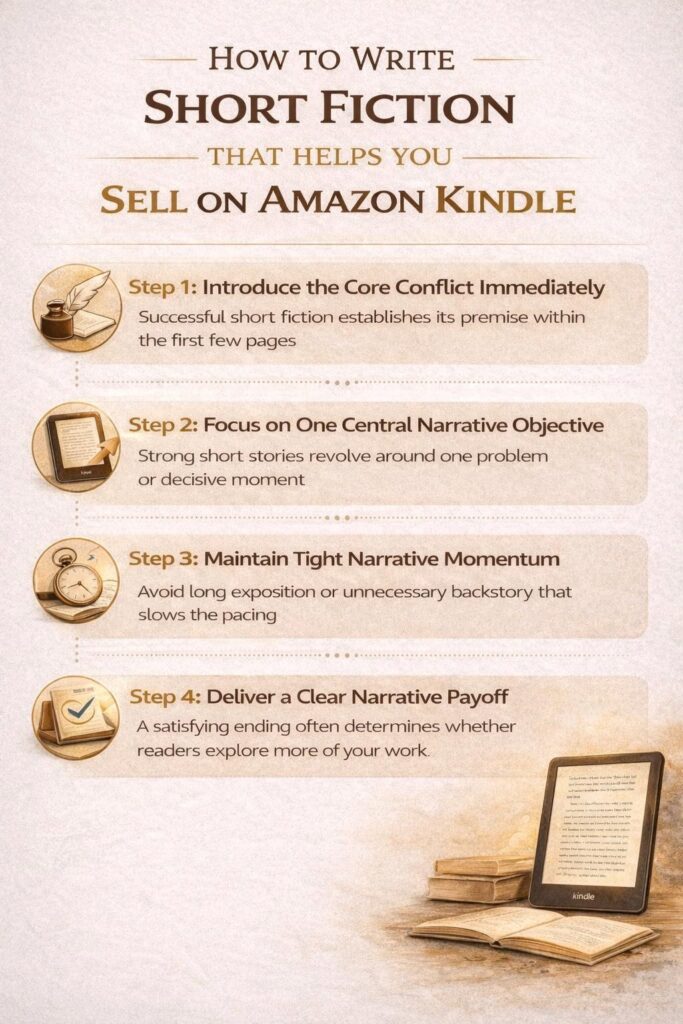
How to Write Short Fiction That Helps You Sell on Amazon Kindle
Writing short fiction for the Kindle marketplace requires a slightly different structural approach than writing longer works. Readers expect the story to establish its premise quickly and deliver a complete narrative experience within a limited number of pages. Authors who want to understand how to sell on Amazon Kindle often discover that the writing itself must follow a tighter, more deliberate structure.
Step 1: Introduce the Core Conflict Immediately
Successful short fiction establishes the premise within the first few pages. Kindle readers often decide very quickly whether the story feels engaging enough to continue.
Step 2: Focus on One Central Narrative Objective
Short stories rarely have room for multiple subplots. The strongest pieces revolve around one problem, one emotional tension, or one decisive moment.
Step 3: Maintain Tight Narrative Momentum
Every paragraph should move the story forward. Long exposition or unnecessary background can slow pacing and reduce reader engagement.
Step 4: Deliver a Clear Narrative Payoff
The ending must feel intentional. Whether through emotional closure or a surprising twist, the resolution often determines whether readers explore more of an author’s work.
When these structural elements align, even a short piece of fiction can deliver a satisfying reading experience that keeps readers turning pages.
How to Upload and Sell Your Story Using Amazon KDP
Publishing a short story on Kindle is technically straightforward. The platform itself is designed so that authors can upload and distribute books without needing a traditional publisher. However, the difference between simply uploading a story and positioning it effectively often determines whether the book gains visibility.
For authors learning how to sell on Amazon Kindle, the process typically follows a few key steps.
Step 1: Prepare the Manuscript and Cover
Before uploading, the story should be properly formatted for Kindle reading devices and paired with a cover that clearly signals the genre. Readers often decide whether to click on a listing within seconds, so visual clarity matters.
Step 2: Create the Book Listing in KDP
Inside the Kindle Direct Publishing dashboard, authors add the book title, description, categories, and keywords. These elements influence how the story appears in search results and recommendation algorithms.
Step 3: Set Pricing and Distribution
Authors then choose a price and decide whether to enroll the story in Kindle Unlimited. Pricing should reflect both the story’s length and reader expectations for short fiction.
Step 4: Review the Book Preview Before Publishing
The Kindle previewer allows authors to confirm that formatting appears correctly across different devices.
Although the upload process itself is simple, many authors eventually discover that metadata, categories, and listing strategy have a significant impact on visibility. This is one reason some writers later explore Amazon KDP publishing services when they want to position their books more effectively within the Kindle marketplace.
How to Sell Short Stories on Amazon Without Getting Lost in the Marketplace
Publishing a story is only the beginning. The Kindle store contains millions of titles, and most short stories disappear quickly if they are not positioned for discoverability. This is where many authors realize that understanding how to sell short stories on Amazon involves far more than uploading a manuscript.
Visibility usually depends on a few strategic elements that influence how readers encounter a book.
Choose Categories That Reflect Reader Behavior
Amazon categories function like shelves in a bookstore. When a story appears in the right genre section, readers who already enjoy that type of fiction are far more likely to discover it.
Authors should look closely at where similar short stories appear and choose categories that match both the story’s tone and reader expectations.
Write a Description That Highlights the Premise
Many book descriptions summarize the plot but fail to emphasize the story’s central hook. Kindle readers often scan descriptions quickly, so the opening lines should clearly communicate the premise and emotional stakes.
Build Early Signals of Reader Interest
Reviews, downloads, and reader engagement help Amazon’s recommendation system decide which books to promote. Even a small number of early reviews can influence whether a story begins appearing alongside similar titles.
Approaching discoverability strategically helps ensure that a short story has a realistic chance of finding its audience rather than remaining buried within the Kindle catalog.
Kindle Short Story Pricing Strategy: What Authors Should Charge
Pricing is one of the most misunderstood aspects of Kindle publishing, especially for short fiction. Many new authors assume that lowering the price will automatically increase sales. In practice, pricing affects perceived value, reader expectations, and impulse purchasing behavior.
In the Kindle marketplace, readers make fast decisions. A price that feels misaligned with the length or genre of the story can discourage clicks even before the reader explores the description.
Understanding how pricing works within the short fiction ecosystem helps authors position their stories more effectively.
Typical Kindle Pricing for Short Stories by Length
Most successful short fiction titles follow fairly predictable pricing patterns. These ranges have gradually emerged across the Kindle marketplace because they match reader expectations for different story lengths.
| Story Type | Typical Word Count | Common Kindle Price |
| Flash Fiction | 3,000–7,000 words | $0.99 |
| Standard Short Story | 8,000–15,000 words | $0.99 – $1.99 |
| Novella | 15,000–30,000 words | $1.99 – $2.99 |
| Short Story Collection | 25,000+ words | $2.99 – $4.99 |
Pricing significantly below these ranges can signal low value, while pricing above them may reduce impulse purchases.
How Kindle Reader Expectations Influence Pricing
Readers browsing short fiction typically expect a quick, satisfying narrative experience. Because the reading time is shorter than a full-length novel, the price must feel proportionate.
Several factors influence reader perception:
- Genre expectations – romance and thriller readers often accept quick reads
- story length – longer stories support higher price points
- author reputation – established authors can price slightly higher
- series connection – stories linked to a larger series may justify a higher price
Aligning price with these expectations helps readers feel confident in the purchase.
When Kindle Unlimited Can Help Short Fiction Visibility
Many authors also enroll short stories in Kindle Unlimited, where readers borrow books rather than purchasing them outright.
This strategy can help:
- increase early visibility
- encourage reader discovery
- build a new author’s audience
Although payouts per page read fluctuate, Kindle Unlimited sometimes helps short fiction gain traction by exposing the story to readers who might not otherwise purchase a standalone short work.
When pricing and distribution align with reader expectations, short fiction can compete effectively within the larger Kindle marketplace while still offering strong value to readers.
How Long Should a Short Story Be for Amazon Kindle Publishing
Amazon does not impose strict word-count requirements for Kindle ebooks, but reader expectations still influence what tends to perform well in the marketplace. The most important factor is not the exact number of words but whether the story delivers a complete narrative experience.
Readers purchasing short fiction usually expect a quick but satisfying narrative arc. When a story feels rushed or incomplete, reviews often reflect that frustration even if the idea itself is strong.
What Word Count Works Best for Kindle Short Stories
Most Kindle short fiction falls within ranges that allow the story to develop a clear beginning, conflict, and resolution. While flash fiction can work in some genres, stories that are extremely short sometimes struggle to justify a paid listing unless they are bundled into collections.
Stories that move closer to novella length typically provide more space for character development and stronger narrative payoff.
Why Story Structure Matters More Than Exact Word Count
From an editorial perspective, the success of a short story depends more on structure than length. A tightly paced narrative with a clear premise, escalating tension, and a satisfying ending will often perform better than a longer story that struggles to maintain momentum.
Readers rarely focus on the exact number of words. Instead, they judge whether the story feels complete.
How Kindle Authors Decide the Right Story Length
Many successful Kindle authors determine length by the scope of the story itself. A concept built around a single twist or emotional moment may only require a few thousand words, while a more complex idea involving multiple characters may naturally expand into novella territory.
Ultimately, the goal is simple: deliver a narrative that feels intentional and satisfying within the reading time the audience expects from short fiction.
Why Most Kindle Short Stories Never Sell
Many authors assume that once a story is published on Kindle, readers will eventually discover it. In reality, most short fiction receives little attention after launch. Understanding how to sell short stories on Amazon Kindle requires recognizing that the platform behaves less like a traditional bookstore and more like a recommendation-driven marketplace.
Once a story goes live, its visibility depends heavily on early reader signals. Without those signals, even well-written stories can remain largely invisible.
Limited Algorithm Visibility After Publication
One of the most common reasons short stories fail is simple algorithmic invisibility. Amazon’s recommendation system tends to promote titles that show early engagement through downloads, page reads, and reviews. When a book launches quietly with little activity, it often struggles to appear in recommendation feeds.
For example, a mystery short story reviewed during a recent publishing consultation had a compelling premise and strong pacing but generated only a handful of sales in its first month. The issue was not the writing itself. The story had simply failed to generate enough early reader activity for Amazon’s algorithm to surface it alongside similar titles.
Publishing Only One Story Limits Momentum
Another pattern frequently seen among new Kindle authors is the “single-story launch.” An author publishes one short story and waits to see whether it sells.
In practice, successful Kindle authors rarely rely on a single title. They often build a small catalog within the same genre so that when one story begins attracting readers, Amazon’s recommendation system can connect those readers to additional books by the same author.
A science fiction author we worked with experienced this firsthand. His first short story generated minimal activity for weeks. After releasing a second story set in the same fictional universe, both titles began appearing in each other’s “also bought” recommendations, which gradually increased visibility.
Weak Launch Strategy and Reader Signals
Visibility also depends on early momentum. Reviews, downloads, and reader engagement all influence whether Amazon begins recommending a book to similar audiences.
Authors who coordinate early reader feedback or promote their launch through newsletters and genre communities often see stronger initial activity than those who publish quietly.
Because building visibility organically can be difficult, some writers eventually explore book marketing services to strengthen their launch strategy and reach readers more effectively.
When writing quality, algorithm visibility, and reader momentum align, short fiction has a far better chance of gaining traction within the Kindle marketplace rather than remaining buried among millions of competing titles.
FAQs
Can you publish a single short story on Amazon Kindle?
Yes. Amazon Kindle Direct Publishing allows authors to publish standalone short stories as ebooks without requiring a minimum number of pages. Many writers use individual stories to introduce readers to a character, genre niche, or series before releasing longer works or story collections.
Do short stories actually sell on Amazon?
Short stories do sell on Amazon, particularly in genres like romance, mystery, thriller, science fiction, and horror. Success usually depends on clear genre positioning, a compelling cover, and effective discoverability rather than story length alone. Many authors also publish multiple stories within the same genre to build visibility.
How much can you earn from Kindle short stories?
Earnings vary widely depending on genre demand, pricing, and reader visibility. Some authors earn modest side income from individual stories, while others use short fiction to attract readers to larger series or collections. In many cases, short stories work best as part of a broader publishing strategy.
Is Kindle Unlimited good for short fiction?
Kindle Unlimited can help short fiction gain visibility because readers can borrow books without purchasing them individually. Although the payout per page read fluctuates, the program sometimes allows new authors to reach readers who may not normally purchase a standalone short story.
Conclusion
Selling short fiction on Kindle is less about simply uploading a manuscript and more about understanding how the platform functions as a digital marketplace. Authors who succeed typically approach short stories with a clear strategy: they write focused narratives that fit recognizable genres, package the book with strong visual and descriptive signals, and build momentum through consistent publishing.
For writers trying to understand how to sell short stories on Amazon Kindle, the key insight is that visibility and positioning often matter as much as the story itself. When the manuscript, cover, categories, and launch strategy align with reader expectations, even a relatively short piece of fiction can find its audience.
Many authors discover that navigating these decisions becomes easier with professional guidance. The editorial and publishing team at Writers of the West works with authors at every stage of the process, from refining manuscripts to preparing books for successful Kindle releases. For writers who want their stories to reach readers rather than disappear into the marketplace, experienced publishing support can make a meaningful difference.