Introduction: Why Most Short Stories Fail Before They Even Reach Amazon
Most short stories fail on Amazon for reasons that have nothing to do with talent.
After reviewing hundreds of manuscripts and auditing countless KDP listings, I can say this clearly: the problem is almost always positioning. Writers focus on uploading the file. Retail success depends on structure, metadata, pricing, and early conversion signals.
If you are researching how to publish a short story on Amazon, you are entering a competitive search-driven marketplace, not a creative workshop. Discoverability depends on how well your story is engineered for Amazon’s ecosystem.
Short fiction magnifies every mistake.
Handled strategically, it can build authority quickly. Handled casually, it undermines credibility just as fast.
This guide approaches short story publishing from a professional, retail-first perspective.
What You’ll Learn in This Guide
Publishing short fiction on Amazon is not just an upload process. It is a positioning strategy. In this guide, you’ll learn:
- How to prepare a short story for Amazon KDP so it meets commercial standards
- How to structure your KDP listing for stronger indexing and discoverability
- How to choose categories that improve ranking probability
- How to price short fiction without undermining perceived value
- How to use Kindle Unlimited strategically
- How to avoid the most common mistakes that limit short story sales
If you’re serious about how to publish a short story on Amazon professionally, this guide walks through the full retail framework, not just the technical steps.
How to Prepare a Short Story for Amazon KDP Before Publishing
Preparation is where most short story releases quietly succeed or fail. Kindle Direct Publishing makes uploading simple, but Amazon is a competitive retail environment. If the manuscript is not structurally sound, professionally edited, and technically clean, visibility will not compensate for weakness.
Before you focus on keywords, categories, or pricing, you must ensure the story can withstand reader scrutiny. Short fiction magnifies every flaw because there is no room for distraction. The margin for error is smaller than in a novel.
This stage is not cosmetic. It determines whether your release builds credibility or collects preventable criticism.
How Long Should a Short Story Be on Amazon?
Amazon does not enforce a strict minimum word count for short fiction, but reader expectations vary by genre.
In commercial fiction categories, most successful short stories range between 5,000 and 15,000 words. Stories under 3,000 words often struggle unless clearly positioned as flash fiction or part of a larger collection.
When evaluating length, consider:
- Whether the story delivers a complete narrative arc.
- Whether the ending feels earned rather than abrupt.
- Whether pricing aligns with perceived narrative weight.
- Whether the genre supports shorter formats.
Length alone does not determine success. Narrative density and reader satisfaction matter more than raw word count.
If a story feels compressed but complete, it is ready. If it feels shortened for convenience, it likely needs further development.
How to Evaluate Whether Your Short Story Is Structurally Ready for Retail Readers
A short story must feel intentional and complete. Readers tolerate brevity only when the narrative arc delivers resolution and movement.
Use this structural diagnostic process before publishing:
- Write one sentence that defines the protagonist’s objective.
- Write one sentence that defines the central obstacle.
- Identify the moment where stakes intensify.
- Identify the emotional or situational shift in the final section.
- Confirm that the ending resolves narrative pressure even if the conclusion is open.
If you struggle to define these elements clearly, the structure likely lacks clarity.
Next, test narrative compression:
- Remove one full scene and evaluate whether the story still functions.
- Highlight every paragraph that does not introduce tension or escalation.
- Cut repetitive emotional reflection.
- Replace passive summary with active conflict.
Short fiction often fails because it explains instead of moves. Structural readiness is about escalation and payoff, not word count.
Professional book editing services focus heavily on compression integrity because short fiction cannot absorb structural inefficiency.
How to Edit a Short Story to Meet Commercial Publishing Standards on Amazon
Editing short fiction requires a disciplined sequence. Polishing language before resolving structure creates surface refinement without impact.
Follow this professional editing workflow:
Step 1: Structural Pass
- Map the story into beginning, escalation, and resolution.
- Ensure each scene changes stakes or information.
- Clarify character motivation.
- Strengthen the ending so it feels earned rather than abrupt.
Step 2: Line Editing Pass
- Eliminate redundant phrasing.
- Replace passive constructions with active verbs.
- Tighten dialogue so each exchange carries tension.
- Remove filler qualifiers such as “seemed,” “felt,” or “almost.”
Step 3: Continuity and Logic Check
- Verify character names and timelines.
- Confirm POV consistency.
- Ensure setting details remain stable.
- Remove contradictions introduced during revision.
Step 4: Proofreading Pass
- Correct grammar and punctuation.
- Review dialogue formatting.
- Check paragraph spacing consistency.
Short fiction that skips the structural pass often reads like a draft polished for grammar but not strengthened for narrative clarity. Retail readers do not differentiate between “almost ready” and “ready.” They respond to the experience.
How to Format a Short Story for Kindle Devices and Print Without Triggering Negative Reviews
Formatting is not decorative. It directly affects readability and perception of professionalism. Many negative reviews on short fiction reference formatting inconsistencies rather than story quality.
Before uploading to KDP, complete this formatting checklist:
Manuscript Preparation
- Use consistent paragraph styles rather than manual tabs.
- Remove extra spaces between paragraphs.
- Standardize font and size.
- Align scene breaks consistently.
Layout Cleanliness
- Avoid forced page breaks that disrupt Kindle flow.
- Keep front matter minimal and professional.
- Place additional titles or calls to action at the back.
Device Validation
- Upload the file to Kindle Previewer.
- Review mobile view first.
- Check tablet layout.
- Look for spacing irregularities or indentation errors.
Print-Specific Considerations
- Select an appropriate trim size.
- Confirm margin requirements.
- Review spine width before finalizing the cover.
- Order and inspect a proof copy before approval.
Short fiction is often consumed on mobile devices. Poor spacing and inconsistent indentation become immediately visible. Clean formatting communicates competence. Inconsistent formatting signals haste.
Authors who want additional technical oversight sometimes have their files professionally reviewed before release to avoid preventable formatting complaints.
How to Decide Whether to Publish Ebook Only or Add a Paperback Edition on Amazon KDP
Short stories do not automatically require a print edition. Strategic format selection depends on genre behavior, production quality, and brand positioning.
Begin with competitive analysis:
- Review the top 20 short stories in your subcategory.
- Note how many are ebook-only.
- Compare average print page counts.
- Evaluate price differences between formats.
Next, assess physical viability:
- Will your formatted manuscript exceed 80 to 100 pages?
- Will the paperback have a visible spine?
- Does the print price align with buyer expectations in your category?
- Does the product feel substantial rather than thin?
Very thin paperbacks can reduce perceived value rather than increase authority.
Finally, consider strategic purpose:
- Is this short story part of a broader catalog?
- Do you plan to sell physical copies at events?
- Does your audience prefer digital convenience?
- Are you building a long-term print brand presence?
If the release is experimental or funnel-based, ebook-only often provides greater flexibility for pricing adjustments and metadata updates. If the story supports a larger brand ecosystem, print may strengthen positioning.
Format selection should enhance authority, not dilute it.
How to Create an Optimized Amazon KDP Listing for a Short Story
Uploading a manuscript to Kindle Direct Publishing creates a product page. Optimizing that page determines whether readers ever see it.
Many writers assume discoverability depends on luck. In reality, visibility depends on how effectively your listing aligns with Amazon’s indexing system and buyer behavior. Title structure, category selection, backend keywords, and description formatting all influence ranking and conversion.
If your short story is structurally sound but your listing is weak, Amazon will not reward it with exposure.
How to Write a Title and Subtitle That Improve Amazon Search Visibility
Your title and subtitle are indexed aggressively by Amazon’s search engine. They must balance clarity, genre signaling, and natural language flow.
Follow this structured process:
- Identify your primary genre descriptor.
- Review the top-ranking short stories in your subcategory.
- Note how they structure subtitles.
- Avoid stacking multiple genre keywords unnaturally.
- Ensure the subtitle reads like a human sentence, not a search string.
For example, a subtitle such as “A Psychological Thriller of Obsession and Betrayal” communicates tone and genre clearly. In contrast, a subtitle like “Short Story Thriller Suspense Mystery Crime Fiction” signals inexperience.
Avoid repeating the exact title phrase in the backend keyword fields. Amazon already indexes title text. Redundancy does not improve ranking and may dilute clarity.
Your objective is not to insert as many keywords as possible. Your objective is to create a searchable, readable product name that signals relevance and authority.
How to Choose Amazon Categories That Increase Ranking Probability
Category selection determines your competitive landscape. Choosing a broad fiction category places your short story against thousands of established titles. Strategic category calibration increases your chance of visibility.
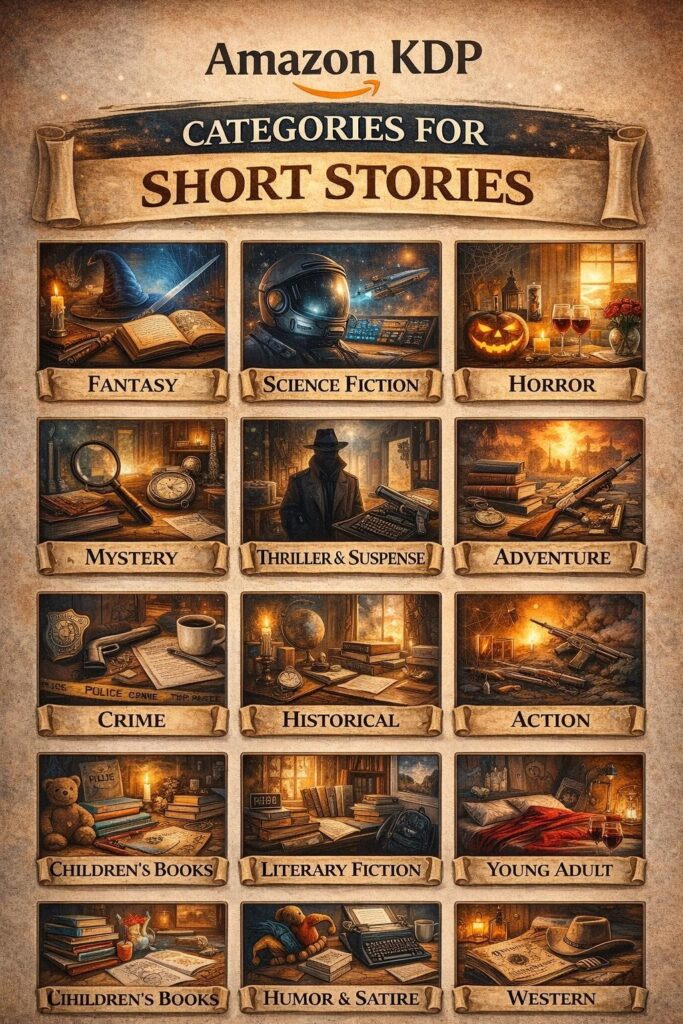
Use this procedure:
- Navigate to your target subgenre on Amazon.
- Analyze the top 20 ranking titles.
- Record average review counts.
- Identify price clustering patterns.
- Determine whether short fiction is common in that category.
If top-ranking books have thousands of reviews and your release has none, ranking probability is low.
Instead:
- Look for niche subcategories with moderate competition.
- Select categories that closely match tone and theme.
- Avoid categories that conflict with genre expectations.
- Monitor performance for 30 days before making adjustments.
Category precision improves discoverability more effectively than broad exposure.
Table: Amazon Category Competition Comparison for Short Stories
| Category Type | Typical Competition Level | Review Threshold to Rank | Ranking Difficulty | Best For |
| Broad Fiction | Extremely High | 1,000+ reviews | Very Difficult | Established authors |
| Subgenre | High | 300–800 reviews | Moderate | Mid-list authors |
| Micro-Niche | Moderate | 50–300 reviews | Achievable | New short story releases |
| Thematic Subcategory | Variable | 100–500 reviews | Strategic | Targeted audience positioning |
This table illustrates why broad exposure rarely benefits a new short story. Precision categories allow ranking traction with lower review thresholds. Ranking traction improves visibility. Visibility improves sales velocity.
How to Select Backend Keywords That Expand Discoverability
Backend keywords allow you to target search phrases not visible in the title or subtitle. This is where strategic modeling matters.
Before entering backend keywords:
- Type your core phrase into Amazon’s search bar.
- Record autosuggest suggestions.
- Identify phrase variations buyers actually use.
- Avoid duplicating words already present in your title.
- Exclude subjective claims such as “best” or “top.”
Use backend fields to expand reach into related search behavior. For example, if your short story is a psychological thriller, backend phrases might include thematic variations rather than repeating the main genre term.
Many poorly optimized listings repeat the same phrase across title, subtitle, and backend fields. That does not improve indexing. It reduces diversity of discoverability.
If your goal extends beyond basic publishing and you are learning how to self publish a short story competitively, backend keyword discipline is one of the most overlooked advantages.
How to Write a Short Story Description That Converts Browsers Into Buyers
Your description does not influence indexing directly as strongly as title and keywords, but it heavily influences conversion rate. Conversion rate affects ranking stability.
A strong description should:
- Open with a hook, not background exposition.
- Introduce stakes within the first paragraph.
- Avoid summarizing the entire plot.
- Maintain tight formatting for readability.
- End with a subtle call to action.
Follow this structured outline:
- Opening hook that introduces tension.
- Brief escalation of stakes.
- Indication of consequence or dilemma.
- Close with intrigue rather than explanation.
Avoid long blocks of unbroken text. Short paragraphs improve readability on mobile devices.
This is also where many authors later seek support from book marketing services when conversion underperforms. Often, the issue is not marketing reach but weak description structure.
Conversion strength compounds visibility.
How to Structure Your Amazon Author Profile for Additional Visibility
Many writers neglect the Amazon Author Central profile. While it does not directly determine ranking, it strengthens credibility and internal linking across titles.
Before launch:
- Ensure your author bio is professional and concise.
- Upload a high-quality author photo.
- Link all titles to your author profile.
- Include a short description of your genre focus.
Consistency across titles strengthens brand recognition. Even in short fiction publishing, authority accumulates across releases.
If your goal is not merely to upload but to build presence, treat your listing and profile as interconnected assets.
How to Price and Launch a Short Story for Maximum Visibility on Amazon
Pricing and launch sequencing determine whether your short story gains early traction or disappears quietly into Amazon’s catalog.
Many authors focus heavily on writing and listing optimization but treat pricing and launch as secondary decisions. In reality, early conversion rate and sales velocity influence visibility far more than formatting precision alone.
If you want sustained performance rather than a brief spike, pricing and launch must be engineered.
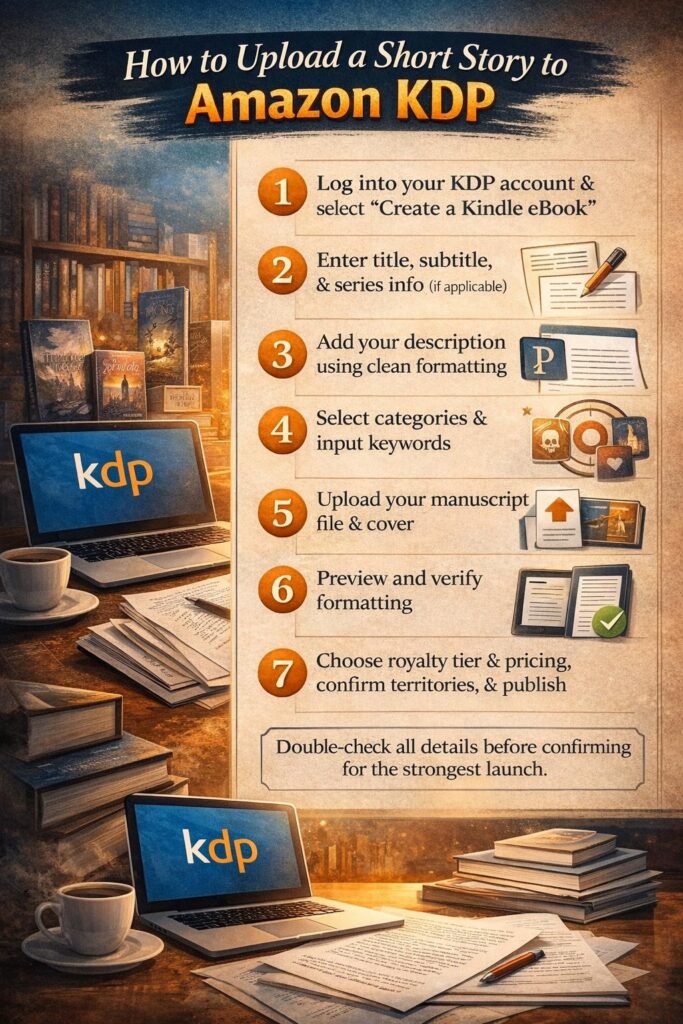
How to Upload a Short Story to Amazon KDP Step by Step
Once your manuscript and listing details are ready, the upload process inside Kindle Direct Publishing is straightforward. The complexity lies in preparation, not the dashboard itself.
Follow this sequence:
- Log into your KDP account and select “Create a Kindle eBook.”
- Enter your title, subtitle, and series information if applicable.
- Add your description using clean paragraph formatting.
- Select relevant categories and input backend keywords.
- Upload your manuscript file and cover.
- Use Kindle Previewer to validate formatting.
- Choose royalty tier and pricing.
- Confirm territories and publish.
Do not rush this stage. Double-check metadata accuracy before submitting. Early mistakes in categories, keywords, or pricing can affect launch momentum.
The upload takes minutes. The preparation determines performance.
How to Price a Short Story on Amazon to Maximize Conversion and Royalties
Pricing is not simply about affordability. It signals value, determines royalty percentage, and influences buyer psychology.
Amazon KDP offers 35% and 70% royalty tiers depending on pricing thresholds. Before selecting a price, you should evaluate three variables:
- Word count and perceived narrative weight
- Genre pricing norms
- Strategic role of the short story
Begin with category benchmarking:
- Review the top 20 short stories in your subgenre.
- Record their price range.
- Note whether higher-priced shorts still convert well.
- Compare word counts when available.
If your short story is positioned as a standalone experience, underpricing can signal disposability. Readers often associate extremely low pricing with low production value.
If your short story functions as a funnel into a series, a lower price may increase read-through and long-term revenue.
Below is a simplified comparison framework:
Table: Short Story Pricing and Royalty Strategy on Amazon KDP
| Pricing Tier | Royalty Percentage | Best Use Case | Perceived Value Impact |
| $0.99 | 35% | Series entry or promotional release | Low authority signal |
| $1.99–$2.99 | 70% eligible | Standard short fiction pricing | Balanced positioning |
| $3.99+ | 70% | Long short story or premium niche | High confidence signal |
Pricing should reflect positioning, not insecurity.
How to Use Kindle Unlimited Strategically for Short Fiction
Kindle Unlimited introduces a different revenue model based on pages read rather than individual purchases. This can be advantageous in certain genres but ineffective in others.
Before enrolling in KDP Select, evaluate:
- Whether top-performing titles in your category are KU-exclusive
- Whether your genre encourages binge reading
- Whether your short story connects to additional titles
- Whether exclusivity aligns with your broader distribution goals
Short fiction can perform in Kindle Unlimited, but page-read economics matter. A very short manuscript will generate fewer pages per reader, which affects payout potential.
Consider the strategic intent:
- If this release is part of a planned multi-title ecosystem, KU may amplify read-through.
- If the story stands alone and you plan broader distribution later, exclusivity may restrict growth.
Below is a structured comparison.
Table: Kindle Unlimited vs Wide Distribution for Short Stories
| Distribution Model | Revenue Type | Visibility Advantage | Strategic Limitation |
| KDP Select (KU) | Sales + Page Reads | Algorithmic exposure within KU | 90-day exclusivity |
| Wide Distribution | Direct sales only | Broader platform presence | No KU visibility |
Enrollment should follow analysis, not assumption.
How to Publish a Short Story on Amazon to Trigger Early Visibility Signals
Amazon rewards early performance. If your short story generates immediate conversion activity, the algorithm is more likely to surface it in category rankings and recommendation feeds.
Launch preparation should begin before publication day.
Focus on:
- Securing early readers willing to leave honest reviews
- Confirming your product page is fully optimized before release
- Aligning launch timing mid-week when retail activity is steady
- Ensuring pricing is finalized before initial traffic arrives
Avoid frequent metadata changes during the first two weeks. Stability helps Amazon evaluate performance signals more clearly.
If visibility underperforms despite strong listing optimization, the issue often lies in weak early traction. This is where strategic book marketing services sometimes become relevant, particularly for authors launching within competitive categories.
Visibility is rarely random. It is often the result of preparation.
How to Monitor Early Performance Without Overreacting
After launch, resist the impulse to make constant adjustments.
Monitor:
- Sales rank trends rather than daily fluctuations
- Conversion rate indicators
- Review acquisition pace
- Kindle Unlimited read-through, if enrolled
Allow at least 14 days before making structural changes unless a clear technical issue exists.
Many short stories lose momentum because authors change pricing, categories, or descriptions too quickly. Consistency allows the algorithm to process engagement patterns.
The Hidden Reasons Most Short Stories Fail on Amazon
Understanding how to publish a short story on Amazon is only part of the equation. Many short stories are uploaded correctly and still fail to gain traction. The causes are rarely mysterious. They are structural, strategic, and predictable.
After reviewing underperforming KDP listings across multiple genres, recurring patterns emerge. Weak positioning, inconsistent publishing decisions, and avoidable metadata mistakes limit visibility long before writing quality becomes the issue.
Short fiction magnifies strategic errors. The margin for recovery is smaller than many writers expect.
How to Position a Short Story on Amazon KDP for Higher Conversion
Positioning determines whether readers immediately understand what they are buying. Amazon shoppers make decisions quickly. If genre, tone, and narrative promise are unclear, conversion drops.
Effective positioning requires alignment across:
- Cover design and subgenre expectations
- Title clarity and tone consistency
- Description structure and emotional stakes
- Category selection
- Pricing logic
Compare your listing directly with the top-ranking titles in your category. If your cover appears disconnected from genre norms or your description fails to communicate tension clearly, readers hesitate.
Strong writing does not compensate for weak presentation. Retail clarity builds trust. Ambiguity weakens it.
How Early Reviews Influence Short Story Ranking on Amazon
Early reviews affect both buyer confidence and engagement signals. A short story that launches without review preparation often struggles to gain algorithmic traction.
Amazon’s ranking system responds to behavior patterns. When early readers leave thoughtful, guideline-compliant reviews, conversion improves.
Before launch:
- Identify trusted readers willing to provide honest feedback.
- Confirm the manuscript is final before distributing copies.
- Ensure review requests comply with Amazon policies.
If a short story receives traffic but fails to convert, the absence of social proof is often a contributing factor. Reviews stabilize ranking momentum. They do not create success alone, but they reinforce it.
How Category Strategy Impacts Short Story Visibility on Amazon
Category placement is frequently misunderstood. Broad fiction categories offer exposure but reduce ranking probability for new releases.
If your short story enters a competitive category dominated by thousands of reviews and high sales velocity, it disappears quickly.
Strategic category selection involves:
- Reviewing review counts of top-ranking titles.
- Estimating realistic competition thresholds.
- Selecting niche subcategories where traction is achievable.
- Avoiding irrelevant placements chosen solely for exposure.
Ranking within a focused and relevant category often produces more meaningful visibility than competing in a crowded one.
How Editing Quality Impacts Short Story Reviews and Retention
Short fiction amplifies editorial imbalance. Structural gaps, pacing inconsistencies, or abrupt endings are more visible in compressed narratives.
Two patterns commonly undermine performance.
The first is underediting. The story feels rushed. Character motivation lacks clarity. Resolution arrives too quickly.
The second is overediting. In tightening prose, voice and emotional texture are reduced.
Writers often focus on how to get a short story published but underestimate how editing quality shapes long-term reception. Readers respond to clarity supported by authenticity. Precision should strengthen voice, not erase it.
Once negative reviews accumulate around editorial weaknesses, recovery becomes difficult.
How Long-Term Publishing Strategy Determines Short Story Success on Amazon
Short fiction performs best when integrated into a broader publishing strategy. Standalone releases without connection to future work struggle to sustain authority.
Evaluate whether your short story:
- Connects to an upcoming release.
- Reinforces a consistent genre identity.
- Includes a preview or cross-reference to related titles.
- Encourages continued reader engagement.
When short stories function within a cohesive catalog plan, reader lifetime value increases. Each new release strengthens the previous one.
If long-term visibility is the goal, some authors seek structured support from Amazon KDP publishing services to ensure metadata alignment, catalog cohesion, and release sequencing are coordinated strategically. Execution consistency compounds over time.
Publishing momentum grows through alignment. Fragmented strategy forces every new title to rebuild from zero.
Frequently Asked Questions About Publishing Short Stories on Amazon
Can you self publish a short story on Amazon?
Yes. Kindle Direct Publishing allows authors to upload short fiction directly without a traditional publisher. You submit your manuscript, enter metadata, choose categories, set pricing, and publish. While the process is simple, strong editing, formatting, and category strategy are essential for competitive visibility.
How long should a short story be for Amazon KDP?
Most commercially viable short stories range between 5,000 and 15,000 words. Very short works under 3,000 words must be clearly positioned as flash fiction to meet reader expectations. Narrative completeness matters more than strict word count.
How much royalty does Amazon pay for short stories?
Amazon pays either 35% or 70% royalties depending on pricing and territory eligibility. Stories priced within the qualifying range typically earn 70%. If enrolled in Kindle Unlimited, authors also earn income from pages read.
Is Kindle Unlimited worth it for short fiction?
Kindle Unlimited can benefit short stories that connect to a series or larger catalog. Standalone short fiction may generate limited page-read revenue. Enrollment should reflect genre norms and long-term publishing goals.
How to self publish a short story professionally?
Learning how to self publish a short story professionally requires more than uploading a file. Authors should focus on structural editing, clean formatting, optimized metadata, strategic pricing, and planned launch timing to compete effectively.
How to get a short story published successfully on Amazon?
Writers often ask how to get a short story published, but publication alone is not enough. Success depends on positioning, category selection, pricing strategy, and early reader engagement. Uploading is the first step. Strategy drives results.
Conclusion: Publishing Short Fiction with Strategy, Not Guesswork
Learning how to publish a short story on Amazon is not about navigating a dashboard. It is about understanding how Amazon functions as a retail ecosystem.
Short fiction magnifies every decision. Editing discipline, metadata precision, pricing strategy, category alignment, and launch timing all influence visibility. Uploading a file completes the technical requirement. Strategic positioning determines whether readers ever see it.
Writers who approach short story publishing casually often experience inconsistent results. Writers who approach it with structure and long-term planning build momentum with each release.
If you want professional guidance refining your manuscript, optimizing your listing, and launching strategically, the editorial and publishing team at Writers of the West works with authors who take their short fiction seriously.
Publishing should not be guesswork. It should be engineered.