Introduction
Let’s be honest. Querying in 2026 can feel like shouting into a void.
You do everything you are supposed to do. You finish the book. You revise it until the sentences hum. Then you hit the part no one prepares you for. Agents are overwhelmed, submission systems are unforgiving, and the margin for error is thinner than it has ever been. One wrong signal, and your work disappears without a trace.
That is the problem. And it is why so many talented writers stall out before they ever gain traction.
Understanding how to get a literary agent today is not about cracking a hidden code or getting lucky at the right moment. It is about knowing how agents and book marketing services actually operate now. What they look for first. What makes them request pages. What quietly sends a query to the reject pile.
This guide exists to remove the guesswork. By the end, you will know how to prepare your manuscript or proposal properly, research agents who are a genuine fit, build a query package that works in 2026, and handle submissions, silence, offers, and signing without second guessing every move.
Clear. Practical. Built for the reality you are facing.
Do You Actually Need a Literary Agent in 2026?
Before you think about queries, tracking tools, or submission strategy, you need to stop and ask a more basic question. Do you actually need a literary agent for this book, right now?
In 2026, publishing is not a single lane. There are more paths than ever, and choosing the wrong one can cost you time, momentum, and confidence. Finding a book agent only makes sense if it supports what you want, not just because it feels like the “serious” option.
When an Agent Is Non Negotiable
If your goal is a Big Five publisher or a top tier independent press, an agent is required. Many of those publishers are closed to unagented submissions. No clever workaround. No hidden door.
An agent also handles the parts of publishing that first time authors often underestimate. Contract negotiation. Rights strategy. Protection against clauses that can quietly limit your future work. If you want a career, not just a single deal, this support matters.
When You Might Skip the Agent Route
There are real reasons to bypass agents in 2026.
Some respected small presses accept open submissions and offer strong editorial support. Certain nonfiction books can sell directly to publishers when the author brings a clear platform and audience. Direct to reader publishing can also make sense if speed, control, or niche reach matters more than traditional distribution.
None of these choices are lesser. They are only risky when you choose them without intention.
The Agented vs. Unagented Decision Checklist
If you are still unsure, ask yourself a few blunt questions.
Do you want help selling audio, translation, or adaptation rights?
Can you handle long submission timelines and multiple revision cycles?
Are you building a long term writing career, or are you trying to publish this one book?
Answer those honestly, and the rest of the process gets much clearer.
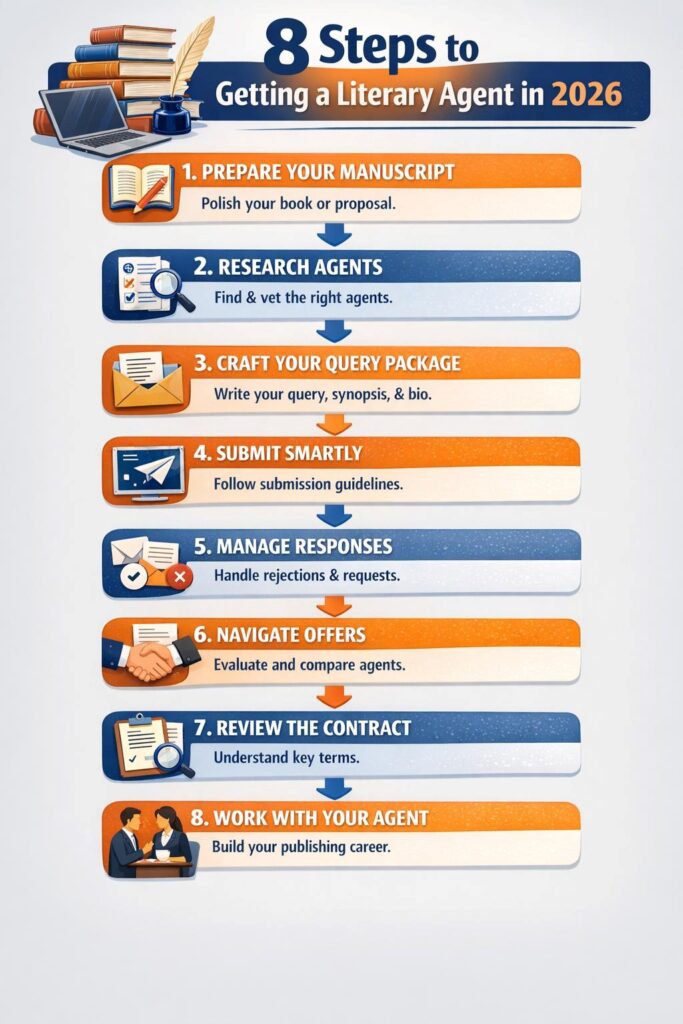
Step 1. Make Your Manuscript or Proposal Query Ready
This step is where most querying mistakes are born. Not because writers are careless, but because they underestimate how ready their work actually needs to be.
Agents move fast. Requests can come quickly. And once they do, there is no grace period to fix fundamentals. Query ready means your material can withstand immediate scrutiny without explanation or apology.
For Fiction
If you are querying fiction, the manuscript must be finished. Not mostly finished. Not waiting on a final polish. Finished, revised, and stable.
That means you have already addressed big picture issues like structure, pacing, and character motivation. You have pressure tested the book through beta readers or critique partners. You have cleaned up obvious technical problems. Agents are not looking for perfection, but they are looking for control.
When an agent asks for pages, they expect what you send to reflect your best professional work, not a draft you are still negotiating with.
For Nonfiction
Nonfiction works differently. In many cases, agents do not want a full manuscript at all. They want a proposal.
A strong proposal explains the idea, defines the market, proves there is demand, and shows why you are the right person to write this book. It includes competitive titles, an outline, platform details, and sample material. Think of it less as a pitch and more as a business case.
If you have never built one before, following a credible book proposal guide can prevent structural mistakes that turn agents off before they reach your writing.
Define Your Market Category Correctly
This part feels abstract, but it drives everything.
Your genre, subgenre, and audience promise tell an agent where your book belongs and who it is for. That positioning affects which agents you query, which editors they pitch to, and how your book is framed inside publishing houses.
If your category is unclear, your query will feel unclear too. Clarity here is not limiting. It is strategic.
Once your material is truly query ready, the rest of the process becomes about alignment, not repair.
Step 2. Build a Smart Agent List (Fit Beats Fame)
This is where the process stops being emotional and starts being strategic.
Most writers think the hard part is writing the book. It is not. The hard part is restraint. Knowing who to query, who to skip, and why. If you treat agent research like a popularity contest, you will burn time and confidence fast. If you treat it like targeted outreach, everything changes.
Learning how to get a literary agent is less about volume and more about precision.
Where to Find Reputable Agents in 2026
You are not guessing. You are cross checking.
Start with agents who are actively asking for work like yours. Look at what they say they want. Then verify what they actually sell. Interviews, wish lists, and agency sites tell you intent. Deal history tells you reality.
You are looking for overlap between those two things. Interest without sales is not enough. Sales without interest usually lead to silence.
How to Verify Legitimacy and Avoid Wasting Time
A legitimate agent does not charge reading fees. They do not upsell editing services. They do not pressure you to move fast or keep things quiet.
They have clear submission guidelines. A visible agency presence. Clients whose books you can find through normal retailers. If any part of that feels vague or evasive, trust that instinct and move on.
You are not being picky. You are being careful.
Use Deal History to Confirm Fit
An agent’s track record should match your category, not just your aspirations.
Look for recent deals in your genre or adjacent spaces. Pay attention to which editors they sell to and which publishers appear repeatedly. One sale years ago is not the same as consistent deal flow.
You are not judging talent. You are assessing momentum.
Build a List in Tiers
This keeps you grounded when nerves spike.
Tier A agents are a near perfect match with active sales in your category. Tier B agents are strong fits with some flexibility. Tier C agents are acceptable fits that expand your reach without diluting it.
This structure lets you query in batches, learn from responses, and adjust without panic.
A smart list does not guarantee an offer. But a careless list almost guarantees frustration.
Step 3. Prepare the Standard Query Package (2026 Edition)
This is the part most writers overthink and under execute.
The query package is not meant to prove you are brilliant. It is meant to prove you are professional, market aware, and worth an agent’s limited time. When this package works, it disappears. When it fails, everything stops here, no matter how strong the book is.
If Step 2 is about who you contact, this step is about what you put in front of them while finding a book agent who actually fits your work.
The Query Letter Purpose and Structure
A query letter has one job. Get the agent to ask for pages.
That is it.
Strong queries are clean and controlled. They open with a clear hook, move into a focused story pitch, establish market awareness through comps, and end with a short bio that adds credibility without noise. Personalization is brief and specific. One or two lines that show alignment, not admiration.
If your query is trying to explain everything, it is doing too much.
The Synopsis Yes Spoilers Included
The synopsis is not marketing copy. It is a diagnostic tool.
Agents use it to see if the story holds together, if the stakes escalate, and if the ending delivers on the premise. That means spoilers are required. Including the ending is required.
Length varies by agent, but clarity always wins. This document should read like a clean map, not a dramatic performance.
Sample Pages That Do Not Get in the Way
Agents read fast. They also stop fast.
Use standard formatting. Normal fonts. No decorative spacing or experimental layouts. The goal is to remove friction, not stand out visually.
Your opening pages should orient the reader quickly, establish voice, and give them a reason to keep going. Confusion here is expensive.
Comparable Titles That Actually Help
Good comps do quiet work.
They show where your book belongs, who reads it, and how it might be positioned. Choose recent titles with a similar audience and shelf placement. Avoid cultural phenomena and once in a generation successes.
You are not claiming equivalence. You are demonstrating awareness.
Author Bio and Platform Only What Serves the Pitch
For fiction, the bio is short. Writing credentials if you have them. Relevant expertise if it informs the work. Nothing else.
For nonfiction, the bio matters more. Platform, authority, and audience access should be clear and concrete. Vague claims of reach do not help. Specifics do.
Every element in the query package should earn its place. If it does not move the agent closer to requesting pages, it does not belong there.
Step 4. Submit Like a Pro (Systems Beat Motivation)
This is where good projects quietly fail. Not because the writing is weak, but because the process is sloppy.
Submission is not the creative part of this journey, but it is the part that exposes how seriously you take it. Agents see patterns all day long. When your submission feels rushed or careless, it signals what working with you might feel like later. Understanding how to get a literary agent includes respecting the systems they use to manage overwhelming volume.
Follow Submission Guidelines Exactly
If an agency asks for a form, use the form. If they specify paste pages instead of attachments, paste them. If they want a synopsis of a certain length, give them that length.
This is not about obedience. It is about friction. Agents use filters, assistants, and standardized workflows. Deviating from guidelines does not make you memorable. It makes you harder to process.
Many queries are rejected before the pages are even read. This is one of the easiest problems to avoid.
Personalization That Is Fast but Real
Personalization does not mean flattery. It means relevance.
One or two lines that reference an interview, a manuscript wish list item, or a recent deal is enough. You are showing that you chose them on purpose, not that you admire them as a concept.
If personalization takes you twenty minutes per query, you are doing too much. If it takes zero effort, you are not doing enough.
Batch Querying With Intention
Sending queries in controlled batches gives you leverage.
If the first group produces only form rejections, that is information. If you receive partials or personalized feedback, that is information too. Adjusting your materials early can save you from burning through your entire list with the same problem.
Batching is not about playing it safe. It is about staying responsive instead of reactive.
Track Everything
You need a system, even a simple one.
Track who you queried, when you queried, what materials you sent, and what their response policies are. This prevents duplicate submissions, missed nudges, and unnecessary anxiety.
Disorganization creates stress that has nothing to do with your writing. Remove it.
Submitting well does not guarantee success. But submitting poorly almost guarantees frustration. This step is about reducing avoidable loss so your work has a fair shot to speak for itself.
Step 5. Manage Responses, Silence, and Requests
This is the phase that tests your patience more than your talent.
Once queries are out, control disappears. You cannot speed up inboxes or predict taste. What you can do is respond professionally, interpret signals accurately, and avoid sabotaging your own momentum while you wait.
Rejections and What They Actually Mean
Not all rejections carry the same information.
Form rejections are neutral. They mean the project was not right for that agent at that moment. Personalized rejections matter more. They suggest engagement, even if the answer is still no. A revise and resubmit is rare and meaningful. It means the agent sees potential but needs changes before committing.
Do not treat every no as a referendum on your ability. Treat it as data.
If rejections are consistent and fast, something may be off in the query or opening pages. This is where stepping back or even considering hiring professional book editor support can help identify issues you are too close to see.
No Response Policies and When to Nudge
Many agents operate on a no response means no policy. Others welcome nudges after a stated period. The key is knowing which is which before you follow up.
Check each agent’s guidelines carefully. A polite nudge after the appropriate time is professional. Repeated follow ups or ignoring stated policies is not.
Silence is frustrating, but it is not personal. It is structural.
Partial and Full Requests
Requests are the signal you are waiting for. Treat them with care.
Respond promptly and send exactly what the agent asked for. Do not revise unless requested. Do not explain changes you wish you had made. Let the work stand.
If multiple requests come in, track them carefully. Consistency matters. You want every agent reading the same version of the book unless you are explicitly asked to revise.
This stage is about steadiness. Calm responses, clean communication, and patience under uncertainty. That professionalism is part of what agents notice, even when they do not say it out loud.
Step 6. When You Get the Call: Offers, Comparisons, and Decision Day
This is the moment every querying writer imagines. The email subject line that makes your heart spike. The request to talk. The call.
It is exciting. It is validating. It is also the point where you need to slow down, not speed up. An offer is not the finish line. It is the start of a decision that can shape years of your writing life.
What Happens on an Offer Call
An offer call is not just a yes.
The agent will talk about their vision for the book, the changes they think it needs, and how they would position it in the market. They may outline a submission strategy, mention editors they have in mind, or explain how hands on they are editorially.
Pay attention to how they talk about revision. Do their notes make the book clearer and stronger, or do they feel generic and rushed. You are not looking for praise. You are looking for insight.
This is also your chance to ask questions. Communication style. Timeline expectations. How often they check in. There are no bonus points for staying quiet.
How to Notify Other Agents
Once you have an offer, you must let other agents with your query, partial, or full know.
This is standard practice. It is not rude or aggressive.
Send a short, professional note saying you have received an offer of representation and are setting a decision deadline. Give a clear date. Usually one to two weeks is reasonable unless the offering agent specifies otherwise.
This step often triggers faster reads and additional offers. That is normal. Do not downplay it or apologize for it.
Evaluating Multiple Offers Clearly
If more than one agent offers, emotion can take over fast. This is where structure matters.
Compare agents based on evidence, not just enthusiasm. Look at their sales history in your category. Consider how their editorial feedback aligns with your vision. Review contract terms carefully, including commission, termination clauses, and scope of representation.
Also consider subrights. Audio, translation, and adaptation strategy can make a significant difference over time.
If you are uncertain about any part of the contract or process, educate yourself. Resources like a reliable book proposal guide or industry specific contract breakdowns can help you ask better questions and avoid blind spots.
Decision Day
There is rarely a perfect choice.
Every agent will come with strengths and trade offs. The goal is not to find the flawless option. It is to choose the agent whose track record, communication style, and long term thinking align with how you want to work.
Once you decide, notify everyone promptly and professionally. Publishing is a small world, and how you handle this moment will be remembered.
Getting the call feels like arrival. In reality, it is the moment you step into the business side of your career with open eyes.
Step 7. Signing With Confidence Contracts and Red Flags
This is the point where excitement can override judgment if you let it. A contract does not need to be scary, but it does need to be understood. Clear structure helps you see what actually matters and where problems usually hide.
Core Contract Clauses You Need to Understand
- Commission structure
This defines how your agent gets paid. The standard rate applies to domestic deals, but you should confirm how commission works for foreign rights, audio, and other subrights. Ask when commission is taken and how payments are reported so there are no surprises later. - Termination clauses
Termination language explains how either party can end the relationship. Look for clarity, not complexity. You should know how much notice is required and whether termination applies to one project or the entire agreement. - Sunset provisions
A sunset clause determines how long your agent continues to earn commission on deals they negotiated after the relationship ends. This is normal, but the time frame should be reasonable and clearly defined. - Expense policies
Some agents deduct submission or administrative expenses. Others do not. The key is transparency. You should know what expenses are allowed, how they are tracked, and when they are deducted. - Scope of representation
This clause defines whether the agent represents one book or your broader career. Neither option is wrong, but it must align with your expectations and future plans.
If any of these points feel vague or rushed, that is your cue to slow the process down and ask questions.
Red Flags and Scams to Watch Harder in 2026
- Reading or evaluation fees
Legitimate agents do not charge to read your work. Any request for upfront payment is a hard stop. - Impersonation scams
Scammers increasingly pose as real agents or agencies. Always confirm offers through official agency websites or publicly listed contact information before signing anything. - Pressure tactics
Urgency that discourages questions, contract review, or outside advice is not professional behavior. A good agent expects you to take this decision seriously. - Vague or evasive answers
If an agent cannot clearly explain their contract, commission, or process, that lack of clarity will likely carry into the working relationship.
Signing should feel steady, not frantic. When you understand each part of the agreement and why it exists, you are not just saying yes. You are protecting your future work and your peace of mind.
Step 8. After You Sign What Working With an Agent Actually Looks Like
Signing the agreement feels like a breakthrough. In reality, it is a transition. The work does not stop here. It changes shape.
This stage often surprises new authors because it is quieter, more structured, and more collaborative than expected. Hiring a literary agent does not remove responsibility. It reshapes it.
Editorial Phase
- Revision planning
Most agents begin with an editorial letter or detailed notes. This is not a quick polish. It is a strategic revision aimed at strengthening positioning, pacing, and market clarity before editors ever see the book. - Market alignment
Your agent may suggest changes that are not strictly about craft. These revisions often focus on category fit, audience expectation, or sharpening the book’s promise. This is normal and usually necessary. - Pitch materials
While you revise, your agent prepares submission materials for editors. This includes pitch language, comparison titles, and internal positioning. You may be asked for input, but your agent leads this work.
This phase can take weeks or months. That does not mean nothing is happening.
Submitting to Editors
- Submission rounds
Editors are usually approached in planned rounds, not all at once. This allows your agent to manage responses, adjust strategy, and maintain momentum. - Timeline expectations
Editorial responses vary widely. Some come quickly. Others take months. Silence is common and not always negative. - Communication flow
A good agent keeps you informed without overwhelming you. You should know when rounds go out, when responses come in, and when strategy shifts.
This stage requires patience and trust in the process.
Your Role as the Author
- Professional communication
Respond promptly. Ask questions clearly. Avoid emotional reactions in the heat of waiting. Publishing is a long game, and your reputation travels. - Meeting deadlines
When revision deadlines are set, meet them. Reliability matters as much as talent. - Brand consistency
How you show up online, at events, and in professional spaces now reflects on your agent and your future editors. Consistency builds confidence in you as a long term partner.
Working with an agent is not passive. It is a partnership built on clarity, follow through, and mutual respect. When it works well, it feels less like being managed and more like being supported.
If I Can’t Get an Agent: A 2026 Plan B That Still Builds a Career
Not getting an agent does not mean your book failed. It means something in the chain did not connect yet.
This section is about staying productive instead of spiraling. A stalled query process is not an ending. It is feedback, even when it arrives indirectly.
Common Reasons Queries Stall and How to Fix Them
- Concept or market mismatch
Sometimes the writing is solid, but the idea does not land cleanly in the current market. This often shows up as fast, consistent form rejections. Revisit how the book is positioned and whether the concept delivers a clear promise to a specific audience. - The query does not reflect the manuscript
If agents request pages and then pass, the issue is often alignment. The query may be selling a different book than the pages deliver. Tightening this connection can dramatically change outcomes. - The opening pages are not landing
Many projects fail in the first ten pages. Not because the writing is bad, but because the opening is slow, confusing, or misfocused. This is one of the most fixable problems once you identify it.
Smart Next Moves That Actually Help
- Workshop the query and pages
Targeted feedback from experienced writers or industry aware editors can surface blind spots quickly. General praise is not helpful here. You want specific, actionable critique. - Refine comps and category
Updating your comparable titles and sharpening your category can reposition the book without changing a single word of the manuscript. - Strengthen the opening
A tighter first chapter can have an outsized impact. Small structural changes early often do more than line edits across the whole book. - Educate yourself strategically
Following a reliable book proposal guide or query focused resource can help you diagnose structural issues instead of guessing at fixes.
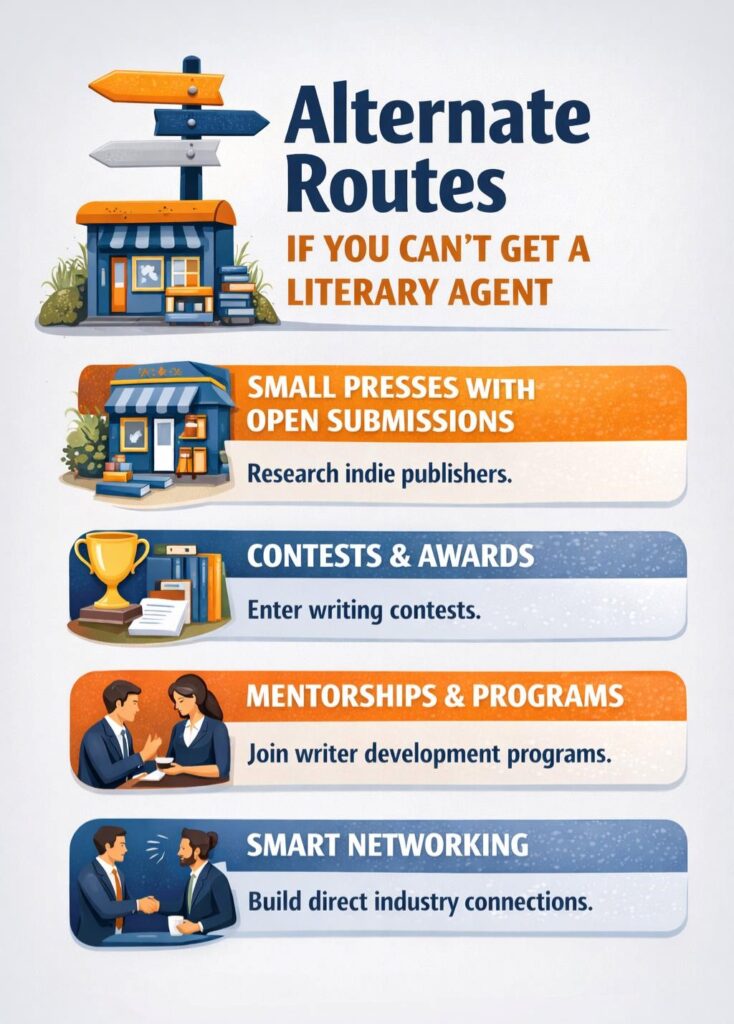
Alternative Routes That Still Build Momentum
- Small presses with open submissions
Many respected presses accept unagented work and offer strong editorial partnerships. Research their lists carefully and submit selectively. - Contests and mentorships
These programs provide validation, feedback, and access. They do not replace agents, but they can open doors. - Strategic networking
Conferences, workshops, and professional communities still matter. Relationships built over time often lead to opportunities that cold querying does not.
A delayed path is not a dead path. The writers who build careers are rarely the ones who succeed immediately. They are the ones who adapt without quitting.
FAQs
How Long Does It Take to Get a Literary Agent in 2026?
There is no clean timeline. Some writers sign within months. Others take a year or more. The difference is rarely talent alone. It usually comes down to market fit, timing, and how targeted the submission strategy is.
Do I Need a Finished Manuscript Before Querying Fiction?
Yes. Agents expect a complete, revised manuscript when querying fiction. Requests can come quickly, and being unprepared signals inexperience.
What Should Be in a Query Letter and How Long Should It Be?
Most effective queries are around 300 to 400 words. They include a hook, a focused story pitch, relevant comparable titles, and a short author bio. The goal is not to explain everything. The goal is to earn a request.
What Is the Difference Between a Synopsis and a Back Cover Blurb?
A synopsis explains the entire story, including the ending. It is a tool for evaluation.
A blurb is marketing copy. It teases without revealing. Mixing the two is a common mistake.
How Many Agents Should I Query at Once?
Small batches work best. Querying in rounds allows you to adjust materials based on feedback instead of sending the same version to everyone at once.
Is QueryTracker Worth Using?
For most writers, yes. It helps track submissions, avoid duplicate queries, and manage response expectations. Organization reduces unnecessary stress.
How Do I Find Agents Who Represent My Exact Genre or Subgenre?
Start with manuscript wish lists, agency websites, and deal research. Look for agents who actively sell books like yours, not just ones who say they are open to it. Precision matters more than volume.
How Do I Research Whether an Agent Is Actually Selling Books Like Mine?
Look at recent deal history and publisher names. Consistent sales in your category are more important than a long client list.
What Are the Biggest Literary Agent Scams to Avoid?
Any request for reading or evaluation fees is a red flag. Impersonation scams are also increasing, so always verify offers through official agency channels.
What Questions Should I Ask on the Call With an Agent?
Ask about editorial approach, submission strategy, communication style, and contract terms. You are evaluating a working relationship, not just an offer.
What Commission Do Literary Agents Typically Take?
The standard commission for domestic deals is 15 percent. Foreign and subsidiary rights may be higher depending on how they are handled. Always confirm specifics in writing.
Can I Submit to Publishers Without an Agent and When Does It Make Sense?
Yes, in certain situations. Small presses, some nonfiction projects, and direct submission opportunities can make sense depending on your goals. Knowing how to get a literary agent also means knowing when an agent is not the right next step.
Conclusion
If you have made it this far, you already know this is not about shortcuts.
Learning how to get a literary agent in 2026 is really about learning how the industry actually works now, not how it worked ten years ago or how social media myths say it works. Preparation matters. Fit matters. Professionalism matters more than almost anything else.
The writers who break through are rarely the loudest or the luckiest. They are the ones who treat this process like a system instead of a gamble. They research before they submit. They revise before they rush. They adjust instead of quitting when something does not land.
An agent is not a prize. They are a partner. The right one helps you reach the best book publishers for your work, protects your long term interests, and positions your career beyond a single deal. The wrong one can stall you just as easily as no agent at all.
Take this process step by step. Use structure when emotions spike. Ask better questions when things feel unclear. And remember this.
Publishing rewards persistence paired with intelligence. You do not need to be perfect. You need to be prepared.