| Written by Margaret Calloway, Senior Editor & Publishing Consultant, Writers of the West
14 years of experience · 200+ completed book projects · memoir, business, nonfiction, leadership · referenced by IBPA and ALLi Last reviewed: March 2026. Based on current Writers of the West project data |
Introduction
Most people trying to figure out how to become a better writer don’t have a motivation problem.
They have a clarity problem.
You can write 1,000 words a day and still not improve. You can read ten books and still struggle to make a point. You can edit the same paragraph five times and still feel like something’s off.
I know this because I did all three.
Early on, I thought improvement meant effort. More writing. More reading. More editing. What actually happened was simpler. I got better at writing the same mistakes faster.
The shift came when I stopped asking: “How do I write more?”
And started asking: “What exactly is wrong with what I’m writing?”
That’s when improvement began.
In this guide, you’ll find practical writing tips, a clear framework for how to improve your writing skills, and a 30-day plan you can start today, whether you’re a beginner or someone who has been writing for years and hit a wall.
| To become a better writer, focus on identifying one repeated mistake, correcting it across your writing, and testing whether those changes hold. Writing more alone does not improve clarity. |
What you’ll find in this guide
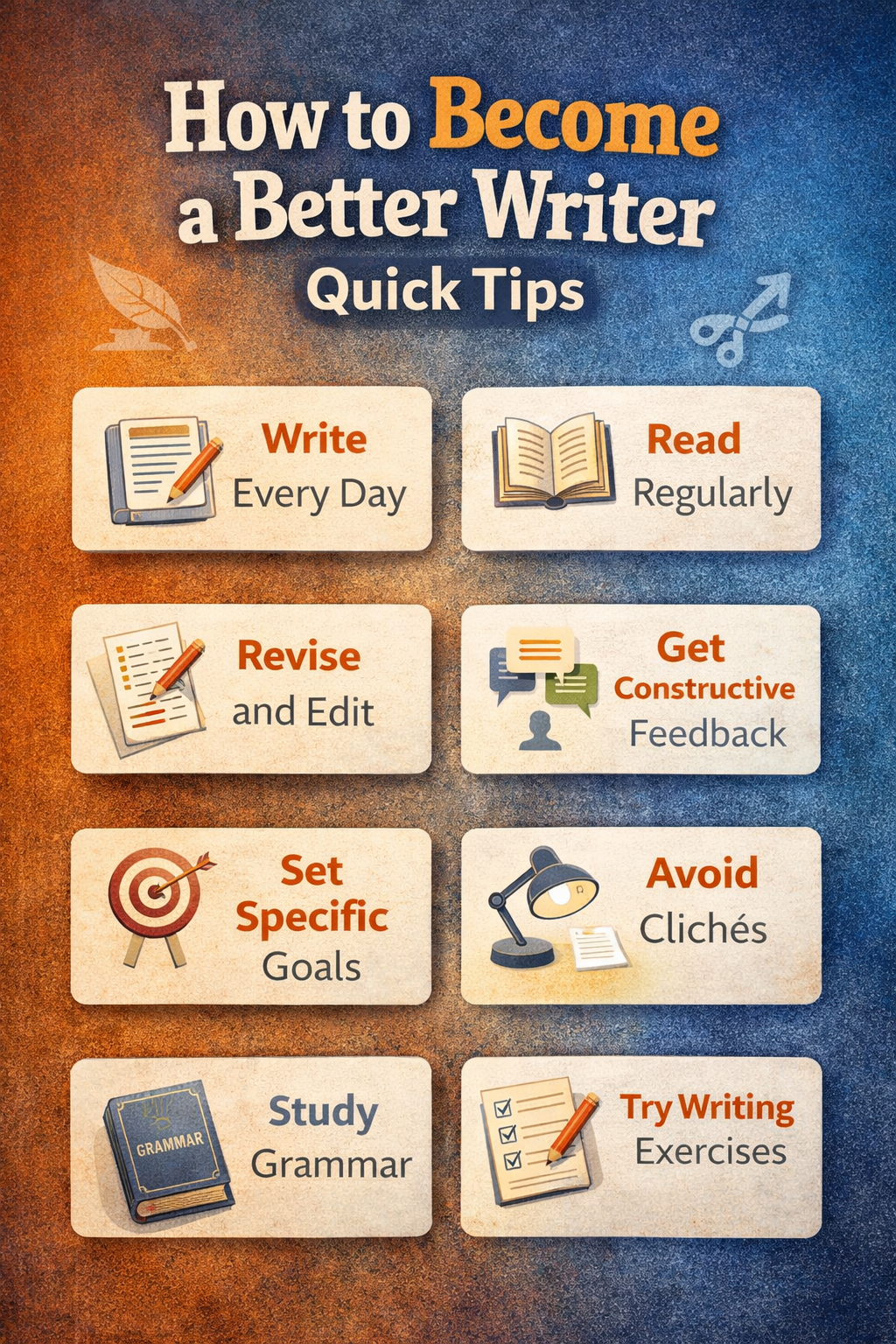
- Quick steps to write better today
- Why writing more doesn’t improve writing skills
- How to practice writing with correction loops
- How to read like a writer (not a passive reader)
- How to structure writing for clarity
- A 30-day plan to improve your writing
- When to get professional help with your writing
- FAQs: common questions about how to write better
How to be a better writer (quick steps that work immediately)
If you want to improve your writing today, not in six months, these writing tips work immediately whether you’re a beginner or have been writing for years:
1. Start every paragraph with the point
Most weak writing hides the idea. New writers often start with background or general statements instead of saying what they mean right away. This makes the reader work harder to understand the point. Clear writing is simpler. Say the main idea in the first sentence, then explain it.
Example:
Before:
“In today’s fast-paced digital environment, businesses are facing a range of challenges…”
After:
“Most businesses struggle because their systems don’t scale.”
Same idea. One is readable. The other isn’t.
2. Stop editing while you’re writing
This is where most beginners get stuck. They write a sentence, then immediately fix it, rewrite it, adjust the tone, and in the process lose momentum. Progress slows, drafts remain unfinished, and improvement never becomes visible. The writing feels active, but it isn’t moving forward. Finish the draft first, then fix it.
3. Fix one mistake across everything you write
This is the fastest way to improve writing skills — and one of the most overlooked writing tips for beginners. Do not try to fix ten things at once. Pick one. If your openings are weak, fix every opening. If your sentences are too long, shorten where needed. Improvement happens faster when one recurring problem is corrected across the entire piece.
4. Read writing for structure, not style
Most writers read like readers. Better writers read like engineers.
They ask:
- where does the point appear?
- how long before clarity shows up?
- what does this paragraph actually do?
That’s where real improvement starts.
Why writing more doesn’t improve writing skills (and what to do instead)
Here’s the uncomfortable truth. Writing more doesn’t fix bad writing. It multiplies it. If the same mistake is in your writing, doing more of it only spreads that mistake across more pages. Improvement doesn’t come from volume. It comes from noticing what’s not working and fixing it.
Why writing every day doesn’t automatically make you better
You can write daily and still repeat the same mistake.
I did this early on. I wrote consistently. Every day. The output improved. The clarity didn’t.
The same issue kept showing up:
- slow openings
- unclear points
- paragraphs that took too long to say anything
I didn’t notice it because I wasn’t looking for it.
What actually improves writing skills in real drafts
Improvement happens when a mistake becomes visible.
In one draft I worked on, almost every paragraph started with background instead of a point.
Fix: Rewrite the first sentence of each paragraph.
That single change:
- reduced repetition
- improved clarity
- made the writing easier to follow
No new content. Just correction.
How to improve writing skills by fixing one pattern?
This is the part most beginners miss. They fix a sentence and move on, thinking the problem is solved. It isn’t. The same issue shows up again in the next paragraph. And the next. What actually helps is stepping back and noticing the pattern. If your writing keeps doing the same thing in different places, that’s the problem you need to focus on. Once you see it clearly, it becomes much easier to fix.
This is where some writers hit a wall and turn to professional ghostwriting services, not because they can’t write, but because they’ve reached the point where they can’t see their own patterns clearly anymore.
How to practice writing and improve writing skills consistently
Practice works. But only if it includes correction.
Why do most writers plateau?
The pattern is predictable:
- you write more
- your sentences get smoother
- your structure stays the same
At 10,000 words, it’s manageable.
At 30,000 words, it becomes repetition.
How to practice writing with correction loops:
Here’s what actually works:
- Write 1,000–2,000 words
- Identify one recurring issue
- Fix only that issue
Example:
Before: “In today’s business world, many teams struggle with decision-making…”
After: “Most teams fail because decisions are delayed.”
Apply that across your writing:
- clarity improves
- sentences shorten
- ideas become easier to follow
Drafting vs correcting: what actually improves writing
| Writing Activity | What Writers Think It Does | What Actually Happens |
| Writing daily | Builds skill | Repeats the same mistakes |
| Editing while writing | Improves quality | Slows progress |
| Finishing full drafts | Feels inefficient | Reveals real problems |
| Fixing one issue across draft | Feels slow | Creates real improvement |
How to improve writing by reading like a writer (not a passive reader)
Why reading doesn’t automatically improve writing skills
Reading increases familiarity with language, but familiarity does not translate into control.
Most writers absorb tone, vocabulary, and rhythm. What actually determines clarity is structural placement. In weaker writing, the main idea appears late, which forces the rest of the paragraph to compensate through repetition.
This is why reading alone rarely improves output. The writer recognizes good writing but does not reproduce how it is built. Research on writing development consistently supports this — passive exposure to language does not transfer to active production without deliberate structural analysis.
How to analyze writing structure instead of style
To use reading as a tool, reduce it to mechanics.
Take a paragraph and identify:
- where the main idea appears
- how long it takes to reach it
- what each sentence is doing
In stronger writing, the first sentence defines the point. In weaker writing, the point appears after context.
Once this is visible, it becomes repeatable.
How to apply reading insights to your own writing
The transfer must be direct.
If strong paragraphs lead with the point, your paragraphs must do the same. If clarity appears within the first sentence, your writing must follow that structure.
This is where writers trying to learn how to write better usually hesitate. They consume strong writing but fail to convert observation into execution.
How to structure your writing for clarity and organization
How to structure writing before you start
Structure is not about outlining everything in detail. It is about deciding what each section is responsible for.
Before writing, the function of the section should be clear. If that function cannot be defined in one sentence, the section will drift once writing begins.
How to keep paragraphs focused and avoid overlap
Paragraphs break when they try to do more than one job.
A paragraph that introduces, explains, and transitions at the same time becomes difficult to follow. The reader cannot identify what matters.
Clarity improves when each paragraph performs a single function. The opening sentence defines the point, and the rest supports it. For example, a paragraph that introduces and explains at the same time usually repeats itself in the second half.
What happens when structure is missing (real example)
A draft that began as a business guide shifted into leadership philosophy midway. The writing itself was competent, but the direction changed without adjustment to earlier sections.
The resolution required removing and rebuilding entire sections, not editing them.
| “Within six months, we restructured and completed a 52,000-word manuscript from a fragmented draft that had stalled for over a year. The book launched in the top 20 of its categories within two weeks.”
Writers of the West, client project, 2025 |
How to revise your writing effectively without making it worse
When to start revising your writing
Revision should begin only after a complete draft exists.
Editing partial sections creates a false sense of progress. The writing improves locally, but the overall structure remains unstable.
How to revise writing in the correct order
Effective revision follows sequence, not preference.
| Stage | What Gets Fixed | Result |
| Structural revision | argument, section roles | repetition decreases |
| Section revision | paragraph clarity | flow improves |
| Line editing | sentence clarity | readability improves |
When this order is reversed, edits do not hold.
Why editing too early slows improvement
In one draft, multiple chapters were refined before the manuscript was complete. Once the full structure was reviewed, those sections were removed.
The issue was not sentence quality. It was that the structure had not been established.
This is where writers begin using professional book editing services, not for grammar, but to correct structural issues that are not visible during drafting.
Drafting vs revising vs editing: what each stage actually does
What drafting is responsible for
Drafting produces material that can be evaluated. It is not meant to be clean or final.
Stopping to refine sentences during drafting interrupts structure before it is visible.
What revising actually changes
Revision adjusts relationships between sections. It removes overlap, aligns direction, and ensures each part contributes to the same argument.
What editing should fix (and when)
Editing improves clarity and readability only after structure is stable. When applied too early, it strengthens sentences that may later be removed.
| Stage | What Happens | What It Should Produce |
| Drafting | Ideas are written in full without interruption | A complete section or chapter that can be evaluated |
| Revising | Structure and flow are adjusted across sections | Alignment between chapters and removal of repetition |
| Editing | Sentences are refined for clarity and readability | Clean, consistent language without changing structure |
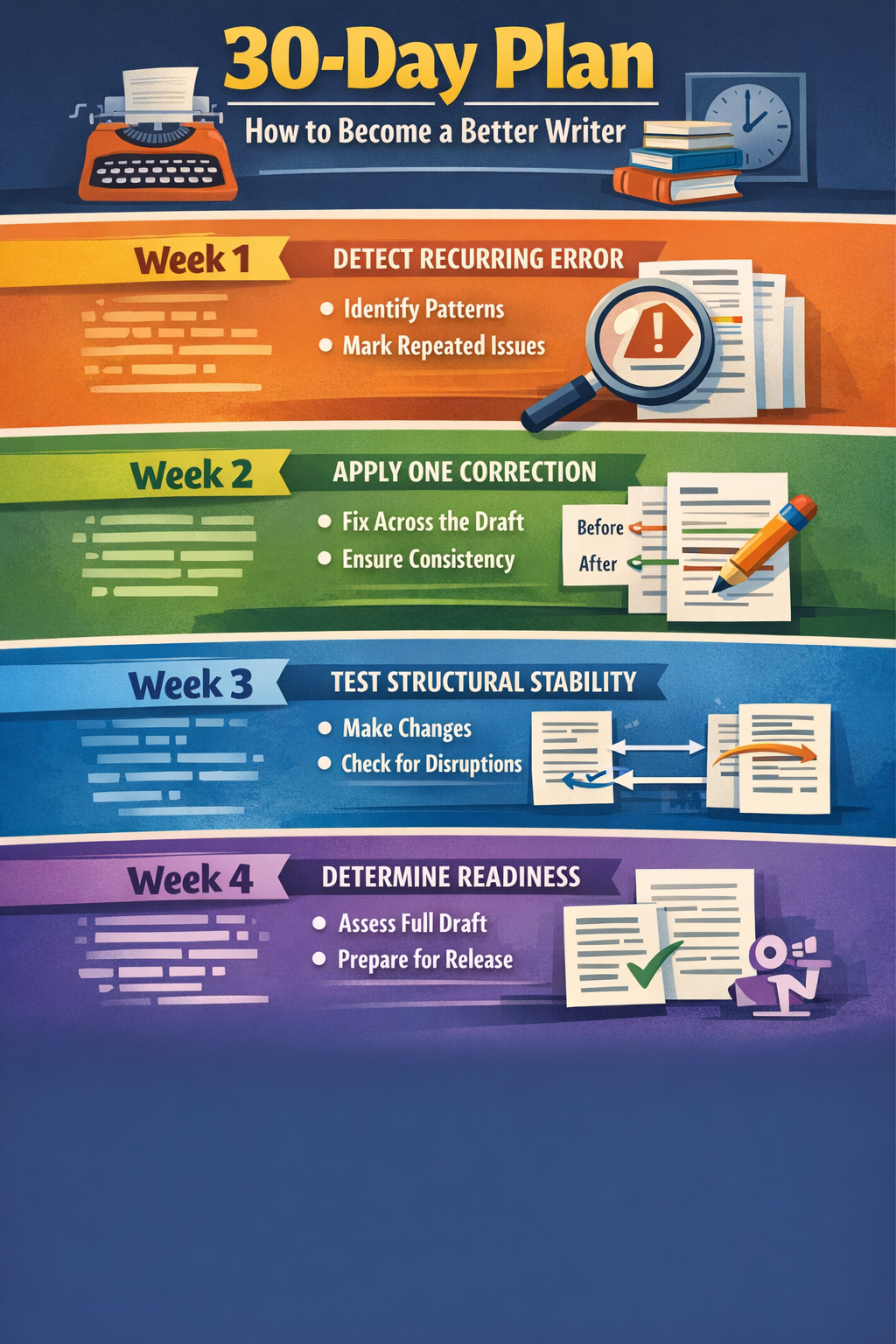
A 30-day plan to become a better writer (step-by-step improvement)
Week 1: identify your biggest writing problem
Improvement begins with isolating a single issue that repeats across your writing.
Review a recent section without editing. The goal is to detect patterns, not fix them. Look for where clarity breaks, where reading slows down, and where ideas repeat.
In early drafts, one dominant issue usually appears across multiple sections. It may be delayed openings, unclear transitions, or paragraphs that expand before committing to a point.
This stage creates visibility. Without it, correction becomes guesswork.
Week 2: correct the issue across your writing
Once identified, the issue must be corrected everywhere it appears.
If the problem is weak openings, then every paragraph must begin with a clear statement. The correction is applied consistently, not selectively.
In practice, this reduces variation. The writing begins to follow a pattern, which makes clarity easier to maintain across sections.
This is where measurable improvement begins. The writing becomes more controlled without adding new content.
Week 3: test whether your writing holds together
At this stage, the goal is not improvement but stability.
Revise one section and observe whether that change affects others. In unstable drafts, adjusting one part introduces inconsistencies elsewhere.
When this happens, the issue is structural, not local. The writing cannot be improved section by section because the underlying alignment is weak.
Stability is reached when sections can be revised independently without breaking the rest of the draft.
Week 4: prepare your writing for real readers
Once the structure holds, attention shifts to clarity at the sentence level.
The writing should now be readable without requiring rework across sections. This is the stage where refinement becomes effective because earlier changes remain stable.
This is also where output becomes relevant. Writers working toward publication begin evaluating readiness, which is where book publishing services enter the process once the manuscript is structurally sound.
This stage is often misread by those trying to learn how to improve writing skills. The writing feels complete before it is stable.
When to get professional help with your writing
Signs your writing has stopped improving
Writers typically reach a point where effort no longer produces change. The same issue persists across drafts, and revisions begin to repeat rather than improve.
When revision stops working
At this stage, changes in one section begin to affect others. Fixes introduce inconsistencies instead of resolving them.
This indicates that the problem is no longer visible from within the draft.
What professional input actually changes
External editing does not focus on sentences first. It identifies structural patterns, removes repetition, and applies corrections across the entire draft.
This is where experienced intervention accelerates progress.
How does Writers of the West train their book writers to Write Better?
At Writers of the West, writing skill is not assumed, it is actively built. Every writer on our team goes through the same development process we recommend to our clients.
Step 1: Read one book outside your genre every month Business writers read memoir. Nonfiction writers read fiction. This breaks genre habits and forces exposure to different ways of structuring ideas and holding a reader’s attention.
Step 2: Review a shared draft as a team Each month the team discusses one draft together — not to line-edit, but to identify where the writing loses the reader and why. Pattern recognition, not style preference.
Step 3: Structural analysis of published work Writers study books that perform well in their category, reverse-engineering how arguments are built, how chapters open, and how reader expectations are managed.
Step 4: Senior feedback on every project Every writer receives structural feedback from a senior editor on each manuscript. The same patterns are tracked across projects, not just corrected once and forgotten.
Step 5: Apply the same correction method we teach Every fix comes with a reason. Writers learn to identify the pattern before the editor does; which is the point.
If you’re interested in our book writing services, get in touch.
FAQs about how to become a better writer
How long does it take to become a better writer?
Improvement does not follow a fixed timeline. In most drafts, visible progress happens only after a recurring issue is identified and corrected across sections. In one manuscript, clarity improved within two revision passes once delayed openings were fixed across all chapters. Without that correction, the draft remained unchanged despite weeks of additional writing.
Why does my writing not improve even though I practice daily?
Daily writing often repeats the same defect. In early drafts, the same structural issue appears across multiple chapters because it was never isolated. In one example, eight chapters used indirect openings. Writing more pages extended the pattern instead of correcting it.
What is the fastest way to improve writing skills?
Speed comes from correcting one issue across the entire draft. In one revision, rewriting only the first sentence of each section reduced repetition and improved clarity without changing the rest of the content. Targeted correction produces faster results than general practice.
Is reading enough to become a better writer?
Reading increases familiarity but does not change output unless structure is extracted. Writers who focus only on tone tend to reproduce surface patterns. In reviewed drafts, this results in controlled language but delayed points and repeated explanations.
Do I need editing help to improve my writing?
Not always. Early improvements come from identifying and correcting recurring issues. External editing becomes necessary when changes in one section create inconsistencies in another, indicating structural instability across the draft.
Conclusion: how to become a better writer without repeating the same mistakes
Most writers don’t fail because they lack ability. They fail because the same problem is carried through the entire draft without being corrected.
Across manuscripts, the pattern is consistent. The issue appears early, repeats across chapters, and becomes harder to fix as the draft grows. Writing more does not resolve it. Editing at the sentence level does not resolve it.
Improvement happens when the defect is identified, corrected across the draft, and tested for stability.
That is the difference between writing more and actually learning how to become a better writer.
| About the Author
Margaret Calloway – Senior Editor & Publishing Consultant, Writers of the West Margaret has 14 years of experience in book publishing and has overseen more than 200 author collaborations at Writers of the West across memoir, business, leadership, health, and nonfiction. Before joining the firm she held senior editorial roles at two independent publishing houses. She has worked with first-time authors, executives, physicians, and public figures on books that reached Amazon bestseller lists across multiple categories. Her publishing work has been referenced in discussions hosted by the Independent Book Publishers Association (IBPA) and the Alliance of Independent Authors (ALLi). writersofthewest.net Professional Ghostwriting Services, Book Editing & Publishing Guidance |