Introduction
Most articles trying to answer what it costs to publish a children’s book do one of two things. They quote a low number to sound encouraging, or they quote a high number to sound authoritative. The problem is that neither approach helps you make decisions.
If you have seen figures from $500 to $25,000, you are not imagining it. Both can happen. What changes is not “publishing.” What changes is production quality, illustration scope, rights structure, and whether the project is built to compete or simply to exist.
After working on hundreds of children’s projects, from bedtime picture books to chapter-book series designed for Amazon scalability, I can tell you the truth most surface-level cost posts skip: children’s publishing gets expensive when decisions are made out of sequence. It becomes efficient when decisions are made like a production pipeline.
This article will give you a realistic, U.S.-market cost structure, show you what actually drives the total, and help you budget for a book that looks professionally published rather than self-assembled.
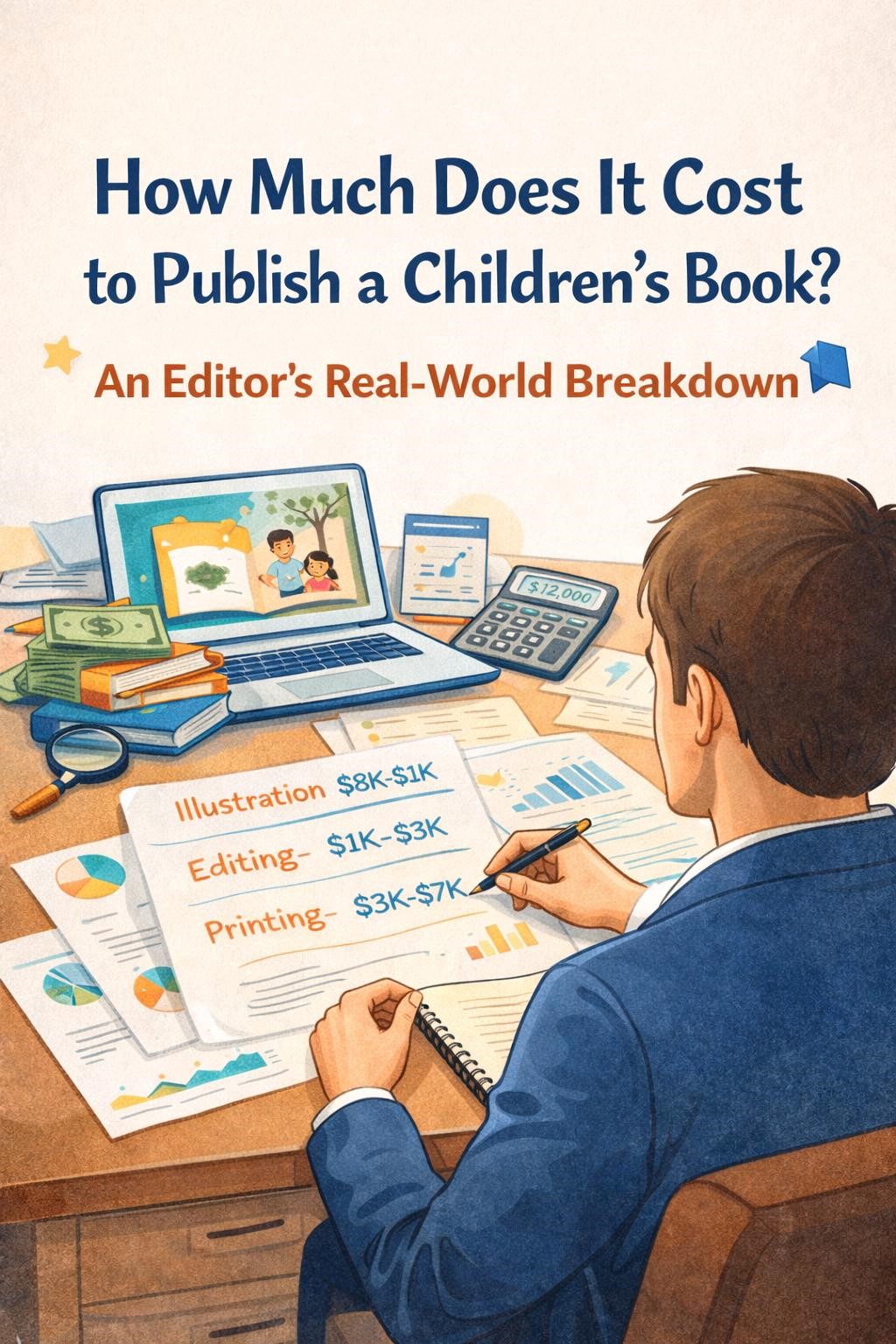
How Much Does It Cost to Publish a Children’s Book in 2026?
In today’s U.S. market, professionally produced children’s books typically fall into three practical tiers.
Table 1: Budget tiers at a glance
| Tier | Typical investment | Best for | What you’re really buying |
| Lean Professional | $6,000 to $9,000 | First-time authors with disciplined scope | Solid editing, an emerging illustrator, professional design, POD distribution |
| Mid-Range Competitive | $9,000 to $15,000 | Authors serious about retail parity | Experienced illustration, strong editing, print-ready files, launch positioning |
| Premium Brand Build | $15,000 to $25,000+ | Authors building series or IP | High-end illustration, rights clarity, brand strategy, stronger marketing infrastructure |
Most serious authors land in the mid-range for one simple reason: it is the point where your book can sit next to traditionally published titles without signaling “DIY” through visual cues. That visual credibility matters more in children’s categories than almost anywhere else.
Why Publishing a Children’s Book Often Costs More Than Publishing a Novel
New authors often assume shorter manuscripts cost less. In children’s publishing, the opposite is common. An 800-word picture book can cost more to produce than an 80,000-word novel, because children’s books are not text products. They are visual products with narrative pacing built through art and design.
How Illustration Impacts the Cost of Publishing a Children’s Book
In a picture book, illustration carries plot, tone, and page-turn tension. A standard 32-page picture book often needs 12 to 16 full spreads, consistent character design, scene continuity, and print-ready files. Professional illustrators typically quote by project scope and rights, not by how quickly they can sketch.
How Children’s Book Design and Layout Increase Publishing Costs
Picture books require precise trim safety, bleed control, typography that reads cleanly at a child’s distance, and layout decisions that protect the art. A novel can survive “good enough” formatting. A picture book cannot, because every flaw is visible.
How Full-Color Printing Increases the Cost of Publishing a Children’s Book
Color shifts, low resolution, and poor margin control show up immediately in print proofs. Parents notice. Retail buyers notice. Librarians notice.
I have watched authors attempt to save money by hiring the cheapest illustrator they can find, only to discover that the art cannot be printed cleanly or that the contract does not allow commercial expansion. The rework often costs more than doing it properly the first time.
Children’s Book Publishing Cost Breakdown by Line Item
When people ask what it costs to self-publish a children’s book, they usually want to understand the line items. Here is how the budget behaves in a professional workflow.
Developmental Editing: $1,000 to $3,000
Yes, even for short manuscripts. In children’s publishing, developmental editing is about rhythm, pacing, and page-turn structure. Most first drafts fail in predictable ways: too much explanation, a moral that lands like a lecture, a flat middle, or text that competes with illustration space.
This is also the phase where you protect the illustration budget. If the story structure is not locked before art begins, changes later get expensive. This is why we link editorial planning to professional developmental editing services when authors ask where money is best spent first.
Line Editing and Copyediting: $500 to $1,500
Children’s language is deceptively hard. When a sentence is short, every word is doing heavy lifting. Editing tightens cadence, removes redundancy, and keeps the voice natural without becoming sing-song.
Illustration: $3,000 to $12,000+
For picture books, illustration is usually the largest cost driver. Pricing depends on experience, complexity, number of spreads, and the rights structure. Low quotes can be legitimate, but they often come with limits: fewer revision rounds, partial rights, or non-commercial licensing.
Book Design and Layout: $1,000 to $3,000
This is where text and illustration become a print-ready product. Designers manage bleed, trim safety, typography, and file prep for KDP or offset printers. DIY layout often leads to text drifting into unsafe margins, color mistakes, or rejected files.
Cover Design: $500 to $1,500
Your cover has two jobs: signal age category instantly and win the thumbnail battle on Amazon. A beautiful interior cannot overcome a weak cover in a crowded search result.
ISBN, Barcode, and Distribution Setup: $125 to $295+
Many U.S. authors buy ISBNs to control imprint identity. You may need separate ISBNs for paperback, hardcover, and ebook.
Printing: Variable
Print-on-demand often lands around $3 to $6 per unit for common picture book specs. Offset printing can lower unit cost but requires upfront capital and demand confidence.
When evaluating overall children’s book production costs, illustration scope and editing depth remain the two primary variables that move your total the most.
Table 2: Typical line-item ranges
| Line item | Lean range | Competitive range | Notes that change cost |
| Developmental editing | $1,000 to $1,800 | $1,800 to $3,000 | Structure, revisions, pacing work |
| Line/copy edit | $500 to $900 | $900 to $1,500 | Voice precision, complexity |
| Illustration | $3,000 to $6,000 | $6,000 to $12,000+ | Detail level, rights, revisions |
| Layout/design | $1,000 to $1,800 | $1,800 to $3,000 | Fixed layout, print specs |
| Cover design | $500 to $900 | $900 to $1,500 | Brand consistency, retail parity |
| ISBN/setup | $125 to $295 | $295 to $600 | Editions, imprint control |
| Proofing/QC | $300 to $600 | $600 to $1,200 | Color checks, multiple proofs |
Children’s Book Publishing Costs by Book Type
Not all children’s books carry the same production burden.
Table 3: Cost by book type
| Book type | Typical word count | Illustration density | Estimated production range | Main cost driver |
| Picture book (32 pages) | 500 to 1,000 | Full color spreads | $8,000 to $18,000 | Illustration and design |
| Early reader | 1,000 to 3,000 | Spot art | $6,000 to $12,000 | Editing plus design |
| Chapter book | 5,000 to 15,000 | Minimal | $4,000 to $9,000 | Editing and cover |
| Middle grade | 20,000 to 50,000 | Limited or none | $3,500 to $8,000 | Editing and positioning |
If you are publishing a picture book, your budget needs to be art-first and production-first. If you are publishing a chapter book, your budget leans more editorial, because readers are buying story and voice with less visual dependency.
Break-Even Math: The Conversation Many Blogs Skip
Most cost guides stop at expenses. That is not enough. You also need unit economics.
A simplified example for a picture book:
- Retail price: $14.99
- Printing and distribution: varies by specs
- Royalty per unit: often around $3.00 to $4.00 in common scenarios
If you invest $12,000 and your net royalty is $3.50 per copy, break-even is roughly 3,429 copies. That can be realistic when you have an audience strategy and positioning. It is rarely realistic when you publish and hope the algorithm discovers you.
Table 4: Break-even snapshots
| Total investment | Net per book | Break-even units | What makes it easier |
| $8,000 | $3.50 | 2,286 | Strong category targeting, reviews, school outreach |
| $12,000 | $3.50 | 3,429 | Email list, launch plan, consistent ads |
| $18,000 | $3.50 | 5,143 | Series strategy, partnerships, broader distribution |
Traditional Publishing vs Self-Publishing a Children’s Book
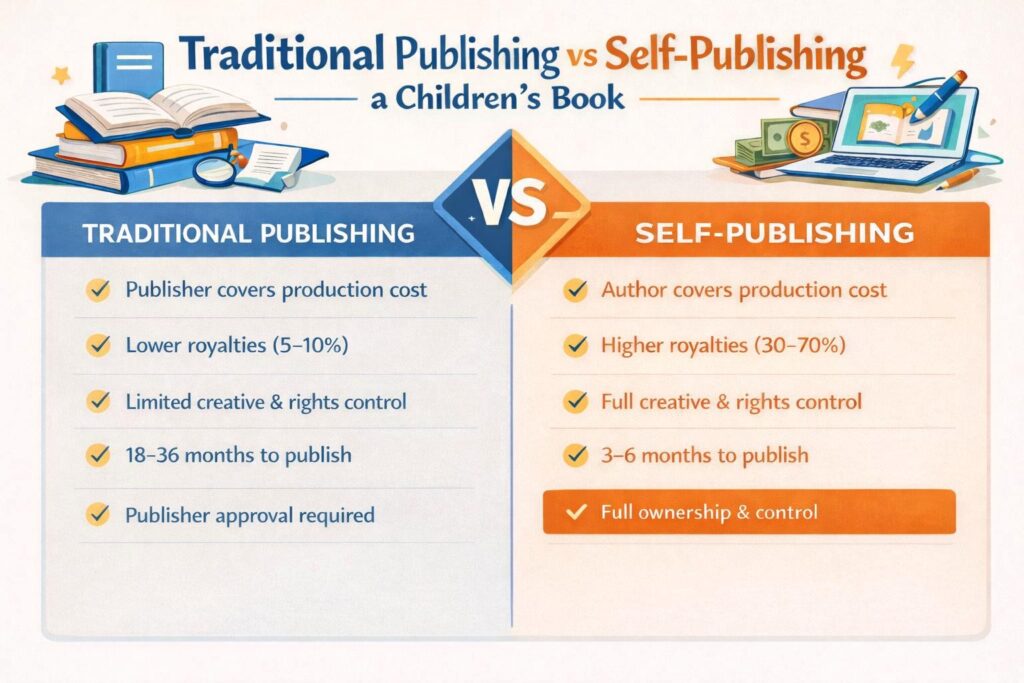
Traditional publishing can reduce upfront cost, but it is not “free.” It is a trade. You exchange control, timeline, and a portion of earnings for access and distribution.
Traditional paths commonly involve:
- Lower royalties per unit
- Less control over illustration direction
- Longer production timelines, often 18 to 36 months
- Lower ownership over certain rights in some deals
Self-publishing shifts costs to you upfront but increases speed, control, and royalty potential. If your question is how much it costs to self-publish a children’s book, the answer is not that self-publishing costs less. The answer is that self-publishing makes you the producer, and producers fund production.
The Hidden Cost of Illustration Rights in Children’s Book Publishing
Most ranking articles talk about illustration price but skip the part that becomes expensive later: rights.
Illustration agreements can include:
- Work-for-hire (you own the art)
- Exclusive commercial license (you can use it commercially, but ownership stays with the artist)
- Limited license (restricted by print run, territory, or derivative use)
In the real world, this matters. I have seen authors plan a board book edition, a foreign translation, or merchandise, only to discover their contract blocks derivative work. The renegotiation cost can exceed the original illustration budget.
If you are building long-term IP, the difference between a $5,000 and a $7,500 illustration contract is often ownership scope. This is one reason serious teams insist on rights clarity before a single spread is approved.
Why Some Children’s Books Fail While Others Succeed in Children’s Book Publishing
After reviewing hundreds of children’s manuscripts, launch campaigns, and Amazon listings, I can tell you that success in children’s book publishing is rarely accidental.
Two books can share the same trim size, price, and word count. One struggles to pass 50 sales. The other builds steady momentum and funds a sequel.
The difference is not talent alone. It is structure, positioning, and professional execution.
Below are the most common factors that determine why some children’s books fail while others succeed.
Poor Positioning in the Children’s Book Market
One of the most frequent causes of underperformance is weak positioning.
A thriving children’s book clearly signals:
- Age range
- Emotional benefit
- Reading context
- Problem it addresses
A failing book often has:
- A vague subtitle
- Broad category placement
- A generic description
- No specific parental benefit
Parents do not search for “heartwarming story.” They search for “bedtime book for anxious toddlers” or “starting kindergarten picture book.” Clear positioning improves discoverability and conversion. Ambiguity reduces both.
As an editor, I often spend as much time refining subtitle clarity as refining prose. In children’s publishing, positioning affects sales more than poetic phrasing.
Low Production Quality in Children’s Book Publishing
Production quality is one of the most visible differentiators in children’s book publishing.
Typography balance, margin spacing, illustration cohesion, print color accuracy, and trim precision are immediately noticeable.
Books that fail frequently exhibit:
- Text placed too close to trim lines
- Inconsistent illustration style
- Amateur layout decisions
- Low-resolution artwork
Parents may not consciously analyze these details. They simply perceive the book as “less polished.”
Books that succeed meet professional production standards from cover to final page. They look indistinguishable from traditionally published competitors.
Professional production is not vanity. It is a trust signal.
Weak Manuscript Structure and Inadequate Developmental Editing
Children’s books rely heavily on pacing and page-turn tension. When structural editing is skipped or minimized, weaknesses remain visible.
Common structural flaws include:
- Overexplained lessons
- Flat emotional arcs
- Abrupt endings
- Repetitive language patterns
In my experience as an editor, manuscripts that succeed commercially have been refined through multiple structural passes.
Authors sometimes assume that because a manuscript is short, it requires less editing. In reality, brevity magnifies flaws.
Investing in structural clarity before illustration begins prevents expensive rework later and improves long-term viability.
Ineffective Children’s Book Marketing Strategy
Many children’s books fail not because they are poorly written, but because marketing begins too late.
Understanding how to market a self-published book in the children’s category requires recognizing that the buyer is often an adult.
Successful children’s book marketing strategies typically include:
- Early review generation
- Targeted Amazon category selection
- Parent or educator outreach
- Clear keyword alignment in metadata
Books that thrive rarely rely on organic discovery alone. They launch with momentum.
From a publisher’s perspective, marketing must be designed into the production timeline, not added after upload.
Unrealistic Sales Expectations and Poor Break-Even Planning
Another common reason children’s books stall is unrealistic financial expectation.
Publishing a picture book for $12,000 and expecting immediate national traction without an audience base creates pressure that undermines long-term strategy.
Books that thrive often:
- Build gradually
- Accumulate reviews steadily
- Develop series potential
- Leverage school or community channels
Books that fail are often treated as one-time events rather than assets with lifecycle planning.
Publishing is not only creative work. It is strategic investment.
Failure to Think Beyond a Single Title
In children’s book publishing, sustainability often depends on ecosystem thinking.
Authors who succeed typically consider:
- Character continuity
- Sequel potential
- Brand identity
- Educational extensions
- Reader community building
Books positioned as standalone passion projects can succeed, but books positioned within a broader brand strategy have greater probability of long-term performance.
As an editor, I encourage authors to think in terms of trajectory, not just launch.
The Publishing Pattern That Determines Long-Term Success
After years of evaluating children’s publishing outcomes, the pattern is clear.
Children’s books succeed when:
- Positioning is specific
- Production quality is professional
- Structural editing is thorough
- Marketing begins before publication
- Financial expectations are realistic
They fail when shortcuts are taken in these areas.
Cost alone does not determine outcome. Strategic allocation does. Children’s publishing is competitive, but it is not arbitrary. When editorial discipline, professional production, and market clarity align, books do more than launch.
They build.
Children’s Book Marketing Strategies That Determine Success
It is common for authors to finish production and then ask how to market a self-published book. In children’s categories, that timing is usually late.
Your buyer is often a parent, educator, or librarian. Those buyers respond to trust signals: reviews, positioning, age clarity, and social proof. They also respond to relevance: classroom themes, bedtime routines, emotional lessons, and series familiarity.
Marketing that works in children’s publishing tends to be built from three layers.
Layer One: Positioning and Metadata
Your subtitle, categories, keywords, and description must signal age range and benefit quickly. “Cute story” is not a benefit. “A bedtime routine book for ages 3 to 6” is.
Layer Two: Launch Mechanics
Advance readers, early reviews, and a planned price window matter. A tight first 30 days can create the sales velocity Amazon respects.
Layer Three: Trust-based Channels
School visits, parent communities, partnerships with educators, and newsletter placements often outperform generic social posting.
This is why children’s book marketing services can be worth it when they focus on sequencing and positioning, not gimmicks. A launch plan should start while the book is still in production, because cover, subtitle, and keywords affect discoverability.
Printing Specs That Quietly Change Your Cost
Two picture books can both be “32 pages” and still have very different printing economics. The cost swings usually come from decisions authors make late, when changing them is painful.
Trim size matters because it affects paper waste and print pricing. Square formats often look premium for picture books, but they can increase unit cost compared to a common 8.5 x 8.5 or 8 x 10 option, depending on the printer.
Paper choice matters because parents handle these books repeatedly. Heavier stock feels better in hand, but it increases printing cost and shipping weight. Lamination and finishes can also shift the budget, especially if you plan a hardcover edition.
Color decisions matter too. Full-bleed color on every spread looks beautiful, but it leaves no room to hide resolution issues. This is why proofing is not optional. A single print proof can save you from a costly relaunch, and multiple proofs are normal when you are dialing in color.
Amazon vs Wide Distribution for Children’s Book Publishing
Amazon is the simplest starting point for many first-time authors. It is also where many projects stall, because the listing is treated like a form to fill out instead of a sales asset.
Going “wide” usually means adding distribution options beyond Amazon, often through platforms that reach bookstores, libraries, and school channels. Wide distribution can be valuable, but it requires professional metadata, clear discount strategy, and sometimes return settings that affect margins.
A practical way to approach this is staged. Launch with POD to validate demand and collect reviews, then expand distribution once you know the book converts. This sequencing keeps costs under control while still supporting long-term growth.
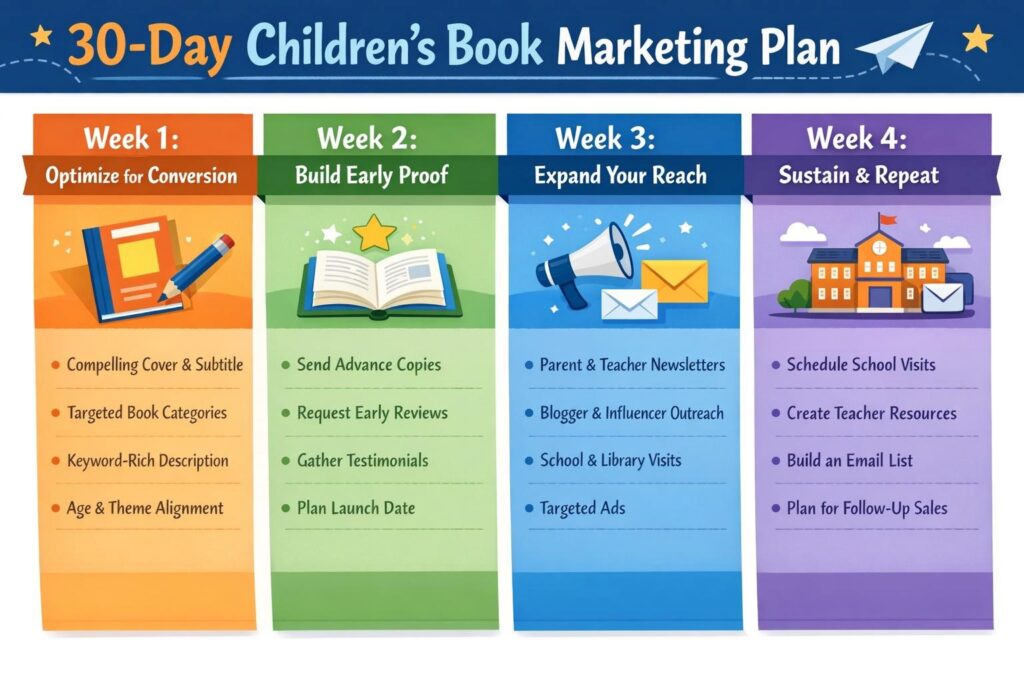
30-Day Children’s Book Marketing Plan for New Authors
Here is what I have seen work when the goal is not a one-week spike, but steady sales.
Week 1 is about conversion basics. Your cover, subtitle, description, and categories must be aligned to buyer intent. In children’s publishing, intent often looks like bedtime routines, emotional regulation, kindness themes, first-day-of-school anxiety, or sibling dynamics. Those phrases matter more than generic claims.
Week 2 is about proof. Reviews do not just influence buyers. They influence algorithms. This is why advance readers and early review requests should be planned while the book is still in production.
Week 3 is about reach. Parent newsletters, educator communities, and niche influencers often outperform broad social content. In real projects, a single placement in the right parenting newsletter has outperformed weeks of posting.
Week 4 is about repeatability. A children’s book that sells steadily is usually attached to a repeatable channel: school visits, educator resources, a themed email list, or a series angle that encourages the next purchase.
The key point is that marketing is easiest when it is designed into the project early, not bolted on after the upload.
How to Choose the Best Self Publishing Company for a Children’s Book
If you are comparing vendors, it is tempting to search lists of top self publishing companies and stop there. Rankings are not the same as fit.
If you are looking for the best self publishing company, look for evidence of process, not just promises.
A good partner should be able to explain:
- How they sequence editing and illustration
- What rights you receive
- How they quality-check print files
- How they approach distribution beyond “upload to Amazon”
- What their children’s portfolio looks like in print, not just on screen
If a service cannot answer those questions clearly, you are buying a package, not a production workflow.
Common Children’s Book Publishing Mistakes That Increase Costs
Most budget mistakes are not about spending too much. They are about spending in the wrong place.
Where Authors Overspend
Package marketing promises that do not connect to real distribution. Press releases without targeted placement. Paid ads before the listing, cover, and categories are optimized. Offset printing before demand is validated.
Where Authors Underspend
Developmental editing, because they assume short text is “already fine.” Professional layout, because they underestimate how obvious formatting errors are in color books. Rights clarity, because they do not realize how licensing affects future opportunities.
If budget is tight, protect structure and print quality first. Decorative add-ons can wait. Structural rework cannot.
How to Reduce Children’s Book Publishing Cost Without Sacrificing Quality
Cost control in children’s publishing is about sequencing, not cheapening.
Start by locking story structure before illustration begins. Then define illustration scope and revision rounds clearly. Test demand with POD before ordering bulk. If you do offset printing, do it after you know what sells, not before.
A real-world example: we worked with an author whose manuscript needed tighter page-turn pacing. Fixing it before illustration saved multiple spread revisions later and reduced total production waste. The book launched cleaner, and the author avoided paying for correction.
Advice for Children’s Book Writers Entering the Publishing Market
Many writers in the children’s category underestimate how commercially dense this market is. Picture books compete visually first. The Amazon thumbnail is a competitive arena, not a bookshelf.
The strongest manuscripts can stall if the cover signals the wrong age range or the interior typography feels amateur. Conversely, a well-produced book with a clear promise can outperform more literary work because it fits what buyers are searching for.
If you are among children’s book writers building a career, treat each title as a portfolio piece. Production quality is part of the brand, not an optional upgrade.
Frequently Asked Questions
How much does it cost to publish a children’s book professionally?
Most professionally competitive children’s books land between $8,000 and $15,000, with picture books often higher due to illustration.
How much does it cost to self-publish a children’s book if I do some work myself?
You can reduce costs modestly by handling certain tasks, but most competitive books still exceed $5,000 once illustration, design, and proofing are included.
What is the most expensive part of a picture book?
Illustration is usually the largest cost driver, especially full-color spreads with high detail.
Can I publish a children’s book for under $3,000?
It is possible for chapter books or text-forward projects. It is rarely competitive for full-color picture books at retail standards.
Do I need my own ISBN?
If you want imprint control and long-term brand ownership, buying your own ISBN is recommended.
How long does publishing take?
A professional timeline is often four to eight months, with illustration schedules driving the length.
What is the biggest budget mistake?
Starting illustration before the manuscript structure is final, then paying for revisions that could have been avoided.
Does marketing have to be expensive?
No, but it must be planned. Many effective strategies are relationship-based: schools, parent communities, and newsletters.
How many copies do I need to sell to break even?
It depends on investment and net royalty. Many authors land between 2,000 and 5,000 copies for break-even.
What should I prioritize with limited funds?
Structure and print quality first: developmental editing, illustration quality, and professional design.
Final Thoughts
After years as a senior developmental editor and publishing strategist at Writers of the West, I have reviewed projects across every production tier.
The pattern is consistent.
Authors who treat publishing as an asset-building process succeed. Authors who treat it as a file-upload exercise often return for revision.
When clients ask me, once again, how much does it cost to publish a children’s book, I answer candidly:
It costs what it takes to meet professional standards without cutting structural corners.
At Writers of the West, we have helped authors re-illustrate entire projects, rebuild flawed layouts, and restructure manuscripts that were rushed into production. In nearly every case, the cost of correction exceeded the cost of doing it correctly the first time.
If you are serious about producing a children’s book that can compete confidently in today’s market, invest strategically from the beginning.
A well-produced children’s book is not just a product.
It is intellectual property.
And when it is built properly, it lasts.