Introduction
One of the most common questions new authors ask after finishing a manuscript is simple: how much does a publisher pay for a first book? Headlines about six-figure deals can create the impression that publishers routinely pay large sums to debut writers. In reality, most first-time book contracts are far more modest and structured around advances against future royalties rather than upfront payouts.
After reviewing hundreds of manuscripts and publishing proposals, a clear pattern emerges. Publishers do not pay authors based solely on writing quality. They evaluate market demand, comparable titles, audience reach, and how clearly the book is positioned for readers.
Understanding how these factors influence advances helps authors approach publishing with realistic expectations and stronger strategies when presenting their first book.
How Much Do Publishers Actually Pay First-Time Authors?
Most publishers pay first-time authors an advance between $1,000 and $20,000 for a debut book. Larger traditional publishers sometimes offer advances between $20,000 and $75,000, while rare competitive deals can exceed six figures. In most cases, however, the advance reflects projected sales rather than the effort required to write the manuscript.
For many writers entering book publishing, this reality comes as a surprise. Industry headlines about major deals create the impression that publishers routinely pay large sums to debut authors. In practice, those deals represent a small fraction of acquisitions.
From the publisher’s perspective, the advance is not simply a payment for a manuscript. It is a calculated investment based on the publisher’s estimate of how well the book will perform in the marketplace.
Typical First-Book Advance Ranges
| Publishing Scenario | Typical Advance Range |
| Small independent press | $1,000 – $5,000 |
| Mid-size traditional publisher | $5,000 – $20,000 |
| Major publishing house debut | $20,000 – $75,000 |
| Competitive multi-publisher auction | $100,000+ |
These ranges appear consistently across acquisitions. Smaller presses often operate with limited budgets but provide focused editorial attention. Mid-size publishers tend to offer moderate advances tied closely to expected sales. Larger houses sometimes offer higher advances when they see strong commercial potential.
Why Advances for First Books Vary So Much
Publishers evaluate a number of factors before deciding how much to offer a debut author. During manuscript reviews and editorial consultations, the same patterns appear repeatedly.
Key factors include:
- Genre demand and how active the market is for that category
- Comparable titles and their recent sales performance
- Author platform, especially for nonfiction projects
- Market positioning and clarity of the book concept
- Publisher marketing investment and expected print run
A well-written manuscript alone does not guarantee a large advance. Publishers are ultimately investing in projected sales, not simply rewarding the effort behind the writing.
What Most First-Time Authors Actually Earn
Despite the headline deals that occasionally appear in publishing news, most debut authors fall into more modest financial ranges.
Typical outcomes include:
- $1,000–$5,000 for small independent press deals
- $5,000–$15,000 for mid-list debut contracts
- $20,000+ for projects with strong commercial positioning
- $50,000+ when multiple publishers compete for the same manuscript
These numbers represent common industry patterns rather than guarantees.
How Modern Publishing Paths Affect Author Earnings
Another factor that influences what authors ultimately earn is the publishing route they choose. Traditional publishing is only one model within the broader publishing ecosystem.
Some authors pursue traditional deals through agents and acquisitions editors. Others choose professional book publishing services that allow them to retain greater control over production, distribution, and royalties. Each pathway involves different financial structures, timelines, and expectations for how authors earn income from their work.
Understanding these differences helps explain why advances vary so widely across the industry.
What Does “Publisher Pay” Actually Mean in a Book Deal?
When authors first begin researching publishing contracts, many assume that a publisher simply pays a writer for completing a manuscript. In reality, traditional publishing operates on a very different financial structure. What publishers usually offer is an advance against royalties, which means the author receives money upfront based on projected book sales.
This distinction is important because the payment is not a salary or a guaranteed long-term income. It is a business calculation based on how many copies the publisher believes the book can realistically sell in the market.
After working with hundreds of manuscripts and proposals, one pattern becomes clear: most first-time authors misunderstand how these payments work. The advance is not a reward for finishing a book. It is an early portion of the revenue the publisher expects the book to generate.
Key Takeaways About How Publishers Pay Authors
- Most first-time authors receive an advance against royalties, not a flat payment for writing the book.
- The advance represents future earnings paid upfront based on projected sales.
- Authors do not receive additional royalties until the book earns back the advance through sales.
- Advances are usually paid in installments tied to publishing milestones rather than all at once.
Understanding these fundamentals helps explain why debut author payments vary so widely across the industry.
What an Advance Against Royalties Means
In traditional publishing, the advance is the publisher’s estimate of what the book will earn once it reaches the market.
Advance against royalties:
An advance is an upfront payment a publisher provides before publication. The amount represents expected royalties from future book sales. The author does not receive additional royalty payments until the advance has been earned back through sales.
This model allows publishers to invest in books while managing financial risk. It also gives authors an initial payment while the book moves through the long production and distribution process.
How Book Advances Are Typically Paid
Another common misunderstanding involves when authors actually receive their advance. Most publishing contracts divide the payment across several stages of the publishing process.
Typical installment stages include:
- Contract signing – the first portion of the advance is paid once the publishing agreement is finalized.
- Manuscript delivery and acceptance – another portion is paid after the completed manuscript is reviewed and approved.
Publication – the final portion is paid when the book is officially released.
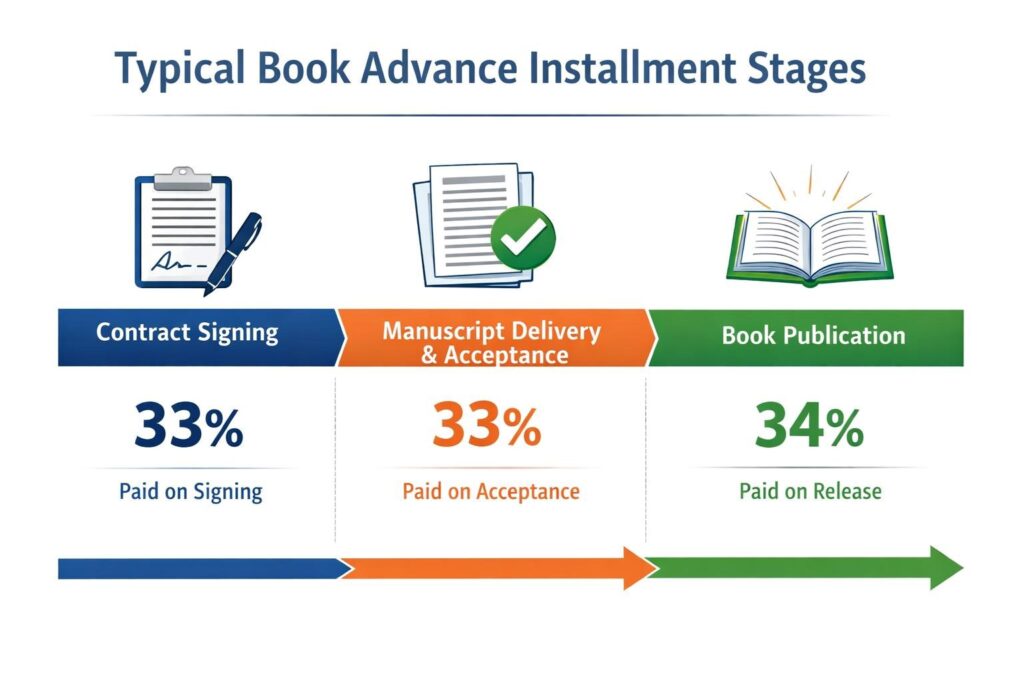
In larger deals, advances may be split across additional milestones such as hardcover publication, paperback release, or international editions.
Example Advance Payment Structure
| Contract Stage | Percentage of Advance | Example on $20,000 Deal |
| Contract signing | 33% | $6,600 |
| Manuscript delivery and acceptance | 33% | $6,600 |
| Book publication | 34% | $6,800 |
This staged payment structure allows publishers to spread risk while ensuring that authors remain engaged throughout the production process.
What It Means for a Book to “Earn Out”
Another term authors encounter in publishing contracts is earning out the advance.
A book earns out when total royalties generated from sales exceed the advance originally paid by the publisher. Only after the advance is earned out does the author begin receiving additional royalty payments.
For example:
- A publisher pays a $15,000 advance
- The author earns $2 in royalties per book sold
- The book must sell 7,500 copies before the advance is fully earned out
Until that threshold is reached, royalties from sales go toward repaying the advance.
Why Publishers Structure Payments This Way
From a publisher’s perspective, the advance system balances financial risk. Before a book ever reaches readers, the publisher invests heavily in editing, cover design, printing, distribution, and marketing.
The advance ensures that authors receive early compensation while giving the publisher time to recover its investment once the book enters the marketplace.
Understanding this structure is essential for anyone entering the publishing world, because the advance is only one part of how authors ultimately earn money from their books.
What Factors Influence How Much a Publisher Pays for a First Book
Not all debut book deals are created equal. Two manuscripts of similar quality can receive dramatically different offers depending on how publishers evaluate the book’s commercial potential. From an acquisitions perspective, the advance reflects a forecast of future sales rather than simply the effort behind the writing.
Genre Demand and Market Size
One of the strongest influences on a debut advance is the size of the potential readership. Publishers look closely at how similar titles are performing in the market.
Genres that often attract stronger advances include:
- Commercial thrillers and suspense
- Romance and contemporary fiction with strong readership demand
- Timely nonfiction tied to business, culture, or current events
- Narrative nonfiction with clear market positioning
By contrast, highly niche topics or literary projects with smaller audiences often receive more modest offers because the projected sales volume is lower.
Author Platform and Audience Reach
For nonfiction in particular, publishers often evaluate whether the author already has access to an audience. An established platform can significantly influence how much a publisher is willing to offer.
Common indicators publishers examine include:
- Professional credibility or expertise in the subject
- Media presence or speaking engagements
- Social media following and newsletter subscribers
- Existing communities or industry networks
Authors who can demonstrate a built-in readership often reduce the marketing risk for the publisher.
Manuscript Positioning and Development
Another factor that frequently affects advances is how clearly the book is positioned in the marketplace. Manuscripts that arrive well structured, with a strong concept and clear audience, tend to attract stronger interest from publishers.
In some cases, authors achieve this level of polish through professional ghostwriting services, particularly when they have valuable ideas or expertise but need help shaping the material into a commercially viable manuscript.
When publishers see a book that is both well written and strategically positioned, the conversation about advances often changes dramatically.
How Much Do First-Time Authors Earn From Royalties After the Advance
For many new authors, the advance feels like the main financial reward of publishing a book. In reality, the advance is only the first stage of how authors are paid. Long-term earnings come from royalties, which represent the author’s share of each book sold.
Royalties are calculated as a percentage of the book’s price or the publisher’s revenue from sales. Once the advance has been earned back through book sales, the author begins receiving royalty payments.
Typical Royalty Rates in Traditional Publishing
Royalty percentages vary depending on format and publisher, but most contracts follow fairly standard ranges.
| Book Format | Typical Royalty Rate |
| Hardcover | 10%–15% of retail price |
| Paperback | 6%–8% of retail price |
| Ebook | 20%–25% of publisher’s net revenue |
These rates explain why advances are tied closely to projected sales. A publisher offering a $20,000 advance must reasonably believe the book can generate enough revenue to recover that investment.
How Long It Takes to Earn Out an Advance
Many debut authors assume they will begin receiving royalty checks soon after publication. In practice, earning out the advance can take time.
Consider a simplified example:
- Advance paid: $15,000
- Royalty earned per book: $2
- Copies required to earn out: 7,500 books
Only after those 7,500 copies are sold would the author begin receiving additional royalty payments.
For some books this happens quickly. For others it may take years, and in many cases the advance never fully earns out.
Why Royalties Are the Long-Term Earnings Model
Publishers rely on royalties because book sales often unfold gradually over time. A title may sell steadily for several years, particularly if it finds a niche audience or gains visibility through reviews and recommendations.
For authors, this means the advance is often just the starting point. The real financial potential of a book depends on how well it performs in the marketplace after publication.
Traditional Publishing vs Amazon Publishing: How Author Earnings Differ
When authors ask how much a publisher pays for a first book, they are often comparing traditional publishing with the alternative path of Amazon Publishing. The financial structures behind these two models are fundamentally different.
Traditional publishers typically offer an advance against royalties, meaning the author receives money upfront before the book is released. Amazon’s publishing ecosystem, by contrast, generally operates on a royalty-first model where authors earn money only after books begin selling.
How Traditional Publishing Pays Authors
In traditional publishing, authors are compensated through two main mechanisms:
- Advance against royalties paid before publication
- Royalties on book sales once the advance earns out
This structure reduces risk for authors because they receive income before the book enters the market. However, royalty percentages are usually smaller because the publisher covers production, distribution, and marketing costs.
Typical characteristics of traditional publishing earnings include:
- upfront advance payments
- lower royalty percentages
- publisher-controlled pricing and distribution
- long production timelines
How Amazon Publishing Pays Authors
The financial model behind Amazon-based publishing platforms works differently. Instead of advances, authors earn royalties directly from each sale.
Common characteristics include:
- no advance payment before publication
- higher royalty percentages on ebook sales
- faster publishing timelines
- direct control over pricing and updates
Because there is no advance, the author assumes more of the financial risk but also keeps a larger share of each sale.
Which Pays More for a First Book?
The financial structures behind these two paths are fundamentally different, which is why author earnings can vary so widely.
Key Differences in Author Earnings
| Factor | Traditional Publishing | Self-Publishing |
| Upfront payment | Advance against royalties | No advance |
| Royalty percentage | Lower percentage per sale | Higher percentage per sale |
| Production costs | Covered by publisher | Paid by author |
| Creative control | Publisher decisions | Author retains control |
| Time to publish | Often 12–24 months | Can be published quickly |
For many first-time authors, the financial outcome depends on how well the book sells over time. A traditional publishing deal offers guaranteed upfront income, while independent publishing can generate higher long-term earnings if the book performs well in the marketplace.
Because of these differences, authors increasingly evaluate both routes carefully before deciding which publishing path aligns best with their goals.
Why Some First-Time Authors Receive Six-Figure Book Deals
Occasionally a headline appears announcing that a debut author has secured a six-figure publishing deal. For writers researching the industry, these stories can create the impression that large advances are common. In reality, such deals represent a small percentage of acquisitions and usually occur under very specific circumstances.
From an editorial standpoint, publishers rarely offer large advances simply because a manuscript is well written. High-value deals typically happen when a book demonstrates unusually strong commercial potential.
Case Study: A Debut Thriller That Triggered a Publisher Auction
A thriller manuscript we reviewed followed a pattern that acquisitions editors often look for. The story had a clear commercial hook and fit neatly within an established genre.
More importantly, the book could be easily compared to successful titles already performing well in the market. Once the manuscript circulated among agents, multiple publishers expressed interest. When this happens, an auction can develop, with publishers competing to acquire the book.
In this case, the advance rose significantly as bids increased, eventually reaching six figures. The key factor was not just writing quality but strong market positioning combined with commercial appeal.
Case Study: Platform-Driven Nonfiction
A similar pattern appears in nonfiction publishing. Authors with established expertise or visible audiences often attract stronger advances because publishers see a built-in readership.
One nonfiction proposal we encountered involved an author with a growing professional platform and strong subject expertise. Because the target audience and marketing pathway were already clear, publishers viewed the project as a lower-risk investment, which resulted in a much higher advance than most debut nonfiction authors receive.
What These Deals Have in Common
Across many acquisitions, larger advances usually appear when several factors align:
- clear market positioning within a recognizable genre
- a strong commercial concept
- existing audience reach or author platform
- competitive interest from multiple publishers
When these conditions come together, advances can rise quickly during negotiations. However, without them, most first-book deals remain within more modest ranges.
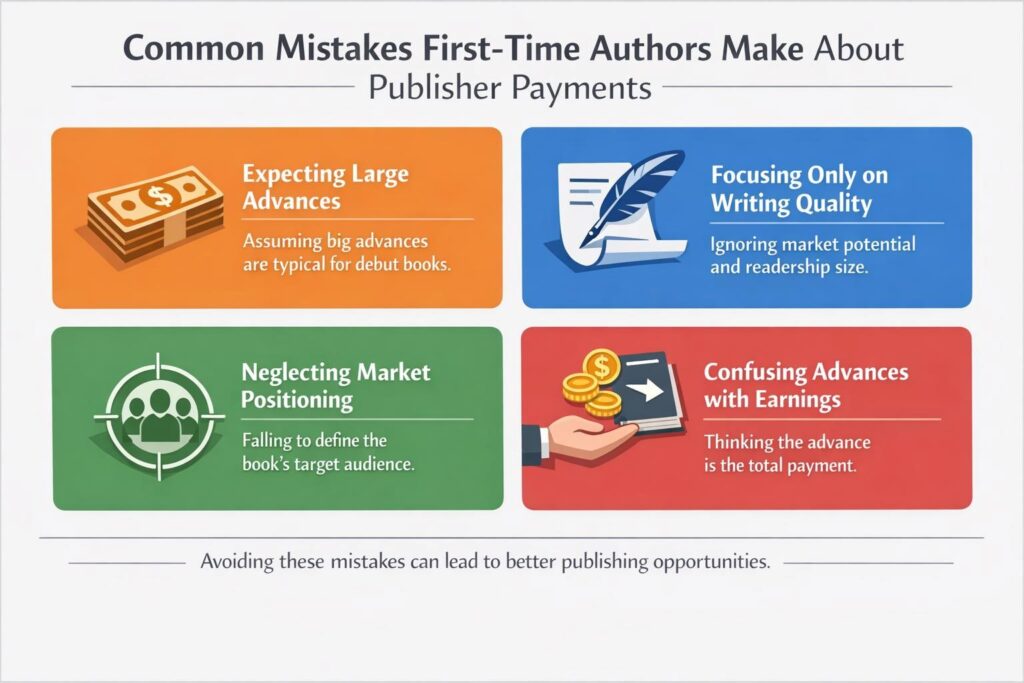
Common Mistakes First-Time Authors Make About Publisher Payments
Many new writers approach publishing with assumptions shaped by headlines rather than industry reality. After reviewing hundreds of manuscripts and book proposals, the same misunderstandings appear repeatedly. These mistakes often lead authors to misinterpret how publishing deals actually work.
Expecting Large Advances for a Debut Book
One of the most common misconceptions among new authors is assuming that large advances are typical. Publishing news often highlights six-figure deals, but those announcements represent unusual circumstances rather than everyday contracts.
In most cases, debut authors receive modest advances because publishers base offers on projected sales rather than the effort involved in writing the manuscript.
Believing Writing Quality Alone Determines the Advance
Strong writing is essential, but it is rarely the only factor that determines how much a publisher offers. Editors evaluate the commercial potential of the project as carefully as the manuscript itself.
During acquisitions discussions, publishers typically consider:
- comparable titles already performing in the market
- the size of the target readership
- the book’s category and demand
- how clearly the concept can be positioned for readers
A well-written manuscript without a clear market position often receives smaller offers.
Submitting a Manuscript Without Market Positioning
Another mistake many authors make is submitting a manuscript without clearly identifying the book’s audience. Publishers frequently ask questions such as:
- Who is the primary reader for this book?
- Which successful titles are most similar?
- How would the book be marketed?
Authors who answer these questions clearly often attract stronger interest from publishers.
Confusing the Advance With Total Book Earnings
Some writers assume that the advance represents the full financial value of a publishing deal. In reality, the advance is only the first stage of author income.
If the book performs well in the marketplace, royalties may generate additional earnings over time. If sales are modest, however, the advance may remain the only payment the author receives.
Understanding these dynamics helps authors approach publishing negotiations with far more realistic expectations.
How to Prepare Your Manuscript Before Submitting to Publishers
Many first-time authors focus entirely on completing their manuscript before approaching agents or publishers. In practice, the books that attract stronger offers usually go through several rounds of refinement before they ever reach an acquisitions editor.
Editors reviewing submissions often notice the same pattern. Manuscripts that generate serious interest tend to arrive with clear structure, strong pacing, and a well-defined audience. These qualities rarely appear in early drafts.
Strengthen the Manuscript’s Structure Before Submission
One of the most common problems in early manuscripts is structural inconsistency. The core idea may be compelling, but the narrative progression or argument lacks clarity.
Before submitting a book, authors should ensure the manuscript clearly communicates:
- a compelling premise or central argument
- consistent pacing and logical flow
- a clearly defined target audience
- a structure that supports the book’s central concept
Publishers often form an early impression within the first few pages, and clarity of structure plays a major role in that evaluation.
Clarify the Book’s Market Position
Another factor that strongly influences the advance a publisher pays for a first book is market positioning. Editors and agents quickly assess whether a book fits within an identifiable category.
They often ask questions such as:
- Which successful books are most comparable to this project?
- What audience is most likely to buy it?
- How would the concept be described in a single sentence?
Authors who answer these questions clearly often present stronger proposals.
Refine the Manuscript Before Professional Submission
Many writers assume the first completed draft is ready to send to agents or publishers. In reality, most manuscripts that receive serious attention have already gone through substantial editorial refinement.
This preparation often includes professional book editing services, which help strengthen narrative structure, pacing, and clarity before the manuscript reaches acquisitions editors.
When a manuscript arrives in this condition, publishers can focus on the book’s market potential rather than basic structural issues. That shift alone can significantly influence the type of offer a project receives.
Frequently Asked Questions
How much money do first-time authors usually receive from a publisher?
Most first-time authors receive an advance between $1,000 and $20,000, depending on the publisher, genre, and expected market demand. Larger publishers sometimes offer higher advances, especially when a book shows strong commercial potential or attracts interest from multiple publishers. In many cases, however, debut authors receive modest advances because publishers base their offers on projected sales rather than the effort required to write the manuscript.
Do publishers pay authors before the book is released?
Yes. In traditional publishing, authors typically receive an advance against royalties before the book is published. This payment is usually divided into installments tied to milestones such as contract signing, manuscript acceptance, and publication. The advance represents expected future royalties from book sales.
Do authors earn royalties after receiving an advance?
Authors only begin receiving royalty payments after the book earns out the advance. This means the total royalties generated by book sales must exceed the amount the publisher initially paid to the author. Once the advance has been earned back through sales, the author starts receiving additional royalty payments.
Can a first-time author receive a six-figure book deal?
It is possible, but uncommon. Large advances typically occur when a manuscript attracts multiple publishers, when the author already has a significant audience, or when the book fits a highly commercial category. Most debut book deals fall within much smaller advance ranges.
What factors influence how much a publisher offers for a first book?
Publishers evaluate several factors before deciding how much to offer an author. These often include:
market demand for the book’s category
comparable titles already performing well
the author’s platform or audience reach
the clarity of the book’s concept and positioning
the publisher’s projected sales for the title
Because of these variables, two manuscripts of similar quality can receive very different offers.
Do authors make more money through self-publishing?
Self-publishing can sometimes generate higher long-term royalties because authors keep a larger percentage of each sale. However, there is usually no advance payment, and the author is responsible for production, marketing, and distribution. Traditional publishing offers upfront income through an advance but typically provides lower royalty percentages.
Conclusion
Understanding how much a publisher pays for a first book requires looking beyond headline deals and focusing on how publishing economics actually work. For most debut authors, advances are calculated projections of future sales rather than large upfront payouts. The size of the offer depends on factors such as market demand, genre, author platform, and how clearly the book is positioned for readers.
The manuscripts that attract stronger deals almost always arrive well developed, strategically positioned, and ready for serious consideration by agents and publishers.
If you’re preparing a manuscript and want expert guidance before submitting to agents or publishers, the editorial team at Writers of the West works with authors to refine manuscripts, strengthen proposals, and position books for successful publication.