Introduction:
Ever feel like your book is invisible on Amazon? You poured your heart into writing it, published it, and then nothing happens. No steady sales. No traction. Just silence. You are not alone. Every day, new authors publish through KDP and wait, hoping readers will somehow find them. But hope is not a strategy. Visibility is. That is where amazon ads for books come in.
If you have ever looked at the top Amazon KDP publishers and wondered how their books seem to show up everywhere, ads are a big part of that story. The good news is this. Amazon Ads are not just for big publishers or marketing experts. They are for authors who want control over their visibility and are ready to learn a system that actually makes sense.
In this guide, you will get a clear, beginner friendly breakdown of how Amazon Ads really work. No hype. No jargon. Just practical guidance you can use to start getting your book in front of the right readers and finally give it a fair shot.
Who This Guide Is For (And What Amazon Ads Can Realistically Do)
This Guide Is for Authors Who Want Control, Not Guesswork
This guide is for you if you want more control over your book’s visibility and you are tired of guessing what might work. It is for first time authors who want their first consistent sales, and for experienced writers who know their book is strong but are struggling to get it seen. It is also for anyone who has opened Amazon Ads before, felt overwhelmed, and quietly closed the tab.
If that sounds familiar, you are in the right place.
What Amazon Ads Actually Are
Amazon Ads are pay per click ads that run entirely inside Amazon’s ecosystem. You are not interrupting readers while they scroll social media. You are showing up while they are actively browsing for books. That distinction matters more than most authors realize.
A solid KDP advertising strategy is built around intent, not hype. Your book appears in front of readers who are already looking for something similar. You are not trying to convince someone to want a book. You are helping them choose yours.
What Amazon Ads Are Best At
Amazon Ads work best when they meet readers at the exact moment they are ready to buy. They are especially effective for:
- Reaching readers who are already shopping for books
- Putting Book 1 of a series in front of new audiences
- Creating consistent sales instead of unpredictable spikes
- Supporting Kindle Unlimited page reads
They are not a shortcut. They are a visibility tool.
Realistic Beginner Goals You Should Aim For
When you are just starting out, your goals should be grounded and practical. Focus on:
- Your first steady flow of sales
- Improving series read through over time
- Increasing visibility during launches or price promotions
- Gathering clear data about what readers respond to
Amazon Ads will not fix a weak book or a confusing product page. But when the fundamentals are in place, they give your book the exposure it needs to compete.
Amazon Ads Basics in Plain English
What Amazon Ads Really Are
Amazon Ads are paid placements that appear directly inside Amazon. You are not advertising to casual scrollers or distracted audiences. You are advertising to people who are already on Amazon with their wallets half open. That alone makes Amazon Ads different from most book promotion strategies you have probably tried.
Instead of paying for exposure, you pay when someone clicks. That is it. No clicks, no cost. This makes Amazon Ads one of the most controllable forms of book marketing available to authors, especially beginners who need clear feedback on what is working.
The Core Metrics You Need to Know
You do not need to become a data analyst. You just need to understand a few numbers and what they are trying to tell you.
Impressions tell you how often your ad was shown.
Clicks tell you how many people were interested enough to look closer.
CTR, or click through rate, shows how relevant your ad is to the audience seeing it.
CPC, or cost per click, shows how much you pay for that interest.
Then there are the numbers that tie everything back to money.
Spend is how much you paid Amazon.
Sales are the purchases attributed to your ads.
ROAS tells you how much you earned for every dollar spent.
ACoS shows how much it cost you to make those sales.
Authors often pay close attention to ACoS because it helps you understand efficiency. Lower is usually better, but context matters, especially if you are building a series or earning Kindle Unlimited page reads.
What Targeting Means in Simple Terms
Targeting is how you tell Amazon where your ads should appear.
You can target keywords, which are the words readers type into the search bar.
You can also target products, usually other books, using their ASINs.
Think of keywords as intent and products as context. One shows you what the reader wants. The other shows you where they already are. Both matter, and you will learn how to use them without overcomplicating things.
Where Your Ads Can Appear
Most beginner ads show up in two main places.
One is in search results, mixed in with organic listings when readers search for books.
The other is on product detail pages, where readers are already looking at another book.
You may also see options like Sponsored Brands. These offer higher visibility and branding, but availability can vary and they are usually better explored after you understand the basics.
For now, the goal is simple. Learn how the system works. Learn how readers respond. Everything else builds from there.
Before You Spend a Dollar: Set Your Book Up to Convert
Your Conversion Stack Comes First
Before you launch even the smallest ad, pause. Look at your book the way a reader would. Ads do not persuade people to buy books they do not want. They only send traffic. That is why amazon ads for books work best when your product page is already doing its job.
Start with the basics. Is your cover clearly in genre and professionally designed? Can a reader understand what kind of experience they are getting in one glance? If the answer is no, ads will only make that problem more expensive.
The Must Have Conversion Elements
Every strong product page has a stack of elements working together.
Your title and subtitle should be clear and benefit driven, especially for nonfiction.
Your blurb should pull the right reader in emotionally and make a promise it can keep.
Your description should echo the language readers use when they search.
Your Look Inside should open strong and reward curiosity instead of testing patience.
Pricing matters too. Book One in a series often converts better at a lower price because it reduces risk for new readers. Ads amplify whatever choice you make here, so choose intentionally.
What to Do About Reviews and Social Proof
Reviews are not optional in the long run, but everyone starts somewhere. If you are at zero or close to it, focus on ethical ways to build early traction. Ask beta readers. Ask your email list. Ask readers who enjoyed the book to leave honest feedback.
You do not need hundreds to start advertising, but you do need enough social proof that a reader feels safe clicking buy. Even a small number of genuine reviews can make a noticeable difference.
The Metadata Foundation That Makes Ads Work
Behind the scenes, Amazon uses your metadata to decide when and where your ads appear. Categories, keywords, series information, and product details all feed that system.
If your metadata is messy or misaligned, your ads will struggle no matter how good your bids are. Clean this up first. It is one of the highest leverage moves you can make before spending money.
Get the foundation right. Then, and only then, turn on the ads.
Choosing the Right Ad Type as a Beginner
Sponsored Products Start Here
If you are new to Amazon Ads, this is where you begin. Sponsored Products are the most common and most forgiving ad type for authors. They place your book directly in search results and on other book pages, right where readers are already making buying decisions.
This ad type works because it does not try to be clever. It does one thing well. It helps readers discover your book while they are actively shopping. That makes it ideal for launching Book One, keeping a backlist visible, and feeding a series so read through can do its work.
For beginners, Sponsored Products are also easier to read and manage. The data is clearer. The setup is simpler. The feedback loop is faster. All of that matters when you are still learning how the system behaves.
When Sponsored Brands Make Sense
Sponsored Brands are more visual and more prominent. They usually feature your author name, a headline, and multiple books. This makes them powerful for brand awareness, but also riskier if your foundation is not solid yet.
Availability has expanded over time, but not every author will see this option right away. Even if you do, it is often better to wait. Sponsored Brands tend to work best once you already know which books convert and how readers respond to your ads.
Think of this as a second step, not a starting line.
Sponsored Display and Other Options for Later
Sponsored Display ads and similar placements can follow readers around Amazon and beyond. They can be useful, but they add complexity. More settings. More variables. More ways to confuse yourself early on.
Many beginners delay these options on purpose. Not because they are bad, but because focus matters. When Sponsored Products are stable and predictable, expanding into other ad types becomes much easier and far less stressful.
Start simple. Master one ad type. Then build from there.
Targeting 101 Automatic vs Manual and When to Use Each
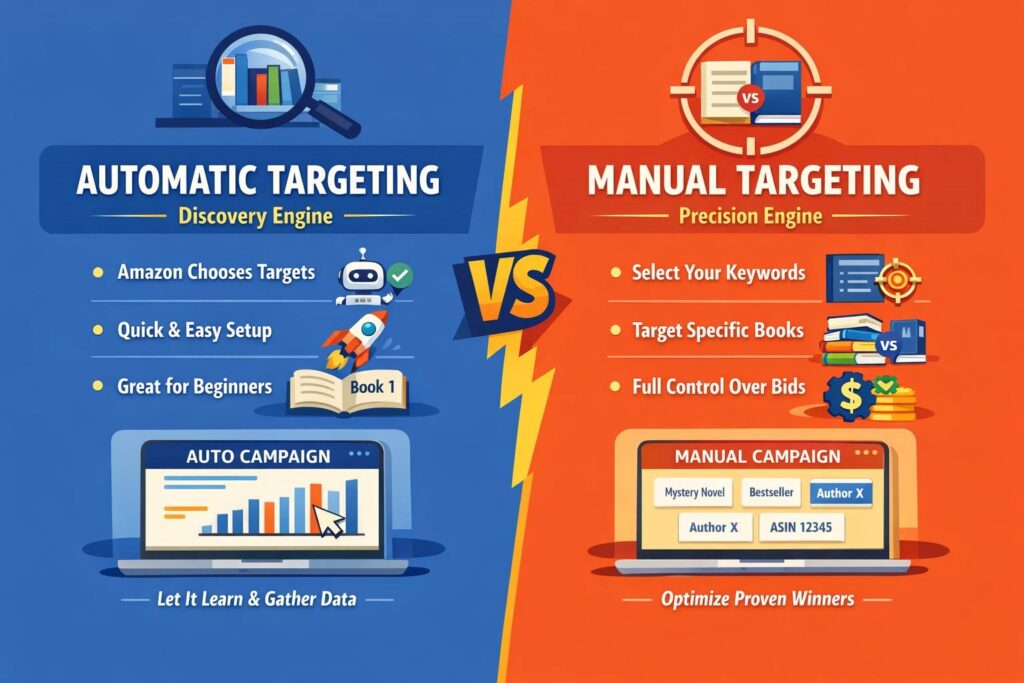
Automatic Targeting Is Your Discovery Engine
Automatic targeting lets Amazon do the matching for you. You tell Amazon which book to advertise, and it decides which search terms and product pages your ad appears on. For beginners, this is incredibly useful because it shows you how Amazon sees your book.
This is where a smart KDP advertising strategy begins. Automatic campaigns uncover real reader search terms you would never think to target on your own. The key is patience. Let the campaign run long enough to collect data. Do not panic and start editing everything after one or two days.
Early on, your job is not to control. It is to observe.
Manual Targeting Is Your Precision Engine
Manual targeting is where you take control. Instead of letting Amazon decide, you choose exactly which keywords or products you want to target.
With keyword targeting, you will choose match types like broad, phrase, and exact. Broad casts a wide net. Phrase narrows intent. Exact is the most precise and usually the most efficient once you know what converts.
With product targeting, you choose specific books or authors by ASIN. This places your ad directly on competitor book pages or next to similar titles, right where comparison happens.
The Simple Run Both Starter Strategy
You do not have to choose one or the other. In fact, beginners get the best results by running both at the same time.
Use one automatic campaign to discover what works. Use one manual campaign to focus on proven terms and placements. This keeps learning and control in balance and prevents you from guessing in the dark.
Let automatic campaigns explore. Let manual campaigns refine. Together, they form a system you can grow with instead of fighting against.
Keyword and ASIN Research Without Getting Overwhelmed
The Beginner Keyword Brainstorm With No Tools
Before you think about software, spreadsheets, or hiring book marketing services, start simple. The goal here is not perfection. It is relevance.
Begin with reader intent. Ask yourself what kind of reader would love your book and what they might type into Amazon when looking for it. Think in terms of genre, subgenre, tropes, themes, and tone. Add comparable authors and similar book titles. These are often called comp titles, and they are incredibly valuable for targeting.
Also consider format. Some readers search with words like ebook, paperback, or audiobook. These terms can reveal buying intent, not just curiosity.
Using Amazon Itself for Research
Amazon is already telling you what readers search for if you know where to look.
Start typing a keyword into the Amazon search bar and watch the suggestions appear. Those suggestions are based on real searches. Explore bestseller lists in your categories to see which books consistently perform well. Scroll through product pages and study the language used in descriptions and reviews.
Pay attention to the also bought section. This is one of the clearest signals of reader behavior you will ever get.
Optional Tools and When They Actually Help
Keyword tools can save time and uncover opportunities, but they are not mandatory at the beginning. Tools like Publisher Rocket are often used to find keyword demand and competition patterns.
If you only have one book and a very small budget, tools can wait. Focus on learning how readers respond to your ads and your product page first. Once you have data and direction, tools become an accelerator instead of a distraction.
Setting Up Your First Campaign Step by Step
Account and Campaign Structure That Keeps You Sane
When you first open the Amazon Ads dashboard, it can feel cluttered fast. This is where structure saves you. A clean setup makes testing easier and mistakes less expensive, especially when running amazon ads for books for the first time.
Use a simple naming convention you will understand months from now. Include the book title, targeting type, match type, and start date. Clear names prevent confusion and help you see patterns instead of guessing what caused a result later.
How Much Should Authors Spend on Amazon Ads Per Month?
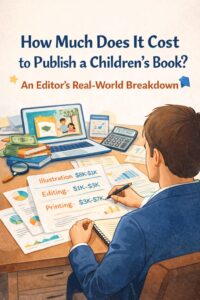
Most authors starting out on Amazon Ads should budget between $5 and $20 per day; that works out to roughly $150 to $600 per month. That range is enough to gather real data without burning through your budget before you understand what is working.
That said, there is no universal number. What you spend depends on your genre, your book’s price point, and what you are trying to achieve. A romance author running ads on a $3.99 ebook operates very differently from a nonfiction author selling a $16.99 paperback. The math on what a click is worth to you changes completely.
Here is how most authors think about it in practice:
$5–$10/day works for testing. You are figuring out which keywords convert, what your click-through rate looks like, and whether your cover and title are doing their job. Do not expect profit at this stage; expect data.
$10–$30/day is where most serious indie authors operate once they have a campaign that shows promise. You have enough spend to see patterns, optimise bids, and start pushing toward a positive return.
$30–$100+/day is for authors scaling a proven campaign; usually someone with a series, a strong backlist, or a launch they are investing behind.
The biggest mistake is starting too high before you know what works, or starting so low that the data is meaningless. Start small, run for at least two weeks before making changes, and let the numbers tell you when to scale.
The First Seven Days Launch Checklist
Day 1: Launch and Verify
Launch your campaign and confirm it is active. Check that your ad is approved and your book is eligible. Click through your own ad preview to make sure it leads to the correct product page. This day is about confirming nothing is broken.
Day 2: Confirm Traffic Is Flowing
Check for impressions and clicks. Do not worry about sales yet. You are simply making sure your ad is being shown and that people can interact with it. If impressions are zero, your bid may be too low or your targeting too narrow.
Day 3: Scan for Obvious Red Flags
Look at early search terms if available. You are not optimizing yet, but you are watching for anything clearly irrelevant. If something is wildly off target, make a note. Do not rush to fix everything.
Day 4: Check Spend and Pace
Make sure your daily spend is staying within limits. If your budget is being spent too fast, consider lowering bids slightly. If spend is extremely low, you may need more exposure. Small adjustments only.
Day 5: Watch Engagement Signals
Now look at CTR and CPC. Are people clicking at all. Are clicks reasonably priced. This gives you early insight into ad relevance, even if sales are not in yet.
Day 6: First Conversion Check
This is often when early sales or page reads start appearing, if they are going to. Do not panic if they have not yet. Many books take longer to convert, especially at higher price points.
Day 7: Review Without Overreacting
At the end of the first week, review performance as a whole. Look for patterns, not single data points. Decide what to keep running, what needs more time, and what may need adjustment next week.
The goal of the first seven days is not profit. It is clarity. Once you have that, real optimization can begin.
Reading Your Results Like an Author, Not a Spreadsheet
Click Through Rate Shows Relevance
Click through rate, or CTR, tells you whether your ad is appealing to the people who see it. It is calculated by dividing clicks by impressions. A low CTR usually means the ad is being shown to the wrong audience or your cover and title are not compelling at a glance.
CTR is not about profit. It is about connection. If readers are not clicking, Amazon Ads cannot do anything else for you. When CTR is weak, look first at targeting, then at your cover, then at your positioning within the genre.
Cost Per Click Reveals Competition
Cost per click, or CPC, tells you how expensive attention is in your niche. High CPCs often mean you are competing in crowded genres or bidding on popular keywords. Low CPCs can signal less competition or very specific targeting.
CPC on its own does not tell you whether a campaign is good or bad. A higher CPC can be perfectly acceptable if the clicks convert. A low CPC is meaningless if no one buys. Always evaluate CPC alongside conversions, not in isolation.
Orders and Sales Are Your Conversion Signal
Sales are the clearest indicator that your ads are doing their job. If people click and buy, the system is working. If people click and leave, the issue is usually the product page.
When clicks do not turn into orders, review your blurb, pricing, reviews, and Look Inside. Ads do not fix hesitation. They only bring readers to the decision point.
This is where many book promotion strategies fail. Authors tweak ads instead of fixing the page.
ACoS and ROAS Measure Efficiency, Not Success
ACoS shows how much you spent to make a sale. ROAS shows how much you earned for every dollar spent. These metrics are about efficiency, not worth.
A high ACoS can still make sense when launching a series, feeding read through, or building momentum. A low ACoS does not matter if volume is too small to move the needle.
These numbers should guide decisions, not dictate panic.
Kindle Unlimited Page Reads Change the Timeline
If your book is in Kindle Unlimited, page reads often arrive days after the click. This delay can make a campaign look unprofitable at first glance.
Page reads add value beyond the initial sale. They contribute to income, visibility, and series discovery. This is why KU authors often evaluate performance over longer periods instead of day by day.
Read Patterns, Not Snapshots
The biggest mistake beginners make is reacting to single days of data. One day means nothing. A week shows direction. A month shows patterns.
Your job is not to chase perfect numbers. It is to understand what readers are responding to and make steady, thoughtful adjustments over time.
Optimization: The Exact Levers to Pull and the Right Order
Add Negative Keywords and Negative ASINs First
Optimization starts with stopping waste. Before you try to push winners harder, cut what is clearly not working. When running amazon ads for books, this is one of the fastest ways to protect your budget.
Negative keywords prevent your ads from showing for search terms that bring clicks but no results. Negative ASINs do the same for product targeting. Add negatives only after you have enough data to see a pattern. One click is noise. Several clicks with no return is a signal.
Focus on terms that are irrelevant, attract free seekers, or signal the wrong genre. This one step alone can dramatically improve performance.
Promote Winners From Automatic to Manual
Automatic campaigns are great at discovery, but they are not designed for precision. Once a search term or ASIN consistently converts, move it into a manual campaign.
Use exact or phrase match so you control how often your ad appears and what you pay for those clicks. This lets you give more budget and stronger bids to what is already proven.
Think of automatic campaigns as scouts. Manual campaigns are where you build.
Adjust Bids Without Breaking Everything
Bid changes should be deliberate and spaced out. Raising bids on proven converters can increase volume. Lowering bids on spenders with no return slows the bleed.
Avoid optimizing daily unless your spend is high enough to justify it. Frequent changes reset learning and make it harder to understand what actually caused improvement.
One change at a time. Let the data respond. Then decide your next move.
Scaling Without Lighting Money on Fire
Know When You Are Ready to Scale
Scaling too early is one of the fastest ways to lose confidence and cash. Before you increase budgets or expand targeting, look for stability. This is where a disciplined KDP advertising strategy matters.
You are ready to scale when conversions are consistent, cost per click is predictable, and your ACoS or ROAS stays within a range you can tolerate. Perfection is not required. Predictability is.
If results swing wildly day to day, stay in learning mode.
Expand What Is Already Working
The safest way to scale is not by reinventing the wheel. It is by extending what already converts.
Add new keywords that are closely related to your winners. Look for adjacent tropes, similar authors, and subgenres that share the same reader intent. Keep relevance tight.
For product targeting, expand to books that sit one step away from your current targets. Similar tone, similar audience, similar expectations.
Test New Placements Carefully
Once Sponsored Products are stable, you can experiment with other placements. Sponsored Brands can help build recognition across multiple books, especially if you write in a consistent genre or have a clear author identity.
Treat these tests as experiments, not commitments. Set separate budgets and watch performance closely. Scaling should feel controlled, not chaotic.
Growth does not come from spending more money. It comes from spending smarter money on proven signals.
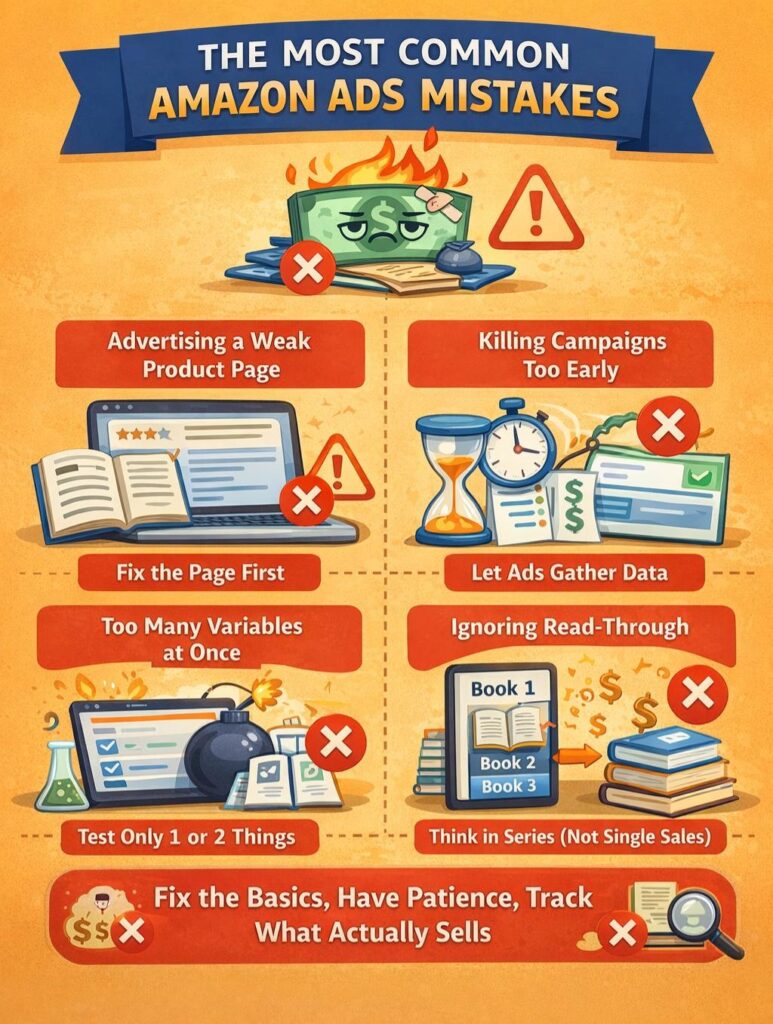
The Most Common Amazon Ads Mistakes and Quick Fixes
Advertising a Weak Product Page
One of the most expensive mistakes authors make is sending paid traffic to a page that does not convert. If your cover looks off genre, your blurb is unclear, or your Look Inside is slow, ads will not save you.
This is often the moment authors realize that investing in book design services or a professional edit is not optional. Ads amplify weaknesses as fast as they amplify strengths. Fix the page first, then advertise it.
Killing Campaigns Too Early
Amazon Ads need time to learn. Shutting down a campaign after a few days because it has not produced sales is a common beginner mistake.
Data needs volume. Volume needs time. If you kill campaigns too early, you never give the system a chance to show you what is possible.
Changing Too Many Variables at Once
Adjusting bids, targeting, budgets, and match types all at the same time makes it impossible to know what caused improvement or decline.
Change one thing. Wait. Observe. Then decide the next step. Clarity always beats speed.
Ignoring Series Read Through
If you write a series, Book One rarely tells the full story. A campaign that looks unprofitable on paper can still be profitable once readers move through the series.
Track what happens after the first sale. Read through changes everything.
Chasing Vanity Metrics
High impressions and low costs can feel good, but they do not pay the bills. Focus on outcomes that matter. Sales, page reads, and long term reader engagement.
Pretty numbers without results are just noise.
Safety, Policy, and Sanity Checks
What You Cannot Do With Amazon Ads
Amazon Ads come with clear rules, and breaking them can shut down campaigns or even your ad account. You cannot make misleading claims, promise results your book cannot deliver, or misrepresent the content inside. This is especially important for nonfiction, where exaggerated benefits can trigger policy violations.
You also cannot use prohibited content in ad copy or images. Amazon reviews ads closely, and rejections are common when claims are vague, exaggerated, or unclear. When in doubt, keep your messaging simple and factual.
Protect Your Budget and Your Headspace
Always use daily budget caps. This is not optional. Budget caps protect you from accidental overspending and give you space to think clearly.
Separate your campaigns mentally into learning campaigns and profit-focused campaigns. Learning campaigns exist to gather data. Profit campaigns exist to scale what already works. Mixing those two goals in one campaign creates frustration and poor decisions.
Know When to Pause Ads
Sometimes the smartest move is to pause everything.
Pause ads if your listing is broken, your price is wrong, or your book is temporarily unavailable. Pause if you experience a sudden review crisis or a technical issue with your product page. There is no benefit to paying for traffic when something is clearly wrong.
Taking a pause is not failure. It is control. Protect your budget, protect your data, and protect your sanity.
Prefer to have your Amazon Ads managed by a team that has launched 100+ author campaigns? See how Writers of the West handles it for you → Review our book marketing for authors.
FAQs
Do Amazon Ads Work for New Authors With Only One Book?
Yes, they can. But expectations matter. amazon ads for books work best when they amplify something solid. If you have one well packaged book with a clear audience, ads can help you get early traction and real data. If the book is weak or confusing, ads will simply confirm that faster.
What Is a Good Daily Budget to Start Amazon Ads as a Beginner?
Start small. Five to ten dollars per day is enough to learn without panic. Early budgets are about gathering information, not forcing results. You can always increase spend once you understand what converts.
Should I Start With Automatic or Manual Targeting?
Start with both. Automatic targeting helps you discover how Amazon matches your book to readers. Manual targeting gives you control once you see what works. Together, they create balance.
What Is a Good ACoS for Books?
There is no universal number. ACoS depends on your book price, whether you write a series, and if you are in Kindle Unlimited. A higher ACoS can still make sense when read through or page reads are strong.
How Long Should I Let a Campaign Run Before Changing Anything?
At least seven days. Longer if spend is low. Ads need time to collect enough data to show patterns. Changing things too quickly leads to bad conclusions.
What Keywords Should I Target for My Genre?
Target how readers think, not how authors talk. Genre, subgenre, tropes, comparable authors, and similar book titles are your best starting points.
Is It Better to Target Keywords or Competitor Book ASINs?
Both serve different purposes. Keywords capture reader intent. ASINs capture reader context. Using both gives you broader and more strategic coverage.
Can Amazon Ads Help Kindle Unlimited Page Reads?
Yes. Ads often drive discovery first, then page reads later. This delay is normal. Many KU authors judge performance over longer time frames because of this.
Why Am I Getting Clicks but No Sales?
This usually points to a conversion issue. Look at your cover, blurb, pricing, reviews, and Look Inside. Ads bring readers to the decision point. They do not make the decision for them.
How Do Negative Keywords Work and When Should I Add Them?
Negative keywords block your ads from showing on irrelevant searches. Add them after you have enough data to see repeated waste, not after one or two clicks.
Are Sponsored Brands Worth It for Authors?
They can be, especially if you have multiple books or a strong author brand. Most beginners wait until Sponsored Products are stable before testing them.
How Do I Know If My Ads Are Profitable if I Have a Series?
Look beyond Book One. Track read through and total revenue per reader. A series often makes money after the first sale.
Should I Run Amazon Ads During a Free or 0.99 Promo?
Yes, but intentionally. Ads can boost visibility during promos, but the goal should be long term reader acquisition, not short term spikes.
What Is the Biggest Don’t for Beginners on Amazon Ads?
Do not panic optimize. Let data breathe. Most failed campaigns are not broken. They were just never given enough time to work.
Conclusion
Amazon advertising can feel intimidating at first, especially when you care deeply about your work and every dollar matters. But once you understand the system, it stops feeling like a gamble and starts feeling like a tool. A tool you control.
The truth is simple. amazon ads for books are not about tricking readers or chasing hacks. They are about alignment. The right book. The right reader. The right moment. When those pieces come together, growth becomes predictable instead of stressful.
You do not need to do everything at once. Start small. Build a strong foundation. Let data guide your decisions instead of emotion. Progress in this space is rarely loud, but it is steady for authors who stay patient and intentional.
If you treat ads as part of a long term publishing strategy, not a last resort, they can become one of the most reliable ways to give your books the visibility they deserve.