Introduction
You are not confused because you are inexperienced. You are confused because the editing world is terrible at naming things.
You finish your manuscript and do what any serious author would do. You look for a professional editor for hire. Within minutes, you are staring at a list of services that all sound like they should mean the same thing but somehow do not. Developmental. Copyediting. Line editing. Manuscript editing. Everyone explains it differently. Everyone sounds certain.
Underneath that confusion is a very real fear. What if you choose the wrong edit and end up paying for changes that do not fix the real problem?
That fear is justified. Authors mix these up because editing labels overlap, editors use different language, and “manuscript editing” can refer to anything from big picture structural work to sentence level cleanup. When you care deeply about a book, it becomes even harder to diagnose what it truly needs.
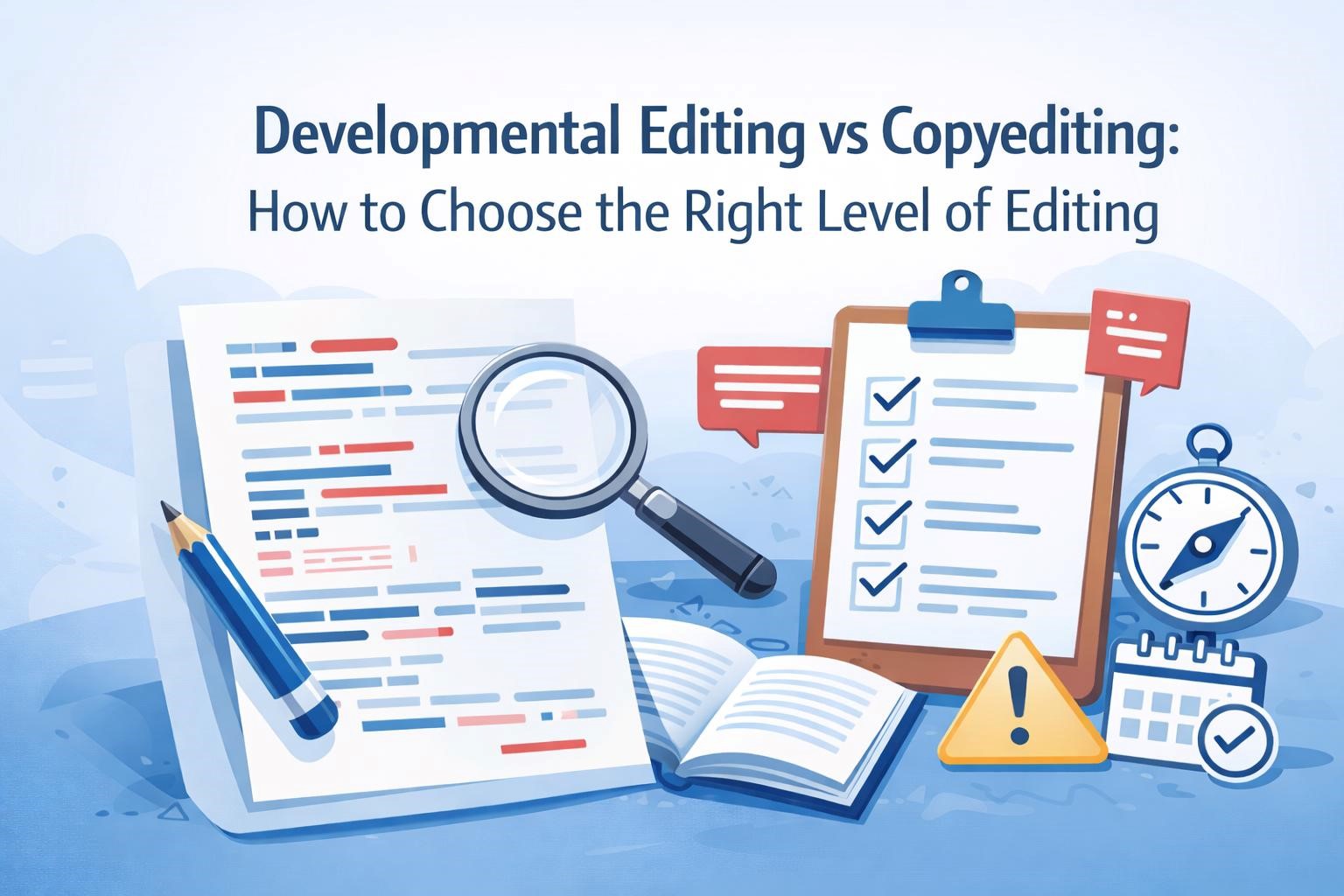
This is why the distinction between developmental editing vs copyediting matters so much. It is not a technical detail. It affects your money, your time, and whether your book actually works for readers.
In the next few minutes, you will get clarity. You will know exactly what each edit does, when to use it, and how to avoid paying for the wrong service at the wrong time.
Why Authors Mix These Up
Editing Labels Are Inconsistent
There is no universal rulebook for what editing services must be called. One editor’s manuscript edit might be another editor’s copyedit. Some use content editing, others use structural editing, and many blend terms depending on their background or market. To an author, these labels sound interchangeable, even when the work behind them is not.
Overlap Creates False Equivalence
Editors rarely work in silos. A copyeditor may flag a confusing chapter order. A developmental editor may rewrite a sentence to demonstrate clarity. These small overlaps make it feel like all editing does the same job, just at different prices. In reality, the intention behind the edit is what separates them.
Emotional Distance Is Hard to Maintain
When you are deep inside a manuscript, every problem looks like a writing problem. Awkward sentences are easy to spot. Structural issues are not. That is why many authors reach for a surface level fix when the real issue sits underneath the prose. This is how writers often skip straight to developmental editing without realizing why the book still feels off.
“Manuscript Editing” Sounds Complete
The phrase suggests a one and done solution. It implies that everything will be addressed in a single pass. But manuscript editing is not a standard service. Without a clear scope, it can mean anything from light cleanup to deep structural analysis, and the results vary just as widely.
Marketing Language Adds to the Confusion
Editing websites are full of confident promises and vague descriptions. Words like full, comprehensive, or professional sound reassuring but rarely explain what is actually included. Without concrete deliverables, authors are left guessing.
Understanding these layers of confusion is the first step toward choosing the right edit at the right time.
What Developmental Editing Is
It Focuses on the Big Picture
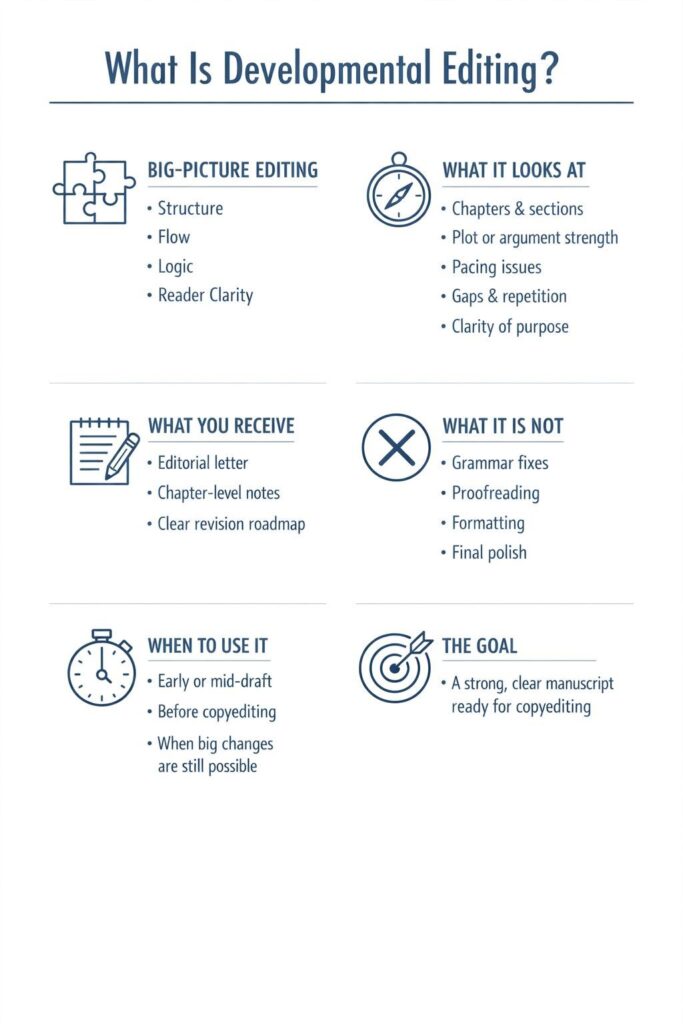
Developmental editing looks at whether your book works as a whole.
This is not about commas or word choice. It is about structure, logic, and momentum. A developmental editor steps back and asks the hard questions readers never articulate clearly but always feel.
Does the opening hook fast enough?
Does the middle sag or repeat itself?
Does the ending deliver on the promise of the beginning?
For nonfiction, this means examining argument flow, chapter order, clarity of ideas, and reader takeaways. For fiction, it means plot logic, pacing, point of view, character motivation, and emotional payoff.
At this stage, clarity beats polish every time.
What a Developmental Editor Actually Examines
A strong developmental edit will address things like:
- Overall structure and organization
- What belongs in the book and what does not
- Missing chapters, scenes, or explanations
- Redundant sections that dilute impact
- Pacing issues that slow readers down
- Market positioning and reader expectations
Below is what each of these means in practice.
Overall Structure and Organization
This is the skeleton of the book. A developmental editor looks at how chapters and sections are ordered and whether the progression makes sense for a first time reader. In nonfiction, this means checking that ideas build logically instead of jumping ahead. In fiction, it means making sure scenes appear where they create maximum tension and payoff.
What Belongs in the Book and What Does Not
Not every good idea belongs in this book. Developmental feedback helps identify material that distracts from the core purpose, repeats earlier points, or serves the author more than the reader. Cutting or relocating content often strengthens clarity and focus.
Missing Chapters, Scenes, or Explanations
Sometimes readers feel confused not because something is wrong, but because something is missing. This could be a skipped step in an argument, a character motivation that is assumed but never shown, or a key transition that never happens. Developmental editing highlights these gaps so the book feels complete and intentional.
Redundant Sections That Dilute Impact
Repetition is common in drafts. Authors restate ideas to be clear, but too much repetition slows momentum. A developmental editor points out where the same point is being made multiple times and suggests consolidation so every section earns its place.
Pacing Issues That Slow Readers Down
Pacing is about rhythm. In fiction, this often shows up as long stretches without tension or scenes that linger too long. In nonfiction, it appears as dense chapters or explanations that overwhelm the reader. Developmental editing identifies where energy drops and why.
Market Positioning and Reader Expectations
A book exists within a category. Developmental feedback considers genre norms, audience expectations, and comparable titles. It asks whether the book is clearly positioned and whether it delivers what readers in that space expect, without becoming generic.
What You Typically Receive
Most developmental editing services include a small number of high impact deliverables rather than line by line edits.
You can usually expect:
- A detailed editorial letter explaining what is working and what needs revision
- Chapter level or margin notes pointing to specific issues
- Clear guidance on next steps and revision priorities
Some editors also include a follow up call to talk through the feedback and help you decide how to tackle revisions.
You do not walk away with a finished manuscript. You walk away with a roadmap.
What Developmental Editing Is Not
- It is not a grammar pass.
- It is not sentence level polishing.
- It is not the final step before formatting.
If you are looking for clean prose, consistency, and correctness, that comes later. Developmental editing exists to make sure the foundation is solid before anything else is refined.
When to Use Developmental Editing
This is the right stage if your book still feels unsettled.
- You should consider developmental editing when:
- You are unsure whether the structure works
- Readers say the middle drags or the ending does not land
- You suspect something is missing but cannot pinpoint what
- You are still adding, removing, or rearranging chapters or scenes
- You want feedback on market fit and reader expectations
If you are still making big decisions about content, this is the edit that saves you from polishing the wrong version of the book.
This stage asks one central question.
Is this book doing what it is supposed to do for the reader?
What Copyediting Is
Focus on Sentence-Level Craft and Consistency
Copyediting begins once the structure of the book is stable.
At this stage, the question is no longer whether the book works, but whether it reads cleanly and professionally. Copyediting tightens language, removes distractions, and makes sure readers are never pulled out of the experience by errors or inconsistencies.
This work happens at the sentence level. The copyeditor looks closely at how each line functions and how the manuscript behaves as a system.
What a Copyeditor Actually Examines
Copyediting typically covers:
- Grammar, punctuation, and usage
- Sentence clarity and readability
- Consistency in names, terms, and details
- Continuity checks for timelines and facts
- Alignment with a chosen style guide
Grammar, Punctuation, and Usage
This is the most visible part of copyediting. A copyeditor corrects errors in spelling, punctuation, and grammar, but also fixes subtle usage issues that can make prose feel awkward or unclear. These are the small mistakes readers notice instantly, even if they cannot explain why something feels off. Most writers consider hiring professional manuscript editing services to make sure there are no such mistakes.
Sentence Clarity and Readability
Not all sentences fail because they are incorrect. Many fail because they are crowded, vague, or harder to process than they need to be. Copyediting improves flow by tightening phrasing, breaking up long sentences, and removing unnecessary complexity while preserving your tone.
Consistency in Names, Terms, and Details
Inconsistency erodes trust. A character’s name changes spelling. A concept is capitalized in one chapter and lowercase in another. A term is defined three different ways. Copyediting catches these issues and standardizes them so the book feels intentional.
Continuity Checks for Timelines and Facts
Copyeditors track details across the entire manuscript. Dates, ages, locations, sequences of events, and factual references are checked for internal logic. This is especially important in long books where small contradictions can easily slip through.
Alignment With a Style Guide
Most copyediting follows a formal style guide, such as Chicago or APA, along with any house rules specific to the project. This is where many people loosely use the term manuscript editing, even though the actual work is precise and rule driven rather than structural.
What You Typically Receive
A professional copyedit usually includes:
- A manuscript with tracked changes so you can review every edit
- A detailed style sheet documenting spelling, terminology, hyphenation, numerals, and consistency decisions
The style sheet is not optional. It is what keeps the book consistent during revisions, formatting, and future editions.
When to Use Copyediting
Copyediting is the right choice when:
- The structure and content are finalized
- You are no longer rearranging chapters or rewriting sections
- You want clean, consistent, publication ready prose
- You are preparing the manuscript for formatting or submission
If you copyedit too early, you risk undoing that work with later revisions. Timing matters.
What Copyediting Is Not
- It is not structural rewriting.
- It is not plot or argument development.
- It is not the final typo hunt after layout.
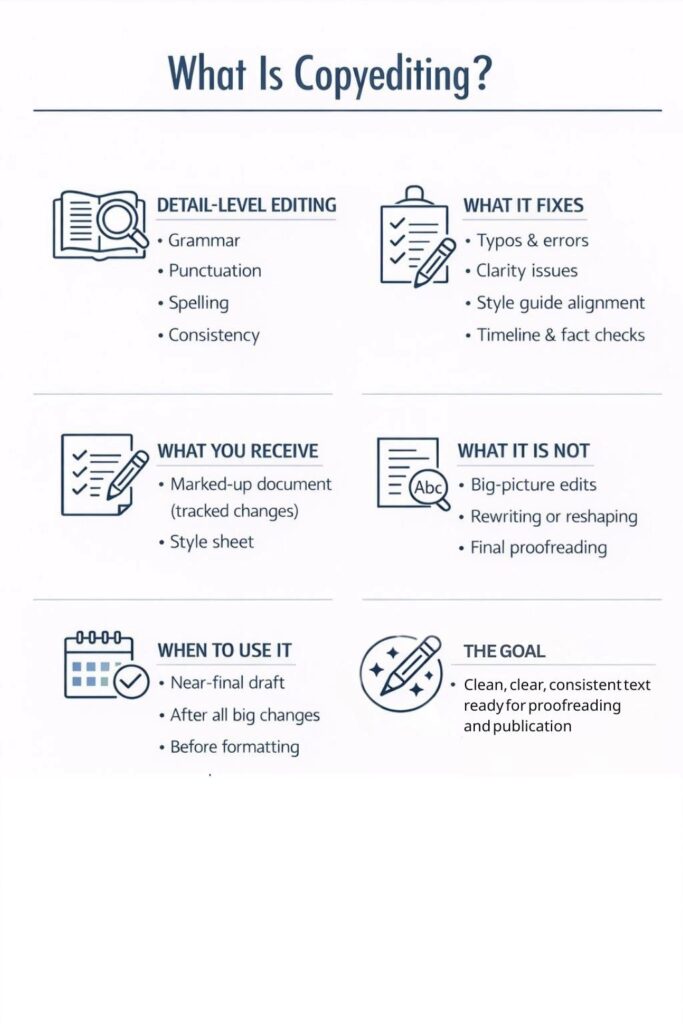
That last step belongs to proofreading. Copyediting exists to make sure your finished manuscript reads smoothly, clearly, and professionally, without calling attention to itself.
Developmental Editing vs Copyediting
The Core Difference
The simplest way to understand this is intention.
Developmental editing is about reshaping the book. Copyediting is about refining it. One asks whether the content works. The other ensures the language does its job without getting in the way.
When authors struggle to choose between developmental editing vs copyediting, it is usually because both improve the manuscript, but in very different ways.
Primary Goal: Reshape vs Refine
Developmental editing focuses on big decisions. Structure, logic, pacing, and reader experience. It challenges what is on the page and often requires significant revision.
Copyediting focuses on execution. Grammar, clarity, consistency, and correctness. It assumes the content is final and makes it clean and readable.
Best Stage in the Process
Developmental editing belongs early or mid draft, when changes are still welcome and cost effective.
Copyediting belongs near the end, once the manuscript is stable and you are no longer making large changes.
Switching the order almost always creates more work.
Typical Output
A developmental edit usually results in a roadmap. An editorial letter, chapter notes, and clear guidance on what to revise and why.
A copyedit results in a marked up manuscript and a style sheet. The changes are specific, visible, and often immediately actionable.
How It Feels as the Author
Developmental editing can feel intense. It asks you to rethink choices you may feel attached to. It is strategic and sometimes uncomfortable.
Copyediting feels more contained. You see clear improvements on the page. The work is focused and easier to evaluate line by line.
Both are valuable. They just solve different problems at different moments.
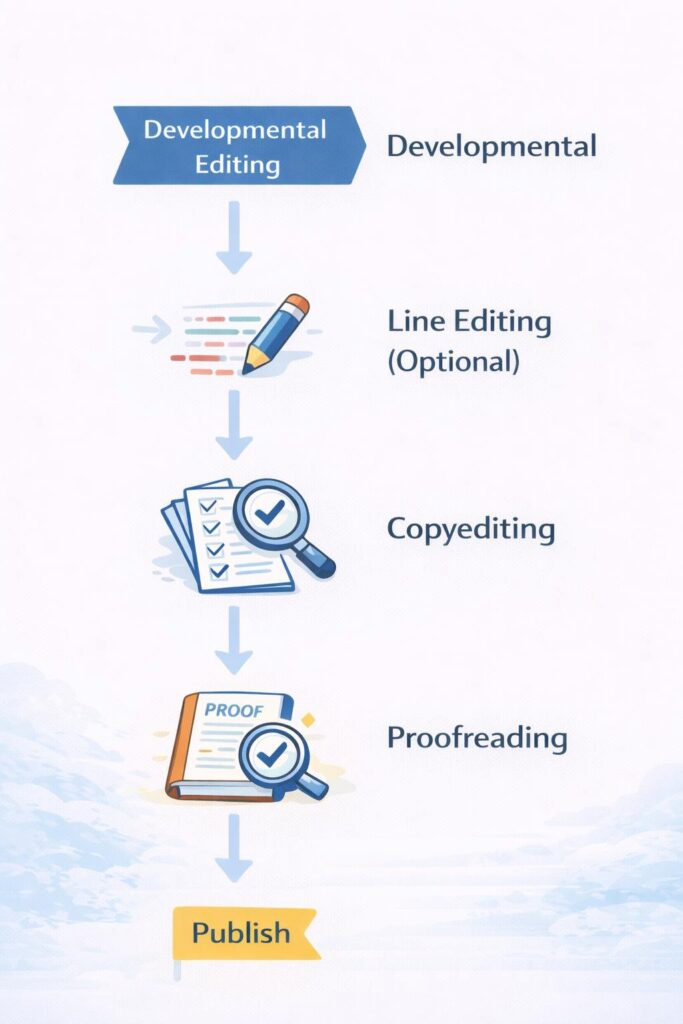
The Editing Timeline Most Books Follow
The Typical Editing Sequence
Most professionally produced books follow a predictable path because each stage solves a different problem.
This sequence exists to reduce rework and protect your budget.
- Each stage builds on the one before it
- Structural decisions are made before language is refined
- Errors are addressed only after content is stable
- The process mirrors how traditional publishers edit books
When this order is followed, editing feels purposeful instead of chaotic.
Why Developmental Editing Comes First
Early drafts are fluid. That flexibility is an advantage.
This is the stage where big changes are still possible without wasted effort.
- Chapters can be reordered without consequence
- Scenes or sections can be added or removed cleanly
- Arguments can be clarified or rebuilt
- Reader expectations and market fit can be addressed
That is why development editing services are most effective before any polishing begins. They shape the foundation the rest of the process relies on.
Where Line Editing Fits
Line editing sits between structure and correctness.
It focuses on how the writing sounds and flows once the content is settled.
- Improves sentence rhythm and readability
- Tightens word choice and removes clutter
- Smooths transitions between paragraphs
- Preserves voice while improving clarity
This stage is optional for some projects and essential for others. The key requirement is that the manuscript structure is already stable.
Why Copyediting Comes Later
Copyediting assumes the manuscript will not change in any major way.
That assumption is critical.
- Consistency decisions only make sense when content is final
- Grammar fixes hold only if sentences remain intact
- Style sheets depend on stable terminology and names
- Efficiency depends on minimal rewrites
When these conditions are met, copyediting becomes precise and cost effective.
Proofreading Is Always Last
Proofreading is tied to design, not drafting.
It addresses problems introduced during formatting.
- Broken lines or missing words
- Incorrect page numbers or headers
- Spacing and layout inconsistencies
- Formatting related typos
Proofreading before layout misses these issues entirely.
Why Doing This Out of Order Backfires
Reversing the sequence creates friction and wasted effort.
Common outcomes include:
- Paying twice for the same corrections
- Reintroducing errors during revisions
- Losing track of consistency decisions
- Feeling frustrated with the editing process
Following the proper timeline keeps each stage focused and prevents unnecessary rework.
Editing is most effective when each phase respects its role and its timing.
How to Tell Which One You Need
Choosing the right edit starts with honesty about where your manuscript actually is, not where you want it to be.
The confusion around developmental editing vs copyediting disappears once you stop thinking in terms of labels and start thinking in terms of problems.
You Likely Need Developmental Editing If
These are signs the book itself needs work, not just the language.
- Early readers say the middle drags or the ending does not land
- The argument feels scattered or repetitive
- You are unsure whether chapters or scenes are in the right order
- You suspect something important is missing
- You are still debating what belongs in the book
If feedback keeps pointing to clarity, structure, or focus, polishing sentences will not fix the issue.
You Likely Need Copyediting If
These are signs the book is solid but messy.
- The structure is stable and no longer changing
- The prose feels uneven or clunky in places
- You notice inconsistency in names, terms, or details
- You want the manuscript to feel professional and trustworthy
- You are preparing for formatting or submission
At this stage, clarity comes from cleanup, not rethinking content.
When the Answer Feels Unclear
If you feel stuck between the two, ask yourself one simple question.
Are you still willing to make big changes?
If the answer is yes, developmental work will serve you better. If the answer is no, and you are ready to lock the content, copyediting is the right next step.
Choosing correctly saves time, money, and emotional energy.
Cost, Time, and Scope Expectations
Understanding the difference between developmental editing vs copyediting also means understanding why they are priced, scheduled, and scoped so differently. They are not interchangeable services, and their demands on an editor’s time are not the same.
Why Developmental Editing Usually Costs More
Developmental editing is analytical and strategic work.
Before an editor writes a single comment, they must fully read and understand the manuscript, the audience, and the market context. The value is not in the number of edits made, but in the quality of insight.
- Requires deep, uninterrupted reading
- Involves pattern recognition across the entire manuscript
- Includes strategic decision making, not mechanical fixes
- Often involves iterative feedback or discussion
You are paying for expertise and judgment, not speed.
Why Copyediting Can Vary Widely in Cost
Copyediting pricing depends heavily on manuscript condition.
Two books with the same word count can require very different levels of effort.
- Clean drafts cost less to copyedit
- Inconsistent or error heavy drafts cost more
- Technical or academic material increases complexity
- Strict style guide requirements add time
This is why reputable copyeditors almost always request a sample before quoting.
Typical Timelines to Expect
Editing takes longer than most authors expect, especially at the developmental level.
General ranges look like this:
- Developmental editing: several weeks, sometimes longer
- Copyediting: one to several weeks, depending on length and condition
- Proofreading: shorter, but dependent on layout readiness
Rushed edits often lead to shallow feedback or missed issues.
How Scope Affects Price and Outcome
Scope clarity protects both the author and the editor.
A clear scope defines:
- What the editor will and will not do
- What deliverables you will receive
- How many revision rounds are included
- Whether follow up discussion is part of the service
Vague scope leads to mismatched expectations and disappointment.
How to Get Accurate Quotes
If you want realistic pricing, you need to give editors enough information to assess the work.
Always provide:
- Word count
- Genre and audience
- A short synopsis or description
- A representative sample
Editors do not rely on guesswork. Accurate input leads to accurate quotes and a smoother editing experience.
What to Ask Before Hiring an Editor
Hiring an editor is not just about skill. It is about fit, clarity, and expectations. The right questions protect your manuscript and your budget long before the edit begins.
Questions for a Developmental Editor
A developmental editor should be able to explain their thinking clearly, not hide behind vague promises.
Ask questions like:
- What deliverables are included, such as an editorial letter, chapter notes, or a call?
- How do you approach market positioning and reader expectations for my genre?
- Will you comment on chapter order, pacing, and story or argument logic?
- How actionable is your feedback, and how do authors typically use it?
You should also ask how they balance honesty with encouragement. Developmental feedback can be intense, and you need to know whether their communication style supports your revision process. A strong developmental editor gives direction without taking control of the book.
Questions for a Copyeditor
Copyediting lives in the details, so precision matters.
Important questions include:
- Do you provide a style sheet with consistency decisions?
- Which style guide do you follow, and how do you handle house style?
- What level of intervention do you offer, light, medium, or heavy?
- How do you handle author voice when making edits?
You may also want to ask whether they regularly work alongside or after professional book editors, as this often signals familiarity with professional publishing workflows and clean handoffs between editing stages.
Questions About Process and Communication
Regardless of edit type, process matters.
- What is the expected timeline?
- How do questions get handled during the edit?
- Will changes be tracked so I can review them?
- What happens if I need clarification after delivery?
Clear communication standards reduce stress during the editing process. When expectations are defined early, authors feel supported instead of uncertain, and editors can focus fully on the work itself.
Red Flags to Watch For
Some warning signs are easy to spot if you know what to look for.
- Guarantees of bestseller status
- No request for a sample or manuscript details
- Vague descriptions of scope or deliverables
- No written agreement outlining the work
Trustworthy editors value transparency. They explain limits, welcome questions, and set realistic expectations instead of selling shortcuts.
A Note on Proofreading in the Bigger Picture
Working with editors who collaborate with or recommend top proofreading services at the appropriate stage is a positive sign. It shows respect for the full editing process and an understanding of how professional books are brought to market.
The best editors guide you through each phase with intention, helping your manuscript reach its strongest possible version.
Real-World Examples
Abstract explanations only go so far. Seeing how different types of editing work on real projects makes the distinction clearer and far more practical.
Example 1: Novel
Before editing:
The story has strong characters and an engaging premise, but early readers lose interest halfway through. Some feel confused about who is telling the story. Others say the ending feels rushed.
Developmental editing focuses on:
- Fixing pacing issues in the middle where tension drops
- Clarifying point of view so scenes feel grounded and consistent
- Strengthening the setup for the climax so the ending feels earned
- Identifying scenes that repeat the same emotional beat and cutting or merging them
After this stage, the novel feels cohesive. The story makes sense. The emotional arc is clear.
Copyediting focuses on:
- Correcting tense drift between past and present
- Removing repeated words and awkward phrasing
- Fixing dialogue punctuation and formatting
- Catching continuity errors, such as small timeline slips
The story does not change. The reading experience does.
Example 2: Nonfiction or Business Book
Before editing:
The content is valuable, but readers say it feels scattered. Ideas repeat across chapters, and the core message gets buried under excess explanation.
Developmental editing focuses on:
- Reorganizing chapters to create a clear throughline
- Strengthening the main argument so each chapter builds on the last
- Removing redundant sections that restate the same ideas
- Clarifying what the reader should take away from each chapter
After this stage, the book has direction. Readers know why each chapter exists.
Copyediting focuses on:
- Enforcing consistent terminology across the manuscript
- Cleaning citations and references
- Standardizing capitalization, numerals, and formatting choices
- Improving sentence clarity without altering meaning
The result is a book that feels credible, polished, and easy to trust.
What These Examples Show
Both books needed both types of editing. They just needed them at different moments.
Developmental editing fixed the problems readers felt but could not always explain.
Copyediting fixed the problems readers noticed immediately.
Understanding this difference is what allows authors to invest wisely and move through the editing process with confidence instead of guesswork.
FAQs
Is developmental editing the same as content editing?
Often, yes. The terms are frequently used interchangeably, but there is no universal standard. One editor’s content edit may be another editor’s developmental edit. What matters is not the label but the scope. Always confirm what the editor will review and what deliverables you will receive.
Can one editor do both developmental editing and copyediting?
Sometimes, but it is usually better to separate the phases. Developmental work requires big picture thinking, while copyediting requires technical precision. Combining them can blur priorities and weaken the outcome, even when the editor is skilled at both.
What is the difference between line editing and copyediting?
Definitions vary. Line editing typically focuses on style, flow, and voice. Copyediting focuses on correctness and consistency. In some publishing contexts, these are bundled together. The safest approach is to ask how the editor defines each service in practice.
Should I copyedit before beta readers?
Usually no. Beta readers often trigger significant revisions. Copyediting too early means paying to polish text that may later change or be removed. It is more efficient to wait until the draft is stable.
Do I still need proofreading after copyediting?
Yes. Copyediting happens before formatting. Proofreading happens after. Layout introduces new errors, and proofreading exists to catch those final issues in the designed pages or ebook files.
How do I know my manuscript is ready for copyediting?
Your manuscript is ready when you are no longer making structural changes. Chapters are set. Sections are not being added or removed. The content feels final, even if the language still needs refinement.
What deliverable should I insist on for copyediting?
You should receive tracked changes and a clear style sheet. The style sheet documents consistency decisions and ensures transparency throughout revisions, formatting, and future updates.
Conclusion
Editing is not a single decision. It is a sequence of choices that shape how your book is built, refined, and ultimately experienced by readers.
When authors feel disappointed after an edit, it is rarely because the editor was unskilled. It is almost always because the wrong type of editing was chosen at the wrong time. Structure was polished instead of fixed. Sentences were perfected before the foundation was solid.
Understanding developmental editing vs copyediting removes that uncertainty. It gives you a framework for making smart decisions about timing, budget, and expectations. You stop guessing what your book needs and start addressing the real problems in the right order.
A strong book is not rushed into polish. It is shaped first, clarified next, refined carefully, and only then perfected.
When you respect the process, the book shows it.