Introduction
People keep wondering the same question: “Can I use ChatGPT as my ghostwriter?” And of course they wonder, because the question feels a little scandalous. A little like cutting the line. Or cheating. Yet also a little like freedom.
Here is what most folks really mean when they say “ghostwriter.” They want to know if ChatGPT can help them write a book, a speech, a newsletter, a LinkedIn post, maybe even an entire content calendar. They want to know if it can take scattered notes and turn them into something polished or maybe even powerful.
The honest answer is yes. It can.
However, that yes comes with legal, ethical, and practical boundaries that matter more than people realize. Accuracy, disclosure, and the very real chatgpt ghostwriting limitations all shape what is possible and what is risky.
I have spent years watching this space evolve. Authors release entire books with AI. Creators scale content output almost overnight. Others step on landmines they never saw coming. So let us make this simple.
By the end of this guide, you will know exactly where AI can help you shine, where it can wreck your credibility, and how to use it as professional ghostwriter for hire without losing your voice, your integrity, or your reputation.
Ready? Let us talk about what ghostwriting actually looks like in the age of AI.
What “Ghostwriter” Means and Where ChatGPT Fits
Traditional Ghostwriting in Plain Language
A ghostwriter is a human writer who creates content that is officially credited to someone else. It is a collaborative relationship. You bring the ideas, experiences, and raw stories. The ghostwriter shapes them into clear, compelling writing that sounds like you.
People hire ghostwriters for all kinds of projects. Books. Memoirs. Speeches. Op-eds. Blog posts. Anything that needs polish or structure. Traditional ghostwriting also relies on four essentials. You need consent, a contract, confidentiality, and clear ownership of rights. Without these, you do not have ghostwriting. You have chaos.
Is ChatGPT Really a Ghostwriter or Just a Tool
Here is the truth. ChatGPT can generate text, but it does not have lived experiences, memories, insights, or instincts. It does not think for itself. It predicts patterns in language based on training data and your prompt.
That difference matters. A human ghostwriter can make judgment calls, ask the right questions, and understand nuance. ChatGPT operates as a tool rather than an independent creative partner. This is why many experts describe AI as an assistant or a co writer instead of a standalone author. If you rely on chatgpt for book writing, you still act as the real author because you make the decisions, supply the context, and evaluate the quality.
How People Already Use ChatGPT in a Ghostwriting Style
Even though ChatGPT is not technically a ghostwriter, people use it in ways that feel similar.
Here are the most common examples:
• Drafting blog posts, newsletters, or social updates from bullet points.
• Turning transcripts or voice notes into polished articles or chapters.
• Repurposing content into new formats. For example, a long thread becomes a blog post. A blog becomes a video script.
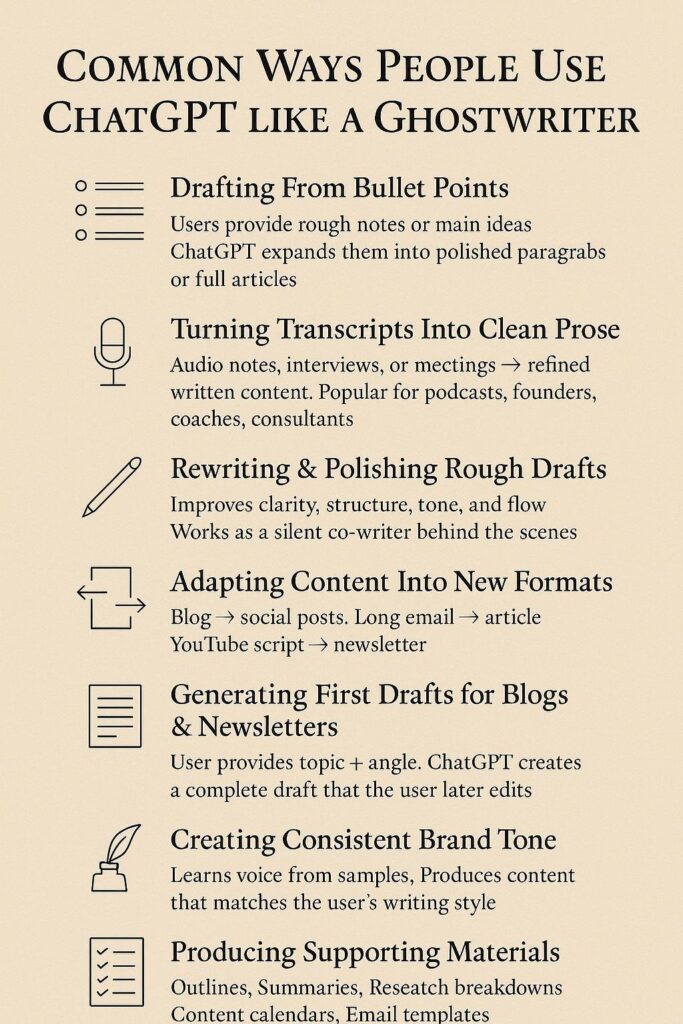
In all of these cases, the human provides the direction and the insight. ChatGPT helps with the heavy lifting and the shaping of the text.
Is It Legal to Use ChatGPT as Your Ghostwriter
Copyright and Ownership of AI Assisted Text
Most major AI platforms treat you as the owner of the output you create with your prompts. In practical terms, if you generate text with ChatGPT and use it in your book or content, you can usually claim the rights to that work.
Here is the complication. Many jurisdictions do not allow purely AI generated text to qualify for copyright protection because it is not created by a human. This does not stop you from publishing your content. It simply means the content may not receive the same legal protection as something created entirely by human authorship.
For authors, this creates a real question. What does it mean for protecting your book or brand content if a portion is AI generated? The short answer is that you should treat yourself as the creator, but you should also understand the limits of how the law views authorship.
Training Data and Ongoing Lawsuits
Several authors and creative organizations have filed lawsuits questioning how AI models were trained. They argue that large language models were exposed to copyrighted books and articles without consent.
As a downstream user, you are not the target of these lawsuits. However, the outcomes can shape future rules and expectations. They may also influence how readers view AI assisted work, especially when they already have strong opinions about fair use, originality, or ethical ghostwriting concerns.
Platform and Marketplace Rules
Publishing platforms are beginning to create guidelines for AI generated content. Amazon, Medium, Substack, and others now have rules about transparency, safety, and quality. Some require you to disclose AI involvement. Others simply expect you to avoid misleading or harmful content.
You must always check three things before you publish anything that used AI support.
- Publisher or employer contracts.
- Platform terms of service.
- Any agreements with clients that prohibit AI or require disclosure.
Following these rules protects you legally and protects your reputation as a responsible author.
Is Using ChatGPT as a Ghostwriter Ethical or Cheating
The Long History of Invisible Collaborators
Ghostwriting is not new. For decades, presidents, CEOs, public figures, and bestselling authors have worked with writers who stay quietly in the background. These collaborators help shape speeches, memoirs, articles, and important messages that the public later attributes to one person.
What makes traditional ghostwriting acceptable is clarity between both parties. The credited author and the ghostwriter understand the arrangement. They agree on tone, ownership, confidentiality, and outcomes. Ethical ghostwriting has always relied on trust and consent rather than secrecy for secrecy’s sake.
Why ChatGPT Support Is Not Automatically Cheating
AI often triggers fear because people imagine it replacing human creativity. In practice, most responsible authors use ChatGPT to support their thinking, not to replace it. AI helps with early drafts, structure, clarity, and organization. It can turn rough notes into something readable, which is very similar to what a human assistant might do.
Most readers care about value. They want insights that help them solve a problem or understand a topic. They rarely focus on who typed every word. If you use AI to assist your process while you remain the source of the ideas, the voice, and the final judgment, you are still the creator.
You control the meaning. You guide the prompts, shape the tone, fact check the information, and choose what stays and what goes. ChatGPT speeds up the early work, but you carry the responsibility and the authenticity.
Where Ethical Concerns Actually Appear
Some situations require a different standard. Academic assignments and licensing exams are built to measure your own understanding. Using AI in these settings violates their purpose. It is not about writing quality. It is about demonstrating personal mastery.
Publishing in sensitive fields also raises significant responsibility. Topics like health, finance, psychology, and self help demand expertise and care. When authors rely on AI to produce books in these areas, inaccurate or shallow content can mislead readers. This is where chatgpt ghostwriting limitations become serious. AI does not have lived experience or an internal sense of harm. It does not know when it is confidently wrong.
Another ethical issue arises in personal storytelling. Memoirs, trauma narratives, and emotionally heavy essays require human depth and lived truth. If AI fabricates emotional experiences or intimate reflections, the writing becomes misleading. Readers expect authenticity when you tell a personal story, and AI cannot supply that authenticity for you.
A Simple Framework for Responsible Use
Start with one question. Who might be harmed if they assume the writing is entirely human? If the answer includes clients, students, readers, or vulnerable audiences, you need stronger oversight or disclosure.
Know when transparency is required. Academic institutions may demand it. Some clients include AI rules in their contracts. Sensitive topics often call for openness because trust matters more than speed.
Above all, take responsibility for your final work. Your name appears on it, not the tool’s. You must revise, verify, refine, and ensure the message is truthful. AI can assist your writing, but it cannot accept accountability on your behalf.
What ChatGPT Does Well as a Ghostwriter
Speed and Idea Generation
One of the most impressive strengths of ChatGPT is its speed. You can feed it a rough outline, a handful of bullet points, or even a half formed thought, and it will generate multiple angles in seconds. It can brainstorm titles, hooks, chapter ideas, email topics, and social content far faster than most writers can warm up their fingers.
This makes it especially helpful for creators who feel stuck or overwhelmed. When the blank page feels heavy, ChatGPT gives you something to react to, which often unlocks your own creativity.
Turning Raw Material Into Drafts
If you have transcripts, voice notes, or long conversations that you want shaped into readable text, AI is incredibly efficient. It can turn a scattered collection of ideas into a smooth first draft that you can then refine into your own voice.
Many authors rely on this ability during early stages of drafting. Instead of spending hours wrestling with messy notes, you can let AI handle the initial transformation so you can start editing a cleaner foundation.
Strong Structural Support
ChatGPT excels at organizing information. If you have a pile of half written thoughts, it can sort them into sections, subheadings, and logical sequences. This makes it valuable for creators who know what they want to say but struggle to structure the narrative.
It can also simplify complex ideas so the writing fits your audience. Whether you are talking to beginners, executives, or specialists, AI can adjust the level of clarity to match their needs.
Volume Content for Everyday Channels
Not every piece of writing needs deep emotional nuance or literary beauty. For everyday content like social posts, simple blog entries, newsletters, or emails, ChatGPT can help you create polished material quickly.
It is also useful for supportive tasks such as summarizing research, cleaning up transcripts, rewriting in a different tone, or reusing content across platforms. You can turn a long blog into a short video script, a thread, or a LinkedIn post in minutes.
A Useful Companion in the Debate of Human Ghostwriter vs AI
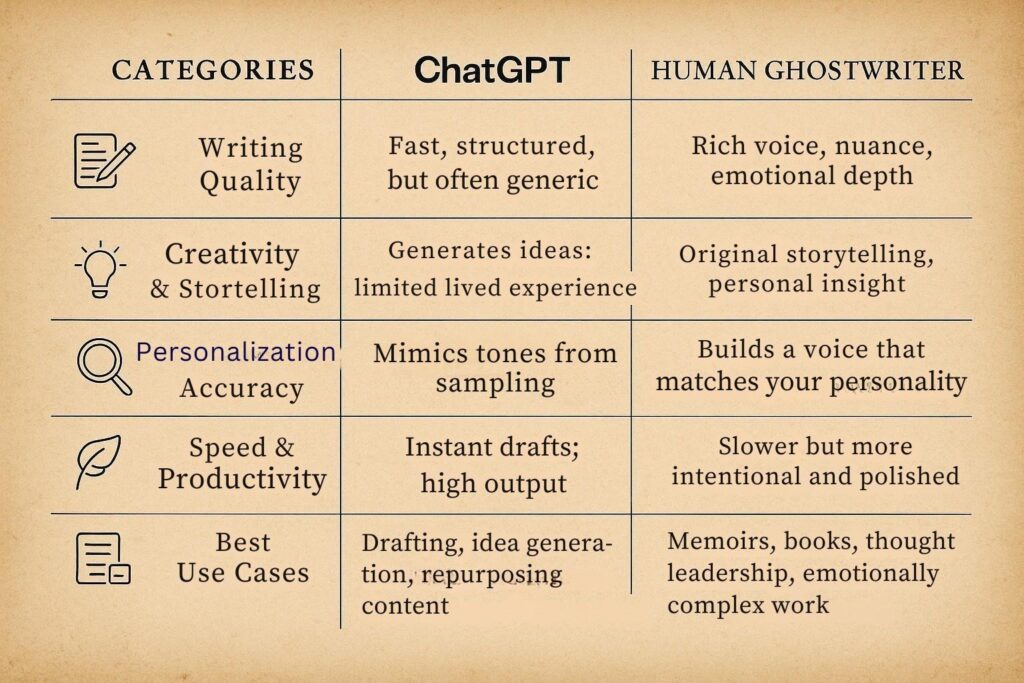
Writers often compare the strengths of people and tools. The discussion of human ghostwriter vs AI is not really a competition. It is a reminder that both offer different advantages. AI brings speed, clarity, and structure. Humans bring emotional depth, experience, originality, and intentional storytelling. When used together, the combination can help you produce high quality content without sacrificing your voice or values.
Where ChatGPT Falls Short as a Ghostwriter
Accuracy Problems and Hallucinations
ChatGPT can sound confident even when it is completely wrong. It may invent statistics, create false quotes, or fill in gaps with information that feels believable but has no real source. This makes it risky for topics that require precision, such as law, medicine, finance, or any step by step instructional content.
Writers who rely on AI still need to verify every claim. A polished sentence is not the same as a true one, and readers can pay the price when the information is incorrect.
Generic or Repetitive Voice
AI has tendencies. It gravitates toward familiar patterns, safe phrasing, and middle of the road tone. Even when you instruct it to mimic your style, it can slip into predictable rhythms that feel flat or overly tidy.
This becomes more noticeable in long projects. A full book draft can start to sound like a loop of repeated phrases, recycled transitions, or emotional moments that feel shallow. Readers can sense when something feels too uniform or too polished, which is why many authors still rely on professional editing services instead of AI editing services to revise and refine the final draft.
Lack of Emotional Depth and Lived Experience
ChatGPT can describe emotion, but it cannot feel it. It can imitate vulnerability, but it cannot access the lived truth behind it. Memoirs, trauma stories, coming of age narratives, and personal essays require a level of authenticity that AI cannot generate.
Readers do not simply want words. They want presence. They want a sense that the writer has lived what they are describing. When the emotional weight is artificial, people notice.
Risk to Your Reputation
Writers today face a growing stigma attached to low quality AI books. Marketplaces have been flooded with rushed, sloppy, or misleading content that damages trust for everyone. If your work is lumped into that category, even unfairly, it can harm your long term credibility.
This risk grows when you publish in sensitive fields or fail to check the accuracy of your content. If readers discover errors, shortcuts, or misleading information, they may not blame the tool. They will blame you.
Limitations in Creative Reasoning
AI can remix information. It cannot originate lived insight or genuine interpretation. It struggles with metaphor that grows from personal experience, humor that relies on timing and intuition, or storytelling that requires subtle psychological awareness.
When your work demands nuance, originality, or deep human perspective, you must guide the creative process. AI can help you shape ideas, but it cannot replace the part of writing that comes from your own life and mind.
How To Responsibly Hire ChatGPT as Your Ghostwriter
Step 1: Define the Scope and Purpose
What You Are Actually Writing
Before opening ChatGPT, get clear on the type of content you want to create. A blog has different demands than a book. A speech needs rhythm and pacing. A newsletter needs clarity and brevity. Knowing the purpose shapes the prompts you will use.
Who the Audience Is
Identify who will read this and what they expect from you. Do they want expertise, encouragement, analysis, or storytelling. AI writes differently depending on your audience, so defining this up front helps you get accurate and useful output.
Step 2: Train ChatGPT on Your Voice
Share High Quality Writing Samples
Feed ChatGPT examples of your best writing. Ask it to identify your tone, pacing, preferred sentence length, and stylistic patterns. The more samples you share, the closer the output will feel to your authentic voice.
Build a Reusable Voice and Style Guide
After the analysis, ask ChatGPT to generate a style guide for your voice. Save it. Reuse it. This becomes your foundation whenever you start a new project, which keeps the tone consistent across all your content.
Step 3: Give Smart, Constrained Prompts
Tell AI What You Want and What You Do Not Want
Strong prompts are specific. They include outlines, key points, examples, and boundaries. This reduces errors and helps the draft sound more like you rather than a generic template.
Clarify Accuracy Requirements
Tell ChatGPT what must be factual, what can be illustrative, and whether you expect citations or source references. If your topic involves sensitive information, make accuracy requirements very clear.
Step 4: Draft in Stages Instead of One Large Ask
Work Section by Section
Do not ask for a full book or complete article in one request. Start with the introduction, then the next section, then the next. This avoids repetition and keeps the writing aligned with your direction.
Use AI Heavily Early, Then Gradually Reduce Its Role
AI excels at brainstorming, structuring, and creating first drafts. Let it handle the early mess. As you move closer to the final version, bring more of your own judgment, editing, and storytelling into the process.
Step 5: Human Editing and Fact Checking
Verify Every Claim
AI can sound confident while being completely wrong. Human review is essential. Check statistics, references, quotes, and any claims that could mislead readers.
Polish for Voice and Clarity
Even when AI writes a solid draft, you may need a human pass for nuance, rhythm, and emotional truth. A human editor can catch inconsistencies, refine tone, and elevate the writing to a professional standard.
Step 6: Decide How Transparent You Want To Be
Know Where Disclosure Is Required
Academic environments, many companies, and some clients require you to disclose AI involvement. Follow the rules to protect your credibility.
Choose When Transparency Is Wise
If your topic is sensitive or your audience values authenticity, a simple note stating that you used AI assistance can build trust rather than undermine it.
ChatGPT vs Human Ghostwriter: A Comparative Section
Understanding the Real Differences
The question many writers ask is simple. Which option is better. A human ghostwriter or an AI tool. The truth is that both serve different roles in the creative process. They do not compete as much as they complement each other. When you understand the strengths of each, you can build a workflow that gives you speed without sacrificing depth, and clarity without losing emotion.
Human writers carry insight, lived experience, and intuition. AI carries speed, structure, and the ability to turn your scattered ideas into something readable almost instantly. The best choice depends on your goals, your budget, your timeline, and the emotional demands of your project.
Side by Side Comparison
Cost Considerations
Human ghostwriters often charge significant fees because they invest time, skill, and creative labor into the work. They interpret your voice, refine your message, conduct interviews, and polish prose with precision. This makes the investment valuable, but not always accessible.
ChatGPT costs far less. It can generate drafts at a fraction of the price and within seconds. For writers who need volume, speed, or early stage support, AI can feel like a powerful shortcut. However, its affordability does not eliminate the need for human editing, which means its true cost includes revision time.
Speed and Turnaround
AI is unmatched in speed. You can request a chapter outline, a sample draft, or a rewritten paragraph and receive the result instantly. This makes AI ideal for brainstorming or getting past creative blocks.
A human ghostwriter, on the other hand, requires time. They schedule interviews, review source material, create outlines, write drafts, and revise based on your feedback. The slower process often leads to deeper insight and stronger narrative quality.
Voice and Emotional Depth
This is where humans shine without question. A human writer can capture vulnerability, humor, tension, and personal rhythm. They know how to translate your experiences into emotional resonance. They can sense when a moment needs softness or when a sentence needs sharpness.
AI can imitate tone, but imitation is not the same as lived authenticity. Over long projects, AI often slips into repetitive patterns or generic phrasing. Readers may feel the writing is clean but not human.
Research and Accuracy
A professional ghostwriter can evaluate the credibility of sources, understand nuance, and adjust writing based on complex information. AI can summarize topics, but it cannot always determine what is accurate. It may produce believable but incorrect details, which means human verification is essential.
Ethics and Reader Trust
Human writers understand context. They recognize when a topic requires sensitivity or when a story demands emotional honesty. AI does not understand impact. It only predicts patterns.
When writing about trauma, health, finance, or vulnerable experiences, readers trust a human perspective far more than an AI generated one.
The Real Role of Each Option
Where AI Shines
AI is excellent for early drafts, structural clarity, idea generation, and fast rewriting. It removes friction and frees your mind to focus on higher level creativity.
Where Humans Shine
Humans bring depth, storytelling instinct, empathy, and original interpretation. These elements cannot be automated.
Why the Comparison Matters
The discussion of human ghostwriter vs AI should not create opposition. It should guide you toward a hybrid approach. Use AI to accelerate the process and use human skill to elevate the writing. That combination leads to work that is both efficient and genuinely meaningful.
How Much of Your Book or Content Can Be AI Written
Understanding the Right Balance
There is no single formula for how much AI you should use, but there is a truth most experienced authors agree on. The best writing is a blend of efficiency and authenticity. AI helps you move faster, think more clearly, and avoid the overwhelm of early drafts. You provide the judgment, the experience, and the emotional honesty that readers trust.
The goal is not to let AI take over your entire project. The goal is to decide how much involvement supports your message without weakening your voice.
Blog Posts and Newsletters
High AI Support With Strong Human Editing
For everyday content like blogs, newsletters, and short articles, you can safely lean on AI for much of the initial writing. These formats are designed for clarity and speed rather than emotional depth. Let AI generate a draft, structure your ideas, and help you maintain a consistent publishing rhythm.
Your role is to shape the final piece. Edit for tone. Add personal examples. Include your lived observations. AI can give you the skeleton, but you should supply the heartbeat.
How To and Business Books
AI for Structure, Humans for Insight
Many authors use AI to outline chapters, develop flow, or create early drafts. This is especially helpful in business writing, where clarity and organization play a big role.
But the core value of a business book is your insight. Readers want the lessons you learned, the stories you lived, and the unique frameworks you developed. AI cannot create these for you. It can only help you express them more clearly.
Use AI to speed up the early stages, then slow down and apply your experience to shape the final message.
Memoir, Personal Essays, and Literary Fiction
Minimal AI Involvement
These genres depend on emotional truth, voice consistency, and lived experience. Readers can feel when something is authentic and when it is not. AI can help with line edits, clarity, and reorganizing scenes, but it should not be the primary writer.
You can use AI to brainstorm themes or reword a paragraph, but the heart of the story must come from you. This is one of the clearest examples of why chatgpt ghostwriting limitations matter. AI cannot recreate your experiences, interpret your emotions, or carry the weight of your memories.
Why a Hybrid Model Is Safest
A hybrid approach offers both speed and integrity. AI can take the pressure off the blank page, help you maintain consistency, and support your planning. You can then review, refine, add nuance, and ensure the final work reflects your personality and your perspective.
This combination produces writing that feels human while still benefiting from modern tools. It respects your readers, preserves your voice, and keeps your work both efficient and credible.
Policies, Contracts, and Real World Consequences
Check the Rules Before You Publish
School and University Policies
Academic environments are very clear about AI use. Many institutions treat AI generated writing as a form of unauthorized assistance. Some require disclosure. Others ban AI completely. If you are writing for a class, a degree program, or any graded assignment, check the rules before using AI in any part of the process.
Employer and Client Agreements
Workplaces often include specific guidelines regarding AI tools. Some companies prohibit AI for confidentiality reasons. Others allow it but require written disclosure. If you are producing client content, contracts may include clauses that restrict AI involvement. Breaking those rules can damage professional relationships and reduce trust.
Publisher and Platform Regulations
Platforms like Amazon, Medium, and Substack continue to tighten their rules about AI generated or AI assisted content. Some require you to disclose AI involvement. Others simply expect accuracy and quality control. Failing to follow these guidelines can lead to content removal, account flags, or long term account issues.
Lessons From High Profile AI Misuse
Fabricated Legal Cases
Several lawyers have accidentally filed briefs containing fake case citations generated by AI. The courts responded with sanctions, damaged reputations, and public scrutiny. These incidents show why AI should never be used blindly in professional or legal contexts.
AI Written Expert Books With Dangerous Claims
Self published marketplaces have seen a wave of low quality books produced entirely with AI. Some contain financial advice that is misleading or medical guidance that is unsafe. Readers have reported harmful errors, and platforms have begun cracking down on misleading content.
These events show that quality control is not optional. Writers must verify everything before publishing, especially when the topic involves public safety or informed decision making.
Protecting Your Reputation Long Term
Use AI to Enhance, Not Replace
Your reputation as a writer depends on credibility, consistency, and trust. AI should support your work, not serve as a shortcut that sacrifices accuracy or meaning. Readers can sense when something feels impersonal or shallow, and that impression can last.
Be Transparent Where It Matters
You do not need to announce AI involvement for every blog post or social caption. However, when the context requires honesty, disclosure protects you. Transparency is especially important when dealing with sensitive topics because it reduces ethical ghostwriting concerns and avoids misleading your audience.
Commit to Human Level Responsibility
Even if AI drafts your content, you are responsible for everything published under your name. Review every claim. Check every example. Ensure the writing aligns with your values and your voice. AI can help you produce more, but you must ensure the work remains meaningful, accurate, and trustworthy.
The Future of Ghostwriting in the Age of AI
Why AI Will Not Replace Human Writers
Human Judgment Still Matters
As powerful as AI has become, it lacks personal experience, moral judgment, and emotional intuition. These elements shape powerful storytelling. Readers connect with perspective, vulnerability, and insight. None of these qualities can be automated because they come from lived reality.
AI can support the creative process, but it cannot understand the deeper meaning behind your ideas. That is why human writers remain essential.
Voice and Authenticity Still Lead
Readers follow specific authors because of how they speak to them. The personal rhythm, humor, honesty, or sharp clarity that makes one writer stand out cannot be replicated perfectly by a tool. AI can help refine your expression, but it cannot replace your voice without losing authenticity.
Emerging Hybrid Models
Writers Who Direct AI Instead of Compete With It
A new wave of creators is learning to partner with AI instead of fearing it. They use AI to outline chapters, brainstorm ideas, rewrite awkward sections, or expand early drafts. Then they apply their own creativity to finalize the work. This blend of human insight and AI efficiency is starting to define modern authorship.
Ghostwriters Who Work With AI Tools
Professional ghostwriters are also adapting. Many now use AI to accelerate administrative tasks, repurpose content, or test different structural approaches before writing the final version themselves. Instead of replacing ghostwriters, AI is becoming part of their toolkit.
Editors and Specialists Becoming Even More Essential
Quality Control Will Define Professionalism
As AI generated content becomes more common, readers will rely even more heavily on editors, sensitivity reviewers, and fact checkers. Professional oversight will become a marker of credibility and trust. Writers who embrace this will stand out in a crowded landscape.
Niche Experts Will Gain More Value
Writers and editors who specialize in fields like health, law, finance, or psychology will become more important, not less. Their expertise helps prevent misinformation and ensures that nuanced topics are handled with care.
How Authors Can Stay Both Productive and Principled
Adopt AI With Clear Boundaries
Use AI to eliminate busywork, speed up drafting, and support your process. Let it make writing more efficient, but do not let it guide decisions that require lived experience, ethical sensitivity, or emotional honesty.
Acknowledge Limitations With Intention
Writers who understand the scope of AI tools navigate them with more confidence. When you recognize chatgpt ghostwriting limitations, you know exactly when to rely on AI and when to rely on yourself. This awareness protects your integrity and strengthens your final work.
Stay Focused on What Only You Can Contribute
Your voice, your insight, your experience, and your story are irreplaceable. AI can help you express them clearly. It cannot create them for you.
FAQs
Is it legal to use ChatGPT to write my book or blog
Yes, in most cases it is legal. You are generally considered the owner of the AI assisted output. However, laws about training data and authorship are still evolving, and different platforms have different disclosure rules. Always check your publisher, client, or platform guidelines before submitting AI assisted work.
Do I own the copyright if ChatGPT helped write the text
You can claim rights to the completed work, especially if you add meaningful human editing or direction. However, purely AI generated text cannot be copyrighted in many jurisdictions because it lacks human authorship. This means the strongest protection comes from combining AI drafts with human creativity and revision.
Is using ChatGPT as a ghostwriter considered plagiarism or cheating
It depends on the context. In business, marketing, and creative writing, using AI as a drafting assistant is common and acceptable. In academic settings, exams, and licensing environments, using AI without disclosure is often considered cheating. The standards shift depending on purpose and expectations.
Can readers or platforms tell if I used ChatGPT
Some readers may notice repetitive phrasing or overly formal tone, but most cannot identify AI use if you revise the content. AI detection tools are inconsistent and not fully reliable. The safest approach is to ensure your final work sounds like you and meets platform guidelines.
Will publishers reject my manuscript if part of it was AI assisted
Publishers vary. Some ask about AI use in submission forms. Others focus on quality and originality rather than the tool used. The key is to follow each publisher’s stated rules. Be prepared to disclose AI involvement if asked.
Can ChatGPT replace a human ghostwriter entirely
Not at this time. AI can draft and organize information, but it cannot match human nuance, emotion, lived experience, or deep storytelling. Complex research and sensitive topics also require human oversight. AI is a tool, not a substitute for skilled writers.
How do I keep my voice when ChatGPT writes the draft
Train ChatGPT on your writing samples, create a style guide, and revise every draft. Add personal insights, stories, and humor. A strong final pass in your own words helps maintain authenticity.
How much editing does AI generated content need
A lot, especially for long form content. You should verify facts, correct tone, refine transitions, and remove generic phrasing. Many writers use human editors or sensitivity readers to complete the final polish.
Will AI tools like ChatGPT take ghostwriters’ jobs
AI will change ghostwriting, but it will not eliminate it. Tasks will shift toward directing AI, refining tone, conducting interviews, shaping narrative, and adding depth. New roles will emerge for writers who know how to guide and enhance AI output.
Conclusion
The rise of AI has changed the writing world faster than anyone expected. Authors, creators, and entrepreneurs now have access to tools that can speed up drafting, spark new ideas, and break through creative blocks in minutes. Yet the heart of great writing still belongs to human insight, emotional truth, and the lived experiences that shape your perspective.
Understanding chatgpt ghostwriting limitations is not about restricting your creativity. It is about knowing how to use AI responsibly so the work remains meaningful, accurate, and unmistakably yours.
Why the Hybrid Approach Wins
Using AI for Momentum
AI gives you speed, structure, and freedom from the blank page. It helps you outline, brainstorm, and explore multiple directions quickly. For many writers, this alone lifts an enormous weight.
Using Humans for Depth
Human judgment brings nuance, credibility, storytelling instinct, and emotional resonance. That is why even the best book writing services rely on skilled writers and editors who understand how to shape your voice, not override it.
The future of authorship is neither purely AI nor purely human. It is the thoughtful balance between both.
Your Responsibility as a Modern Author
You control the message. You decide how much of your writing is AI assisted. You determine when to disclose, when to revise, when to fact check, and when to speak directly from your own experience. These decisions shape your reputation and protect your audience.
AI is a tool. You are the author. When you guide the process with clarity and integrity, your work becomes stronger, not weaker.
Your Path Forward
Use AI where it strengthens your workflow. Use your own voice where it matters most. Embrace innovation without sacrificing authenticity. The writers who thrive in this new era are the ones who stay flexible, stay thoughtful, and stay true to the stories only they can tell.