Introduction
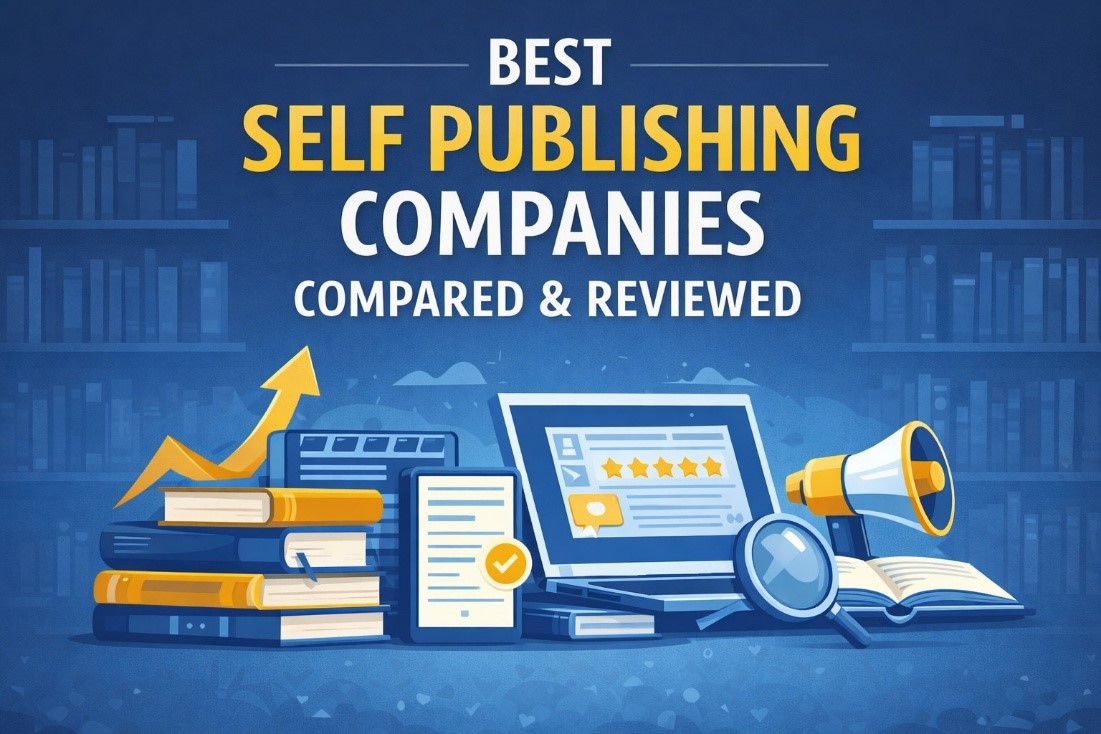
Choosing among the best self publishing companies in 2026 is no longer just about who can upload your book to Amazon. Today’s authors face a crowded market filled with full-service publishers, hybrid models, and companies that blur the line between legitimate support and costly upsells. The right publishing partner can help you protect your rights, produce a professional book, and reach global readers. The wrong one can lock you into restrictive contracts and unnecessary expenses.
This guide is designed to help authors make an informed decision. Instead of marketing claims, it focuses on transparency, service quality, author control, and real publishing outcomes. Each company included has been evaluated using clear criteria so you can confidently compare options and choose the publishing path that aligns with your goals, budget, and long-term success.
What “Self-Publishing Company” Really Means in 2026
A decade ago, the phrase self-publishing company meant something simple.
Someone helped you upload a book.
Maybe they designed a cover.
Maybe they formatted the pages.
Then they stepped away.
In 2026, that definition no longer holds.
Today, a self-publishing company can be a technician, a guide, a production partner, or in some cases, a gatekeeper in disguise. The label stays the same. The reality underneath it does not. And that difference matters more than most authors realize when they begin.
At its most basic level, a self-publishing company offers professional services that allow authors to bring a book to market without surrendering ownership. Editing, cover design, interior formatting, ISBN setup, and distribution support are common. Authors typically pay upfront, retain creative control, and decide what happens to the book long after launch. These services often resemble professional book publishing services, but resemblance does not guarantee consistency or quality.
Why Definitions Matter Before Comparing Companies
Problems rarely begin with bad intentions. They begin with mismatched expectations.
Some companies exist to execute tasks. They prepare files, connect platforms, and complete projects efficiently. Others act as long-term partners, helping authors navigate decisions that affect pricing, revisions, distribution strategy, and marketing long after publication. When authors expect one model and receive the other, frustration follows. Not because the work was poorly done, but because the role was never clearly defined.
This distinction has become more important as the industry has matured.
In 2026, three shifts now define the self-publishing landscape:
- Clearer demand for transparent pricing and contract terms
- A move away from rigid bundles toward customizable service paths
- Global distribution and print-on-demand becoming baseline expectations rather than premium upgrades
These changes reflect a more educated author base. Writers ask better questions now. They compare more carefully. And companies that cannot explain what they do, and just as importantly what they do not do, are losing credibility.
This is also why surface-level comparisons fail. A premium publishing partner and a lean production provider may both call themselves self-publishing companies, yet serve entirely different needs. One prioritizes guidance and structure. The other prioritizes speed and cost control. Neither is universally better. Context decides.
The best self publishers are not defined by the size of their packages or the confidence of their sales language. They are defined by alignment. Alignment between services offered and promises made. Alignment between author goals and company limitations. Alignment between what happens before launch and what support remains afterward.
Understanding what a self-publishing company truly is, before judging which one is “best,” creates clarity. It replaces marketing noise with structure. And it prepares authors to evaluate companies based on suitability, transparency, and long-term value rather than assumption. That clarity is what makes the comparisons ahead meaningful instead of misleading.
How We Ranked the Best Self Publishing Companies in 2026
Ranking publishing companies is easy if the goal is entertainment.
It becomes more difficult when the goal is accuracy.
Lists are everywhere. Promises are loud. Numbers are polished. But authors do not live inside marketing copy. They live with the consequences of contracts, production decisions, and support that either continues after launch or disappears the moment a book goes live.
To identify the best self publishing companies in 2026, we focused on outcomes rather than appearances. Not what companies claim to offer, but how their services function when an author is navigating real decisions, real costs, and real expectations.
Every company reviewed was evaluated using the same framework. This was intentional. Consistency matters when comparisons are meant to inform rather than persuade.
The criteria used reflect the points where authors most often encounter friction:
- Pricing transparency
Whether costs are disclosed clearly at the beginning, without essential services being introduced later as unavoidable upgrades. - Author rights and ownership
How intellectual property, royalties, and long-term control are handled after publication, not just during setup. - Editorial and production quality
The standard of editing, design, and formatting, and whether these services meet professional publishing expectations. - Distribution access
How easily books can reach major retailers and international markets without artificial limitations or lock-in. - Marketing realism
Whether promotional services are explained honestly, with clear boundaries between exposure and outcomes. - Contract flexibility
The freedom authors retain to revise, update, or move their work without penalties or prolonged restrictions.
This approach favors clarity over speed and sustainability over spectacle. It recognizes that publishing is not a single moment, but a process that continues long after release day. By applying these criteria uniformly, the comparisons that follow are designed to help authors identify publishing partners that support long-term goals rather than short-term optimism.
Types of Self-Publishing Companies Authors Will Encounter in 2026
Not all self-publishing companies exist for the same reason.
They share a name, but not a function.
In 2026, most confusion around self-publishing does not come from bad actors. It comes from authors assuming that one model applies to every company they encounter. It does not. Understanding the different types of providers is essential before any comparison can be meaningful.
Full-Service Self-Publishing Firms
Full-service firms position themselves as end-to-end publishing partners. They typically offer editing, design, formatting, distribution setup, and optional marketing under a coordinated process. For authors who want structure and guidance, this model can reduce decision fatigue and provide a clearer publishing path.
The trade-off is involvement. Authors may rely more heavily on the company’s timelines, workflows, and recommendations. When expectations are clear, this can be productive. When they are not, it can feel restrictive. The value of a full-service firm depends almost entirely on transparency and communication.
Hybrid Publishing Models
Hybrid publishers sit between traditional and self-directed publishing. They often curate submissions, maintain selective standards, and offer a level of editorial oversight that resembles traditional publishing without assuming full financial risk.
For experienced authors, this model can feel validating. For newer authors, it can be confusing. Costs are typically higher, and benefits vary widely depending on distribution reach and marketing support. Hybrid publishing is not inherently better or worse, but it demands careful scrutiny to ensure that selectivity is not confused with superiority.
Platform-First Service Providers
Some companies focus almost entirely on technical execution. Their primary function is to prepare files, manage uploads, and ensure compatibility with major retail platforms. Editing and design may be optional or outsourced.
This model appeals to authors who already understand the publishing process and want efficiency without oversight. It offers flexibility and cost control, but little guidance. Success here depends largely on how prepared the author is before engaging the service.
Marketing-Centric Publishing Companies
A growing segment of the market centers its value proposition around promotion rather than production. These companies emphasize visibility, advertising, and audience reach, often assuming that the book itself is already publication-ready.
This approach can be useful when paired with strong editorial foundations. Without them, marketing becomes amplification without substance. Authors considering this model must clearly separate exposure from outcome and understand what level of responsibility remains theirs after campaigns conclude.
Each of these models serves a different purpose. None is universally correct. The mistake is assuming that all self-publishing companies solve the same problem. They do not. They solve different problems for different authors at different stages.
Recognizing which category a company belongs to brings clarity to every comparison that follows. It shifts evaluation away from surface promises and toward suitability, alignment, and long-term value. That clarity is what makes informed publishing decisions possible.
Quick Comparison of Top Self Publishing Companies in 2026
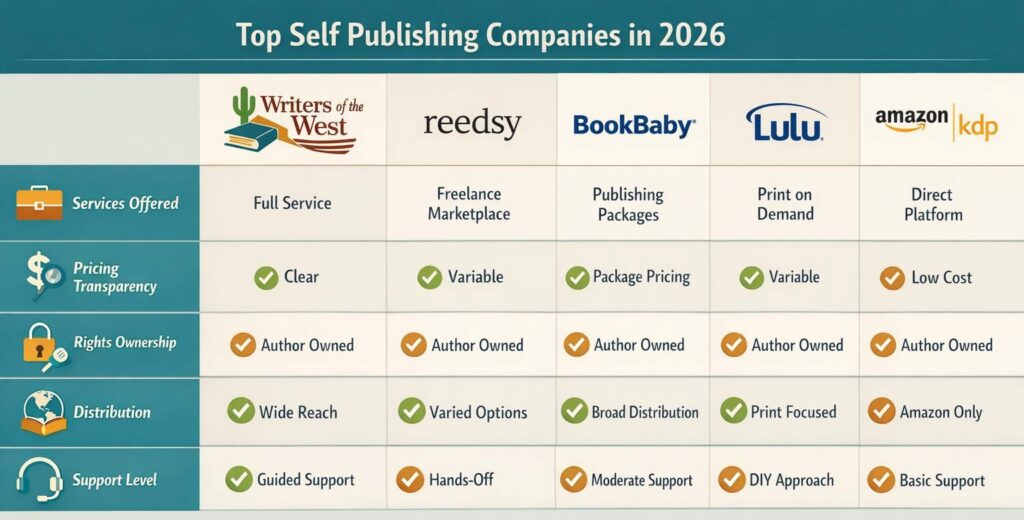
Before diving into individual reviews, it helps to see how leading self-publishing providers compare at a glance. This table focuses on the factors authors consistently cite as most important when choosing a publishing partner: transparency, rights ownership, publishing model, and distribution reach.
Rather than listing every possible service, the comparison highlights structural differences that affect long-term outcomes. Each company included here operates legitimately within the self-publishing space, but they serve different author needs. Understanding those differences early makes the detailed evaluations that follow more meaningful and easier to navigate.
Comparison Table: Leading Self-Publishing Companies
| Company | Best For | Publishing Model | Pricing Transparency | Rights Ownership | Distribution Reach | Overall Rating |
| Writers of the West | Authors seeking full-service guidance with control | Full-service self-publishing | High | Author retains full rights | Global (ebook + print) | ⭐⭐⭐⭐⭐ |
| Reedsy | Authors hiring individual publishing professionals | Marketplace-based services | High | Author retains full rights | Platform-dependent | ⭐⭐⭐⭐☆ |
| BookBaby | Authors wanting bundled production services | Full-service self-publishing | Medium | Author retains full rights | Global (ebook + print) | ⭐⭐⭐⭐☆ |
| Lulu | Authors focused on print-on-demand flexibility | Platform-first services | High | Author retains full rights | Global print network | ⭐⭐⭐⭐☆ |
| KDP | Authors publishing directly on Amazon | Platform-only publishing | High | Author retains full rights | Amazon ecosystem | ⭐⭐⭐⭐☆ |
In-Depth Reviews of Leading Self-Publishing Companies
Writers of the West: Full-Service Self-Publishing With Author Control
Writers of the West positions itself as a full-service partner for authors who want professional publishing standards without surrendering ownership. The company’s approach emphasizes structure, transparency, and long-term thinking rather than speed or spectacle.
Rather than pushing authors through rigid packages, services are scoped around the manuscript’s needs. Editorial development, design, formatting, and distribution are treated as connected stages of a single process. Authors remain involved in decisions, but they are guided with context rather than left to navigate unfamiliar territory alone.
Best for
- Authors seeking end-to-end guidance while retaining full rights
- First-time or serious nonfiction and fiction authors
- Writers who value clarity over rapid release
Strengths
- Clear separation between production and optional marketing services
- Author retains full creative and publishing control
- Coordinated workflow from manuscript to distribution
- Flexible approach to print and ebook formats
Limitations
- Not designed for authors who want a completely hands-off process
- Requires active author participation and feedback
Writers of the West is best suited for authors who see publishing as a long-term investment and want professional support without being locked into restrictive models.
Reedsy: Professional Talent Without a Centralized Process
Reedsy operates as a curated marketplace rather than a traditional publishing company. Its value lies in direct access to experienced editors, designers, and publishing professionals, many with backgrounds in traditional publishing.
Authors select each professional individually, define project scopes, and manage timelines themselves. This creates a high degree of flexibility, but also places responsibility for coordination entirely on the author.
Best for
- Experienced authors who understand the publishing process
- Writers who want to assemble their own team
- Authors seeking high-quality freelance talent
Strengths
- Strong vetting of professionals
- Upfront pricing and clear contracts
- Full author control over creative decisions
Limitations
- No end-to-end publishing guidance
- Authors must manage workflow and strategy themselves
Reedsy works well for authors who prioritize independence and already know what services they need.
BookBaby: Bundled Publishing With Predictable Structure
BookBaby offers a package-based approach to self-publishing. Editing, design, formatting, ISBN services, and distribution are grouped into predefined tiers, simplifying decision-making for authors who prefer a guided path.
The process is orderly and clearly mapped, which reduces uncertainty during production. However, the bundled structure can limit customization for authors who only need specific services.
Best for
- First-time authors seeking a structured process
- Writers who prefer bundled solutions
- Authors focused on efficient production
Strengths
- Clear workflows and production timelines
- Consistent editing and design standards
- Wide print and ebook distribution
Limitations
- Limited flexibility within packages
- Some authors may pay for services they do not fully need
BookBaby suits authors who value predictability and simplicity over customization.
Lulu: Platform-First Publishing With Print Flexibility
Lulu is best understood as a print-on-demand platform rather than a full publishing service. Its strength lies in production and distribution infrastructure, particularly for print books.
Authors manage most aspects of publishing themselves, using Lulu primarily for printing and order fulfillment. Editing, design, and marketing are typically handled externally.
Best for
- Authors focused on print books
- Writers comfortable managing production independently
- Creators selling directly or in niche markets
Strengths
- Global print-on-demand network
- No inventory requirements
- High control over print formats
Limitations
- Minimal guidance or publishing support
- Not a complete end-to-end solution
Lulu is effective for authors who already have polished files and need reliable print distribution.
Amazon KDP: Direct Platform Publishing With Maximum Reach
Amazon KDP allows authors to publish directly to Amazon’s ecosystem without intermediaries. It offers simplicity, speed, and access to the world’s largest book marketplace.
The platform is easy to use, but support is limited to documentation and automated systems. Authors are responsible for editing, design, and marketing decisions.
Best for
- Authors prioritizing Amazon visibility
- Writers comfortable managing the process themselves
- Budget-conscious publishers
Strengths
- Free setup and fast publishing
- Full rights retention
- Seamless integration with Amazon
Limitations
- Limited human support
- Dependence on a single platform
- Requires external services for professional polish
KDP works best for authors who want direct access to Amazon and are prepared to manage publishing independently.
Cost Breakdown: What Authors Actually Pay in 2026
Cost is rarely the first question authors ask, but it is often the one that determines everything else. In 2026, self-publishing costs are more visible than they once were, yet still widely misunderstood. The issue is not how much authors pay. It is what those costs represent, when they appear, and how clearly they are explained.
Editorial Costs: Where Most Budgets Are Won or Lost
Editing remains the largest and most variable expense in the self-publishing process. Developmental editing, line editing, and proofreading serve distinct purposes, and compressing them into a single step often leads to problems that only become apparent after publication.
Editorial costs typically vary based on:
- Manuscript length and structural complexity
- Type of editing required, from big-picture development to final polish
- Degree of collaboration and revision included
Professional editing services are rarely inexpensive, but its value compounds over time. Strong editing improves clarity, credibility, and reader trust. Skipping or minimizing this stage may reduce upfront cost, but it often increases long-term expense through revisions, poor reviews, or diminished discoverability.
Design and Formatting: Predictable, but Not Identical
Cover design and interior formatting tend to be more standardized in pricing, but not in approach. Some providers deliver fixed designs with limited revisions. Others treat design as an iterative process that evolves alongside the manuscript.
The difference matters. A cover is not decoration. It is positioning. Formatting is not cosmetic. It affects readability across devices, print formats, and screen sizes. Authors should look beyond price and ask how much refinement, feedback, and flexibility are included.
Distribution Setup: Often Included, Sometimes Oversold
Most self-publishing providers now include basic distribution setup as part of their core services. Access to print-on-demand networks and major ebook platforms is no longer a premium feature.
What still varies is scope. Some companies emphasize wide distribution across retailers. Others focus on depth within a single ecosystem. Neither approach is inherently better, but authors should understand where their book will, and will not, appear before assuming reach or visibility.
Marketing Costs: The Most Misunderstood Expense
Marketing is where expectations most often diverge from reality. Promotional services are frequently sold as packages, but outcomes are never guaranteed. Visibility does not equal sales, and exposure does not replace audience-building.
Marketing services commonly include:
- Advertising setup and platform configuration
- Short-term launch or visibility campaigns
- Limited promotional outreach rather than sustained sales support
These services should be approached as experiments, not promises. Budgets here should remain conservative, measurable, and aligned with realistic goals. This is where meaningful differences emerge. The best self publishing book companies are not defined by how aggressively they sell marketing, but by how clearly they explain its limits.
What Authors Can Expect to Spend Overall
In 2026, most authors can expect total publishing costs to range from a few thousand dollars to significantly more, depending on scope, genre, and ambition. A lean release and a fully polished, market-ready book require different levels of investment.
What matters most is alignment. When costs match goals, authors feel informed rather than surprised. When they do not, frustration follows.
What Self-Publishing Companies Don’t Tell You
Most problems in self-publishing do not come from deception. They come from silence. Important details are not hidden, exactly. They are simply delayed, revealed only after decisions feel irreversible.
This is where authors often realize that understanding publishing is not just about what is offered, but about what is quietly assumed.
“Full-Service” Does Not Always Mean Full Guidance
The phrase full-service publishing is widely used, but loosely defined. In practice, it often refers to production tasks rather than strategic support. Editing, design, and distribution may be included, while planning, positioning, and post-launch decisions remain the author’s responsibility.
Authors are often surprised to learn that services they assumed were part of the process were never included at all.
These gaps commonly involve:
- Strategic guidance beyond manuscript preparation
- Long-term publishing or pricing advice
- Post-launch planning and iteration
Understanding scope early prevents disappointment later.
Upsells That Appear After Commitment
Upselling is rarely aggressive. It is usually framed as concern. A suggestion becomes a recommendation. A recommendation becomes a requirement. By the time this shift occurs, authors may already feel invested enough to comply.
Marketing services are the most frequent source of this pressure, particularly when framed as essential for success.
Upsells often focus on:
- Visibility rather than reader conversion
- Short-term exposure rather than sustained momentum
- Access to platforms rather than outcomes
The language sounds supportive. The results remain uncertain.
Contracts Are Clear, but Rarely Explained
Most publishing contracts are written plainly. The problem is not readability. It is interpretation. Authors skim familiar terms and assume standard protections without fully understanding how those clauses function in practice.
Issues usually surface around:
- Rights duration and termination conditions
- Limits on revisions or updates
- Restrictions on moving a book elsewhere
Clarity on paper does not always translate to clarity in experience.
Marketing Promises and Marketing Reality Are Not the Same Thing
Marketing is often presented as progress. Ads are launched. Listings are optimized. Campaigns begin. But none of these actions guarantee sales.
Advertising can place a book in front of readers. It cannot compel interest. It cannot create demand. Companies rarely emphasize this distinction, because it complicates expectations.
Marketing services typically provide:
- Setup and configuration
- Temporary visibility
- Access, not assurance
Recognizing this difference protects both budget and morale.
What Happens After Your Book Is Published
For some companies, publication marks the end of the relationship. For others, it is a transition point. Authors are rarely told which experience to expect.
Post-publication support may or may not include:
- Updates or revisions
- Format expansions
- Ongoing strategic guidance
The absence of clarity here often matters more than the services themselves.
The most reliable publishing partners are not those who promise certainty. They are the ones who explain limits early, define scope clearly, and leave space for authors to decide with full information. Silence is not neutral in publishing. It is a signal. Learning to recognize it is part of becoming an informed author.
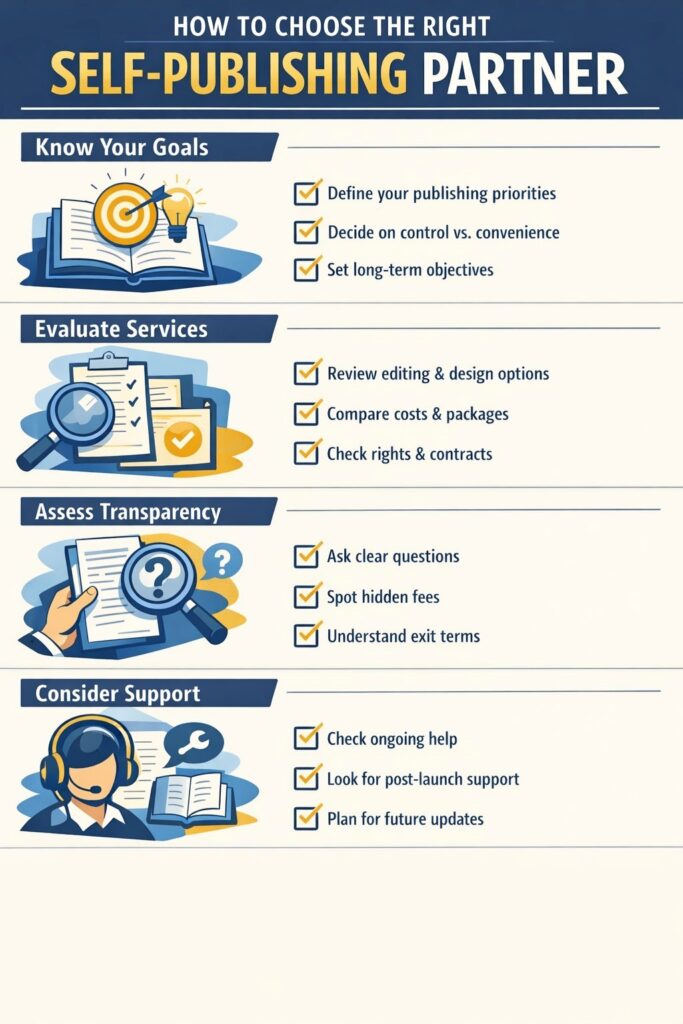
How to Choose the Right Self-Publishing Partner for Your Goals
Choosing a publishing partner is not about finding the “best” option in the abstract. It is about alignment. The same company can be the right fit for one author and the wrong fit for another, depending on experience, expectations, and long-term intent.
This decision becomes clearer when authors stop asking what a company offers and start asking what they actually need.
If You Are Publishing for the First Time
First-time authors often underestimate how many decisions publishing involves. Editing stages, design trade-offs, distribution choices, and marketing assumptions can feel overwhelming when encountered all at once.
In this situation, structure matters more than speed.
First-time authors should prioritize:
- Clear explanations of each stage in the process
- Transparent pricing and defined scopes
- Guidance that supports decision-making rather than replaces it
Support does not mean surrendering control. It means having context when it matters.
If You Value Control Over Convenience
Some authors want to remain deeply involved in every choice. They prefer selecting collaborators individually, setting their own timelines, and retaining flexibility to adjust after publication.
This approach requires confidence and time, but it also offers autonomy.
Authors who value control should look for:
- Flexible service models rather than rigid packages
- Full rights retention with minimal restrictions
- The ability to revise, update, or reposition their book later
For these authors, the best self publishers are those that support independence rather than centralize authority.
If Budget Is a Primary Constraint
Cost shapes publishing decisions whether authors acknowledge it or not. A limited budget does not mean publishing poorly, but it does require prioritization.
When budget matters most, authors should focus spending where it has lasting impact and remain cautious elsewhere.
Budget-conscious decisions often include:
- Investing in essential editing
- Choosing functional design over elaborate customization
- Treating marketing as an experiment rather than a guarantee
Clarity here prevents regret later.
If Long-Term Reach Matters More Than Launch Speed
Some authors publish quickly. Others publish deliberately. If a book is meant to evolve, reach new audiences, or support a broader platform, flexibility matters more than immediacy.
In these cases, authors should consider:
- Distribution options beyond a single platform
- Ease of updating editions or formats
- Ongoing support versus one-time delivery
Publishing is not always a moment. Often, it is a process.
Choosing the right self-publishing partner is ultimately an exercise in self-awareness. When authors understand their priorities clearly, trade-offs become easier to evaluate. The goal is not to eliminate uncertainty, but to choose a path where uncertainty is manageable, expected, and openly discussed.
Frequently Asked Questions
Are self-publishing companies worth it in 2026?
Self-publishing companies can be worth it when they provide clarity, professional standards, and support that matches an author’s needs. They are most valuable for authors who want guidance through editing, design, and distribution without giving up ownership. They are less useful for authors who are already comfortable managing the process independently and only need technical tools.
How much does it typically cost to self-publish a book?
Costs vary widely depending on the level of editing, design quality, and marketing support involved. In 2026, many authors spend anywhere from a few thousand dollars to significantly more for a fully polished release. The most important factor is not the total cost, but whether expenses are clearly explained and aligned with realistic publishing goals.
Do self-publishing companies take ownership of your book?
Reputable self-publishing companies do not take ownership of an author’s work. Authors typically retain full rights and royalties. However, contracts should always be reviewed carefully to confirm rights duration, distribution terms, and exit conditions before committing.
What is the difference between self-publishing and a vanity press?
Self-publishing companies provide services while allowing authors to retain control and ownership. Vanity presses often charge high fees while presenting themselves as traditional publishers and may impose restrictive contracts. The difference lies in transparency, rights retention, and whether services are optional or framed as requirements.
Can you switch self-publishing companies after publishing?
In most cases, yes. Authors who retain their rights can update editions, change distributors, or move their book to another provider. Limitations may apply depending on contract terms, ISBN ownership, or platform exclusivity, which is why understanding exit conditions upfront is important.
Are marketing packages offered by self-publishing companies effective?
Marketing packages can provide exposure, setup, and short-term visibility, but they do not guarantee sales. Effectiveness depends on genre, audience, pricing, and timing. Authors should treat marketing services as experiments and evaluate results rather than assuming outcomes.
How do you choose between different publishing options?
Choosing between publishing options depends on experience, budget, desired control, and long-term goals. Authors comparing the top self publishing companies should focus on transparency, rights ownership, and how clearly each provider explains what is included and what is not.
Conclusion
Self-publishing in 2026 is not about bypassing the system. It is the system. What has changed is not access, but responsibility. Authors now choose their partners directly, and those choices shape not just how a book is released, but how it lives afterward.
The best self publishing companies are rarely the loudest. They are the ones that explain trade-offs without disguising them, that define scope before money changes hands, and that respect the fact that a book is not a disposable product. When expectations are set carefully, publishing feels intentional rather than improvised.
Every author arrives with different priorities. Some want guidance through unfamiliar territory. Others want room to make their own decisions. Some are focused on speed, others on longevity. There is no single right path, only paths that fit better than others.
For authors who want full-service support without giving up ownership or control, Writers of the West is one option worth considering. Their process is built around clarity, collaboration, and long-term thinking rather than shortcuts or spectacle.
Publishing rarely ends at launch. It continues in revisions, updates, new formats, and new readers. The choices made at the beginning tend to echo far longer than expected. Taking the time to choose a partner thoughtfully is not hesitation. It is part of the work.