Introduction
Publishing a book is an act of courage. You spend months, sometimes years, shaping an idea into something that can live in another person’s hands. Yet when the manuscript is finished, a new and unfamiliar question appears. How does this story find its readers? Talent alone rarely answers that. The modern publishing landscape is crowded, fast, and driven by visibility as much as by craft. Authors must think like strategists as well as storytellers.
Marketing is no longer a final step that happens after the book is done. It is part of the creative process itself, influencing positioning, audience, and even format. From launch timing to metadata, from email lists to ads, every choice shapes a book’s chance to survive and grow.
This guide explores how authors can navigate that process thoughtfully, evaluate options with clarity, and decide when investing in best book marketing services makes sense for their goals, their genre, and their long-term publishing career.
Why Marketing Matters More Than Ever
The hardest truth in publishing is simple. A good book is not enough. Quality opens the door, but visibility decides who walks through it. Every year, millions of new titles appear across digital and print platforms. In that flood of content, even strong writing can vanish without a plan to support it.
The Shift From Discovery to Strategy
In the past, discovery depended on bookstores, reviews, and word of mouth. Today, discovery is shaped by algorithms, search behavior, and platform signals. Readers find books through keywords, categories, ads, and recommendation engines. If those systems cannot see your book clearly, readers will not either.
Marketing, then, becomes an act of translation. It explains your book to machines and to humans at the same time. It defines who the book is for, what problem it solves, and why it belongs in a specific shelf.
When Professional Support Makes Sense
Not every author needs outside help at every stage. But there comes a point when time, skill, and scale begin to matter. Launching across multiple channels, managing ads, building funnels, and tracking performance require expertise that many writers do not have or do not want to develop.
This is where book marketing services enter the conversation. Used well, they do not replace the author’s voice. They amplify it, structure it, and give it a fair chance to reach the right readers.
Marketing as a Long-Term Asset
The most important shift is this. Marketing is not a one-week event. It is a long-term asset that compounds over time. Email lists grow. Backlists sell. Brands form. Each book becomes easier to launch than the last.
Authors who understand this early stop chasing quick wins. They start building systems. And systems, not luck, are what sustain a publishing career.
When to Involve Outside Partners
There is a moment in many publishing journeys when ambition outgrows capacity. The idea is strong. The goals are clear. But time, skill, or experience become limiting factors. This is often when authors begin to look beyond doing everything alone.
Writing Support and Marketing Support Are Different Decisions
One common confusion is blending writing and marketing into a single choice. They solve different problems. Writing support helps you shape the book. Marketing support helps you place it in the world. Knowing which problem you are solving prevents expensive mistakes.
For some authors, the right first step is hiring professional book writing services to bring a complex idea to life. For others, the manuscript is finished, but the path to readers is unclear. Each stage calls for a different kind of partner.
How to Evaluate External Help
The danger is not in seeking help. The danger is in choosing blindly. Many providers promise reach, sales, or bestseller status without explaining how those results are built.
Strong partners ask difficult questions. They want to understand your genre, your audience, your timeline, and your budget. They explain trade-offs. They define scope. They show you what success will look like before any money changes hands.
This is especially important when comparing book marketing companies. The label is easy to claim. The quality is not. Experience, transparency, and process matter far more than branding.
Partnerships as Strategic Investments
The best authors do not outsource responsibility. They build partnerships. They stay involved. They learn from the process. They treat every engagement as part of their long-term education in publishing.
Outside help works best when it extends your thinking, not replaces it. When that happens, support becomes leverage. And leverage is what allows a career to scale.
How to Choose the Right Marketing Partner
The choice of a marketing partner is not a branding decision. It is a strategic one. The right partner can clarify your direction, protect your budget, and accelerate your learning curve. The wrong one can drain resources and leave you more confused than when you started.
Start With Your Real Objective
Before comparing providers, define what success actually means for you. Is the goal visibility, reviews, email subscribers, steady sales, or a foundation for future books? Each objective requires a different approach. Without that clarity, every pitch will sound persuasive.
A serious partner begins here. They do not sell packages first. They diagnose the problem first.
Look for Process, Not Promises
Be cautious of guarantees. Sales cannot be promised honestly. What can be promised is process. A clear methodology. Defined stages. Transparent reporting. Ongoing testing and adjustment.
Ask how decisions are made. Ask how performance is measured. Ask what happens when something fails. The answers will tell you more than any testimonial.
This is how authors separate marketing vendors from best book marketing services. Not by claims of reach, but by the discipline of their systems.
Evaluate Fit, Not Just Reputation
Reputation matters, but fit matters more. A firm that excels in business nonfiction may struggle with literary fiction. A team built for ads may not understand community building. Look for partners who already serve authors like you.
Pay attention to how they communicate. Do they listen? Do they explain? Do they respect your voice? Marketing should clarify your identity, not overwrite it.
Think in Terms of Long-Term Value
Finally, think beyond this one launch. The right partner helps you build assets you can reuse. Lists, data, positioning, and strategy carry forward into every future book.
Short campaigns fade. Systems compound. The best decisions are the ones that make the next book easier than the last.
What “Book Marketing Services” Actually Include
Core Service Types You’ll See in 2026
Launch Strategy + Campaign Management (Planning, Positioning, Rollout)
This is the “big picture” work that turns a finished book into a market-ready product. A marketing team helps you clarify your ideal reader, tighten your positioning, and build a launch sequence that fits your genre and goals. That includes timeline planning (often 30/60/90 days), pre-launch setup, launch-week execution, and post-launch follow-through so the book does not drop off the map after the first push.
Paid Ads Management (Amazon/BookBub, Plus Creative Testing)
Ads are no longer set-and-forget. In 2026, real ad management includes testing multiple audiences, refining targeting, building keyword and comp data, and continuously improving creative. You will see teams managing Amazon Ads, BookBub Ads, and sometimes additional paid channels depending on the book. Small changes in images, hooks, or copy can drastically affect cost-per-click and conversion.
Publicity/PR (Podcasts, Media, Reviews, Thought Leadership)
Publicity focuses on credibility and visibility through earned media. This can include podcast outreach, press pitching, review placement efforts, media kits, and angle development. For nonfiction, thought leadership is often part of the strategy, positioning the author as a credible voice and using the book as the foundation for broader visibility.
Promo Features (Deal Newsletters and Reader Lists)
These are promotional placements designed to create short-term visibility spikes, usually tied to a discount or limited-time offer. This includes features on deal sites, reader newsletters, and genre-specific lists. When used strategically, this is where many authors first encounter structured book promotion services designed to drive controlled bursts of traffic and sales.
Author Platform Growth (Email List, Reader Magnet Funnel, Brand Assets)
This is the long-term side of marketing. Instead of chasing one-off sales, platform work builds an audience you can reach anytime. Typical assets include reader magnets, email sequences, landing pages, onboarding funnels, and brand elements like author positioning statements, consistent visuals, and content strategy. The goal is to increase lifetime value by turning a one-time buyer into a repeat reader.
What These Services Do Not Fix
Weak Cover/Genre Signals
If the cover does not clearly communicate genre and tone, marketing becomes expensive and inefficient. Traffic may arrive, but readers will not click or buy.
Confusing Blurb / Product Page
A weak description kills conversion. Even strong ads and publicity cannot overcome a product page that fails to deliver clarity and reader confidence.
No Clear Audience Promise
If you cannot answer “Who is this for?” in one sentence, every marketing channel becomes harder. Ads will target the wrong readers, PR angles will feel generic, and promos will underperform.
How We Selected the “Best” for This 2026 List
This list was not built from popularity, advertising, or brand recognition. It was built from practical filters and working criteria designed to answer one question. Which services can authors realistically hire and use in 2026?
Every company included here passed two layers of evaluation. The first removed services that did not meet basic operational standards. The second assessed how usable and relevant each service is for modern author marketing.
Hard Filters: Your Requirements
Only companies based in the United States or the United Kingdom were considered. These two markets dominate English-language publishing infrastructure, paid ad platforms, and media ecosystems. Limiting geography also improves accountability and legal clarity.
Any company with a dead, broken, or obviously non-functional website was removed. An active, accessible site is the minimum signal of an operating business. If a service could not clearly present its offering online, it did not belong on a 2026 list.
Legacy brands with no visible, current book-focused activity were excluded. This list reflects who is actively working with authors now, not who was relevant years ago.
Practical Evaluation Criteria
After passing the hard filters, each remaining company was evaluated on how usable it actually is for working authors.
We looked first for clear deliverables and scope. The service had to explain what it does, what the author receives, and how a campaign or engagement is structured. Vague promises without defined outputs were a reason for removal.
We then evaluated transparent positioning. Strong services clearly state who they help and what they specialize in. Genre focus, career stage, and typical use cases matter because the wrong fit wastes both time and money.
We also looked for evidence of an established offering. This included detailed service pages, documented processes, tools, platforms, or a visible methodology that shows the company has moved beyond ad hoc consulting.
Fit for Modern Author Marketing
Finally, we assessed whether each service fits how books are actually marketed in 2026.
We prioritized companies that understand paid ads, funnel thinking, launch sequencing, and conversion strategy. Services built only around generic exposure or outdated tactics were removed.
The goal was not to list the biggest brands. The goal was to identify the best book marketing services that authors can realistically hire, manage, and benefit from in today’s publishing environment.
The 10 Best Book Marketing Services of 2026
Below are the top book marketing services authors are using in 2026, starting with Writers of the West, followed by established platforms and agencies. Each entry breaks down who the service is best for, along with clear advantages and limitations so you can choose with confidence.
1. Writers of the West
Best for:
Authors who want a hands-on, guided marketing experience that connects branding, positioning, and promotion into one cohesive plan.
Why authors choose them:
Writers of the West focuses on strategy first. Instead of pushing a fixed package, they look at your goals, genre, and audience, then map out how your book fits into a bigger visibility and growth plan. Their strength is helping authors who feel overwhelmed and unsure where to start, especially those who feel stuck between creation and promotion.
Pros:
- Personalized marketing strategy rather than templated campaigns
- Strong emphasis on author positioning and brand clarity
- Works well for authors who want alignment between book editing services, launch planning, and long-term promotion
Cons:
- Not ideal for authors looking for quick, low-cost promo blasts
- Requires active collaboration and decision-making from the author
2. Reedsy
Best for:
Authors who want to hire a specific expert rather than a full agency.
Why authors choose them:
Reedsy is a curated marketplace where you can browse experienced marketers, publicists, and launch strategists by genre and specialty. This makes it easier to find someone who fits your exact needs without committing to unnecessary extras.
Pros:
- Access to vetted professionals with transparent pricing
- Flexible hiring for one-off or ongoing projects
- Ideal for niche or specialized roles
Cons:
- Quality varies by freelancer
- You are responsible for managing timelines and coordination
3. BookBub
Best for:
Authors who want to reach high-volume, engaged readers.
Why authors choose them:
BookBub has one of the most powerful reader audiences in publishing. Their promotions and ads are built around real reader behavior, which gives authors clearer feedback on what is working.
Pros:
- Excellent targeting and reader data
- Strong results for series and established genres
- Scalable ad platform
Cons:
- Competitive and often expensive
- Requires strong covers, blurbs, and metadata to perform well
4. Written Word Media
Best for:
Authors running price promotions to increase downloads and visibility.
Why authors choose them:
Their brands, including Freebooksy and Bargain Booksy, are widely used for promo stacking during launches or relaunches, especially when authors want fast traction.
Pros:
- Large, deal-focused reader lists
- Simple submission process
- Effective for short-term visibility spikes
Cons:
- Results are temporary without a follow-up funnel
- Less effective for full-priced books
5. Kindlepreneur
Best for:
Authors who want to market intelligently without wasting money.
Why authors choose them:
Kindlepreneur provides detailed research on promotion sites, ad strategies, and keyword optimization, helping authors avoid low-quality book promotion services that look good on paper but fail in practice.
Pros:
- Frequently updated resources
- Strong focus on data and testing
- Ideal for DIY-minded authors
Cons:
- Requires time and learning
- No direct execution of campaigns
6. StoryOrigin
Best for:
Authors focused on long-term email list growth.
Why authors choose them:
StoryOrigin makes it easy to organize newsletter swaps, reader magnets, and cross-promotions with other authors who share a similar audience.
Pros:
- Excellent for audience building
- Supports consistent reader engagement
- Affordable compared to agencies
Cons:
- Growth is gradual, not instant
- Requires consistent email marketing habits
7. BookSprout
Best for:
Authors launching new books who need early reviews.
Why authors choose them:
BookSprout helps authors manage ARC teams and collect reviews in a structured, ethical way that aligns with retailer guidelines.
Pros:
- Streamlined ARC management
- Reviewer tracking and reminders
- Helps build early credibility
Cons:
- Does not guarantee reviews
- Limited impact beyond launch phase
8. Smith Publicity
Best for:
Authors seeking traditional media exposure.
Why authors choose them:
Smith Publicity specializes in podcast bookings, interviews, and press placements, especially for nonfiction and timely topics.
Pros:
- Established media relationships
- Strong for authority and credibility building
- Hands-off execution
Cons:
- Higher investment
- Media exposure does not always translate to direct sales
9. Author Marketing Experts
Best for:
Authors who want a blended approach to marketing and publicity.
Why authors choose them:
This agency focuses on education and strategy alongside campaign execution, which helps authors build confidence instead of remaining dependent on outside help.
Pros:
- Strategic guidance, not just tactics
- Author-focused planning
- Good fit for long-term growth
Cons:
- Not designed for rapid, high-volume launches
- Requires author involvement
10. Scribe Media
Best for:
Entrepreneurs and executives treating a book as a brand asset.
Why authors choose them:
Scribe Media offers premium launch infrastructure, including funnels, landing pages, and publicity support designed to extend the book’s lifespan.
Pros:
- High-quality assets and execution
- Strong brand alignment
- Ideal for authority and lead generation
Cons:
- Premium pricing
- Less suitable for budget-conscious authors
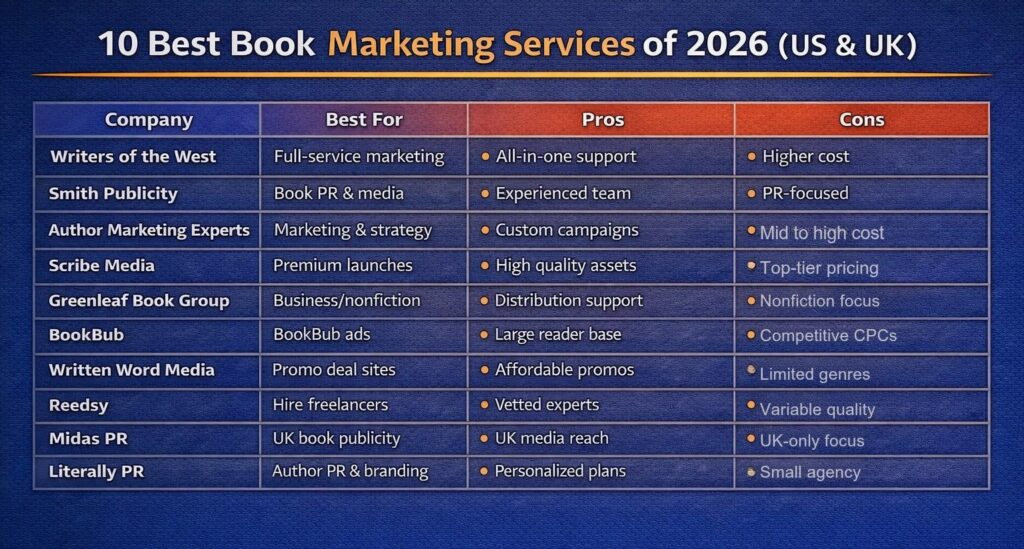
How to Think About This List as a Whole
No single service on this list is objectively “best.” The real advantage comes from matching the service to your current stage as an author. Early-stage writers benefit most from structure, feedback, and audience building. Mid-career authors often see stronger returns from targeted promotions and advertising. Established authors usually focus on authority, reach, and efficiency.
If you approach these services as tools rather than miracles, your chances of long-term success increase dramatically.
Which Service Should You Pick? A Simple Matching Guide
Choosing a marketing service is about matching the tool to your current goal. Below is a simpler way to decide, without overcomplicating it.
Sales Spikes
If you want fast visibility, especially during a launch or discount, deal-based promotions work best. They put your book in front of large genre audiences quickly. This approach works best when you already have a sequel, a backlist, or a clear next step for readers.
Scalable Growth
If your goal is steady, repeatable results, advertising platforms are the better choice. Ads reward strong covers, clear genre signals, and books that convert. They take time to optimize, but once they work, they can be repeated and scaled.
Audience Building
If you are thinking long-term, focus on email lists, review teams, and reader relationships. These strategies grow slowly but compound over time and give you control over future launches.
Credibility and Authority
If the book supports your expertise or business, publicity and media exposure make sense. This path builds trust and visibility, even if sales are not immediate.
Choosing the Right Fit
Do not try to do everything at once. Start with one clear goal and build from there. The most effective book marketing companies are the ones that align with where you are right now, not the ones promising the biggest outcome.
What to Budget for Book Marketing in 2026
One of the most common questions authors ask is how much they should spend on marketing. The honest answer is that budgets vary widely, but most fall into a few predictable ranges depending on your goals and how hands-on you plan to be.
Lean DIY Budget
This range works best if you are early in your journey or testing the waters. Most of the spend goes toward deal promotions, basic tools, and small experiments. You are trading time for money here. You will be learning as you go, managing the setup yourself, and tracking results manually.
This approach can work well if you are patient and willing to iterate.
Mid-Range Marketing Budget
At this level, authors usually invest in advertising, creative assets, and limited professional support. You might pay for cover or ad creative help, run structured promotions, or hire a specialist for one part of the process.
This is often the point where authors start seeing more consistent results because testing and tracking become easier.
Premium and Full-Service Budget
Premium budgets are typically used for publicity campaigns, full launch management, or brand-level positioning. These services save time and reduce guesswork, but they require trust in the team you hire and clear expectations around outcomes.
This level makes sense when the book supports a business, speaking career, or long-term authority goal.
The Real Cost Most Authors Miss
Your true budget is not just money. It is time, focus, and energy. If you cannot test, track, and refine consistently, paying for execution often delivers better results than paying for ideas alone.
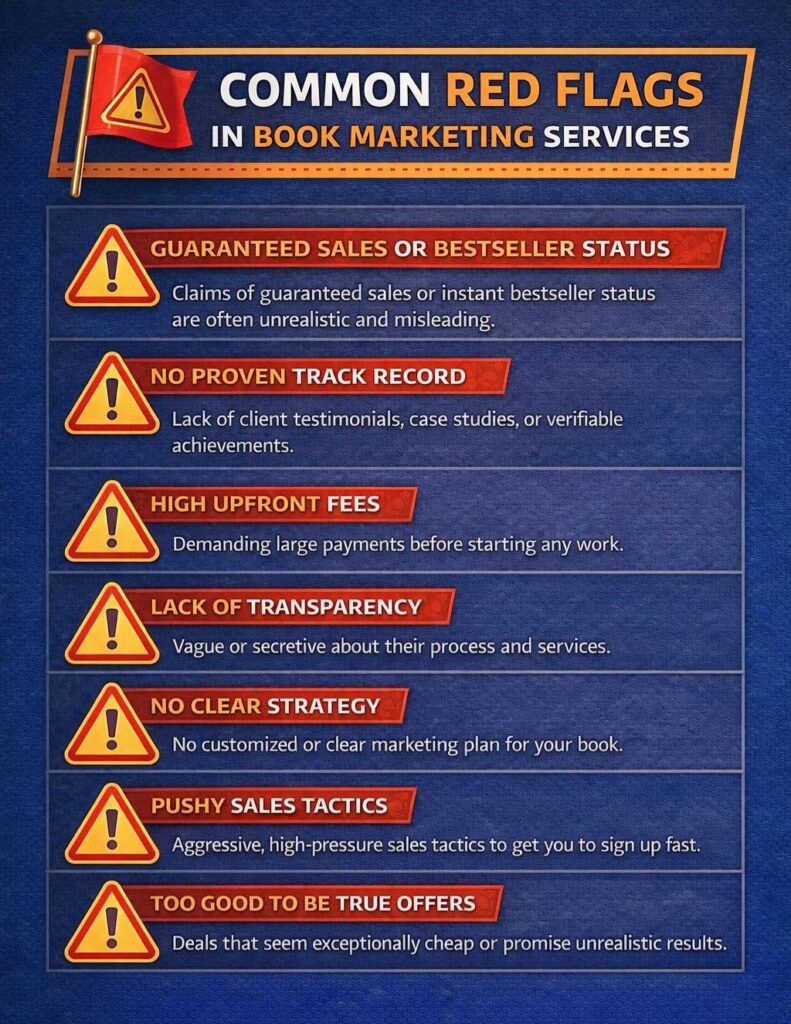
Red Flags to Avoid When Hiring Book Marketing Services
Not all marketing offers are created equal, and in 2026 there are more options than ever. That also means more noise. Knowing what to avoid can save you money, time, and frustration.
Guaranteed Bestseller Claims
Any service that guarantees bestseller status is selling an outcome they cannot control. Rankings depend on timing, competition, pricing, and retailer algorithms. Legitimate book promotion services focus on visibility, data, and reader engagement rather than promises that sound impressive but cannot be verified.
Vague Deliverables
If a company cannot clearly explain what they will do, when they will do it, and what you will receive, that is a major warning sign. You should be able to point to concrete actions such as ads created, emails sent, or outreach performed.
No Timeline or Reporting
Marketing without timelines or reporting is guesswork. You should expect regular updates, even if the results are underwhelming. Silence usually means nothing is happening or results are being hidden.
“We Do Everything” Messaging
Broad claims often hide shallow execution. Effective marketing requires focus. A service that claims to cover every channel without detail is often spreading itself too thin.
No Genre or Audience Questions
A serious marketer will ask about your genre, reader expectations, comparable titles, and goals early in the conversation. If they skip this step, they are not building a strategy. They are selling a package.
Pressure to Sign Quickly
High-pressure sales tactics are another red flag. Credible providers allow time for questions, review, and consideration. Rushed decisions rarely lead to good partnerships.
Lack of Past Examples
You do not need guarantees, but you should see examples of previous campaigns or case studies in similar genres. If a company avoids showing past work, proceed carefully.
FAQs
What is the difference between book marketing and book publicity?
Book publicity focuses on media exposure. That includes podcasts, interviews, articles, and press features. Book marketing is broader. It includes publicity, but also advertising, email strategy, launch sequencing, promo sites, and conversion optimization. Publicity builds credibility. Marketing builds systems that can be repeated.
Is Writers of the West a good fit for first-time or overwhelmed authors?
Yes, especially for authors who want guidance instead of guessing. Writers of the West works well for writers who need help clarifying positioning, building a marketing plan, and connecting strategy with execution rather than chasing disconnected tactics.
Do promo sites work if I only have one book?
They can, but expectations matter. Promo sites usually create short bursts of attention. If there is no sequel, backlist, or email capture, most of that attention fades quickly. Authors who pair promos with even a simple reader magnet often see better long-term results.
What is the best marketing setup for a first-time author?
Most first-time authors benefit from structure before scale. That usually means building an email list, setting up ARC reviews, planning a small but intentional promo push, and then testing ads once the basics are in place. Platforms like StoryOrigin and BookSprout support these early steps well.
Can I hire someone for just one task?
Yes. Many specialists offer single-scope services such as ads management, metadata optimization, or launch strategy. Marketplaces like Reedsy make it easier to find targeted expertise without committing to a full campaign.
How do I know if a marketing company is legit?
Ask for specifics. You should understand the deliverables, timeline, reporting cadence, and how success is defined. Request examples of past campaigns in your genre. If answers are vague or evasive, that is your signal to walk away.
How long does book marketing usually take to show results?
It depends on the tactic. Promo sites and discounts can show movement within days. Ads and list building often take weeks or months to stabilize. Marketing is rarely instant and is usually cumulative.
Should I market my book before or after launch?
Ideally, both. Pre-launch marketing builds awareness and reviews, while post-launch marketing sustains momentum. Authors who only market at launch often struggle to maintain visibility afterward.
Can marketing help a poorly performing book?
Marketing can amplify a book with clear genre fit and solid packaging. It cannot fix weak positioning, confusing blurbs, or mismatched reader expectations. In those cases, revising the product often matters more than increasing promotion.
Conclusion
By 2026, most authors have realized that marketing is not about finding shortcuts. It is about choosing support that matches your goals, your budget, and your stage as a writer. The services covered in this guide range from DIY tools to full-service agencies, and each plays a different role in an author’s growth.
The most important shift is mindset. Marketing works best when you treat it as a system, not a one-time event. That means building a foundation first, testing what works, and then scaling with intention. Jumping from tactic to tactic usually leads to frustration and inconsistent results.
The best book marketing services are not the ones with the loudest claims. They are the ones that explain what they do clearly, ask smart questions about your audience, and help you make informed decisions instead of emotional ones.
If you approach marketing with patience and clarity, even modest efforts can compound over time. The goal is not perfection. The goal is momentum you can sustain from one book to the next.